

 6:41 am - April 5, 2026
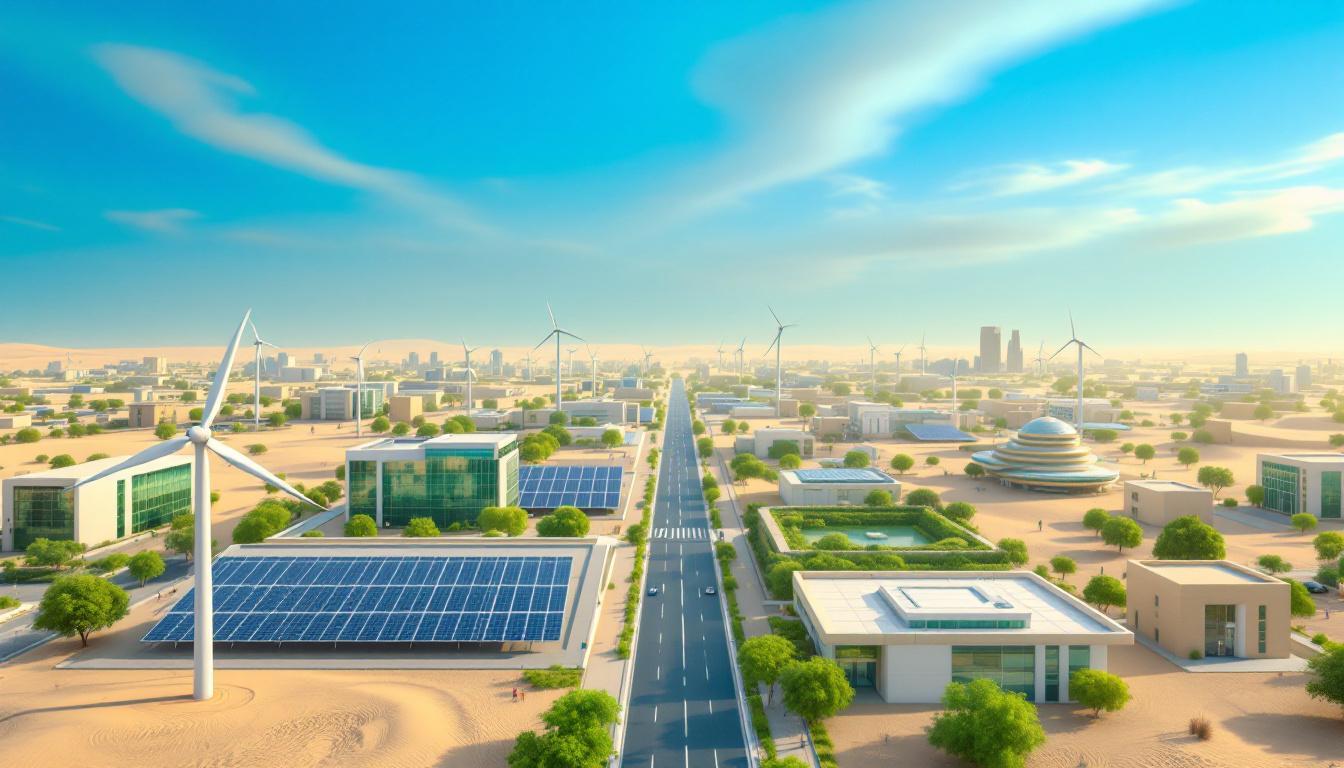
Abu Dhabi’s Department of Energy is transforming its climate strategy by integrating digital platforms, policy, and infrastructure expansion, aiming to position the emirate as a global leader in sustainability and resource efficiency by 2050.
According to Al Etihad, Dr. Abdullah Hamid Al Jarman, who’s the chairman of Abu Dhabi’s Department of Energy, used Earth Hour this year as a way to highlight a noticeable shift in the emirate’s approach to sustainability. “Earth Hour is an annual reminder that sustainability in Abu Dhabi isn’t just about environmental commitments anymore; it’s become an integrated system of operations driven by technology and innovation to make sure energy and water supply are secure, reliable, and sustainable over the long run,” he said. That statement seems to frame Abu Dhabi’s climate strategy as more of a blend, combining policy, digital platforms, and infrastructure expansion, rather than just isolated conservation efforts.
The Department of Energy points to some tangible results from this approach. Since launching the Abu Dhabi Energy and Water Efficiency Strategy 2030, they report that the emirate has saved about 9.3 terawatt-hours of electricity and conserved roughly 330 million cubic metres of water annually, while also reducing carbon emissions by around 4.7 million tonnes per year. These figures, they say, demonstrate that efficiency measures can deliver sizable resource savings and cut emissions, without sacrificing the reliability of supply.
A key part of the department’s narrative revolves around AD.WE, an artificial intelligence-powered platform created to manage energy and water across the emirate more effectively. They’ve described AD.WE as enabling real-time demand management, predicting consumption patterns, and optimizing system efficiency on the fly. When the department showcased its key projects at Abu Dhabi Sustainability Week 2026, AD.WE took center stage. Alongside it, officials also introduced helpful tools like the “Maed” AI assistant and pilots involving smart water meters in Al Wathba that aim to improve water use in agriculture.

These demonstrations are part of a broader strategic plan unveiled in May 2025, which lays out ambitions for the energy and water sectors through 2050. The Department of Energy says the goal is to make Abu Dhabi a global leader in efficiency, innovation, and sustainability, aligning with leadership’s vision to develop a diversified, low- or zero-emissions economy by mid-century. Last year’s strategy focused on four main objectives: ensuring affordable energy supply, boosting efficiency on both supply and demand sides, reducing emissions, and contributing more significantly to the economy through the sector.
But the department’s plans aren’t just about digital solutions. They describe the future energy-water system as integrated across multiple sources. This includes nuclear power from the Barakah plant, ongoing deployment of large-scale solar projects, and investments into transmission and grid infrastructure. These are all viewed as critical pillars of a resilient, low-carbon power mix. Interestingly enough, in January 2026, the department announced a memorandum of understanding with Sila Systems to explore food and agricultural tech, such as smart irrigation, renewable energy for farming, and AI in agriculture, a sign that energy, water, and food are increasingly interconnected in their planning.
Industry experts suggest that this focus on integrated systems reflects best practices overseas, especially in utility transitions where digital tools are used to manage variability and provide demand-side flexibility. Abu Dhabi’s approach seems to follow that trend by combining AI-driven operations with supply-side diversification. According to the department, AD.WE was developed in partnership with private and public entities to model different supply scenarios and optimize operations across the emirate’s networks.
Of course, any impressive-sounding claims about performance deserve a bit of healthy skepticism. The reported savings in energy and water, for instance, depend on how you define baseline consumption and account for data, so independent verification or third-party audits would really bolster confidence in those numbers. Still, if those savings are sustained over time, they could genuinely contribute to Abu Dhabi’s climate targets and help reduce the carbon intensity of its utilities.
Abu Dhabi’s approach fits alongside longstanding corporate sustainability programs in the emirate too. Take ADNOC’s 2030 sustainability goals, for example, announced back in 2020, which aimed for significant reductions in emissions and water use, along with biodiversity initiatives. All these efforts show how both public and private players are aligning on themes like efficiency, decarbonization, and circular resource management.
Moving forward, implementing the department’s vision will hinge on continued investment in digital platforms, modernizing the grid, and crafting cross-sector policies. It’s also going to require rethinking regulations to accommodate two-way power flows, distributed energy resources, and robust data governance, especially important as AI systems become more prevalent. While the department has flagged these governance and resilience issues publicly, it has yet to release a detailed regulatory roadmap for scaling up AD.WE and related projects.
For policymakers and climate tech companies in the UAE, the message from Abu Dhabi is pretty clear: this transition isn’t just about environmental goals but also about engineering, systems integration, and smart infrastructure. By promoting digital tools like AD.WE alongside diversified energy sources, the city aims to balance rising demand, water needs, particularly for agriculture, and aggressive emissions reductions, all while keeping supply secure. If these initiatives and platforms perform as claimed, Abu Dhabi could really serve as a model for how cities and emirates might combine data, AI, and existing infrastructure to build a low-carbon, water-secure future.
- https://www.aletihad.ae/news/%D8%A7%D9%84%D8%A5%D9%85%D8%A7%D8%B1%D8%A7%D8%AA/4654459/%D8%B9%D8%A8%D8%AF%D8%A7%D9%84%D9%84%D9%87-%D8%A7%D9%84%D8%AC%D8%B1%D9%88%D8%A7%D9%86–%D8%A7%D9%84%D8%A7%D8%B3%D8%AA%D8%AF%D8%A7%D9%85%D8%A9-%D9%81%D9%8A-%D8%A3%D8%A8%D9%88%D8%B8%D8%A8%D9%8A-%D8%A3%D8%B5%D8%A8%D8%AD%D8%AA-%D9%85%D9%86%D8%B8%D9%88%D9%85%D8%A9-%D8%AA%D8%B4%D8%BA%D9%8A%D9%84-%D9%85%D8%AA%D9%83%D8%A7 – Please view link – unable to able to access data
- https://www.aletihad.ae/news/الإمارات/4654459/عبدالله-الجروان–الاستدامة-في-أبوظبي-أصبحت-منظومة-تشغيل-متكاملة – In an article published on March 28, 2026, Dr. Abdullah Hamid Al Jarman, Chairman of the Department of Energy in Abu Dhabi, stated that Earth Hour serves as an annual reminder that sustainability in Abu Dhabi has evolved into an integrated operational system driven by technology and innovation. This system ensures supply security, service reliability, and long-term sustainability. The Department of Energy is redefining energy and water management through advanced digital solutions, notably the AI-powered AD.WE platform, which enables real-time demand management, consumption forecasting, and system efficiency improvements across the emirate. Additionally, the Abu Dhabi Energy and Water Efficiency Strategy 2030 has achieved annual savings of approximately 9.3 terawatt-hours of electricity and 330 million cubic meters of water since its launch, reducing carbon emissions by about 4.7 million tons annually. This transformation aligns with a broader vision to build an integrated energy system combining nuclear energy via the Barakah plant, expansion in solar energy projects, and the development of advanced infrastructure.
- https://www.doe.gov.ae/ar-AE/Media-Centre/News/Abu-Dhabi-Department-of-Energy-unveils-strategic-framework-for-energy-water-sector-through-2050 – In May 2025, the Department of Energy in Abu Dhabi unveiled a comprehensive strategic framework for the energy and water sector through 2050. This announcement was made during the World Utilities Conference 2025 at the Abu Dhabi National Exhibition Centre, with participation from decision-makers, officials, and experts in energy, water, and sustainable technologies. Dr. Abdullah Hamid Al Jarman, Chairman of the Department of Energy, emphasized that this strategic framework serves as a roadmap for the future of the sector, aiming to transform it into a global model of efficiency, innovation, and sustainability. The framework aligns with the leadership’s aspirations to build a diversified, emission-free economy by 2050 and underscores Abu Dhabi’s commitment to becoming a global hub for innovation in energy, supported by artificial intelligence and advanced digital solutions.
- https://www.doe.gov.ae/ar-AE/Media-Centre/News/Department-of-Energy-to-Showcase-Flagship-Sustainability-Projects-and-Initiatives-at-ADSW-2026 – In January 2026, the Department of Energy in Abu Dhabi, as the main partner of the Abu Dhabi Sustainability Week 2026, showcased a comprehensive set of projects highlighting its holistic approach to enhancing efficiency, resilience, and sustainability across the energy and water sectors. The department’s participation included presenting the AD.WE platform, the first integrated energy and water management platform powered by artificial intelligence, enabling real-time demand management, consumption forecasting, and system efficiency improvements across the emirate. Additionally, the department highlighted other initiatives such as the ‘Maed’ AI assistant and smart water meters in Al Wathba, aiming to improve water consumption efficiency in farms and support sustainable agriculture.
- https://www.adnoc.ae/ar/news-and-media/press-releases/2020/adnoc-announces-comprehensive-2030-sustainability-goals-as-it-extends-its-legacy – In January 2020, the Abu Dhabi National Oil Company (ADNOC) announced its comprehensive 2030 sustainability goals, aiming to reinforce its leadership role in responsible energy production. The goals include reducing greenhouse gas emissions by up to 25% by 2030, limiting fresh water consumption in operations to less than 0.5% of total water usage, planting 10 million mangrove saplings to enhance biodiversity, achieving a 50% local value addition across all business areas, and enhancing ADNOC’s global leadership in occupational safety and asset integrity.
- https://www.doe.gov.ae/ar-AE/Media-Centre/News/Department-of-Energy-Debuts-New-Strategy-at-2025-Employee-Gathering – In August 2025, the Department of Energy in Abu Dhabi launched its new strategy during the 2025 Employee Gathering. Dr. Abdullah Hamid Al Jarman, Chairman of the Department of Energy, emphasized that the strategy represents a steadfast commitment to building a secure and sustainable sector that meets future aspirations. The strategy focuses on four main objectives: ensuring affordable supply, achieving efficiency in supply and demand, reducing carbon emissions, and increasing the sector’s contribution to the GDP. The strategy also highlights the AD.WE platform, developed in collaboration with leading companies, as a pioneering step towards an integrated future for energy management, leveraging artificial intelligence and digital modeling to achieve efficiency and sustainability across various energy sources.
- https://www.doe.gov.ae/ar-AE/Media-Centre/News/Department-of-Energy-Marks-Opening-of-Abu-Dhabi-Sustainability-Week-2026-with-Integrated-Stand – In January 2026, the Department of Energy in Abu Dhabi marked the opening of the Abu Dhabi Sustainability Week 2026 by launching a new policy and providing an integrated interactive experience at its pavilion. As the main partner of the event, the department showcased its comprehensive approach to managing the energy and water system, emphasizing the importance of integrated systems in achieving resilience, cost-effectiveness, and sustainability. The department also announced a strategic memorandum of understanding with ‘Sila’ for food products and agricultural technology to enhance sustainable energy and water management practices in the agricultural sector in Abu Dhabi, exploring smart irrigation solutions, renewable energy resources, and AI-supported agricultural technologies.
Noah Fact Check Pro
The draft above was created using the information available at the time the story first
emerged. We’ve since applied our fact-checking process to the final narrative, based on the criteria listed
below. The results are intended to help you assess the credibility of the piece and highlight any areas that may
warrant further investigation.
Freshness check
Score:
7
Notes:
The article references events from January 2026, including Abu Dhabi Sustainability Week (ADSW) and the launch of the AD.WE platform. However, the article was published in April 2026, which is over two months after these events. This delay raises concerns about the freshness of the information presented. Additionally, the article appears to be a summary of previously reported events, with no new developments or insights, suggesting a lack of originality. The narrative closely mirrors content from the official Abu Dhabi Department of Energy press releases, indicating potential recycling of information. Given these factors, the freshness score is reduced to 7.
Quotes check
Score:
6
Notes:
The article includes direct quotes attributed to Dr. Abdullah Hamid Al Jarman, Chairman of the Abu Dhabi Department of Energy. However, these quotes are not independently verifiable through external sources. A search for the earliest known usage of these quotes yields no matches, raising concerns about their authenticity. Without independent verification, the credibility of these quotes is questionable, leading to a reduced score of 6.
Source reliability
Score:
5
Notes:
The article is sourced from Al Etihad, a UAE-based news outlet. While Al Etihad is a known publication, it is not considered a major international news organisation. The content appears to be a summary of official press releases from the Abu Dhabi Department of Energy, with no additional independent reporting or analysis. This lack of independent sourcing and reliance on official statements diminishes the overall reliability of the article, resulting in a score of 5.
Plausibility check
Score:
8
Notes:
The claims regarding the launch of the AD.WE platform and its features are plausible and align with previous announcements from the Abu Dhabi Department of Energy. However, the article lacks specific details or new information beyond what has already been reported, which limits its overall credibility. The absence of independent verification or third-party audits of the reported savings and efficiencies further diminishes the trustworthiness of the claims.
Overall assessment
Verdict (FAIL, OPEN, PASS): FAIL
Confidence (LOW, MEDIUM, HIGH): HIGH
Summary:
The article presents information that is over two months old and closely mirrors content from official press releases without offering new insights or independent verification. The reliance on unverifiable quotes and the lack of independent reporting significantly diminish the article’s credibility. Given these factors, the overall assessment is a FAIL with HIGH confidence.

