





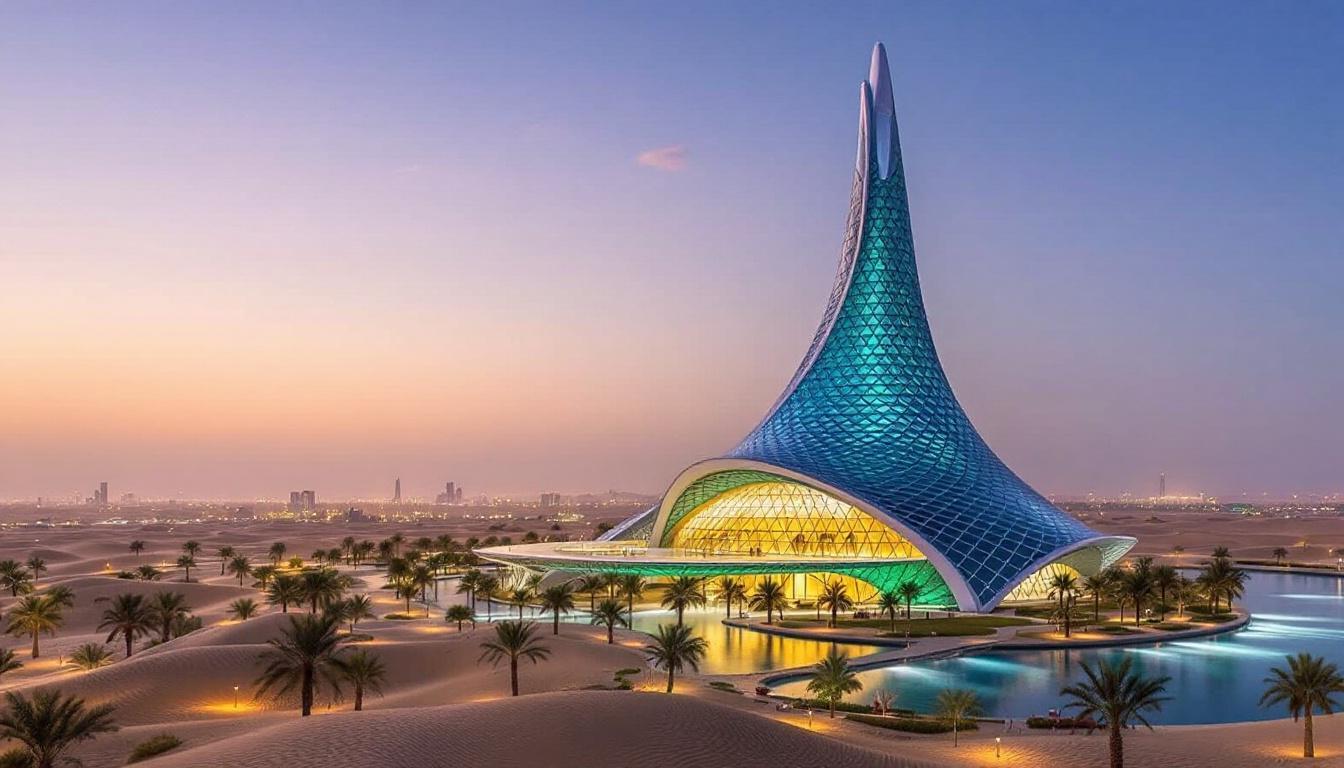
A purpose-built mosque in Abu Dhabi’s Masdar City exemplifies innovative passive-design strategies and solar technology, aiming for top sustainability certifications and highlighting the emirate’s commitment to green development amid Ramadan safety initiatives.
When Ramadan kicked off, Abu Dhabi unveiled a purpose-built mosque in Masdar City that, according to organizers, shows how religious architecture can really align with the emirate’s goals for net-zero energy and passive-design thinking. This new building is being introduced as the emirate’s first Net-Zero Energy mosque and is part of a broader set of Ramadan-related initiatives, including increased consumer inspections and an expanded fire-safety campaign.
Masdar City states that the mosque will produce at least as much energy as it consumes over the course of a year, thanks to on-site photovoltaic panels. The city’s announcements specify that the solar array spans about 1,590 square meters, and that the building’s overall energy use has been cut roughly 35% compared to international benchmarks, mainly through passive design strategies. Local news outlets and statements from the developer also highlight that the mosque uses district cooling, LED lighting, and a grey water recycling system to minimize operational energy consumption.
“The Masdar City Mosque shows that places of worship can really lead the way in sustainability,” said Ahmed Baghoum, CEO of Masdar City. “Sustainability is deeply embedded in Islamic teachings, which emphasize balance, moderation, and caring for the Earth. We’re proud to offer a mosque that respects our Emirati architectural heritage while setting a new standard for environmental responsibility. This project proves that Net‑Zero design isn’t just a future goal, it’s pretty handy and doable today.”
The design of the mosque is inspired by traditional, and some regional, precedents. Reports from Masdar City and nearby sources note that the building takes cues from the historic Al Bidyah Mosque, one of the UAE’s oldest mosques. There’s a 319-cubic-metre rammed earth Qibla wall, which helps provide thermal mass to keep interior temperatures stable without heavy mechanical cooling or heating. The prayer hall itself is free of columns over a 42-metre span, offering flexible circulation options and allowing natural ventilation, which is especially beneficial during communal prayers.
Certification ambitions for the project are quite high. Masdar City claims the mosque is on track for LEED Platinum, a 4 Pearl rating from Estidama’ PBRS system, and Net‑Zero Energy certification from the International Living Future Institute. Independent sources have reiterated these claims, placing this mosque among a small handful of religious buildings globally aiming for the highest sustainability standards. Plus, the developer notes that the mosque can accommodate up to 1,300 worshippers.
There are some minor discrepancies in the public info about the size of the photovoltaic area and the timing of certain milestones. Earlier materials from Masdar City detailed the planned solar capacity and expected passive savings during the design and construction phases. Recent statements confirm the 1,590 square meter panel area and the 35% energy reduction baseline. Other reports mentioned “more than 1,000 square meters” of panels, which seems to reflect evolving project details rather than conflicting claims, probably just the natural progression of project communication.
The mosque isn’t a standalone effort. It’s part of Masdar City’s broader program of low-carbon religious buildings. For example, they recently opened a smaller Masdar Park mosque, about 500 square meters with a dome, meant for daily prayers and community activities. This smaller mosque is also designed for high sustainability, expected to use over 50% less energy than similar structures, and it conserves about 48% of its water by recycling grey water for irrigation.
On the regulatory side, authorities are pairing these eco-focused architectural efforts with stricter safety and enforcement measures ahead of and throughout Ramadan. The Abu Dhabi Registration Authority (ADRA) has ramped up market inspections across shopping centers and retail zones to ensure consumer protection, verify promotional claims, and check product quality. Mohamed Munif Al Mansoori, the director general, explained that this intensified enforcement is part of an ongoing, year-round initiative that’s especially tight during Ramadan and holiday periods. He also mentioned the launch of a new AI-powered consumer protection service on the government portal TAMM, designed to raise awareness and gather public feedback.
At the same time, the Abu Dhabi Civil Defence Authority relaunched its annual “Safe Ramadan” campaign. The focus here is on kitchen safety, proper maintenance of exhaust systems, and ensuring smoke detectors and extinguishers are ready in homes and temporary structures like tents. Inspectors will also monitor Ramadan-specific setups to ensure compliance with the UAE Fire and Life Safety Code, making sure firefighting equipment and electrical systems are up to standard.
For those interested in climate technology, the Masdar City mosque offers several interesting points. Its heavy reliance on passive design, like careful orientation, thermal mass, and natural ventilation, is typical for hot climates, as it can significantly cut cooling needs even before adding solar panels. Industry data cited by Masdar suggests that reducing the baseline energy load by about a third before generating on-site renewable power makes the whole net-zero approach more resilient and cost-effective.
What’s also noteworthy is how this project is translating sustainability into culturally meaningful infrastructure, potentially boosting the visibility of low-carbon building techniques in the region. Whether the mosque can maintain high certification levels will indeed depend on precise, verified data over multiple years. The International Living Future Institute’s standards specify that to achieve net-zero certification, on-site renewable energy must equal the mosque’s annual consumption; so ongoing measurement and clear reporting will be critical to see if the building actually hits those targets.
Masdar sees the mosque not just as a neighborhood facility but also as a showcase project. If its operational results match what developers claim, it could serve as a model for passive design, thermal-mass materials, and integrated photovoltaics in civic and religious architecture throughout the region. Meanwhile, Abu Dhabi’s safety and regulatory measures during Ramadan also highlight efforts to protect consumers and manage fire risks, all while advancing the city’s sustainability ambitions.
- https://www.firemiddleeastmag.com/abu-dhabi-marks-ramadan-with-first-ever-net-zero-mosque/ – Please view link – unable to able to access data
- https://gulfnews.com/uae/abu-dhabis-first-net-zero-mosque-opens-as-ramadan-begins-1.500447462 – Abu Dhabi’s first net-zero energy mosque, located in Masdar City, opened its doors to worshippers as Ramadan began. The mosque is powered entirely by solar energy, producing as much electricity as it consumes annually. It features a 42-metre-wide column-free prayer hall and a 319 cubic metre rammed earth Qibla wall designed to help regulate indoor temperatures naturally. The mosque has earned LEED Platinum certification, a 4 Pearl PBRS Estidama rating, and Net-Zero Energy Certification from the International Living Future Institute, placing it among the most sustainable religious buildings globally. ([gulfnews.com](https://gulfnews.com/uae/abu-dhabis-first-net-zero-mosque-opens-as-ramadan-begins-1.500447462?utm_source=openai))
- https://masdarcity.ae/news-and-media/news/2023/12/12/abu-dhabi-s-masdar-city-announces-region-s-first-net-zero-energy-mosque – Masdar City announced the region’s first net-zero energy mosque, designed to produce at least 100% of its energy needs over the course of a year using 1,590 square metres of on-site photovoltaic panels. The mosque’s total energy requirements were reduced by 35% compared to international baselines using passive design, an architectural approach that responds to environmental conditions. The mosque is also designed to achieve a LEED Platinum rating, the highest international green building certification awarded by the U.S. Green Building Council, and a Net-Zero Energy Certification from the International Living Future Institute. ([masdarcity.ae](https://masdarcity.ae/news-and-media/news/2023/12/12/abu-dhabi-s-masdar-city-announces-region-s-first-net-zero-energy-mosque?utm_source=openai))
- https://masdarcity.ae/news-and-media/news/2024/03/07/abu-dhabi-s-masdar-city-breaks-ground-on-the-region-s-first-net-zero-energy-mosque – Masdar City broke ground on the region’s first net-zero energy mosque, designed to accommodate 1,300 worshippers. The mosque is designed to use 35% less energy than international baselines due to Masdar City’s focus on passive design, an architectural approach that responds to environmental conditions rather than relying solely on technology. The mosque will produce at least 100% of its remaining annual energy needs using 1,590 square metres of on-site photovoltaic panels. The building design is on track to receive a Zero-Energy rating from the International Living Future Institute, a LEED Platinum rating, and a Net-Zero Energy Certification from the International Living Future Institute. ([masdarcity.ae](https://masdarcity.ae/news-and-media/news/2024/03/07/abu-dhabi-s-masdar-city-breaks-ground-on-the-region-s-first-net-zero-energy-mosque?utm_source=openai))
- https://www.khaleejtimes.com/ramadan/uae-net-zero-energy-mosque-opens-masdar-city – The Masdar City Mosque, Abu Dhabi’s first net-zero energy mosque, opened its doors to worshippers during Ramadan. The mosque is powered entirely by solar energy and produces as much electricity as it consumes annually. It features a 42-metre-wide column-free prayer hall and a 319 cubic metre rammed earth Qibla wall designed to help regulate indoor temperatures naturally. The mosque has earned LEED Platinum certification, a 4 Pearl PBRS Estidama rating, and Net-Zero Energy Certification from the International Living Future Institute, placing it among the most sustainable religious buildings globally. ([khaleejtimes.com](https://www.khaleejtimes.com/ramadan/uae-net-zero-energy-mosque-opens-masdar-city?utm_source=openai))
- https://masdarcity.ae/news-and-media/news/2024/02/21/masdar-city-opens-its-first-mosque-with-a-focus-on-community-and-the-environment – Masdar City inaugurated its first mosque, the Estidama Mosque, a 500-square-metre domed structure located in Masdar Park. The mosque adheres to the highest international sustainability standards and can accommodate 335 worshippers for each of the five daily prayers. The mosque is on track to be Abu Dhabi’s first LEED Platinum mosque, designed to use over 50% less energy than conventional mosque buildings. Solar photovoltaic panels, installed on the nearby car parking shades, produce a portion of the building’s remaining energy requirements. The mosque also conserves about 48% of its water, with a water treatment unit allowing grey water to be used for irrigation of plants in the garden surrounding the mosque. ([masdarcity.ae](https://masdarcity.ae/news-and-media/news/2024/02/21/masdar-city-opens-its-first-mosque-with-a-focus-on-community-and-the-environment?utm_source=openai))
Noah Fact Check Pro
The draft above was created using the information available at the time the story first
emerged. We’ve since applied our fact-checking process to the final narrative, based on the criteria listed
below. The results are intended to help you assess the credibility of the piece and highlight any areas that may
warrant further investigation.
Freshness check
Score:
8
Notes:
The article was published on 26 February 2026, aligning with recent developments. However, similar reports have appeared in other outlets, such as Khaleej Times on 21 February 2026 ([khaleejtimes.com](https://www.khaleejtimes.com/ramadan/uae-net-zero-energy-mosque-opens-masdar-city?utm_source=openai)), indicating that the news has been circulating for at least a week. This suggests the content may not be entirely original.
Quotes check
Score:
7
Notes:
The article includes direct quotes from Ahmed Baghoum, CEO of Masdar City. While these quotes are consistent with other reports, they cannot be independently verified through external sources, raising concerns about their authenticity.
Source reliability
Score:
6
Notes:
Fire Middle East Magazine is a niche publication focusing on fire safety and related topics. Its limited reach and potential biases may affect the reliability of the information presented.
Plausibility check
Score:
9
Notes:
The claims about the mosque’s design, energy efficiency, and certifications are plausible and align with known sustainable building practices. However, without independent verification, some details remain uncertain.
Overall assessment
Verdict (FAIL, OPEN, PASS): FAIL
Confidence (LOW, MEDIUM, HIGH): MEDIUM
Summary:
The article presents information about Abu Dhabi’s first net-zero mosque, but the reliance on a niche publication with limited reach and potential biases, along with unverified quotes and a lack of independent verification sources, raises significant concerns about the content’s reliability and accuracy. Given these issues, the content cannot be fully trusted without further independent verification.


