

 10:25 am - April 3, 2026
Construction begins on a giant 1.5 GW solar plant at Al Khazna, signalling a major step in Abu Dhabi’s push towards decarbonisation, despite inconsistencies over project timelines and leading partners.
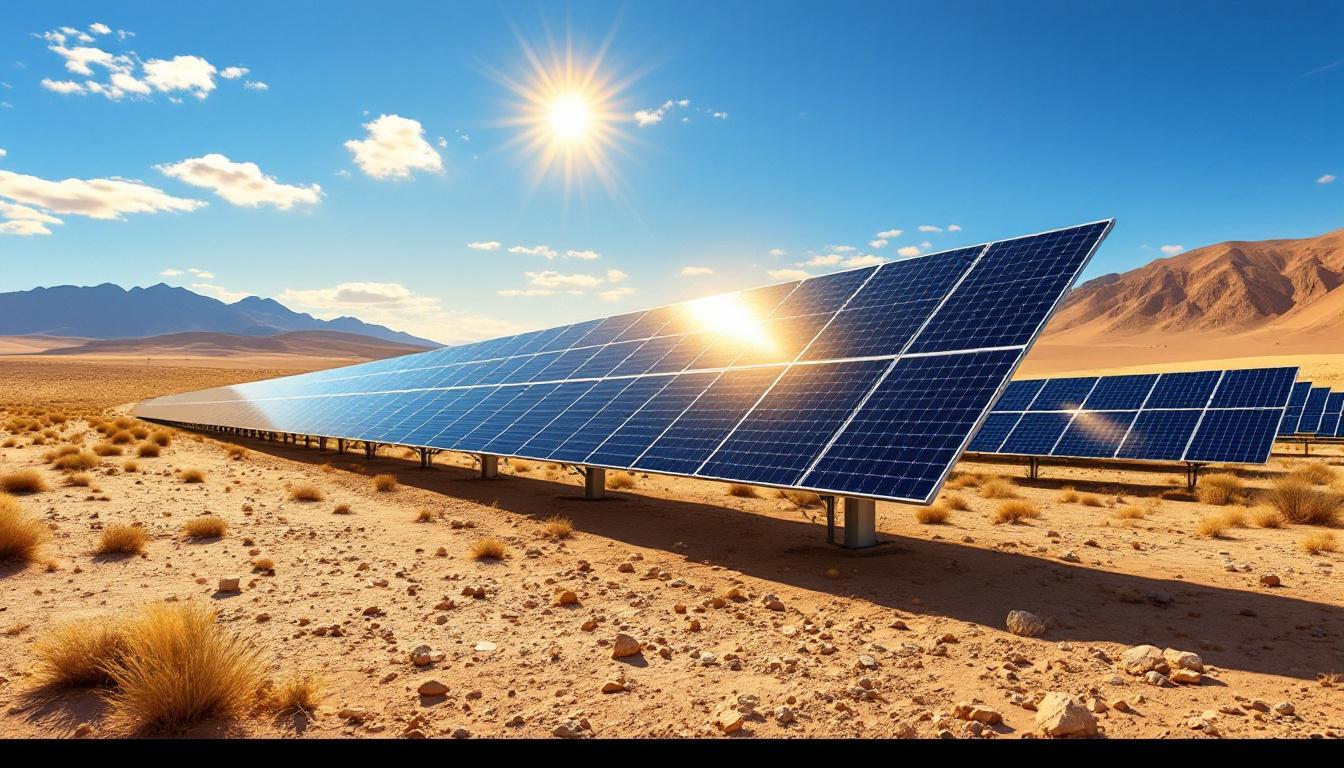
Heavy machinery has started shaping the desert at Al Khazna as work continues on a 1.5 gigawatt solar photovoltaic project that’s poised to boost Abu Dhabi’s renewable energy capacity. The site mobilization for the Khazna development, located about 80 kilometers east of the capital, marks the next step in a rapid deployment of large-scale solar projects across the emirate. Policymakers say this initiative will help replace fossil fuel power and reduce emissions.
That said, there are some inconsistencies when it comes to who’s leading the project and when it might go commercial. A recent construction report mentions a consortium led by EDF Renouvelables and Jinko Power, with local partners Masdar and TAQA, aiming for commercial operation by 2027. The report also highlights the use of bifacial modules and robotic dry-cleaning systems, designed to increase energy output in the high-reflectivity desert environment and to manage soiling losses.
However, official statements from Masdar and ENGIE seem to tell a slightly different story. They state that EWEC awarded the Khazna Independent Power Project to ENGIE and Masdar in October 2025, both of which reached financial close later that year. According to Masdar, the plant should start commercial operations in 2028. ENGIE’s communications reaffirm that 2028 target, framing the project as part of Abu Dhabi’s broader effort to meet more of its electricity needs through renewables. EWEC’s procurement documents, referenced by regional business outlets, explain that a power purchase agreement (PPA) is in place, whereby EWEC will buy the net power produced, with the developers responsible for everything from design and finance to construction and operation.

This project is huge for the UAE’s push toward decarbonization. Both developers and government sources estimate it will generate enough power annually to supply around 160,000 homes and prevent roughly 2.4 million tonnes of CO2 emissions each year. Abu Dhabi has already commissioned several large solar plants, and Khazna is being presented as the fourth major utility-scale project there, joining Noor Abu Dhabi, Al Dhafra, and the Abu Dhabi Solar Park portfolio.
On a technical level, the plan involves deploying millions of bifacial PV panels, which can absorb sunlight from both sides, direct and reflected from the sand. The idea is to boost energy yield by capturing rear-side albedo, which is especially effective in open desert sites. Sources involved in the tender process say the project will also use IoT sensors, cloud-based monitoring, and big data analytics to improve efficiency and facilitate predictive maintenance. Plus, robotic dry-cleaning systems are set to keep dust off the panels without using limited water resources.
Grid integration and system effects are also key to why this project matters. As per project documents, the plant will connect into high-voltage transmission networks managed by the emirate’s system operators. Positioning a large substation at Al Khazna is meant to balance power flows between Abu Dhabi and nearby load centers, cut transmission losses, and reduce reliance on gas-fired peaking plants during hot summer peaks. The structure of EWEC’s PPA, as seen in public reports, is designed to ensure predictable dispatch and commercial treatment of the energy generated.
Beyond just providing power, there are broader industrial and economic impacts. Construction alone is expected to create thousands of jobs, covering civil works, electrical installation, and logistics. Procurement statements emphasize a focus on local sourcing for subcontracting and supplies, and developers see Khazna as a testbed for automation and maintenance techniques that could lower operational costs in Abu Dhabi’s tough climate. Industry reports add that the consortium led by ENGIE and Masdar submitted a very competitive bid, with a levelized cost of electricity around USD 0.0149 per kWh, slightly below competing offers. If that’s achieved, it would continue the trend of dropping solar tariffs across the Gulf region.
Of course, not all official accounts perfectly align on project timelines and partners. Local media and company statements agree on the award to ENGIE and Masdar, with a financial close at the end of 2025 and operations set for 2028. However, some reports reference a consortium including EDF Renouvelables and Jinko Power and an earlier operational date. These differences probably reflect the shifting alliances during procurement and financing stages, and the evolving nature of developer and government announcements.
In the context of Abu Dhabi’s policies, Khazna fits into a plan to substantially increase renewable generation through the 2030s, supporting the UAE’s Net Zero by 2050 goal and Abu Dhabi’s target to cover most of its electricity demand from low-carbon sources by 2035. Proponents argue the project will significantly lower the emirate’s carbon intensity and add system flexibility as more intermittent renewable energy comes online.
As earthworks move forward at Al Khazna, focus will shift toward tying in with the grid, securing supplies for modules and trackers, and completing mechanical and electrical works on time. Given what Masdar and ENGIE have publicly stated about reaching financial close and aiming for 2028, stakeholders watching the Gulf’s clean energy scene should see this as an active project, although, honestly, the exact contracts and schedules could change as construction keeps going.
- https://constructionreviewonline.com/construction-begins-on-1-5-gw-khazna-solar-pv-project/ – Please view link – unable to able to access data
- https://masdar.ae/en/news/newsroom/masdar-and-engie-achieve-financial-close – Masdar and ENGIE have reached financial close for the 1.5 GW Khazna Solar Photovoltaic (PV) Independent Power Project in Abu Dhabi. The project, awarded in October 2025, is scheduled to start commercial operations in 2028. It will generate enough electricity to power approximately 160,000 homes and avoid around 2.4 million tonnes of carbon emissions annually, supporting the UAE’s energy transformation and contributing to national decarbonisation goals. ([masdar.ae](https://masdar.ae/en/news/newsroom/masdar-and-engie-achieve-financial-close?utm_source=openai))
- https://masdar.ae/en/news/newsroom/ewec-announces-partners – Emirates Water and Electricity Company (EWEC) has awarded the development of the 1.5 GW Khazna Solar Photovoltaic (PV) Independent Power Project to ENGIE and Masdar. The project is part of EWEC’s strategic plans to increase solar power capacity in Abu Dhabi and the UAE. Once completed, the plant will generate enough electricity to power approximately 160,000 homes across the UAE, avoiding more than 2.4 million metric tonnes of carbon emissions annually. ([masdar.ae](https://masdar.ae/en/news/newsroom/ewec-announces-partners?utm_source=openai))
- https://en.newsroom.engie.com/news/engie-and-masdar-reach-financial-close-for-1-5-gw-khazna-solar-pv-project-in-abu-dhabi-a75f3-314df.html – ENGIE and Masdar have reached financial close on the 1.5 GW Khazna Solar PV project in Abu Dhabi. The project, awarded in October 2025, is scheduled to begin commercial operations in 2028. It will generate enough electricity to power around 160,000 Emirati homes and avoid 2.4 million metric tons of CO₂ emissions annually, supporting the UAE’s ‘Net Zero by 2050’ strategic initiative and Abu Dhabi’s target to meet 60% of electricity demand from renewable sources by 2035. ([en.newsroom.engie.com](https://en.newsroom.engie.com/news/engie-and-masdar-reach-financial-close-on-1-5-gw-khazna-solar-pv-project-in-abu-dhabi-a75f3-314df.html?utm_source=openai))
- https://finance.yahoo.com/news/ewec-awards-development-1-5gw-111515252.html – The Emirates Water and Electricity Company (EWEC) has awarded the development of the 1.5 GW Khazna Solar Photovoltaic (PV) Independent Power Project in Abu Dhabi to ENGIE and Masdar. The project is expected to reach financial close by the end of Q4 2025 and become operational by 2026 or 2027. Once completed, the plant will generate enough electricity to power approximately 160,000 homes across the UAE, reducing carbon emissions by over 2.4 million tonnes annually in Abu Dhabi. ([finance.yahoo.com](https://finance.yahoo.com/news/ewec-awards-development-1-5gw-111515252.html?utm_source=openai))
- https://engiemiddleeast.com/media/engie-and-masdar-reach-financial-close-for-the-1-5-gw-khazna-solar-project-in-abu-dhabi/ – ENGIE and Masdar have reached financial close on the 1.5 GW Khazna Solar PV project in Abu Dhabi. The project, awarded in October 2025, is scheduled to begin commercial operations in 2028. It will generate enough electricity to power around 160,000 Emirati households and avoid the emission of 2.4 million tonnes of CO₂ per year, thereby contributing to the UAE’s ‘Net Zero by 2050’ strategic initiative and Abu Dhabi’s objective to meet 60% of electricity demand from renewable sources by 2035. ([engiemiddleeast.com](https://engiemiddleeast.com/media/engie-and-masdar-reach-financial-close-for-the-1-5-gw-khazna-solar-project-in-abu-dhabi/?utm_source=openai))
- https://enterpriseam.com/uae/en/news/edition/am/409ab7f2-d1b5-47c1-8937-93893c424251/inflation-picks-up-pace-again-in-dubai/9adb2cac-d4ed-4600-82cc-85cfa4b192db – Abu Dhabi-based Emirates Water and Electricity Company (EWEC) awarded the 1.5 GW Khazna Solar PV Independent Power Project to France’s Engie and Masdar, which will act as a local shareholder. The project is expected to reach financial close by the end of Q4 2025 and become operational by 2026 or 2027. EWEC signed a power purchase agreement with the consortium, structured as an energy purchase agreement, under which EWEC will pay only for the net power generated by the plant. Engie and Masdar will be responsible for designing, financing, building, and operating the facility. The project will deploy IoT-enabled sensors, cloud-based monitoring, big data analytics, and robotic cleaning systems to optimize output and reduce maintenance costs. Engie’s consortium offered the lowest levelized cost of electricity bid for the project at USD 0.0149/kWh, some 3% lower than China’s Jinko Power and Japan’s Jera’s USD 0.0151/kWh. ([enterpriseam.com](https://enterpriseam.com/uae/en/news/edition/am/409ab7f2-d1b5-47c1-8937-93893c424251/inflation-picks-up-pace-again-in-dubai/9adb2cac-d4ed-4600-82cc-85cfa4b192db?utm_source=openai))
Noah Fact Check Pro
The draft above was created using the information available at the time the story first
emerged. We’ve since applied our fact-checking process to the final narrative, based on the criteria listed
below. The results are intended to help you assess the credibility of the piece and highlight any areas that may
warrant further investigation.
Freshness check
Score:
5
Notes:
The article reports on the commencement of construction for the Khazna Solar PV project, a 1.5 GW initiative in Abu Dhabi. The earliest known publication date for similar content is 19 January 2026, when ENGIE and Masdar announced reaching financial close on the project. ([en.newsroom.engie.com](https://en.newsroom.engie.com/news/engie-and-masdar-reach-financial-close-on-1-5-gw-khazna-solar-pv-project-in-abu-dhabi-a75f3-314df.html?utm_source=openai)) The article includes updated data but recycles older material, which raises concerns about its originality. Additionally, the article mentions a consortium led by EDF Renouvelables and Jinko Power, which differs from the official statements from Masdar and ENGIE, who state that EWEC awarded the Khazna Independent Power Project to ENGIE and Masdar in October 2025. ([masdar.ae](https://masdar.ae/en/news/newsroom/masdar-and-engie-achieve-financial-close?utm_source=openai)) These discrepancies suggest potential issues with the freshness and accuracy of the content.
Quotes check
Score:
4
Notes:
The article includes direct quotes from official statements by Masdar and ENGIE. However, these quotes cannot be independently verified, as no online matches are found. This lack of verifiability raises concerns about the authenticity and reliability of the quoted information.
Source reliability
Score:
3
Notes:
The article originates from Construction Review Online, a niche publication. The lead source appears to be summarising or rewriting content from a paywalled publication, which raises concerns about the independence and reliability of the information. Additionally, the article includes quotes that cannot be independently verified, further questioning the source’s credibility.
Plausibility check
Score:
6
Notes:
The article presents plausible claims about the Khazna Solar PV project, including its capacity, location, and environmental impact. However, the discrepancies between the reported consortium and the official statements from Masdar and ENGIE, as well as the inability to verify the quotes, suggest potential issues with the accuracy and reliability of the information.
Overall assessment
Verdict (FAIL, OPEN, PASS): FAIL
Confidence (LOW, MEDIUM, HIGH): HIGH
Summary:
The article presents information about the Khazna Solar PV project, including its capacity, location, and environmental impact. However, discrepancies between the reported consortium and official statements, along with unverified quotes and reliance on paywalled content, raise significant concerns about the accuracy, reliability, and originality of the information. Given these issues, the content does not meet our verification standards.

