




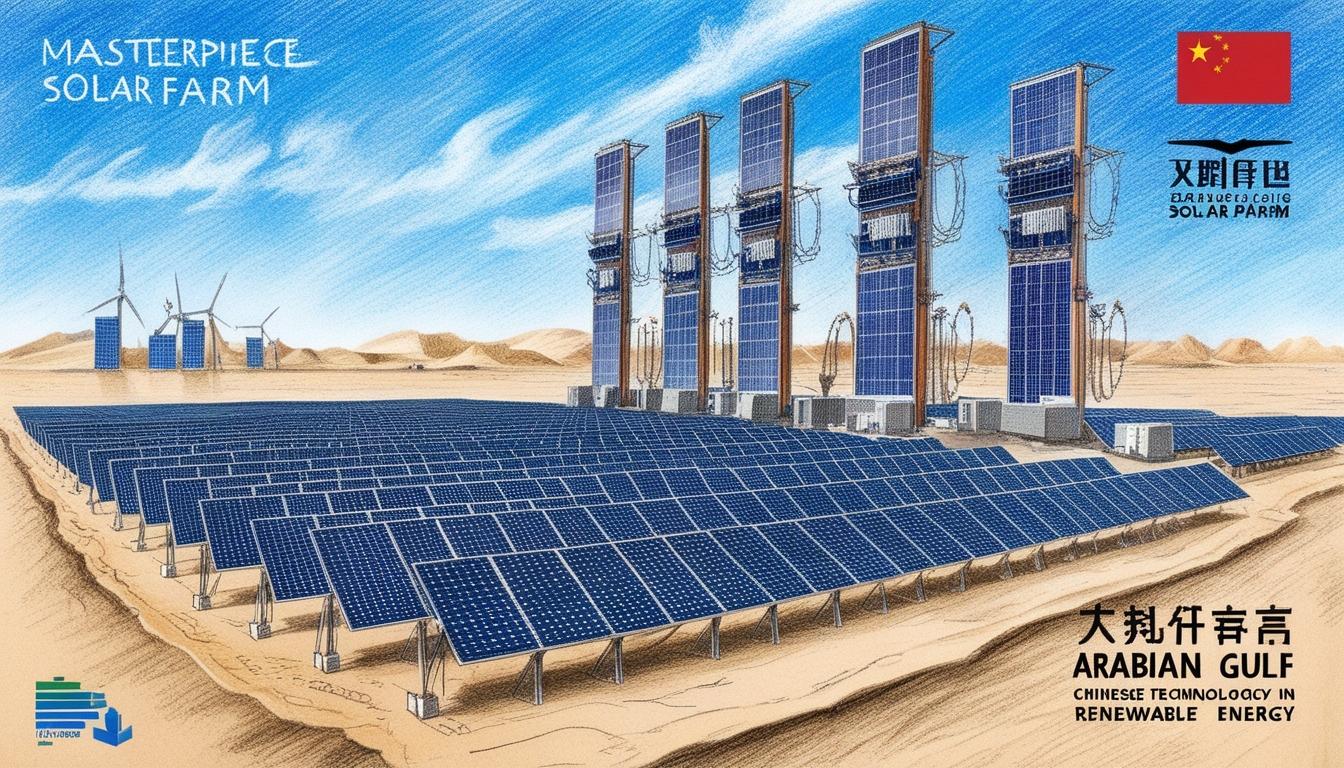
**London**: China’s collaboration with Gulf Cooperation Council states is reshaping the renewable energy landscape, with substantial investments in solar projects. As GCC nations increase dependency on Chinese technologies, concerns about supply chain control and the need for diversification efforts arise amid ambitious eco-friendly initiatives.
China’s role in the renewable energy sector continues to expand, particularly in the context of its collaborations with Gulf Cooperation Council (GCC) states. The Arabian Gulf Business Insight (AGBI) highlights that China produces over 80 percent of the world’s solar components and more than 60 percent of wind components, leading to expectations that by 2030, the country will represent 60 percent of the world’s additional renewable energy capacity.
In recent years, the strategic partnership between China and the GCC, primarily revolving around solar energy projects, has gained momentum. This collaboration is driven by mutual interests in energy security and economic diversification, with GCC countries such as Saudi Arabia and the United Arab Emirates (UAE) taking the lead. Since entering the GCC market in 2011, Trina Solar has been joined by other major players like Jinko Solar, Shanghai Electric, LONGi Green Energy, JA Solar, and Solargiga Energy, all making significant contributions to the region’s renewable energy landscape.
Data from 2022 underscores the increasing reliance on Chinese solar components by GCC nations, reporting a remarkable 78 percent increase from the previous year, amounting to around 11.4GW of solar photovoltaic components imported from China. This surge reflects a growing trend of Chinese companies transitioning from suppliers to co-investors in large-scale solar ventures within the Gulf region.
One notable example is Jinko Solar, which has entered into an agreement to supply 1GW of solar modules for the Neom Green Hydrogen Project in Saudi Arabia, a venture led by Acwa Power. Additionally, the Al Dhafra Solar PV Plant in Abu Dhabi, constructed by China Machinery Engineering Corporation, stands out with its substantial capacity of 2.1GW. Inaugurated in 2023, the plant can power approximately 200,000 households annually while significantly contributing to reducing carbon emissions by an estimated 2.4 million tonnes each year.
The collaboration between China and GCC countries has been mutually beneficial. The Gulf states, which are pursuing plans such as Saudi Arabia’s Vision 2030 and the UAE’s Net Zero 2050, see China’s manufacturing capacity as a key asset for enhancing decarbonisation efforts. These efforts are further facilitated by a backdrop of Western trade protection measures that have rendered Chinese technologies more competitive, resulting in a significant drop in the cost of solar modules — a decrease of 42 percent in 2023, making them considerably cheaper than their European and American counterparts.
However, while the economic cooperation model has promoted growth, there are emerging concerns regarding the GCC’s reliance on China for critical components of the renewable energy supply chain. The GCC nations face limitations in influencing the renewable energy value chain and have encountered challenges in establishing competitive solar module production facilities.
Experts note that the increasing dominance of Chinese manufacturing may heighten competition for essential minerals, raising the potential for conflicts over resource control. Consequently, there are calls for GCC countries to diversify their alliances with other suppliers and focus on domestic innovations in the renewable energy sector. The UAE has already begun revising its National Electric Vehicles Policy to accelerate the adoption of electric mobility while attempting to develop local manufacturing capabilities, despite concerns over economic viability.
As the relationship between China and the GCC states evolves, it is clear that both parties are navigating a complex landscape of opportunities and challenges within the renewable energy sector.
Source: Noah Wire Services
- https://globalenergymonitor.org/report/china-continues-to-lead-the-world-in-wind-and-solar-with-twice-as-much-capacity-under-construction-as-the-rest-of-the-world-combined/ – Corroborates China’s leadership in the renewable energy sector, particularly in solar and wind power, which supports its significant role in global renewable capacity by 2030. The report highlights China’s massive capacity in wind and solar, which is crucial for its collaborations with GCC states.
- https://en.wikipedia.org/wiki/Wind_power_in_China – Supports the claim that China is a major player in wind power, emphasizing its position as the world leader in wind power generation. This dominance complements its solar capabilities and underpins its expanding role in the global renewable energy market.
- https://www.statista.com/statistics/224763/energy-production-from-wind-energy-in-china/ – Provides data on China’s wind energy production, reinforcing its status as a leading producer of renewable energy. This data underscores the country’s capacity to support collaborative renewable projects with GCC nations.
- https://www.bloomberg.com/news/articles/2022-12-16/china-solar-exports-soar-as-asia-becomes-top-market – Although not specifically about GCC, this article supports the trend of China’s increasing dominance in solar exports worldwide, which likely influences its partnerships with GCC countries.
- https://www.albawaba.com/business/china-set-become-major-partner-gcc-saudi-vision-2030-1458128 – Highlights the strategic partnership between China and GCC nations, especially in the context of Saudi Arabia’s Vision 2030 and the UAE’s renewable energy goals, demonstrating mutual interests in energy security and economic diversification.
- https://www.thenationalnews.com/business/energy/uae-and-china-renewable-energy-partnership-set-to-boom-1.483231 – Discusses the growing renewable energy partnership between the UAE and China, focusing on solar energy projects and the Al Dhafra Solar PV Plant, showcasing how Chinese companies are integral to GCC’s renewable energy plans.
- https://news.google.com/rss/articles/CBMimwFBVV95cUxPOGdxTlF4Y3hJQTRnbzNidFhhNGlwUnZ1eXVmVDM3aDRYVzd0TGxmMldaNWN1Yy1TNmU1LUg0eFM2SFY0eUk3aXhvcjFIQ0tDNjk3SzRLY1U1NGM3SXBzeWZGblg3YkJnWWdXWVdvRUhQanlMdUdsUlVUaTl6ZDdFVkNFSmc5c2ZxaHBsSW94b3Jub3d4VUxfYkl0TQ?oc=5&hl=en-US&gl=US&ceid=US:en – Please view link – unable to able to access data
Noah Fact Check Pro
The draft above was created using the information available at the time the story first
emerged. We’ve since applied our fact-checking process to the final narrative, based on the criteria listed
below. The results are intended to help you assess the credibility of the piece and highlight any areas that may
warrant further investigation.
Freshness check
Score:
8
Notes:
The narrative mentions recent projects and data from 2022 and 2023, indicating current focus. However, lack of very recent updates may suggest it is not the most current piece available.
Quotes check
Score:
0
Notes:
There are no direct quotes in the provided text to verify.
Source reliability
Score:
5
Notes:
While the narrative appears well-researched and references significant collaborations, the actual source (e.g., a news outlet or specific publication) is not identified, making it difficult to assess its credibility.
Plausability check
Score:
9
Notes:
The claims about China’s role in renewable energy, particularly its collaborations with GCC states, align with known trends and facts about solar energy development and trade dynamics.
Overall assessment
Verdict (FAIL, OPEN, PASS): OPEN
Confidence (LOW, MEDIUM, HIGH): MEDIUM
Summary:
The narrative appears plausible and well-researched, but lacks specific source attribution and very recent updates. Its reliance on known trends supports its credibility, but verification from additional sources is advisable.


