




The Dubai Supreme Council of Energy plans up to 2,000MW of lithium-ion storage by 2029, the region’s largest such facility, as the emirate’s solar capacity passes 2,500MW and needs firming overnight.
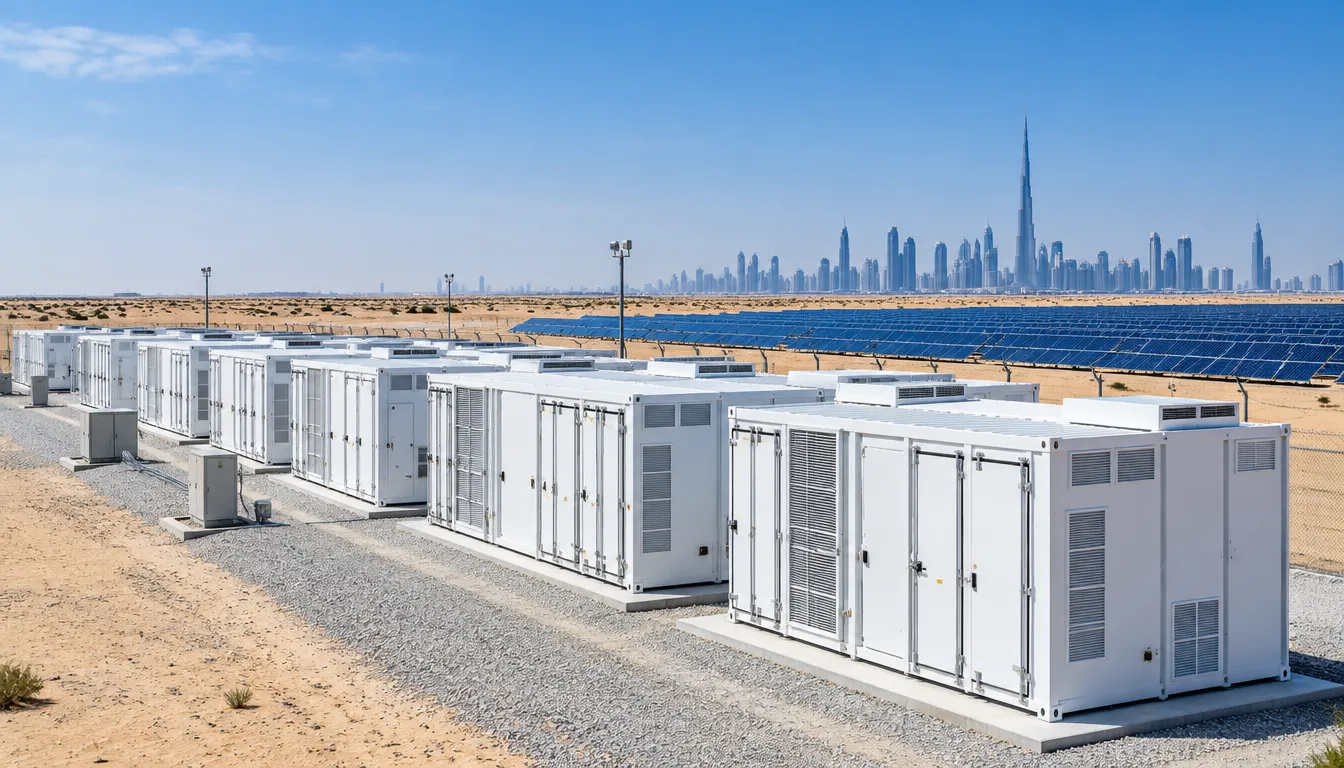
Dubai’s Supreme Council of Energy plans to build 1,000MW of lithium-ion battery storage, expandable to 2,000MW and 6,000MWh, for delivery between 2027 and 2029, Dr Faisal Ali Rashid, the council’s senior director of demand side management, said at the Energy Storage Summit Middle East 2026 in Dubai in early September. The facility would be the largest battery storage plant in the region.
Rashid said the project builds on a battery storage programme the council started with a 1MW pilot in 2010. The new capacity is designed to keep power flowing around the clock as Dubai’s solar generation, already above 2,500MW, keeps expanding toward the emirate’s clean energy targets for 2030 and beyond. Storage lets the grid draw on solar output stored during the day once the sun sets.
The announcement came on a panel that set out how Gulf utilities and developers are financing and engineering large battery projects. Ibraheem Mansouri, senior director of engineering at Masdar, described the firm’s Abu Dhabi round-the-clock project, which pairs 5.2GW of solar with 19GWh of storage to supply 1GW of continuous power, an investment of around $6.1bn.
Panellists said battery storage still poses financing hurdles that solar and wind projects have largely moved past. Thomas Spannring, chief financial officer at EtihadWE, said batteries are harder to underwrite than mature technologies such as gas turbines because their long-term performance cannot be predicted with the same confidence at financial close. He also pointed to the concentration of battery supply chains in China as a risk lenders weigh alongside the cost benefits of that reliance.
Shaharyar Nashat, executive director of legal, assets and operations at Aljomaih Energy and Water Company, said standard engineering, procurement and construction contracts do not account for the non-linear way batteries degrade, and called for more flexible indexation and payment terms tied to availability rather than output.
Mansouri said design mistakes from early projects, including units positioned so that one battery’s exhaust heat feeds into another’s intake, have informed how newer facilities are laid out, along with cooling systems sized for the heat that large battery farms generate locally. Masdar has sent 12 UAE nationals to train with its equipment supplier as part of building domestic technical capacity.
For Dubai, the plan signals that battery storage is moving from pilot scale to core grid infrastructure as solar penetration rises. A facility of this size would give the emirate a template for pairing storage with renewables that other UAE and Gulf utilities are likely to watch closely as they plan their own round-the-clock clean power supplies.


