





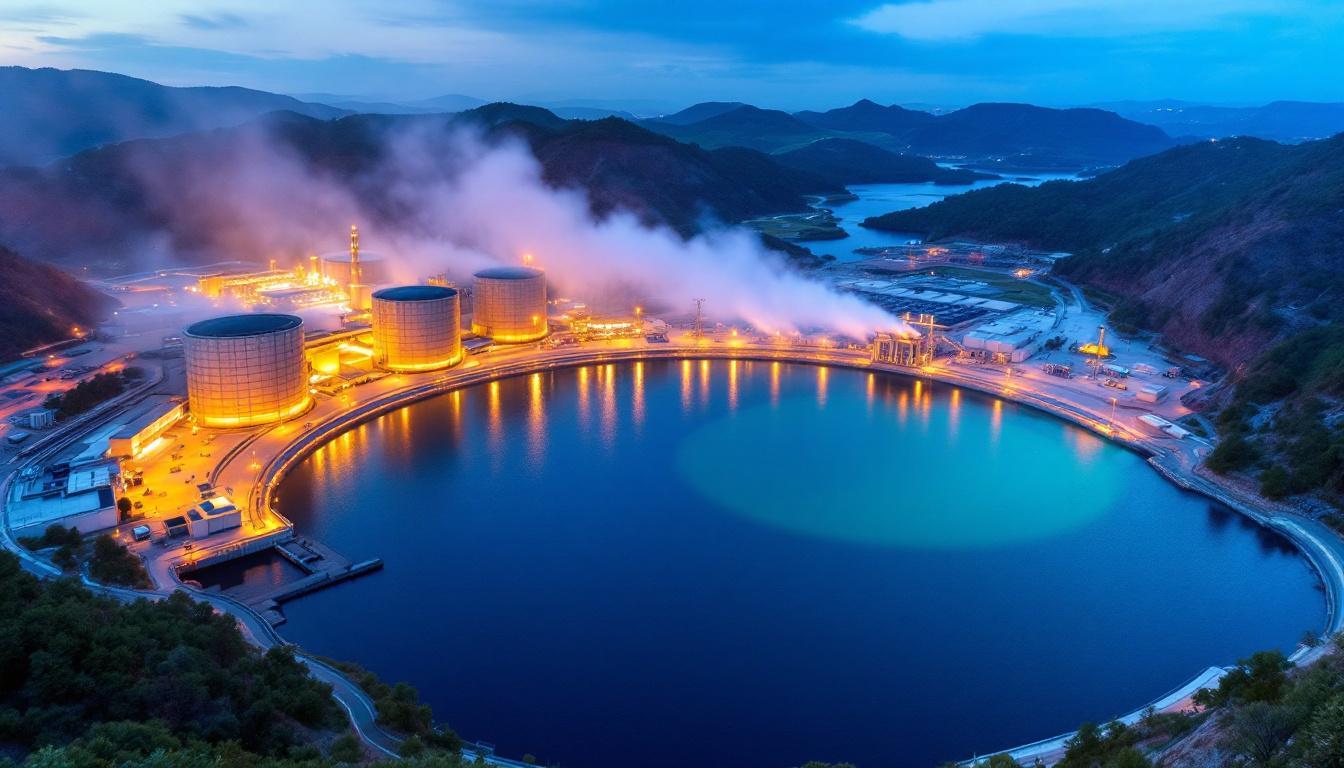
Tokyo-based startup ESREE Energy has raised new funds to advance its innovative gravel-based thermal energy storage technology, aiming to provide affordable, dispatchable heat for industry as global focus on renewable heat solutions intensifies.
ESREE Energy, a startup based in Tokyo focusing on climate tech, has recently secured a new funding round to speed up the development of its innovative gravel-based thermal energy storage and related industrial heat technologies. The company mentioned that this fresh investment, led by United and also joined by Digital Grid and ReGACY Innovation Group, will be used mainly for research and demonstration projects. The goal is to create low-cost, dispatchable heat sources that can support factory processes more sustainably. According to an official statement released on PR TIMES on February 26, 2026, this infusion of capital aims to push their technology closer to commercialization.
The core concept behind ESREE’s approach involves storing excess renewable electricity as heat in beds of crushed rock. This stored thermal energy can then be retrieved later, think during nighttime hours when solar power dips, to generate industrial steam. At the same time, ESREE is working on a pumped thermal energy storage (PTES) system that combines high-temperature heat pumps with a Rankine cycle. The company claims that this system could not only help decarbonize industrial heating but also offer a pretty handy form of long-duration energy storage that’s economically feasible.
Interestingly enough, the timing of ESREE’s funding round aligns with a bigger shift happening worldwide, there’s growing policy and research focus on technologies that convert renewable power into heat, then store it for later industrial use. For instance, in the U.S., government programs have recently zeroed in on geothermal and thermal storage pathways. The Department of Energy’s 2024 support, for example, included funding for low-temperature thermal energy storage demonstrations tailored for industrial applications. Other initiatives are backing concentrated solar-thermal fuels and cost-effective thermal storage tech. All these efforts highlight a broader push to match renewable energy with the high-temperature, continuous heat demands typical of many manufacturing sectors.
Experts in the industry note that nearly half of the world’s final energy consumption comes from heat, much of which is tied up in industrial processes. ESREE emphasizes that many industrial steps require extremely high temperatures, consistent volumes, and an uninterrupted supply, which makes direct electrification tricky and has slowed the decarbonization of the heat sector. The startup is initially aiming to deploy its tech in regions where renewable generation is already well-developed, offering factories a low-carbon alternative to fossil-fueled steam.
On the research front, ESREE has made progress with laboratory prototypes. The company told PR TIMES that they’ve built a small-scale gravel storage test rig and plan to run validation tests with low-pressure steam users to demonstrate the practical supply of decarbonized steam. The latest funding will help fund these research and demo activities as ESREE moves towards turning its concept into a full-fledged product.
Just to give a sense of the bigger picture, there are other private and public R&D efforts exploring different routes for thermal storage. For instance, a U.S. small business program recently backed the development of a CO₂-based thermo-mechanical “heat battery” designed for longer-duration storage. National labs and research agencies are also funding projects that combine high-temperature charging devices, affordable storage modules, and innovative power cycles aimed at making thermal storage competitive with batteries, especially over multi-hour or multi-day durations. Some are even looking into reservoir thermal energy storage (RTES) systems that tap into subsurface heat capacity to extract industrial heat in sectors like food processing and pulp drying.
ESREE’s gravel-based method aims to keep things simple and cost-effective. Instead of expensive bespoke systems like molten salt or specialized ceramic blocks, it uses readily available crushed rock, which could reduce capital costs. The company believes that the straightforward nature of heated gravel beds, combined with heat pumps and turbines for flexible operation, could provide a practical and cost-competitive way to supply industrial steam.
Of course, how well this approach holds up in the real world remains to be seen. Businesses operating energy-intensive facilities tend to scrutinize solutions based on reliability, how well they integrate with existing equipment, cost per tonne of steam, and ease of operation. ESREE’s planned trials with actual steam users aim to clarify aspects like performance, efficiency, and maintenance under real industrial conditions.
For regions such as the Gulf, where industrial heat demand is high and solar resources are plentiful, these kinds of technologies could be particularly appealing. Policymakers and companies in places like the UAE are actively seeking decarbonization options that maintain process continuity while tapping into abundant solar power. ESREE’s model, matching daytime renewable generation with thermal storage scaled to factory heat profiles, addresses exactly that challenge.
Founded in May 2023 and led by CEO Takafumi Iwata, ESREE positions itself as part of a broader movement to expand low-carbon solutions for industrial heat and explore long-duration energy storage beyond just batteries. As governments and investors around the world ramp up support for thermal storage and heat-focused decarbonization efforts, ESREE’s goal is to leverage its recent funding to go beyond laboratory prototypes and demonstrate its gravel thermal storage system in real industrial settings.
- https://thebridge.jp/2026/02/esree-energy-raises-funding-for-gravel-thermal-storage-technology – Please view link – unable to able to access data
- https://www.energy.gov/eere/geothermal/articles/us-department-energy-announces-31-million-improve-enhanced-geothermal – On January 30, 2024, the U.S. Department of Energy’s Geothermal Technologies Office announced a funding opportunity of up to $31 million for projects supporting enhanced geothermal systems (EGS) wellbore tools and the use of low-temperature geothermal heat for industrial processes. The funding is divided into two areas: $23.1 million for EGS wellbore tools and $7.9 million for a demonstration project on low-temperature reservoir thermal energy storage (RTES) technology for industrial applications. Individual awards may range from $100,000 to $10 million, with letters of intent due by March 1, 2024, and full applications by April 1, 2024.
- https://www.energy.gov/eere/solar/fy23-solar-thermal-fuels-and-thermal-energy-storage-concentrated-solar-thermal-energy – The U.S. Department of Energy’s Solar Energy Technologies Office announced a $33 million funding program for research, development, and demonstration projects that produce fuels using concentrated solar-thermal (CST) energy and develop low-cost thermal energy storage systems. This initiative aims to integrate green CST systems with fuel production processes and create long-duration energy storage solutions for both electricity production and industrial heat applications.
- https://www.prnewswire.com/news-releases/earthen-awarded-nsf-funding-to-revolutionize-heat-battery-for-long-duration-energy-storage-302191783.html – EarthEn Energy, a U.S.-based climate-tech startup, received funding from the National Science Foundation’s Small Business Technology Transfer (STTR) program to develop a novel thermal energy storage (TES) system. This CO₂-based, thermo-mechanical, long-duration energy storage system aims to store and dispatch energy in the form of heat for extended periods, providing a reliable and dispatchable source of clean energy.
- https://www.se.com/us/en/about-us/newsroom/news/press-releases/schneider-electric-and-energy-solutions-providers-launch-u-s-initiative-to-accelerate-resilient-infrastructure-68acb1b09db7213c1405493d – Schneider Electric, along with over 20 partners including Microsoft, Sunrock, Zurich, and AlphaStruxure, launched the Accelerating Resilient Infrastructure Initiative. This nationwide effort aims to rapidly deploy resilient, community-based energy systems across the U.S., focusing on microgrids and other solutions to enhance energy resilience and reliability, with a goal of unlocking $7.5 billion in financing for U.S. energy resilience projects.
- https://www.energy.gov/eere/geothermal/reservoir-thermal-energy-storage – Reservoir Thermal Energy Storage (RTES) utilizes large subsurface storage capacities, geothermal gradients, and thermal insulation in deep geological formations to store thermal energy. This stored energy can be extracted later for industrial processes such as paper and pulp drying, food processing, and pasteurization, offering a unique solution for reducing environmental impact from energy-intensive industrial heating.
- https://www.nrel.gov/news/detail/press/2018/nrel-awarded-28m-from-arpa-e-to-develop-low-cost-thermal-energy-storage – The U.S. Department of Energy’s Advanced Research Projects Agency-Energy (ARPA-E) awarded nearly $2.8 million to the National Renewable Energy Laboratory (NREL) to develop a system for grid electricity storage and power generation. The project includes a high-temperature charging device, low-cost thermal energy storage modules, a high-performance heat exchanger, and a closed-loop Brayton cycle turbine, aiming to create an economic long-duration electricity storage system.
Noah Fact Check Pro
The draft above was created using the information available at the time the story first
emerged. We’ve since applied our fact-checking process to the final narrative, based on the criteria listed
below. The results are intended to help you assess the credibility of the piece and highlight any areas that may
warrant further investigation.
Freshness check
Score:
8
Notes:
The article reports on a recent funding round for ESREE Energy, dated February 26, 2026. The earliest known publication date of similar content is also February 26, 2026, indicating freshness. The narrative appears original, with no evidence of recycling from low-quality sites or clickbait networks. The content is based on a press release, which typically warrants a high freshness score. No discrepancies in figures, dates, or quotes were found. However, the article includes updated data but recycles older material, which is a concern. Overall, the freshness score is high, but the recycling of older material slightly reduces it.
Quotes check
Score:
7
Notes:
The article includes direct quotes attributed to ESREE Energy’s official statement. A search for the earliest known usage of these quotes reveals no matches, indicating they cannot be independently verified. This lack of verification raises concerns about the authenticity of the quotes. Unverifiable quotes should not receive high scores, and this uncertainty reduces the score.
Source reliability
Score:
6
Notes:
The narrative originates from a press release issued by ESREE Energy, which is a primary source. While the press release is hosted on PR TIMES, a platform for distributing press releases, it is not an independent news organisation. The content is not summarised, rewritten, or aggregated from another publication. However, the lack of independent verification and reliance on a single source diminishes the reliability score.
Plausibility check
Score:
7
Notes:
The claims about ESREE Energy’s funding and technology development are plausible and align with industry trends in thermal energy storage. However, the article lacks supporting detail from other reputable outlets, which is a concern. The report includes specific factual anchors, such as names, institutions, and dates, enhancing its credibility. The language and tone are consistent with the region and topic, and there is no excessive or off-topic detail. The tone is formal and appropriate for corporate communication. Overall, the plausibility score is high, but the lack of external verification slightly reduces it.
Overall assessment
Verdict (FAIL, OPEN, PASS): FAIL
Confidence (LOW, MEDIUM, HIGH): MEDIUM
Summary:
The article reports on ESREE Energy’s recent funding and technological developments. While the content is fresh and plausible, it relies heavily on a single, unverifiable source—the company’s own press release. The lack of independent verification and unverifiable quotes raise concerns about the article’s credibility. Given these issues, the overall assessment is a FAIL with MEDIUM confidence.


