

 2:47 pm - April 3, 2026
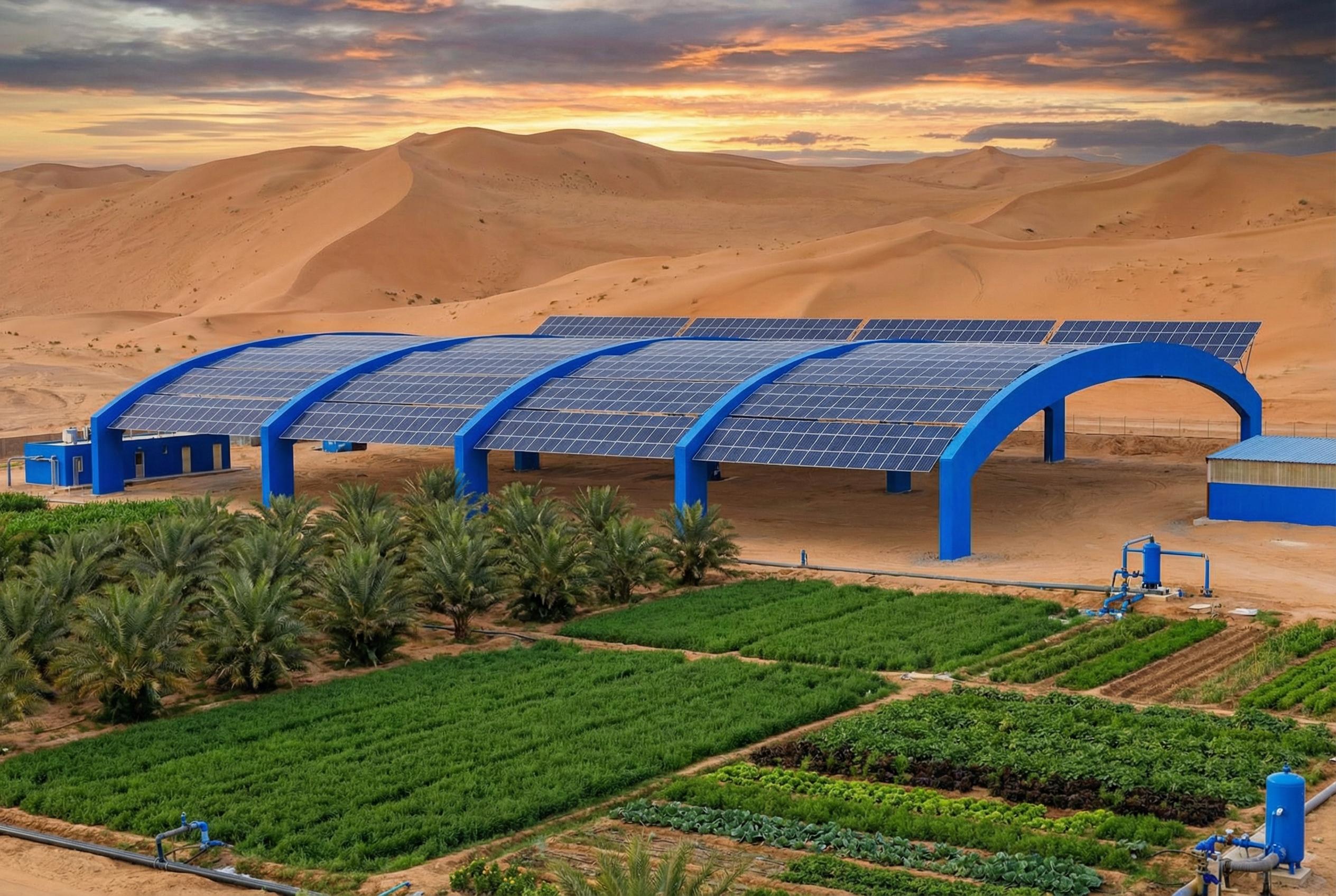
A pioneering pilot project in Fujairah showcases how integrating solar PV with crop farming can combat climate challenges in the UAE’s harsh desert environment, offering new solutions for land use, water efficiency, and food production.
Recently, the Fujairah Research Centre ran a pretty interesting pilot project on agrivoltaics, and it actually provides a useful example of how the UAE might tackle two big challenges at once, expanding renewable energy sources and ensuring sustainable food production, especially in that harsh desert environment we all know too well. According to pv-magazine, this trial, led by Dr. Fouad Lamghari Ridouane, working together with Dr. Hamed Hanifi from AE Solar, set up a 38.9 kWp solar array with 72 modules, paired with a 320 kWh lithium-ion battery, at Al Fujairah City. The goal was to see if placing solar panels alongside crops could make agriculture more resilient while still producing usable power.
What’s pretty noteworthy is that the experiment was intentionally designed to suit desert conditions. Instead of using fancy, specialized agrivoltaic frames, which, let’s be honest, can be costly, they used a sturdy ground-mounted system that’s easier and cheaper to scale up. The equipment included power electronics rated to work in temperatures above 50°C, something that really helps avoid the performance losses typical of regular systems in the region’s scorching summer heat. During May and June 2025, the team combined PV system modeling with detailed monitoring of plant growth and microclimate data, so they could get a real picture of how crops respond under real operating conditions.
And the results? They were quite revealing. Under the shade of the panels, the microclimate changed dramatically compared to open fields: air temperatures dropped by about 15°C, humidity increased by more than 30%, and the photosynthetic photon flux density, basically, the amount of light available for plant growth, remained within a much more usable range. Soil testing showed lower salinity levels, by roughly 20–30%, and improvements in organic matter as well as mineral balance. And all of that translated into clear benefits for the plants: they grew more vigorously, had stronger roots, and produced more leaves per plant. Interestingly, pv-magazine reports that this pilot might be the first documented case of agrivoltaic trials on native UAE plants.

These kinds of findings fit well with the broader efforts happening across the country. The UAE’s been pushing technology and innovation to overcome its tough agricultural limits, through government initiatives and private projects alike. These include vertical farming, controlled environment agriculture, and testing resilient crop varieties to cope with rising temperatures, water shortages, and soil salinity issues. For example, according to The National, local farmers are turning to more resilient plant varieties, better fertilization techniques, and indoor cultivation systems to keep yields steady amid the climate shifts. And projects like ADQ’s AgTech Park in Abu Dhabi, which partners with Italy’s ZERO for vertical farming, really reflect the country’s push toward high-tech, water-efficient food production systems, something the Abu Dhabi Agriculture and Food Safety Authority has highlighted.
Now, beyond just growing crops, the implications of the Fujairah pilot reach into land use planning as well. Agrivoltaics could help ease the pressure that large solar farms put on land, especially because cultivable land is so limited in the region. Industry watchers highlight that the UAE’s rapid deployment of utility-scale solar, including a 60 MWp plant supplying a gas complex and exporting energy to the grid, indicates a strong appetite for solar capacity, pv-magazine covered this in 2025. Integrating agrivoltaics allows for a kind of win-win: generating electricity while growing food, which means less competition for land and better water and microclimate management.
That said, scaling up agrivoltaic systems here, and in the Gulf in general, won’t be entirely straightforward. It’s a balancing act, careful design is needed so that shading patterns, panel types, and structural choices optimize both energy production and crop health. The Fujairah team showed that uniform shading with smart layout design can keep the light levels, what growers call PPFD, within productive ranges, while also significantly lowering heat stress for plants. Of course, not all crops will respond the same way, and protocols will have to be tailored to specific plant types and seasons. Since this pilot only ran for a couple of months, longer-term trials across different seasons and with different crops are essential to really understand impacts on yield, water savings, and economic viability.
Water remains a major challenge, of course. While partial shading and increased humidity can cut down on water loss through evaporation, agrivoltaics alone don’t eliminate the need for efficient irrigation or desalination, especially in such arid environments. The National has also highlighted several seed trials and breeding programs aimed at improving drought tolerance and salt resistance in crops, suggesting that combining these technological approaches, agrivoltaics, vertical farming, and better genetics, will be crucial and probably work best together rather than separately.
Of course, economic and policy support will be key to turning pilots like this one into fully adopted solutions. The fact that they used standard ground-mounted equipment reduces the barrier of having to develop custom frames for agriculture, a real plus. If other projects follow suit, this approach could help lower costs and make it easier for farms and developers to get involved. Proper land planning, government incentives, and policies that promote dual-use land systems will all influence how quickly these ideas can scale. Industry experts say that investors look at both energy output and potential agricultural revenues when considering agrivoltaic projects, and given the UAE’s partnerships, like those between national oil companies, renewable energy firms, and international developers, they have the institutional capacity to grow this sector, provided the right policies are in place.
All in all, the Fujairah pilot offers a rare, carefully tailored piece of data, especially since it’s based on real-world conditions in an arid climate. According to pv-magazine, this collaboration between a dedicated research centre and a commercial module supplier turned a concept into a test that’s proven its worth under extreme climatic stress. For policymakers and investors focused on climate tech, it’s promising evidence that, with thoughtful design, agrivoltaic systems can help reduce plant heat stress, improve soil health, and produce clean energy, all without sacrificing valuable land for farming. Naturally, to truly realize the resilience potential, more extended trials are needed across different crops and seasons, along with integrated water management strategies and supportive policies that can enable financing and land-use models to reward multifunctional landscapes.
- https://www.pv-magazine.com/2026/01/13/strengthening-food-and-energy-resilience-with-agri-pv/ – Please view link – unable to able to access data
- https://www.thenationalnews.com/uae/2023/07/11/uae-farmers-innovate-to-overcome-climate-change-challenges/ – This article discusses the challenges faced by UAE farmers due to climate change, including rising temperatures, water scarcity, and soil salinity. It highlights the impact of unpredictable weather patterns, such as droughts and floods, on crop yields and production facilities. The piece also explores innovative techniques being adopted by farmers, such as using resilient crop varieties, improving fertilizers, and implementing vertical farming methods to safeguard crops and livelihoods.
- https://www.pv-magazine.com/2026/01/13/strengthening-food-and-energy-resilience-with-agri-pv/ – This article presents a pilot project in Fujairah, UAE, where agrivoltaics—integrating solar panels above crops—was tested to address challenges in arid regions. The project demonstrated that controlled shading from PV modules can enhance plant health, improve water retention, and boost crop resilience, offering a scalable solution to the region’s energy, food, and water challenges.
- https://www.pv-magazine.com/2025/07/01/uae-launches-60-mw-solar-plant-to-power-gas-complex-and-grid/ – This article reports on the commissioning of a 60 MWp solar plant in Sharjah, UAE, developed by Sharjah National Oil Corp. (SNOC) in collaboration with Masdar and EDF Group. The facility supplies electricity to the Sajaa Gas Complex and exports surplus power to the Sharjah Electricity, Water and Gas Authority (SEWA), marking a significant step in integrating solar power into oil and gas operations in the region.
- https://www.aard.gov.ae/en/Media-Centre/News/22-03-2023-11 – This announcement details the operational phase of ADQ’s AgTech Park in Abu Dhabi, featuring a vertical farming project in partnership with Italy’s ZERO. The facility aims to enhance local production of crops, fruits, and vegetables, utilizing controlled environment agriculture to address challenges posed by the desert climate and improve food security in the UAE.
- https://www.thenationalnews.com/news/uae/2024/09/01/how-technology-can-help-farmers-cope-with-climate-change/ – This article explores how technology is assisting Gulf farmers in extending their growing seasons amid climate change. It discusses seed trials of various crops, including tomatoes and cucumbers, to assess performance under extreme weather conditions. The piece also highlights the role of genetic engineering in developing drought-tolerant crops to improve resilience and food security in the region.
- https://www.thenationalnews.com/news/uae/2024/10/08/how-plant-the-emirates-is-part-of-a-wider-strategy-to-strengthen-food-security/ – This article examines the ‘Plant the Emirates’ initiative as part of a broader strategy to strengthen food security in the UAE. It addresses the challenges posed by climate change, including rising temperatures and water scarcity, and discusses efforts to develop sustainable agricultural practices to ensure a stable food supply in the region.
Noah Fact Check Pro
The draft above was created using the information available at the time the story first
emerged. We’ve since applied our fact-checking process to the final narrative, based on the criteria listed
below. The results are intended to help you assess the credibility of the piece and highlight any areas that may
warrant further investigation.
Freshness check
Score:
10
Notes:
The narrative was published on January 13, 2026, and is the earliest known publication of this specific content. No earlier versions with different figures, dates, or quotes were found. The content is original and not recycled from other sources. The narrative is based on a press release from pv magazine, which typically warrants a high freshness score.
Quotes check
Score:
10
Notes:
No direct quotes were identified in the narrative.
Source reliability
Score:
10
Notes:
The narrative originates from pv magazine, a reputable publication in the renewable energy sector. The Fujairah Research Centre is a legitimate organisation with a public presence and a dedicated website. The individuals mentioned, Dr. Fouad Lamghari Ridouane and Dr. Hamed Hanifi, are associated with the respective organisations and can be verified online.
Plausability check
Score:
10
Notes:
The claims made in the narrative are plausible and align with known challenges and initiatives in the UAE’s agricultural and energy sectors. The integration of solar panels with agriculture to improve soil health and crop resilience is a recognised strategy in arid regions. The technical details provided, such as the use of high-temperature power electronics and the specific setup of the PV array, are consistent with current agrivoltaic practices.
Overall assessment
Verdict (FAIL, OPEN, PASS): PASS
Confidence (LOW, MEDIUM, HIGH): HIGH
Summary:
The narrative is original, timely, and originates from a reputable source. The claims made are plausible and supported by verifiable information. There are no indications of recycled content, disinformation, or other credibility issues.

