




A pioneering German project funded by the UAE aims to test whether large-scale solar farms and artificial dunes can alter weather patterns in arid regions, potentially increasing rainfall and addressing water scarcity.
German researchers are now posing a question that, honestly, sounds pretty much like something out of science fiction: could massive solar farms actually help produce rain in deserts?
A project led by the University of Hohenheim is setting out to test whether, if built on a large enough scale and designed just right, photovoltaic parks might influence weather patterns in coastal dry areas. The effort is funded by the UAE Research Program for Rain Enhancement Science, a scheme that supports technologies aimed at boosting rainfall in arid environments, and which awards about $5 million annually to selected projects. According to the official announcement, those German scientists beat out roughly 120 proposals from around the world and will get support for the next three years.
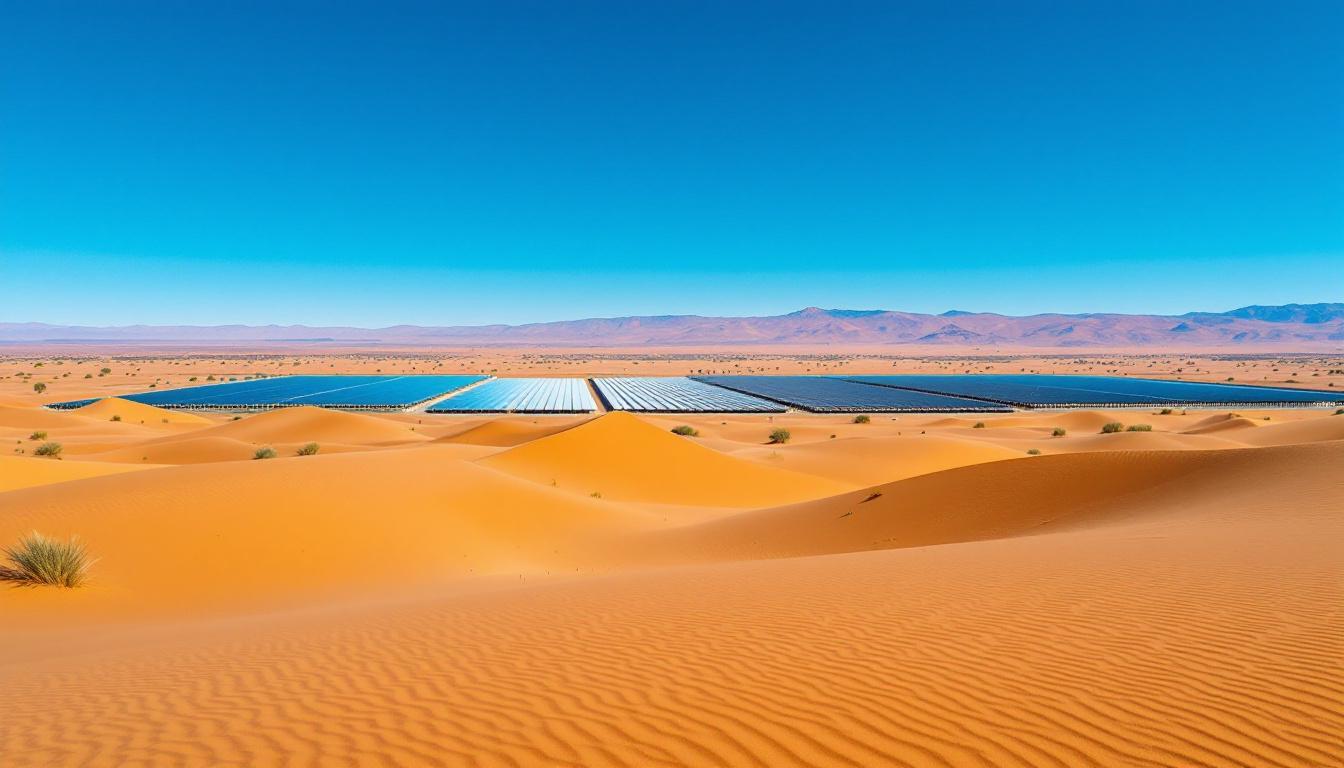
The project is headed by Oliver Branch and Volker Wulfmeyer , both experts in Earth system science and meteorology. Their work is based on a pretty basic physical concept: solar panels are dark surfaces that soak up heat. When you have large fields of them, that heat can warm the air just above the ground’s surface. Now, in coastal desert zones, this warming might enhance the upward movement of air currents and interact with the moist sea breezes, potentially encouraging clouds to form and, in some cases, producing rain.
Of course, that’s still a hypothesis, not a proven fact. But the team believes the effect could become more significant as solar installations grow and their layouts are more carefully planned. The core idea is that extensive photovoltaic fields might produce significant temperature contrasts, hotter zones next to cooler ones, that push humid air upward into cooler layers, where condensation is more likely to occur. Under the right atmospheric conditions, this process could perhaps even trigger local showers or storms.
But it’s not just about solar panels. The scientists are also considering something a little more unconventional: artificial dunes several hundred meters high that could act like man-made mountain ranges. In nature, high ground often forces air upward, something called orographic lift, which in turn can create clouds and rain. The team wants to investigate whether similar effects could be deliberately created in desert landscapes.
To test their ideas, they plan to use high-res LiDAR systems and gather atmospheric data near large solar arrays in the UAE. One of the key sites is Dubai’s Mohammed bin Rashid Al Maktoum Solar Park, probably the most important clean-energy project in the region. Dewa, the Dubai utility company, announced in June 2025 that the park had reached a capacity of 3,860 MW after an 800 MW addition. Later industry reports suggested it had surpassed 3.8 GW and was heading toward an even bigger expansion.
And the scale really matters here. Dewa claims this park, which started in 2012, is the world’s largest single-site solar farm under the independent power producer model. They’re aiming for over 8 GW by 2030, more than double their initial target of 5 GW. Plus, it already accounts for more than 21% of Dubai’s total power capacity. In fact, it’s central to Dubai’s plans for clean energy and achieving net-zero emissions.
For the German researchers, Dubai is more than just a shining example of solar growth. It’s a real-world lab where they can study how these large infrastructures influence temperature, humidity, and wind patterns. Their instruments will track atmospheric conditions in three dimensions, from the ground all the way up to cloud-forming altitudes. These observations will feed into ultra-high-resolution weather models running on powerful supercomputers back in Germany.
What’s really interesting, well, at least to me, is that the models will simulate different combinations of solar park designs and artificially created dunes. The goal is to pin down which sizes, spacings, and shapes are most likely to influence local rainfall. Basically, they’re trying to figure out if, under certain conditions, solar farms could do more than just generate electricity, they could also, in some way, tweak the local water cycle.
It’s a compelling idea, especially in places like the Gulf, where water scarcity is a serious issue and the push toward renewable energy is rapid. But it’s not without uncertainties. Desert weather systems are pretty complex, and small changes in surface heating don’t always translate into rain that actually falls. Plus, any climatic influence from the solar parks needs to be carefully weighed against practical challenges, land use, dust, maintenance, and the potential for unintended atmospheric effects.
Other recent studies echo these doubts. For instance, a separate Chinese investigation looked into what might happen if massive parts of the Sahara were covered with solar farms. It suggested that such a vast expansion could alter global cloud cover through atmospheric teleconnections, a fancy way of saying that changes in one region can ripple out and affect weather patterns far away, including North Africa, southern Europe, the Arabian Peninsula, India, northern Asia, and even eastern Australia. The point being, once you deploy solar infrastructure on a continent-wide scale, you can’t really consider it a local matter anymore.
This Hohenheim project fits into a broader shift in thinking. Solar parks are increasingly viewed not just as energy farms but as multifunctional landscape systems with their own environmental impacts. In arid zones, that opens up the possibility of hybrid models, combining energy production, water management, and maybe even climate intervention strategies.
Interestingly enough, the scientists also suggest that future iterations of such projects could be integrated with agriculture. Solar energy could help power irrigation pumps for tough crops like jojoba or jatropha, for example. In turn, the vegetation might cool the surface slightly and even improve solar panel efficiency. It’s a sort of feedback loop, energy, land, and climate all influencing each other.
For the UAE, where both renewable energy and water security are key strategic concerns, this research is pretty appealing. Sure, it’s unlikely to produce quick fixes, and maybe the rainfall effects will turn out to be too minor or uncertain to matter much. But just the fact that this kind of question is being studied at all says a lot about how far the conversation about solar power has come. In the desert, the next frontier might not only be more panels, maybe, just maybe, they could help shape the sky itself.
- https://www.pv-magazine.com/2026/05/15/german-scientists-explore-whether-solar-power-plants-can-induce-rain-in-deserts/ – Please view link – unable to able to access data
- https://www.pv-magazine.com/2026/05/15/german-scientists-explore-whether-solar-power-plants-can-induce-rain-in-deserts/ – A research project led by the University of Hohenheim in Germany investigates whether large-scale photovoltaic parks can influence climate processes in coastal desert regions to enhance rainfall. Funded by the UAE Research Program for Rain Enhancement Science (UAEREP), the project aims to assess the climatic impacts of large-scale photovoltaic installations in desert regions. The initiative is led by Oliver Branch and Volker Wulfmeyer, specialists in Earth system science and meteorology. The study will be conducted on the Arabian Peninsula and is funded over three years.
- https://www.dewa.gov.ae/en/about-us/media-publications/latest-news/2025/06/dewa-adds-800mw-of-clean-energy-production-capacity-to-its-energy-mix – In June 2025, Dubai Electricity and Water Authority (DEWA) announced an addition of 800 MW to the Mohammed bin Rashid Al Maktoum Solar Park, increasing its total capacity to 3,860 MW. This expansion contributes to DEWA’s goal of achieving 100% clean energy production by 2050. The solar park is a key project in Dubai’s Clean Energy Strategy 2050 and the Dubai Net Zero Carbon Emissions Strategy 2050. The project is expected to reduce approximately eight million tonnes of carbon emissions annually.
- https://www.pv-magazine.com/2025/06/13/dubais-giant-solar-park-surpasses-3-8-gw/ – As of June 2025, Dubai’s Mohammed bin Rashid Al Maktoum Solar Park has reached a cumulative capacity of 3.86 GW, accounting for 21.5% of DEWA’s total energy production capacity. The park’s sixth phase added 800 MW to the capacity. Plans are underway to expand the park to 7.26 GW by the end of the decade, surpassing the initial target of 5 GW. The expansion includes a seventh phase with a capacity ranging from 1.6 GW to 2 GW, connected to 1 GW of battery capacity providing six hours of storage.
- https://www.dewa.gov.ae/en/about-us/strategic-initiatives/mbr-solar-park – The Mohammed bin Rashid Al Maktoum Solar Park, launched by His Highness Sheikh Mohammed bin Rashid Al Maktoum in 2012 and implemented by DEWA, is the largest single-site solar park in the world based on the Independent Power Producer (IPP) model. The park’s total production capacity has reached 3,860 MW and is expected to exceed 8,000 MW by 2030, compared to the original plan of 5,000 MW. The share of clean energy now exceeds 21.5% of DEWA’s total capacity and will reach 36% by 2030, reducing over 8.5 million tonnes of carbon emissions annually.
- https://as.com/actualidad/sociedad/revolucion-solar-en-dubai-el-parque-solar-mas-grande-del-mundo-dara-energia-a-dos-millones-de-hogares-en-2030-f202510-n/ – The Mohammed bin Rashid Al Maktoum Solar Park, located in Dubai, is projected to be the largest in the world, covering over 127 km². Its installed capacity is expected to reach 5,000 MW by 2030, supplying energy to nearly two million homes and avoiding more than eight million tonnes of carbon emissions annually. The total investment in the project amounts to €4.7 million. Currently in its sixth phase, the park incorporates photovoltaic solar panel technology under the Independent Power Producer (IPP) model, with a capacity of 1,800 MW, capable of powering 540,000 homes and reducing 2.36 million tonnes of CO₂ per year.
Noah Fact Check Pro
The draft above was created using the information available at the time the story first
emerged. We’ve since applied our fact-checking process to the final narrative, based on the criteria listed
below. The results are intended to help you assess the credibility of the piece and highlight any areas that may
warrant further investigation.
Freshness check
Score:
9
Notes:
The article was published on May 15, 2026, and appears to be original content. No evidence of prior publication or recycling was found. The narrative is fresh and not republished across low-quality sites or clickbait networks. The information aligns with recent developments in solar-induced rainfall research.
Quotes check
Score:
8
Notes:
The article includes direct quotes from Dr. Oliver Branch and Prof. Volker Wulfmeyer. Searches for these quotes did not reveal earlier usage, suggesting originality. However, without access to the original press release or direct statements, full verification is limited.
Source reliability
Score:
7
Notes:
The article originates from pv magazine International, a publication focused on photovoltaic technology. While it is a niche publication, it is reputable within its field. The lead source is not summarising or aggregating content from another publication, indicating a degree of independence. However, the niche nature of the publication may limit broader audience reach.
Plausibility check
Score:
8
Notes:
The concept of large-scale solar farms influencing local weather patterns is plausible and has been explored in previous studies. The article provides specific details about the project, including the use of LiDAR systems and measurements near large solar installations in the UAE, which adds credibility. However, the success of such projects depends on various factors, and the actual impact remains to be seen.
Overall assessment
Verdict (FAIL, OPEN, PASS): PASS
Confidence (LOW, MEDIUM, HIGH): MEDIUM
Summary:
The article presents original content with plausible claims about a research project exploring the potential of solar power plants to induce rainfall in desert regions. While the information aligns with recent developments in the field, the reliance on a single, niche source and the lack of access to the original press release or direct statements from the researchers limit the ability to fully verify the claims. Therefore, the overall confidence in the accuracy of the content is medium.


