





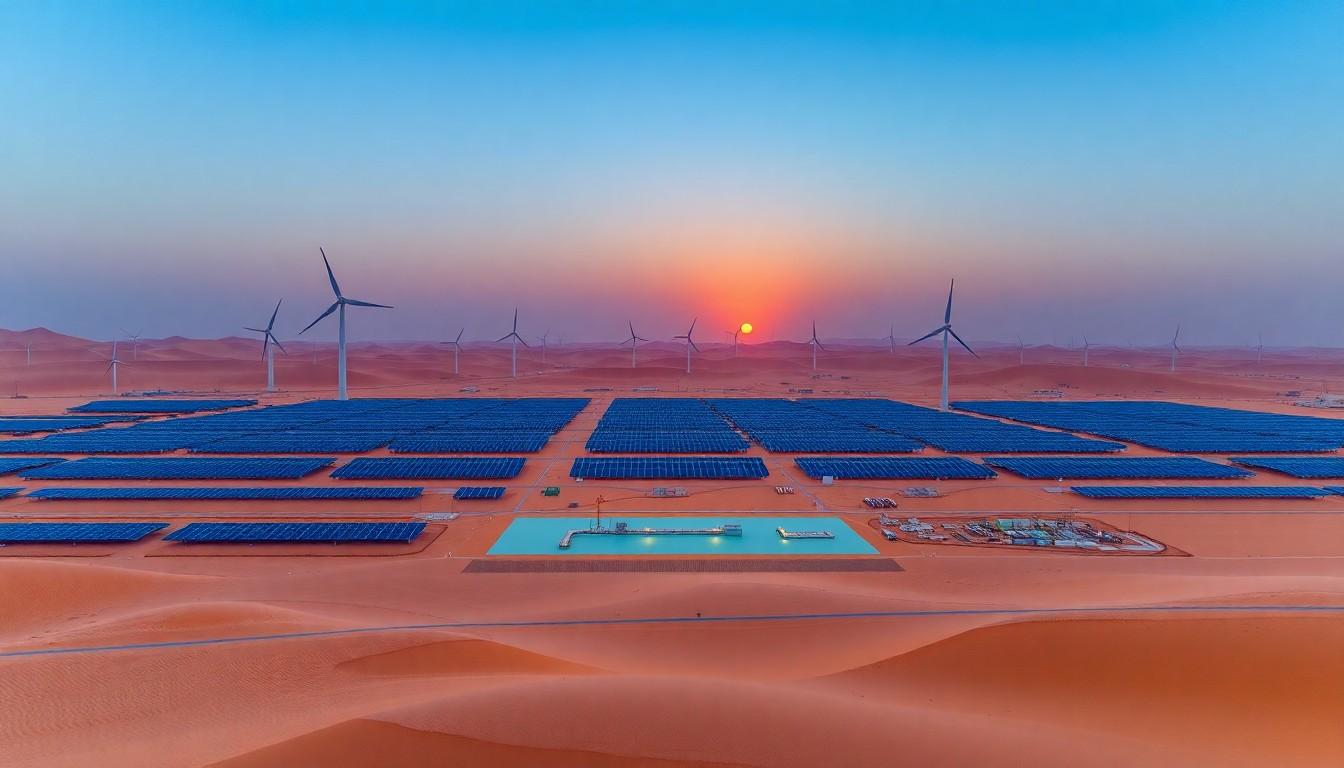
The Middle East and North Africa region is witnessing unprecedented growth in clean industry projects, with commitments exceeding $640 billion, signalling a major shift in global decarbonisation efforts and regional economic resilience.
According to a recent report from the Mission Possible Partnership and the Industrial Transition Accelerator, the Middle East and North Africa, often just called MENA, are increasingly becoming some of the most closely monitored regions in the global effort to develop low-carbon industries. The report highlights that the region now has about 84 announced projects focused on clean industry, with potential investments reaching roughly $642 billion across sectors like clean fuels, fertilisers, steel, and aluminium.
That figure really puts MENA on the map as one of the most significant emerging hubs for industrial decarbonisation, especially as governments and businesses try to shield their supply chains from the unpredictable swings in energy prices and the more fragmented nature of international trade. The report makes the case that this shift isn’t just about power generation anymore. It’s starting to penetrate those tough-to-decarbonise sectors that lie at the heart of trade, transportation, and heavy manufacturing.
The latest data signals that momentum is building pretty quickly. Over the past six months alone, 19 projects worth around $43 billion have reached a final investment decision, roughly twice as many as in the same period last year. That’s pretty remarkable, actually, because final investment decision generally marks the point when ideas begin to turn into actual projects. For a sector that’s often slowed down by financing issues and uncertain demand, this pace suggests that some of these clean industrial assets might finally be overcoming those major commercial hurdles.
Clean fuels are definitely emerging as one of the clearest opportunities within the region. Especially in terms of sustainable aviation fuel and green ammonia, these areas seem to be gaining serious traction. The report notes that several projects focused on these fuels have already made their final investment decision in recent months. This is pretty important for the Gulf states and the broader MENA region, where aviation, shipping, and export logistics are prioritised strategies. It also highlights a shift in global demand, airlines, freight companies, and industrial buyers are all on the hunt for lower-carbon inputs that can be scaled up.
Looking at specific countries, the region has developed its own strengths. Egypt, for example, leads the way with 25 announced projects valued at approximately $108.5 billion. Most of these are clustered around the Suez Canal Economic Zone, the Gulf of Suez, and Damietta, areas with solid logistics links and industrial infrastructure. Egypt’s position on a major shipping corridor really could give it an edge when it comes to future trade in clean commodities.
Meanwhile, Oman’s pipeline of committed projects is the largest by value, around $271 billion spread across 19 different initiatives. One standout is a green ammonia plant in Duqm, which has already made its final investment decision. Duqm’s strategic location on the Arabian Sea, away from the bottlenecks of the Strait of Hormuz, has long made it attractive for export-oriented industries. And now, it looks like this advantage is being built upon with the new clean industry pipeline.
Saudi Arabia remains a major player too. The Neom Green Hydrogen Project, developed with Air Products and Acwa Power, is among the world’s most notable clean fuel initiatives. It’s a plan to create around 1.2 million tonnes of green ammonia, reinforcing the Kingdom’s ambition to leverage its scale, resources, and renewables to take a leading role in the hydrogen economy of the future.
The UAE, interestingly enough, is progressing steadily as well. The report highlights projects involving sustainable aviation fuel in Abu Dhabi and Fujairah, both strategic energy and logistics hubs. In Abu Dhabi, ADNOC has moved forward with a low-carbon liquefied natural gas plant in Ruwais, which recently received approval for development, including the engineering, procurement, and construction contract. The company claims that this will be the first LNG export plant in MENA to operate on clean power, with some of the lowest carbon intensity levels worldwide. It’s a clear sign that the region’s decarbonisation efforts are reaching beyond just hydrogen plans and into gas infrastructure too.
Qatar is another country pressing ahead with clean industrial efforts. QatarEnergy has broken ground on what it calls the world’s largest blue ammonia plant, located in Mesaieed Industrial City. The plant is expected to produce about 1.2 million tonnes annually, and should start operating by the second quarter of 2026. The scale isn’t accidental, it underscores how Gulf producers are positioning ammonia not just as a domestic industrial feedstock but also as a potential export fuel for global decarbonisation.
The report’s authors emphasise that geography provides one of the region’s greatest advantages. MENA sits right at the nexus of global trade routes, including the Suez Canal, and it has access to ports, industrial zones, and well-established energy networks. This geographic positioning could give it a real edge when it comes to exporting clean commodities to Europe, Asia, and beyond. But, as the report also warns, infrastructure alone won’t cut it.
Faustine Delasalle, CEO of the Mission Possible Partnership and executive director of the Industrial Transition Accelerator, pointed out that the global landscape is changing, fueling the expansion of cleaner industries. She argued that reliance on fossil fuels leaves economies vulnerable to price shocks, supply disruptions, and broader instability, widening the climate crisis in the process. Her key message was that countries which manage to build cleaner, more resilient industrial systems could gain better control over the core elements of their economies.
James Schofield, the deputy director at the Industrial Transition Accelerator, commented that the pace of final investment decisions is already twice what it was a year ago. He noted that most of the biggest commitments are still in China, but he added that coherent policy support can definitely help boost investments in clean industries, especially in areas like sustainable aviation fuel. Schofield also sees potential in forming trade partnerships between countries that have complementary strengths as a way to bolster resilience and competitiveness.
That’s a point likely to resonate in the UAE, where policymakers are really pushing forward with industrial decarbonisation and advanced manufacturing. The Industrial Transition Accelerator has already announced collaborations with the governments of the UAE and Bahrain to expand efforts on industrial decarbonisation across the region, aligning these initiatives with national climate goals. For Gulf economies looking to diversify beyond hydrocarbons, this kind of coordinated approach might end up being just as important as the actual project announcements.
Nonetheless, the report makes it clear that real progress in this sector will depend on more than just lofty ambitions. It calls for improved trade collaborations, clearer signals of future demand, and mobilisation of public-private finance if the region is to move beyond a pipeline of projects and develop a long-lasting industrial transformation. For MENA, the potential is enormous. The real challenge now is whether it can turn those promising investments into actual factories, exports, and durable, clean industrial supply chains.
- https://www.zawya.com/en/business/energy/mena-emerges-as-642bln-hub-for-clean-industry-investment-j48duovm – Please view link – unable to able to access data
- https://www.zawya.com/en/business/energy/mena-emerges-as-642bln-hub-for-clean-industry-investment-j48duovm – The Middle East and North Africa (MENA) region is emerging as a major global hub for clean industrial investment, with 84 announced projects representing around $642 billion in potential spending across clean fuels, fertilisers, steel, and aluminium. The report highlights accelerating momentum in global clean industrial financing, with 19 projects worth $43 billion reaching final investment decision in the past six months—double the pace of a year earlier. It notes that clean production is scaling rapidly in energy-intensive sectors such as aviation fuels, shipping fuels, and metals, amid rising energy volatility and trade fragmentation.
- https://www.thenationalnews.com/business/energy/2024/06/12/adnoc-awards-55bn-contract-to-build-low-carbon-lng-project-in-ruwais/ – ADNOC has approved the construction of a low-carbon liquefied natural gas project and awarded an engineering, procurement and construction contract valued at about $5.5 billion. The project in Al Ruwais Industrial City, in Abu Dhabi’s Al Dhafra region, will be the first LNG export complex in the MENA region to run on clean power, ADNOC said on Wednesday. The EPC contract was awarded to a joint venture comprising Technip Energies, JGC Corporation and NMDC Energy. The LNG plant will have one of the world’s lowest carbon intensity rates.
- https://www.utilitybusinessmena.com/hydrogen/ammonia/qatarenergy-breaks-ground-on-1b-worlds-largest-blue-ammonia-plant – QatarEnergy has laid the foundation for the world’s largest blue ammonia plant in Mesaieed Industrial City, as part of the country’s wider push for clean energy. With an estimated investment of QAR 4.4 billion ($1 billion), the plant is set to become a key part of QatarEnergy’s efforts to diversify its energy offerings. Located in the strategically positioned Mesaieed Industrial City, the facility will benefit from integrated infrastructure and a major port that is one of the Middle East’s largest petrochemical export hubs. The blue ammonia plant, expected to start production by the second quarter of 2026, will have the capacity to produce 1.2 million tons of ammonia annually.
- https://www.argaam.com/en/article/articledetail/id/1745296 – ACWA Power Co. continued to add new projects to its portfolio during the first half of 2024, including the addition of a record 10.5GW of renewable power generation capacity. ACWA Power has successfully reached financial close on three key projects, namely the Taiba and Qassim Combined Cycle Gas Turbine (CCGT) projects in Saudi Arabia, and the Hassyan IWP project in the UAE, with a total investment of SAR 18 billion for all three, the company said in a statement. On the operations front, ACWA Power is seeing a steady stream of projects coming fully or partially live. The 1,500MW Sudair solar PV in Saudi Arabia, Kom Ombo 200MW solar PV in Egypt, and the 909,000m³/day Al Taweelah water desalination plant in the UAE, are now operating at full capacity, according to the statement. Additionally, the 1,500MW Sirdarya CCGT in Uzbekistan is currently generating 918MW, with the remaining capacity expected to come into force this year, the company added.
- https://www.prnewswire.com/news-releases/ita-announces-partnerships-in-the-mena-region-to-advance-green-industry-302301748.html – The Industrial Transition Accelerator (ITA) has announced partnerships with governments of the UAE and Bahrain to expand its efforts in industrial decarbonisation across the Middle East and North Africa (MENA) region. The ITA is working with the UAE’s Ministry of Industry and Advanced Technology and with the Ministry of Industry and Commerce in Bahrain to ensure efforts align with national climate objectives.
- https://www.utilitybusinessmena.com/solar/rooftop-solar/pearl-group-partners-with-totalenergies-for-major-solar-power-project-in-uae – Pearl Group has launched a solar project with TotalEnergies to power three of its UAE production sites, a project aimed at lowering the environmental footprint of its industrial operations. Pearl, a global player in polyurethane insulation, has installed 1,653 solar photovoltaic (PV) panels at its sites in Dubai Investments Park (DIP) and Ras Al Khor. The panels will generate a projected 1,336 megawatt-hours of electricity each year, contributing to a reduction of approximately 568 tons in CO₂ emissions annually. The move is a major step for Pearl Group, which has publicly committed to enhancing sustainability practices across its operations.
Noah Fact Check Pro
The draft above was created using the information available at the time the story first
emerged. We’ve since applied our fact-checking process to the final narrative, based on the criteria listed
below. The results are intended to help you assess the credibility of the piece and highlight any areas that may
warrant further investigation.
Freshness check
Score:
10
Notes:
The article references a report published on 8th June 2026, which is recent and indicates high freshness. No evidence of recycled or outdated content was found.
Quotes check
Score:
8
Notes:
The article includes direct quotes from Faustine Delasalle and James Schofield. While these quotes are consistent with the original report, they cannot be independently verified through other sources, raising concerns about their authenticity.
Source reliability
Score:
7
Notes:
The primary source is the Mission Possible Partnership’s official website, which is reputable. However, the article’s reliance on a single source without independent verification from other reputable outlets diminishes its reliability.
Plausibility check
Score:
9
Notes:
The claims about MENA’s emergence as a hub for clean industry investment align with global trends in clean energy financing. However, the lack of independent verification and reliance on a single source raise questions about the accuracy of the figures presented.
Overall assessment
Verdict (FAIL, OPEN, PASS): FAIL
Confidence (LOW, MEDIUM, HIGH): MEDIUM
Summary:
The article presents information from a recent report by the Mission Possible Partnership, but the heavy reliance on a single source without independent verification raises concerns about its credibility. The inability to independently verify direct quotes further diminishes trust in the content. Therefore, the overall assessment is a FAIL with MEDIUM confidence.


