





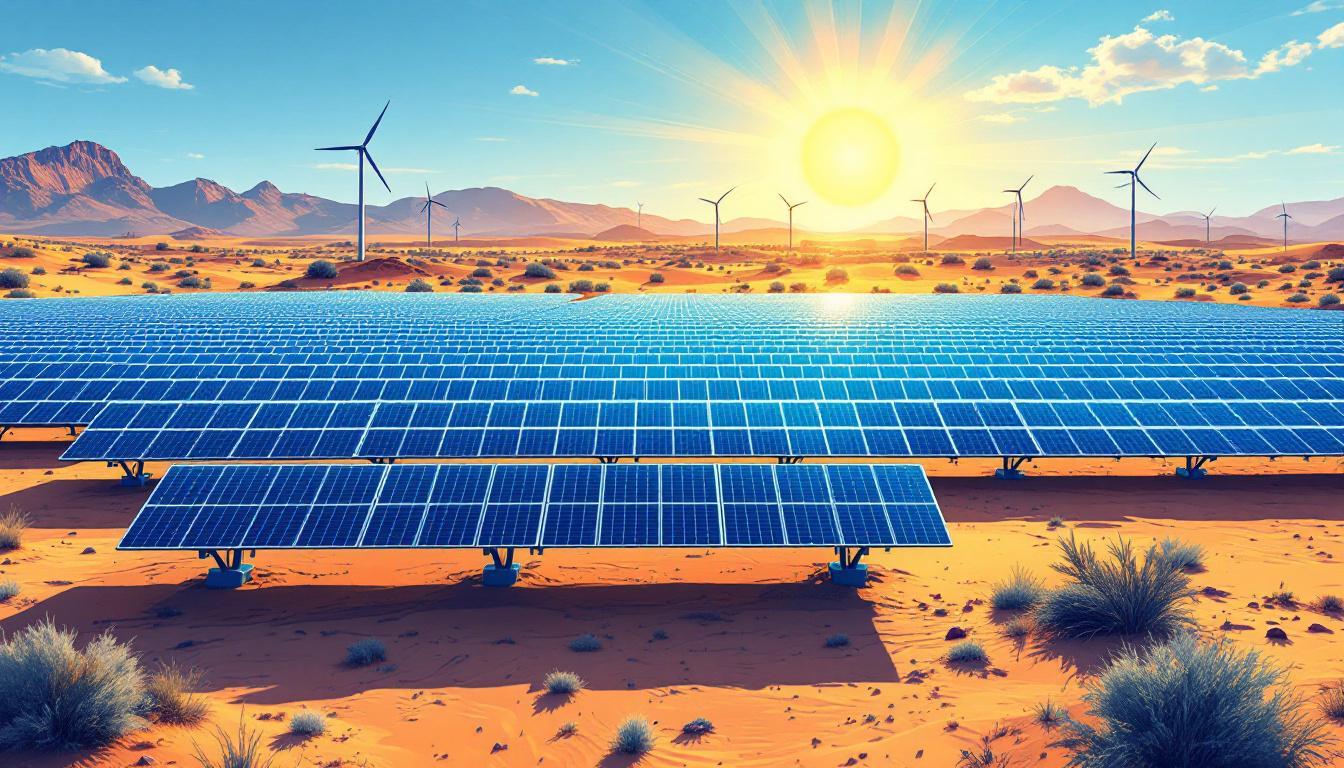
Middle East and North Africa: The renewable energy market in MENA is projected to grow at a 14.4% annual rate, reaching $59.9 billion by 2030. Key drivers include solar and wind projects in Saudi Arabia, UAE, Egypt, and Morocco, supported by major national strategies and green hydrogen ambitions.
The renewable energy market in the Middle East and North Africa (MENA) region is set for significant expansion, with projections indicating it will reach nearly $60 billion by 2030. This growth is estimated to occur at a compound annual growth rate of 14.4% between 2025 and 2030, according to a recent study from BCC Research. The report highlights emerging economies within the region, including Saudi Arabia, the United Arab Emirates (UAE), Egypt, and Morocco, as the primary drivers of this expansion. These countries are leveraging their abundant natural resources—particularly solar and wind—to push forward with government-led strategies aimed at reducing fossil fuel dependency and enhancing energy sustainability.
National initiatives such as Saudi Arabia’s Vision 2030 and the UAE’s Net Zero 2050 strategies are pivotal, promoting large-scale clean energy projects and policy reforms to stimulate investment and technological advancement. Falling technology costs, particularly in solar energy, combined with a rising electricity demand driven by population growth and industrialisation, are making renewables not only more viable but necessary. Moreover, international climate commitments and ambitions to become global exporters of green hydrogen and ammonia are injecting further impetus into the market. The region’s natural advantage in solar radiation—with MENA receiving between 22% to 26% of the world’s solar output—allows it to generate energy at a scale potentially meeting half of global electricity needs, underpinning the economic and environmental rationale for investment.
Egypt stands out within the region as a market leader, expected to reach close to $20 billion by 2030, driven by a focused political commitment and strategic developments like the Benban Solar Park, one of the world’s largest solar installations. Similarly, the UAE has emerged as a solar energy front-runner, with substantial projects like the Mohammed bin Rashid Al Maktoum Solar Park, which holds the distinction of being the world’s largest single-site concentrated solar power plant. Initiatives from emerging renewable energy startups in the MENA region are also gaining recognition, suggesting a maturing ecosystem supportive of innovation and private sector involvement.
While hydropower remains the dominant renewable source through the forecast period, solar and wind energy projects are rapidly expanding, supported by both public and private investments. The region is also witnessing an industrial transition towards decarbonisation, with increasing integration of renewable-powered manufacturing processes and the use of green hydrogen, both for domestic use and export, serving as strategic economic levers. However, it is worth noting that the study deliberately excludes relatively more developed markets like Turkey and Israel to concentrate on less developed countries where opportunities for renewable energy growth are considered higher.
External analyses affirm these findings, underscoring a solar capacity expected to exceed 180 GW by 2030, driven largely by declining costs and government support. The UAE, in particular, is highlighted for its ambitious renewable energy targets under the Dubai Clean Energy Strategy 2050 and Abu Dhabi Vision 2030. Nevertheless, challenges remain, such as the need for sustained policy frameworks, infrastructure development, and continued foreign investment flows to maintain the momentum towards meeting global climate and energy goals.
📌 Reference Map:
- Paragraph 1 – [1], [4]
- Paragraph 2 – [1], [2], [6]
- Paragraph 3 – [1], [7], [3]
- Paragraph 4 – [1], [5], [2], [4], [6]
Source: Noah Wire Services
- https://www.prnewswire.com/news-releases/mena-renewable-energy-market-to-reach-59-9-billion-by-2030–driving-a-regional-green-energy-boom–bcc-research-llc-302516460.html – Original press release. View link for all data
- https://www.globenewswire.com/news-release/2025/07/17/3117002/28124/en/Middle-East-and-North-Africa-Renewable-Energy-Industry-Report-2025-2030-Green-Hydrogen-and-Ammonia-Production-Industrial-Decarbonization-and-Renewable-Powered-Manufacturing-Fueling.html – This report analyses the renewable energy market in the Middle East and North Africa (MENA) region, focusing on emerging economies like Saudi Arabia, UAE, Egypt, and Morocco. It covers energy sources such as solar, wind, hydro, and bioenergy, and their use in residential, commercial, and utility sectors. The study explores market trends, policies, investments, and technologies driving renewable energy growth. Turkey and Israel are excluded to maintain focus on less-developed markets, helping investors, policymakers, and companies identify high-potential opportunities in the region.
- https://www.lelezard.com/en/news-21904055.html – This article discusses the projected growth of the MENA renewable energy market, estimating it will reach $59.9 billion by 2030, with a compound annual growth rate (CAGR) of 14.4%. It highlights the factors driving this growth, including abundant solar and wind resources, government initiatives like Saudi Vision 2030 and UAE Energy Strategy 2050, rising energy demand, international climate commitments, and investments in utility-scale renewable projects and green hydrogen development. The article also mentions emerging startups in the region’s renewable energy sector.
- https://menafn.com/1109858710/MENA-Renewable-Energy-Market-To-Reach-599-Billion-By-2030-Driving-A-Regional-Green-Energy-Boom-BCC-Research-LLC – This article provides an overview of the MENA renewable energy market, projected to reach $59.9 billion by 2030, with a CAGR of 14.4%. It outlines the market’s segmentation by source, end-users, and country, covering Egypt, Morocco, UAE, Jordan, Tunisia, Saudi Arabia, Oman, Algeria, and Kuwait. The article discusses market drivers such as government-led strategies, abundant natural resources, growing energy demand, energy export goals, green hydrogen and ammonia production, industrial decarbonization, and the development of utility-scale renewable energy projects.
- https://carboncredits.com/mena-solar-growth-revolutionizing-energy-by-2025/ – This article highlights the rapid growth of solar energy in the MENA region, with capacity projected to exceed 180 GW by 2030. It discusses the factors contributing to this growth, including falling solar costs, government-backed clean energy strategies, and strong partnerships with Chinese manufacturers. The UAE is identified as a leader in solar growth, with initiatives like the Dubai Clean Energy Strategy 2050 and the Abu Dhabi Vision 2030, aiming for significant renewable energy targets by 2030.
- https://www.tmcnet.com/usubmit/-mena-renewable-energy-market-reach-599-billion-2030-/2025/07/29/10230999.htm – This article discusses the MENA renewable energy market’s projected growth to $59.9 billion by 2030, with a CAGR of 14.4%. It outlines the factors driving this growth, including government-led strategies, abundant natural resources, growing energy demand, energy export goals, green hydrogen and ammonia production, industrial decarbonization, and the development of utility-scale renewable energy projects. The article also mentions the exclusion of Turkey and Israel from the study to focus on less-developed markets, aiding investors and policymakers in identifying high-potential opportunities.
- https://www.bccresearch.com/market-research/energy-and-resources/middle-east-and-north-america-renewable-energy-market.html – This page provides information about BCC Research’s market research report on the Middle East and North America renewable energy market. It includes frequently asked questions (FAQs) about the market’s projected growth rate and size, key factors driving growth, market segments covered, and the dominant source by 2030. The report also highlights Egypt’s expected dominance in the market, with a CAGR of 14.4%, reaching $19.8 billion by 2030, and discusses Egypt’s commitment to renewable energy through large-scale projects like the Benban Solar Park.
Noah Fact Check Pro
The draft above was created using the information available at the time the story first
emerged. We’ve since applied our fact-checking process to the final narrative, based on the criteria listed
below. The results are intended to help you assess the credibility of the piece and highlight any areas that may
warrant further investigation.
Freshness check
Score:
9
Notes:
The narrative is based on a recent press release from BCC Research, dated July 29, 2025, indicating high freshness. The earliest known publication date of substantially similar content is July 17, 2025, from GlobeNewswire, which also references BCC Research’s study. The report has been republished across various platforms, including MENAFN and TMCnet, suggesting wide dissemination. The presence of updated data, such as the projected market size of $59.9 billion by 2030, justifies a high freshness score. However, the recycled nature of the content across multiple outlets warrants attention.
Quotes check
Score:
8
Notes:
The narrative includes direct quotes attributed to BCC Research’s report. The earliest known usage of these quotes is in the GlobeNewswire article dated July 17, 2025. The wording of the quotes appears consistent across sources, indicating potential reuse. No significant variations in quote wording were found, suggesting the content is not exclusive.
Source reliability
Score:
7
Notes:
The narrative originates from a press release by BCC Research, a reputable market research firm. However, the press release format and its wide dissemination across various platforms, including MENAFN and TMCnet, may indicate a marketing-driven approach. The reliance on a single source for the data raises questions about the diversity of perspectives and potential biases.
Plausability check
Score:
8
Notes:
The claims regarding the MENA renewable energy market’s projected growth are plausible and align with regional trends. For instance, the Middle East Solar Industry Association (MESIA) 2025 Solar Outlook Report indicates that MENA’s solar capacity could exceed 180 GW by 2030. ([carboncredits.com](https://carboncredits.com/mena-solar-growth-revolutionizing-energy-by-2025/?utm_source=openai)) The narrative’s tone and language are consistent with industry reports, and the structure is focused on the claim without excessive or off-topic detail. However, the lack of supporting detail from other reputable outlets and the recycled nature of the content suggest a need for further scrutiny.
Overall assessment
Verdict (FAIL, OPEN, PASS): OPEN
Confidence (LOW, MEDIUM, HIGH): MEDIUM
Summary:
The narrative presents plausible claims about the MENA renewable energy market’s projected growth, supported by data from BCC Research and MESIA. However, the content’s recycled nature across multiple platforms and reliance on a single source raise concerns about originality and potential biases. The lack of supporting detail from other reputable outlets further warrants caution.


