

 1:29 am - April 4, 2026
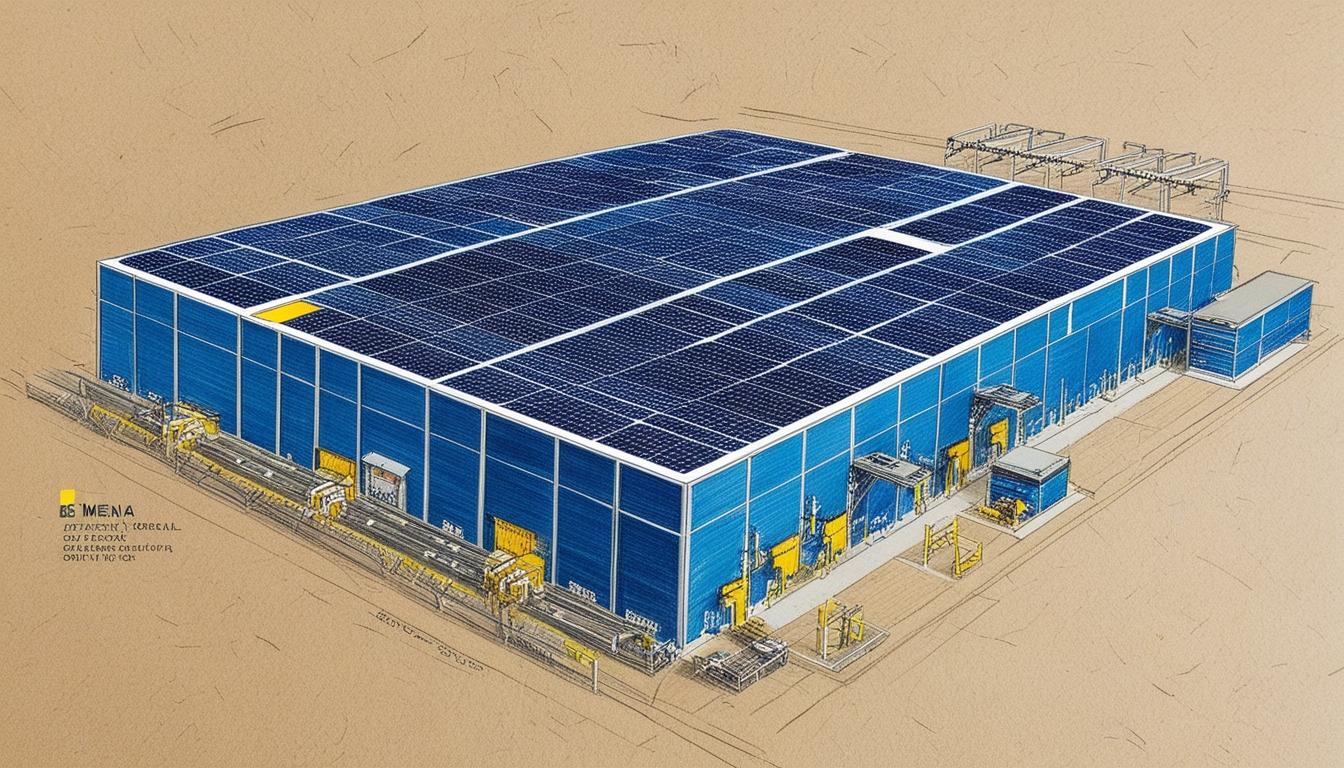
Middle East and North Africa (MENA): The region is positioned to reshape global solar manufacturing with 44 GW capacity by 2029, boosted by favourable US tariffs and strong Chinese partnerships. This surge challenges Southeast Asia’s dominance and offers a new model amid rising costs and uncertainties in the US solar market.
Solar manufacturing in the Middle East and North Africa (MENA) is on a trajectory poised to reshape global energy dynamics, with projections from Wood Mackenzie estimating that the region’s manufacturing capacity will reach an impressive 44 gigawatts (GW) by 2029. Furthermore, installations across the MENA landscape are anticipated to surpass 140 GW by the decade’s end, signalling both robust growth and a shift towards renewable energy.
At the core of this promising development is MENA’s status as a tariff haven, where a favourable 10% basic tariff on solar module imports to the US contrasts sharply with the staggering duties of up to 651% imposed on countries such as Vietnam and Malaysia. This tariff landscape has created a competitive edge for MENA producers, positioning them to serve the US market effectively and marking a pivotal shift in global solar trade flows. Yana Hryshko, senior analyst at Wood Mackenzie, referred to this advantage as a “game changer” for the region, suggesting it could effectively supplant Southeast Asia as the primary source of solar panels for the US.
The surge in MENA’s solar manufacturing capabilities is not solely a function of advantageous tariffs; it is underpinned by strategic partnerships with Chinese firms, which are expected to dominate over 85% of the region’s solar module manufacturing capacity by 2028. This partnership approach is strategic, anchoring the region as a significant production base for Chinese firms outside Asia. While local content requirements further fuel this growth, they also hint at a landscape of self-sufficiency as Wood Mackenzie forecasts that MENA’s module production will achieve independence by 2026.

In stark contrast to strategies seen in the United States, India, and Southeast Asia—where approaches can often be fragmented—MENA’s model is characterised by a vertically integrated system and a long-term growth perspective. This focus is bolstered by strong governmental support geared towards the deployment of advanced technologies, rather than short-term profit maximisation. Hryshko articulated that MENA is not merely catching up to its global counterparts; it is establishing a new standard for integrated solar manufacturing that could influence energy policies well beyond its borders.
This emerging solar landscape comes amidst turbulent conditions for the US solar industry, which is grappling with rising import costs due to newly imposed tariffs. Reports indicate that these broad protections are likely to inflate utility-scale solar project costs by approximately 30%, pushing projected installations down from 35–40 GW to between 20–25 GW in 2025, a considerable downturn for a market recently poised for expansion.
However, it is essential to note that the US is also experiencing a renaissance in low-carbon energy manufacturing, with Wood Mackenzie reporting a quadrupling of US module manufacturing capacity since late 2022, attributed to newly enacted tariffs and tax incentives under the Inflation Reduction Act (IRA). Yet, the pathway to fulfilling ambitious growth targets remains fraught with challenges; experts anticipate that only a fraction of projected domestic manufacturing capacity—45% for modules and a mere 5% for wafers—will be realised.
As the debate around solar manufacturing intensifies, it becomes increasingly clear that the strategies adopted by MENA could provide valuable insights for other regions struggling to balance local manufacturing ambitions with global competitiveness. The transition towards a solar-driven economy in MENA marks not merely a regional evolution but a potential global paradigm shift, reinforcing the idea that the future of energy relies on innovative approaches to manufacturing, robust partnerships, and strategic positioning in a competitive global market.
As MENA continues to expand its solar footprint, the implications for global energy trade and policy will undoubtedly evolve, setting the stage for a significant pivot away from fossil fuel reliance towards sustainable energy solutions.
Reference Map
- Paragraph 1: Source [1], [2]
- Paragraph 2: Source [1], [3]
- Paragraph 3: Source [1]
- Paragraph 4: Source [1], [4], [6]
- Paragraph 5: Source [1], [5], [7]
- Paragraph 6: Source [1], [5]
Source: Noah Wire Services
- https://www.pv-magazine.com/2025/05/13/middle-east-north-africa-solar-manufacturing-capacity-to-reach-44-gw-by-2029-says-woodmac/ – Please view link – unable to able to access data
- https://www.pv-magazine.com/2025/05/13/middle-east-north-africa-solar-manufacturing-capacity-to-reach-44-gw-by-2029-says-woodmac/ – An article from PV Magazine reports that Wood Mackenzie forecasts the Middle East and North Africa (MENA) region’s solar manufacturing capacity will reach 44 GW by 2029, with installations exceeding 140 GW by the end of the decade. The region is emerging as a tariff haven for solar manufacturing, offering a 10% basic tariff on solar modules imported to the US, compared to duties up to 651% elsewhere. Yana Hryshko of Wood Mackenzie describes this tariff advantage as a ‘game changer’ for MENA, positioning it to offer the most cost-competitive solar modules for the US market.
- https://www.reuters.com/business/energy/roaring-us-solar-market-hit-by-higher-import-costs-2024-12-05/ – Reuters reports that the US solar market is facing higher import costs due to new tariffs and duties. The Commerce Department set preliminary anti-dumping rates ranging from 53.3% to 271.28% for imports from Vietnam, Cambodia, Thailand, and Malaysia. These measures are expected to increase the cost of utility-scale solar projects by around 30%, potentially lowering US solar installations to 20 to 25 GW in 2025, compared to 35 to 40 GW under no tariff action.
- https://www.woodmac.com/blogs/energy-pulse/us-low-carbon-energy-manufacturing-booms/ – Wood Mackenzie discusses the surge in US low-carbon energy manufacturing, highlighting that US module manufacturing capacity has quadrupled in less than two years, rising from about 9 GW per year at the end of 2022 to more than 30 GW per year by mid-2024. The article attributes this growth to tariffs and tax credits, noting that the US is in a period of clean energy manufacturing renaissance, though challenges remain due to global competition and policy uncertainties.
- https://www.forbes.com/sites/woodmackenzie/2024/05/30/is-the-ira-paying-off-for-the-us-solar-supply-chain/ – Forbes reports that the Inflation Reduction Act (IRA) has led to a massive increase in investments for the US solar supply chain. Wood Mackenzie tracks 144 GW of announced module manufacturing capacity, 71 GW of cell manufacturing capacity, and 61 GW of wafer manufacturing capacity by 2027. However, Wood Mackenzie predicts that only about 45% of module capacity, 25% of cell capacity, and 5% of wafer capacity will come to fruition, indicating challenges in meeting the projected growth.
- https://www.pv-tech.org/meeting-us-solar-needs-with-domestic-equipment-will-be-challenging-woodmac-details-iras-impact-on-manufacturers/ – PV Tech reports on Wood Mackenzie’s analysis of the IRA’s impact on US solar manufacturers. The article highlights that US manufacturing costs can be as much as 32% higher than imports, and sourcing module components domestically would raise the overall cost of domestic panels by an additional 17%. Despite the rapid growth in domestic manufacturing capacity, it is unlikely to meet the current demand, with module expansion plans totaling 45 GW of supply, while upstream cell, wafer, and ingot capacity is less established.
- https://taiyangnews.info/business/protectionism-to-create-expensive-us-solar-supply-chain – TaiyangNews discusses how protectionist trade actions are likely to lead to an expensive US solar supply chain. Factors contributing to higher costs include high labor costs driven by apprenticeship and diversity requirements, local hiring, shorter work shifts, and higher staff turnover in the US compared to other countries. Additionally, the US is far from achieving the economies of scale enjoyed by leading solar manufacturing regions, which could further increase costs for US-made solar equipment.
Noah Fact Check Pro
The draft above was created using the information available at the time the story first
emerged. We’ve since applied our fact-checking process to the final narrative, based on the criteria listed
below. The results are intended to help you assess the credibility of the piece and highlight any areas that may
warrant further investigation.
Freshness check
Score:
9
Notes:
The content is recent, discussing projections up to 2029 and referencing current market conditions and policies like the Inflation Reduction Act. There are no apparent indications of outdated information or recycled news.
Quotes check
Score:
8
Notes:
The quote from Yana Hryshko, a senior analyst at Wood Mackenzie, is specific and not easily verifiable online without additional context. However, the lack of earlier references suggests it may be original or context-specific.
Source reliability
Score:
8
Notes:
The narrative originates from PV Magazine, which is a well-known publication in the solar industry. While it is considered reliable, specific claims should be verified against other credible sources for full accuracy.
Plausability check
Score:
8
Notes:
The claims are plausible given the context of global solar market trends and the strategic advantages of MENA. The narrative highlights a shift towards sustainable energy, which is a likely global trend.
Overall assessment
Verdict (FAIL, OPEN, PASS): PASS
Confidence (LOW, MEDIUM, HIGH): HIGH
Summary:
The narrative is timely and likely based on current market conditions. The source is reliable, and the claims align with global trends in the solar industry. However, specific projections and quotes should be verified further for absolute accuracy.

