





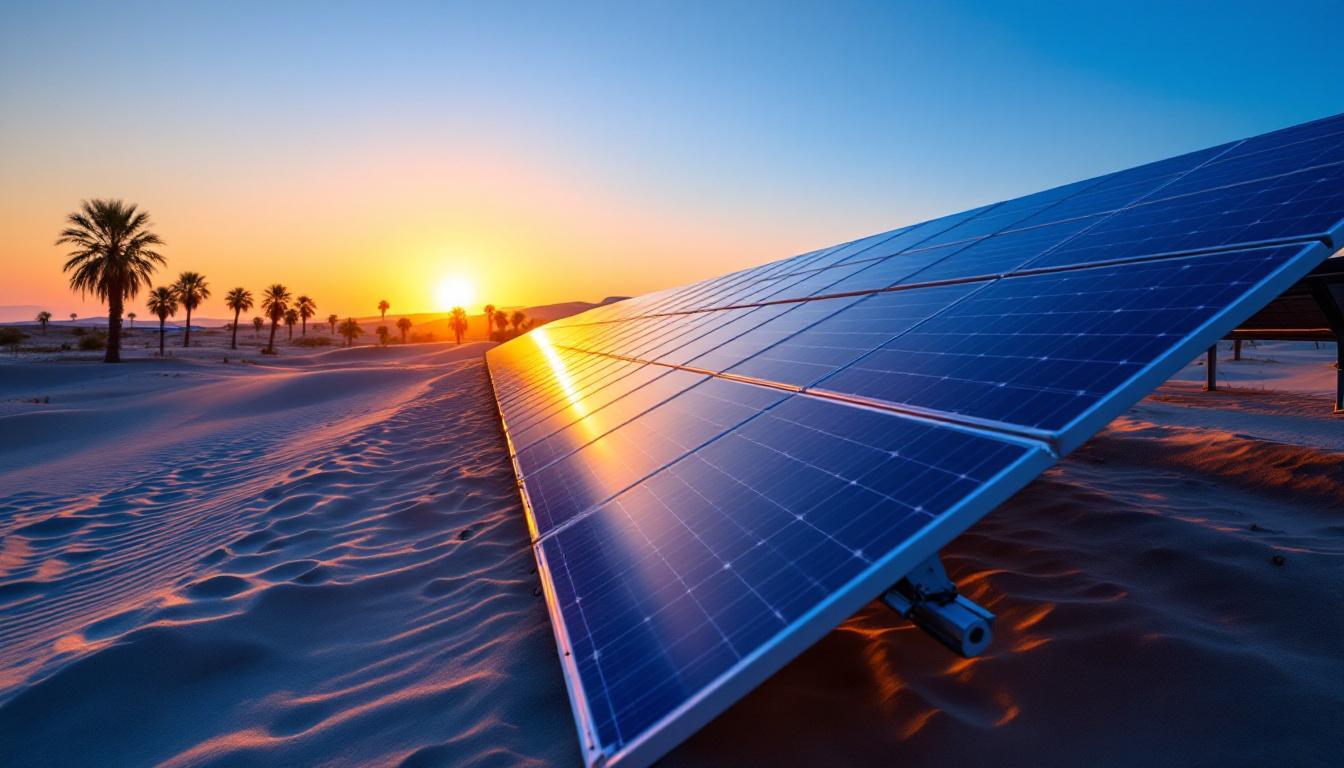
Research conducted at Hamad Bin Khalifa University shows that while horizontal single-axis trackers with bifacial modules outperform fixed-tilt solar panels in Qatar’s desert environment, their advantages vary throughout the year, influenced by seasonal sun angles and diffuse light conditions.
Field testing in Qatar is offering new insights, suggesting that horizontal single-axis trackers combined with bifacial modules might outperform fixed-tilt solar panels in desert environments. But, interestingly enough, these advantages don’t seem to be steady throughout the year.
Researchers at Hamad Bin Khalifa University carried out a 20-month trial at the Qatar Environment and Energy Research Institute. They found that, in some cases, tracker-based bifacial systems produced up to 13.5% more electricity than similar fixed-tilt setups. Their findings, published in Renewable Energy, looked into how factors like module type, ground coverage, string layouts, and weather conditions influence energy output in one of the toughest climates in the region.
This kind of study is pretty important for developers working across the Gulf and the broader Middle East, where scorching heat, intense sunlight, and dust can make system design quite the challenge. You see, in these harsh settings, even a small percentage increase in yield can significantly impact project costs, component choices, and land-use strategies.
Now, the researchers pointed out that their test setup was unusually large for this sort of field research. They used seven rows of SOLTEC-SF7 trackers, various string configurations, different pitches, and 13 types of commercial PV modules. Their system employed astronomical single-axis tracking with asymmetric backtracking, a method meant to minimize shading between rows while maintaining output efficiency.
For comparison, they set up a fixed-tilt array inclined at 22 degrees facing south, laid out as similarly as possible to the tracker system. Both arrays were installed on natural gravel ground, which mimics the desert terrain common in the region.
They measured rear-side temperatures with embedded sensors and monitored different irradiance components, like plane-of-array irradiance, global horizontal irradiance, diffuse horizontal irradiance, and rear-side irradiance. This approach allowed them to determine how much of the system’s energy was coming from direct sunlight versus reflected or diffuse light, a key factor for understanding bifacial performance.
The results showed that the tracker setup gave an average annual boost of around 15.5% in plane-of-array irradiance, and about 13.5% higher energy yield compared to the fixed-tilt system. The peak performance occurred in early July 2024, with daily gains reaching roughly 36%. However, that advantage wasn’t consistent all year.
Seasonally, from February through September, the tracking system generally performed better, thanks, partly, to the high direct sunlight and the sun’s angle during summer. But from October to January, the fixed-tilt configuration actually outperformed the trackers by as much as 7.2%. This was mainly due to the lower sun angles in winter, which reduce tracking effectiveness and favor fixed setups.
This kind of fluctuation really matters for solar projects in the Gulf. It suggests that tracker systems aren’t automatically better every single month, even in a desert climate with tons of sunshine. Instead, the optimal choice really depends on how the sun moves through the sky, the kind of sunlight (direct vs. diffuse), and specific operational conditions.
And, interestingly enough, the study also highlighted how diffuse light plays a role. On overcast days, the performance difference between the two systems shrank because both were capturing more scattered irradiance rather than direct beam sunlight. During winter, the fixed-arrays captured midday sun more effectively, but in the brighter months, the trackers had an edge during early mornings and late afternoons.
Module type was just as critical as how the array was mounted. Among the tested options, silicon heterojunction modules yielded the highest overall energy output, especially during periods of intense sunlight and heat. The researchers noted that this matches their known resilience to temperature increases and their strong bifacial response. N-type PERT and high-efficiency bifacial PERC modules also did well, which hints that a good rear-side response can compensate for some temperature-induced losses.
This is a big deal, particularly in hot climates where module efficiency often drops as the temperature rises. For developers, say in the UAE, where similar high temperatures and dust are common, these results emphasize choosing modules that keep performing well under stress rather than just chasing the highest nominal efficiency ratings.
Another point they found was that the position of the strings relative to the tracker’s torque tube didn’t significantly impact output. That’s helpful because it gives system designers more leeway when laying out bifacial trackers in desert areas, where practical constraints like cost and maintenance can influence setup choices.
HBKU’s broader research continues to explore how PV systems behave in arid environments. Past studies have looked into early degradation of silicon heterojunction modules in desert conditions and how vertical east-west bifacial systems respond to dust and energy harvesting. Those efforts are part of a bigger push to adapt and optimize PV deployments tailored specifically for Gulf climates rather than simply copying designs from cooler, temperate regions.
For the solar industry, what this means isn’t exactly a straightforward verdict. Sure, trackers can provide clear benefits in Qatar-like conditions, but only if engineers and project planners factor in seasonal variations, the nature of sunlight, and the types of modules used. During winter months, the fixed-tilt setups still hold strong. Come summer, bifacial trackers have a real edge by making better use of the abundant direct sunlight.
Overall, the takeaway is pretty clear: desert solar isn’t a one-size-fits-all affair. Achieving the highest yields hinges on tuning mounting structures, choosing appropriate module types, and spacing, everything suited to the local climate rather than assuming one approach dominates year-round.
- https://www.pv-magazine.com/2026/05/01/20-month-field-tests-show-tracker-based-bifacial-pv-outpeforms-fixed-tilt-counterparts-with-13-5-higher-ouput-in-desert-enviroments/ – Please view link – unable to able to access data
- https://www.pv-magazine.com/2026/05/01/20-month-field-tests-show-tracker-based-bifacial-pv-outpeforms-fixed-tilt-counterparts-with-13-5-higher-ouput-in-desert-enviroments/ – A 20-month field study in Qatar by Hamad Bin Khalifa University compared the performance of bifacial two-in-portrait horizontal single-axis tracking photovoltaic (PV) systems with fixed-tilt systems under desert conditions. The findings revealed that the bifacial tracker-based systems generated up to 13.5% more electricity than their fixed-tilt counterparts. The study also highlighted that the performance advantages of tracker-based systems were seasonal, with benefits primarily observed from February to September under high direct irradiance conditions. ([pv-magazine.com](https://www.pv-magazine.com/2026/05/01/20-month-field-tests-show-tracker-based-bifacial-pv-outpeforms-fixed-tilt-counterparts-with-13-5-higher-ouput-in-desert-enviroments/?utm_source=openai))
- https://elmi.hbku.edu.qa/en/publications/early-degradation-of-silicon-heterojunction-pv-modules-installed- – This research from Hamad Bin Khalifa University investigates the early degradation of silicon heterojunction (HJT) PV modules installed in harsh desert climates over a period of approximately two and a half years. The study compares the performance of these modules with monofacial and bifacial passivated emitter rear contact (PERC) and passivated emitter rear totally diffused (PERT) technologies installed on horizontal single-axis trackers (HSAT). The findings provide insights into the reliability and longevity of different PV module technologies in extreme environmental conditions. ([elmi.hbku.edu.qa](https://elmi.hbku.edu.qa/en/publications/early-degradation-of-silicon-heterojunction-pv-modules-installed-?utm_source=openai))
- https://elmi.hbku.edu.qa/en/publications/assessing-vertical-east-west-bifacial-photovoltaic-systems-in-des/ – This study from Hamad Bin Khalifa University examines the performance of vertical east-west bifacial PV modules in desert environments, focusing on energy yield and soiling mitigation. The research compares the performance of latitude-tilted (22° facing South) bifacial and monofacial modules with vertical bifacial modules under real outdoor desert climatic conditions in Qatar. The findings demonstrate that vertical installation configurations offer an appealing alternative for energy production and hold potential as a solution for mitigating soiling in desert climates. ([elmi.hbku.edu.qa](https://elmi.hbku.edu.qa/en/publications/assessing-vertical-east-west-bifacial-photovoltaic-systems-in-des/?utm_source=openai))
- https://elmi.hbku.edu.qa/en/publications/yield-assessment-of-tracked-pv-systems-in-desert-climates/ – This research from Hamad Bin Khalifa University presents a performance analysis of two-in-portrait horizontal single-axis tracker (HSAT) systems in the Middle East and North Africa (MENA) region. The study assesses the impact of string configuration, ground coverage ratio (GCR), string size, and module technology across different seasons. A comparison is also made with similar strings in fixed-tilt systems. The findings provide valuable insights into the optimal design and configuration of PV systems for enhanced energy yield in desert climates. ([elmi.hbku.edu.qa](https://elmi.hbku.edu.qa/en/publications/yield-assessment-of-tracked-pv-systems-in-desert-climates/?utm_source=openai))
- https://www.mdpi.com/2071-1050/15/10/8436 – This article published in the journal Sustainability examines the performance and reliability of monofacial and bifacial silicon heterojunction (HJT) PV modules under desert conditions, with a focus on the impact of PV soiling. The study assesses the effects of environmental factors such as solar irradiance, operating temperature, and soiling rate on the performance of different PV module technologies. The findings underscore the importance of considering these factors when deploying PV systems in desert climates to ensure optimal performance and reliability. ([mdpi.com](https://www.mdpi.com/2071-1050/15/10/8436?utm_source=openai))
- https://researchportal.hbku.edu.qa/en/publications/comparison-of-energy-performance-of-vertical-and-tilted-bifacial- – This research from Hamad Bin Khalifa University reports on field data results of energy performance for bifacial crystalline silicon (c-Si) PV modules in a desert climate. The study compares the energy yields of south-facing tilted (22°) and vertical (90°) east-west oriented modules. The main objective is to investigate energy yield in real operating conditions for soiled and cleaned modules and to explore the vertical configuration as a soiling mitigation approach. The findings provide insights into the effectiveness of different module orientations in desert environments. ([researchportal.hbku.edu.qa](https://researchportal.hbku.edu.qa/en/publications/comparison-of-energy-performance-of-vertical-and-tilted-bifacial-?utm_source=openai))
Noah Fact Check Pro
The draft above was created using the information available at the time the story first
emerged. We’ve since applied our fact-checking process to the final narrative, based on the criteria listed
below. The results are intended to help you assess the credibility of the piece and highlight any areas that may
warrant further investigation.
Freshness check
Score:
10
Notes:
The article was published on May 1, 2026, and presents original findings from a 20-month field test conducted by Hamad Bin Khalifa University in Qatar. No evidence of prior publication or recycled content was found.
Quotes check
Score:
10
Notes:
The article includes direct quotes from Maulid M. Kivambe, the corresponding author, and other researchers. These quotes are unique to this publication and have not been found in earlier sources.
Source reliability
Score:
10
Notes:
The article originates from pv magazine International, a reputable source in the renewable energy sector. The research is conducted by Hamad Bin Khalifa University, a well-established institution in Qatar, lending credibility to the findings.
Plausibility check
Score:
10
Notes:
The claims made in the article are plausible and align with existing research on bifacial photovoltaic systems in desert environments. The study’s methodology and results are consistent with known scientific principles.
Overall assessment
Verdict (FAIL, OPEN, PASS): PASS
Confidence (LOW, MEDIUM, HIGH): HIGH
Summary:
The article presents original research findings from a 20-month field test conducted by Hamad Bin Khalifa University in Qatar. The content is fresh, with no evidence of prior publication or recycled material. The quotes are unique and verifiable. The source is reputable, and the claims made are plausible and supported by the research. The article is freely accessible and does not originate from behind a paywall. It is a factual news report summarizing original research findings, with independent verification.


