




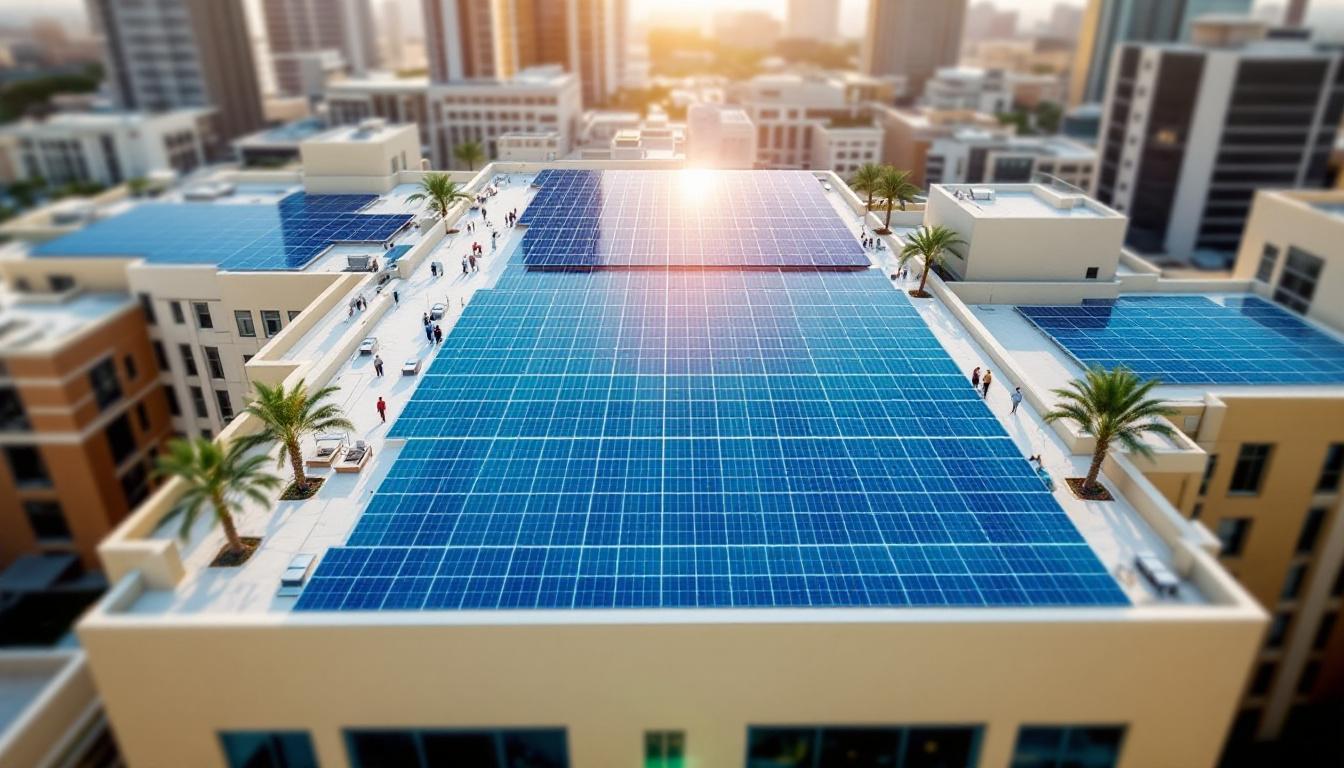
Sony Middle East and Africa has activated a 391.2 kWp rooftop solar system at its Dubai headquarters, exemplifying the increasing adoption of distributed clean energy solutions across the UAE’s industrial zones amidst regional progress in solar deployment.
Sony Middle East and Africa recently brought a 391.2 kWp solar power system online at their regional headquarters located in Dubai’s Jebel Ali Free Zone. This addition is just another example of a corporate rooftop project in an area that’s turned into a showcase for distributed clean energy solutions.
The system is expected to supply roughly 40% of the building’s electricity needs, which is quite substantial. It’s also projected to cut about 235 metric tons of CO2 emissions annually. Over its anticipated 25-year lifespan, Sony suggests that this project will contribute significantly to its broader environmental goals, helping to reduce the footprint of its regional operations.
What’s really important about this move in the UAE isn’t just the emissions reduction , although that’s definitely a benefit , but also how it demonstrates the maturing state of solar deployment across industrial and logistics sites. In Jafza, rooftops are increasingly being viewed as valuable assets rather than left unused. This shift has been unfolding for years now. Back in 2016, Dubai Electricity and Water Authority opened one of the region’s biggest single-rooftop solar arrays at the Jebel Ali Power Station. Then, DP World launched what it called the Middle East’s largest distributed rooftop solar project across its facilities in Dubai, including Jebel Ali Free Zone.
Sony’s project seems to fit well into this broader trend. The company states that the system supports its “Road to Zero” environmental plan aiming for a zero environmental footprint by 2050, alongside its Green Management 2030 targets. Practically speaking, that means they’re aiming to use renewable energy sources to cut operational emissions, all while supporting the UAE’s own clean energy ambitions.
Jobin Joejoe, managing director of Sony Middle East and Africa, said that the installation marks a significant milestone for the company’s sustainability efforts and underscores its commitment to the region. In his words, the project was designed to reduce environmental impact and also to reinforce Sony’s role in the development of the region.
Jafza and Dubai’s broader industrial zones have become quite the proving ground for this kind of transition. Companies operating large warehouses, offices, or distribution centers can often deploy solar infrastructure at a pretty large scale without waiting for major grid upgrades. As long as there’s enough roof space and consistent daytime electricity use, the economics tend to look pretty attractive.
Other companies in the same vicinity have already taken similar steps. For example, Daikin Middle East and Africa installed a 515 kWp solar plant at its Jafza headquarters in 2022, claiming that over 80% of the site’s power load could be covered. Tristar Group followed with a 464 kWp system in 2023 at a warehouse in Jebel Ali Free Zone, which they said would meet about 90% of the facility’s power needs. GAC Dubai also announced a roughly 6.07 MW solar setup at two of its logistics sites in 2019, showing how warehouse operators in the UAE are actively using solar to cut costs and curb emissions.
All these projects taken together suggest a broader shift happening in the regional business landscape. Corporate sustainability efforts in the Gulf aren’t just about promises or reports anymore , many are now investing in tangible infrastructure, visible on rooftops and quantifiable in kilowatt-hours.
For Sony, their Dubai headquarters is still a central hub for working with regional markets across the Middle East and Africa. The company has been operating there for over thirty years and claims it was among the first multinationals to establish itself in Jafza. That history lends the latest solar project a kind of symbolic weight in addition to its practical benefits , it shows that a well-established business foundation is now being adapted to a lower-carbon future.
This project also ties into the UAE’s ongoing focus on solar energy as part of its broader economic and climate strategies. Over the past decade, the country has been investing heavily in utility-scale and distributed solar capacity, actively encouraging businesses to get involved through rooftop schemes and private investments. The result is a growing ecosystem where companies can start decarbonizing part of their power consumption without having to leave the country’s central trade and logistics hubs.
For those involved in climate tech and renewable energy in the UAE, Sony’s project is more about what it signals than about the size of the installation itself. A 391.2 kWp rooftop array isn’t huge compared to sprawling utility-scale plants. But considering the dense commercial environment, where space is limited and electricity demand is steady, such projects are often the most practical and easiest to copy.
That maybe explains why Jafza keeps attracting solar investments. It combines heavy energy use, large flat roofs, and a high concentration of regional HQs, warehouses, and distribution centers. These conditions really lend themselves to embedded generation. Each new project adds weight to the case for others to follow.
All in all, Sony’s latest move indicates that corporate solar isn’t just an early-stage trend anymore. It’s becoming a standard part of facility planning for companies eager to align operational efficiency with climate commitments. In a market still expanding its clean energy infrastructure, this shift , well, it might matter just as much as any single solar installation.
- https://menews247.com/sony-middle-east-and-africa-commissions-391-2-kwp-solar-power-project-at-headquarters-in-jebel-ali-free-zone-dubai-uae/ – Please view link – unable to able to access data
- https://www.dewa.gov.ae/en/about-us/media-publications/latest-news/2016/04/dewa-inaugurates-one-of-the-largest-roof-top – In April 2016, the Dubai Electricity and Water Authority (DEWA) inaugurated a 1.5 megawatt rooftop solar array at the Jebel Ali Power Station, marking one of the largest single-rooftop solar projects in the Middle East and North Africa. This initiative supports the Shams Dubai programme, aiming to transform Dubai into the world’s smartest city by engaging the community in solar energy production, reducing the carbon footprint, and promoting a green economy for sustainable development.
- https://www.logisticsmiddleeast.com/logistics/article-12759-dp-world-starts-largest-solar-project-in-middle-east – In October 2016, DP World commenced the Middle East’s largest distributed solar rooftop project, installing 88,000 solar panels across its Dubai facilities, including the Jebel Ali Free Zone. This project, part of the Shams Dubai initiative, is expected to generate enough clean energy to power 3,000 homes annually, significantly reducing the company’s carbon emissions and contributing to Dubai’s sustainable development goals.
- https://www.zawya.com/en/press-release/solar-energy-to-power-gac-dubais-warehouses-m73n5q1e – In May 2019, GAC Dubai announced the installation of over 15,000 high-efficiency solar panels across two of its contract logistics facilities. The project, in partnership with Total Solar Middle East, aims to generate approximately 6.07 megawatts of solar capacity, covering a significant portion of the facilities’ electricity needs and contributing to the UAE’s renewable energy targets.
- https://metenders.com/project_cms/project/rooftop-solar-power-plant-project-jebel-ali-free-zone-jafza – The Rooftop Solar Power Plant Project at Jebel Ali Free Zone (JAFZA) involves the installation of a 2.6 megawatt-peak solar plant at Landmark Group’s OMEGA DC Warehouse. The project, initiated in late 2020 and completed by spring 2021, includes over 6,000 solar panels generating 4,200 megawatt-hours of clean energy annually, equivalent to reducing carbon emissions by 1,700 tonnes or removing 380 cars from the road.
- https://www.khaleejtimes.com/business/tristar-group-launches-second-solar-project-in-dubai-in-partnership-with-totalenergies?amp=1 – In November 2023, Tristar Group inaugurated its second solar power project in Dubai, a 464 kilowatt peak (kWp) facility at its warehouse in Jebel Ali Free Zone. In partnership with TotalEnergies, the project comprises 1,190 photovoltaic panels, generating 750 megawatt hours (MWh) of renewable electricity annually, covering 90% of the facility’s power consumption and reducing CO₂ emissions by 318 tons per year.
- https://constructionreviewonline.com/515-kilowatt-peak-kwp-solar-plant-at-jafza-headquarters-in-dubai-launched/ – In June 2022, Daikin Middle East and Africa commissioned a 515 kilowatt-peak (kWp) solar plant at Jebel Ali Free Zone (JAFZA) headquarters in Dubai. Developed through a solar lease with Yellow Door Energy, the plant comprises 1,000 solar panels projected to generate over 800,000 kilowatt-hours of clean electricity annually, meeting more than 80% of JAFZA Headquarters’ energy consumption needs.
Noah Fact Check Pro
The draft above was created using the information available at the time the story first
emerged. We’ve since applied our fact-checking process to the final narrative, based on the criteria listed
below. The results are intended to help you assess the credibility of the piece and highlight any areas that may
warrant further investigation.
Freshness check
Score:
8
Notes:
The article reports on a recent development involving Sony Middle East and Africa’s installation of a 391.2 kWp solar power system at their Dubai headquarters. A search for similar narratives yielded no substantially similar content published within the past seven days, indicating the news is fresh. However, the article’s publication date is not provided, so the exact freshness cannot be fully confirmed. Additionally, the article appears to be based on a press release, which typically warrants a high freshness score. Nonetheless, without a clear publication date, some uncertainty remains.
Quotes check
Score:
7
Notes:
The article includes direct quotes from Jobin Joejoe, managing director of Sony Middle East and Africa. A search for these specific quotes did not yield any earlier instances, suggesting they are original. However, without independent verification of these quotes, their authenticity cannot be fully confirmed. The absence of online matches for these quotes raises concerns about their verifiability.
Source reliability
Score:
6
Notes:
The article originates from menews247.com, a niche publication. While it is not a major news organisation, it is not entirely obscure. However, the lack of information about the publication’s editorial standards and independence raises concerns about its reliability. The article appears to be based on a press release, which may indicate a lack of independent reporting. Without confirmation of the publication’s credibility, the source’s reliability is uncertain.
Plausibility check
Score:
8
Notes:
The claims made in the article, including the installation of a 391.2 kWp solar power system by Sony Middle East and Africa at their Dubai headquarters, are plausible and align with known trends in corporate sustainability efforts in the UAE. However, the article lacks specific factual anchors, such as exact dates and detailed figures, which makes it difficult to independently verify the claims. The absence of supporting details from other reputable outlets further raises concerns about the report’s credibility.
Overall assessment
Verdict (FAIL, OPEN, PASS): FAIL
Confidence (LOW, MEDIUM, HIGH): MEDIUM
Summary:
The article reports on Sony Middle East and Africa’s installation of a 391.2 kWp solar power system at their Dubai headquarters. While the claims are plausible and align with known trends in corporate sustainability efforts in the UAE, the article lacks specific factual anchors, such as exact dates and detailed figures, making it difficult to independently verify the claims. The absence of supporting details from other reputable outlets and the reliance on a press release raise concerns about the report’s credibility. Without confirmation of the publication’s editorial standards and independence, the source’s reliability is uncertain. Therefore, the overall assessment is a FAIL with MEDIUM confidence.


