





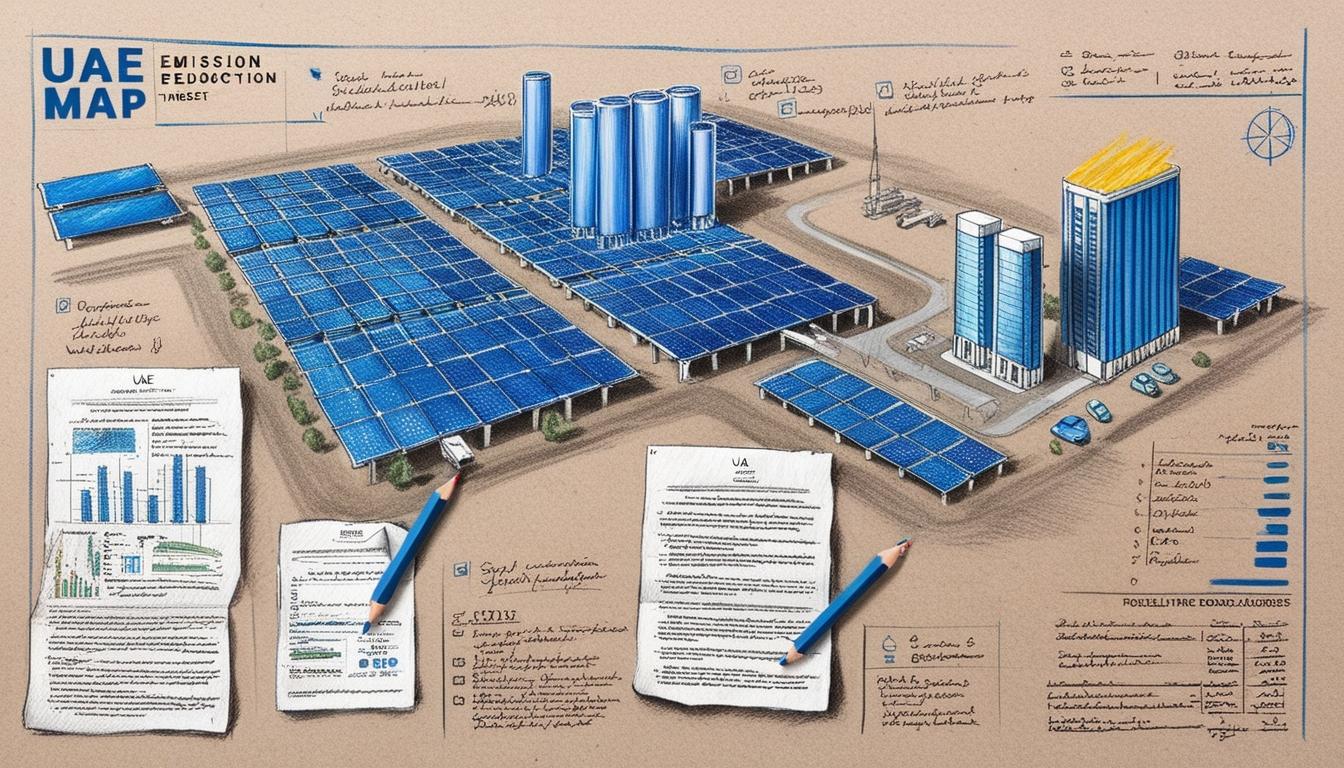
In a landmark move for the Middle East, the United Arab Emirates (UAE) has officially enacted a federal legislative framework aimed at combatting climate change, positioning itself as the first country in the region to implement such binding legislation. This new law, which came into effect today, mandates all institutions and companies in the UAE to measure and work towards reducing their greenhouse gas emissions while integrating comprehensive plans to adapt to the repercussions of climate change across various sectors.
The legislation, adopted nine months prior, is seen as a pivotal development that aligns with the UAE’s ambition to become a leader in environmental stewardship and climate action. Notably, environmental organisation Greenpeace has highlighted this initiative as a “qualitative shift” in regional environmental policies. The company’s commitment to achieving tangible reductions in carbon emissions marks a significant step forward in its broader climate strategy.
This legislative framework complements the UAE’s ongoing efforts to enhance sustainability, which include notable investments in renewable energy projects such as the solar facilities “Shams” and “Noor,” as well as a commitment to nuclear energy. Alongside these initiatives, the UAE is supporting the evolution of a clean transport sector through incentives for electric vehicles and the development of low-emission infrastructure. Additionally, there is a strong emphasis on adopting sustainable building practices alongside community initiatives like the promotion of biodegradable products.
Further reinforcing the UAE’s climate action agenda is its ambitious Net Zero 2050 Strategy, which aims to achieve net-zero emissions by the year 2050. This strategy not only proposes extensive legislative mandates but also focuses on the economic ascent that can accompany a transition to greener practices. It is projected that this strategy will generate approximately 200,000 new jobs across various sectors, such as solar energy, battery technology, and hydrogen production. Moreover, it promises to contribute roughly 3% to the nation’s GDP through the facilitation of over 25 programmes designed to enhance efficiency across key sectors, including power, industry, and agriculture.
At the core of the UAE’s policy direction is a commitment to cutting emissions significantly over the coming decades, with clear targets of an 18% reduction by 2030, reaching 60% by 2040, and ultimately achieving a full 100% reduction by 2050, all compared to 2019 emission levels. This ambitious approach demonstrates a commitment to both climate goals and economic diversification, positioning the UAE as a model for others in the region grappling with similar environmental challenges.
The onus now lies in the comprehensive execution of these strategies, which highlight not only a significant legislative shift but also the necessity of cooperation among governmental, private, and public sectors. As echoed at the recent COP28 conference in Dubai, the UAE’s proactive stance serves as an essential framework for addressing climate issues within a scientific and systematic approach. The diverse initiatives mentioned, coupled with a detailed national action plan, signify a decisive commitment to implementing effective solutions for climate resilience.
In conclusion, the UAE’s move to enact binding climate change legislation reflects a broader vision that melds economic growth with environmental accountability. The international community will closely observe how this framework unfolds and whether it inspires other nations in the region to pursue similar pathways toward sustainable development.
Reference Map:
- Paragraph 1 – [1], [6]
- Paragraph 2 – [1], [2], [5]
- Paragraph 3 – [3], [4], [7]
- Paragraph 4 – [1], [2], [6]
- Paragraph 5 – [1], [5], [4]
- Paragraph 6 – [1], [7]
Source: Noah Wire Services
- https://www.eanlibya.com/%D9%85%D9%86-%D8%A7%D9%84%D8%AA%D8%B4%D8%B1%D9%8A%D8%B9-%D8%A5%D9%84%D9%89-%D8%A7%D9%84%D8%AA%D9%86%D9%81%D9%8A%D8%B0-%D8%A7%D9%84%D8%A5%D9%85%D8%A7%D8%B1%D8%A7%D8%AA-%D8%AA%D8%B3%D8%A8%D9%82-%D8%A7/ – Please view link – unable to able to access data
- https://u.ae/en/about-the-uae/strategies-initiatives-and-awards/strategies-plans-and-visions/environment-and-energy/the-uae-net-zero-2050-strategy – The UAE’s Net Zero 2050 Strategy outlines the nation’s commitment to achieving net-zero emissions by 2050. This initiative aims to stimulate economic and societal advancement by leading the transition to net-zero emissions, contributing to global mitigation efforts. The strategy is expected to create approximately 200,000 new job opportunities across sectors such as solar, battery, and hydrogen, and is projected to contribute around 3% to the national GDP. It encompasses over 25 programmes across six key sectors: power, industry, transport, buildings, waste, and agriculture, focusing on enhancing efficiency and expanding the utilisation of renewable energy sources.
- https://u.ae/en/about-the-uae/strategies-initiatives-and-awards/strategies-plans-and-visions/environment-and-energy/uae-energy-strategy-2050 – The UAE Energy Strategy 2050 aims to triple the contribution of renewable energy and invest between AED 150 and AED 200 billion by 2030 to meet the country’s increasing energy demand. The updated strategy promotes the deployment of renewable and nuclear energies, enhances energy efficiency, drives research and development in energy technologies, increases local clean energy capacity, and encourages investments in the renewable and clean energy sector. It outlines a long-term national programme to balance meeting rising energy demand and sustaining natural resources for future generations.
- https://www.moccae.gov.ae/en/media-center/news/11/11/2022/uae-unveils-national-net-zero-by-2050-pathway-at-cop27-in-sharm-el-sheikh.aspx – At COP27 in Sharm El Sheikh, the UAE unveiled the National Net Zero by 2050 Pathway, setting a clear timeline and mechanisms for implementing the UAE Net Zero by 2050 Strategic Initiative. The pathway defines the country’s climate ambition with absolute emission reduction targets of 18% by 2030, 60% by 2040, and 100% by 2050, compared to 2019 levels. The strategy includes measures such as increasing the share of clean energy in the energy mix, expanding the use of clean electricity in various sectors, and reducing the use of fossil fuels in line with a just energy transition.
- https://www.moccae.gov.ae/en/media-center/news/16/11/2023/climate-neutrality-a-national-priority-as-uae-net-zero-2050-strategy-accelerated-following-the-announcement-at-the-uae-government-annual-meetings.aspx – Following the announcement at the UAE Government Annual Meetings, the UAE accelerated its Net Zero 2050 Strategy, outlining a detailed nationwide action plan to achieve climate neutrality by 2050. The strategy includes over 25 initiatives across six core sectors: power, industry, transport, buildings, waste, and agriculture. It sets emission reduction targets for each sector, aiming for zero emissions in power and water by 2050, and significant reductions in industry, transport, buildings, waste, and agriculture sectors. The strategy also focuses on nature-based solutions and carbon capture technologies to achieve its goals.
- https://www.hoganlovells.com/en/publications/driving-decarbonization-inside-the-uae%E2%80%99s-new-climate-change-legislation – The UAE has introduced Federal Law on the ‘Reduction of Climate Change Effects,’ set to take effect on 30 May 2025. This law is a significant step in the country’s climate change policy, aiming to achieve its Nationally Determined Contributions (NDCs) and advance its energy transition ambitions. Key provisions include setting annual emission reduction targets for all sectors, establishing a National Pathway to Climate Neutrality, and mandating the measurement, reporting, and verification of greenhouse gas emissions by the Ministry of Climate Change and Environment.
- https://www.moccae.gov.ae/en/media-center/news/16/11/2023/climate-neutrality-a-national-priority-as-uae-net-zero-2050-strategy-accelerated-following-the-announcement-at-the-uae-government-annual-meetings.aspx – The UAE’s Net Zero 2050 Strategy has been accelerated following the announcement at the UAE Government Annual Meetings, with climate neutrality now a national priority. The strategy includes over 25 initiatives across six core sectors: power, industry, transport, buildings, waste, and agriculture. It sets emission reduction targets for each sector, aiming for zero emissions in power and water by 2050, and significant reductions in industry, transport, buildings, waste, and agriculture sectors. The strategy also focuses on nature-based solutions and carbon capture technologies to achieve its goals.


