





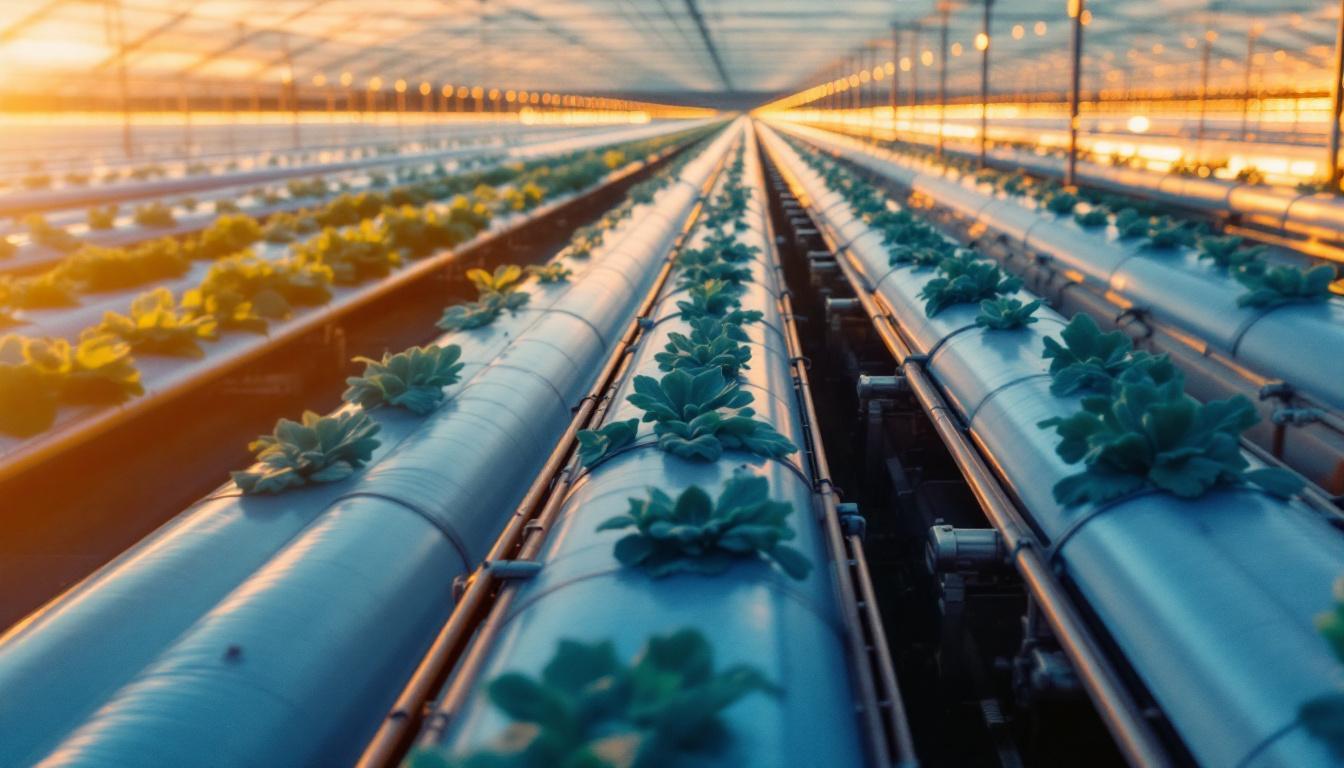
Armela Farms leads the UAE’s move towards controlled environment agriculture, leveraging automation, AI, and hydroponics to transform desert farming into a sustainable, resource-efficient industry tailored for water-scarce conditions.
The UAE’s push to boost food resilience is increasingly taking shape through farms that resemble tech campuses more than traditional fields. Armela Farms is one of the companies leading this transformation, utilizing automation, AI-driven climate control, robotics, and hydroponics to grow leafy greens tailored for desert conditions and water scarcity.
Their approach mirrors a broader national effort to expand local food production under initiatives like Make it in the Emirates. For producers, the message is straightforward: resilience isn’t going to come from expanding open-field farming in an arid climate, but rather from controlled environments that use less land, less water, and rely heavily on data.
Armela Farms emphasizes precision in its systems. In their hydroponic facilities, parameters like temperature, humidity, CO₂ levels, light, and nutrient delivery are constantly monitored and adjusted in real-time. The company claims its robotic growing system has increased annual yield per square meter by over 200% compared to typical systems, all while improving consistency. That kind of efficiency, well, at least to me, really matters in a country where food imports still dominate, and supply chains can be disrupted by delays, political tensions, or extreme weather events.
Avir Shah, who’s both the founder, CEO, and chairman of Armela Farms, frames the business as more than just a farm. During a talk at Make it in the Emirates, he described it as a form of food engineering, built on controlled environment agriculture, automation, and data analytics. The goal, he said, is not only to achieve self-sufficiency but also to support the UAE’s broader industrial diversification efforts.
That mindset is echoed on their website too. Armela Farms identifies itself as a big-scale commercial producer, packer, and distributor of water-grown lettuce and kale. They see their model as turning previously unused desert land into a high-tech, productive food facility. The focus isn’t just on volume, but also on freshness, reducing emissions, and supporting local distribution networks.
Hydroponics plays a key role in their strategy. According to the company, it enables crops to grow in a controlled environment using nutrient-rich water instead of soil. The plants are protected from unpredictable outdoor conditions and can be produced without relying heavily on chemicals that are sometimes used in traditional farming systems. They say this helps deliver cleaner, longer-lasting produce year-round.
Water, of course, is one of the biggest hurdles for any kind of agriculture in the Gulf region. Armela Farms mentions their closed-loop irrigation system recycles all the water used, cutting down waste and maintaining crop performance. Plus, hydroponic farming is claimed to use up to 80% less water compared to traditional methods, quite a claim in a region where every drop really counts, especially with governments pushing for food security alongside sustainability.
In recent years, the UAE has become more focused on ensuring steady food supply, especially as it faces challenges in import reliability. Local production offers some clear advantages here, shorter transportation routes, less vulnerability to shipping delays, and quicker access to fresh produce. It also makes matching supply with fluctuating demand much easier.
Armela Farms asserts that its systems are designed with that in mind. Being controlled and modular means they can tweak planting and harvesting schedules more swiftly than traditional open-field farms. They use climate data and predictive algorithms to estimate yields and keep production steady throughout the year. Essentially, this gives them extra flexibility when demand spikes or external supply disruptions happen.
On the sustainability front, there’s also a compelling case. Armela Farms says it recycles plant residues, turning organic waste into valuable resources instead of sending it to landfills. This aligns with the UAE’s growing interest in circular industrial models, where waste streams are minimized and resources reused more efficiently.
They’ve also partnered with Dutch technology firms. Koppert Biological Systems, for instance, mentioned supporting what they called the largest automated and data-driven vegetable farm in the UAE, a three-hectare site in Abu Dhabi designed to produce around nine million heads of lettuce each year. Koppert highlighted a growth increase of over 250% since the farm’s first harvest back in 2018.
All in all, these figures reflect a wider shift in how the UAE approaches food security. Instead of relying solely on imports or attempting to mimic wetter climate farming in the desert, the country is building an ecosystem rooted in precision agriculture, automation, and climate control. The idea is simple, produce more with fewer resources and bring food production closer to consumers.
That’s why controlled-environment agriculture is gaining traction among policymakers, investors, and industrial players alike. In a region where water scarcity and extreme heat are constant obstacles, farms capable of consistent growth, resource recycling, and reduced reliance on imports are likely to become more vital.
Armela Farms’ message is pretty clear: the future of farming in the UAE will depend heavily on technology just as much as on land. If their model keeps expanding, it could serve as a practical example of how climate-smart tech and food security can go hand in hand, even in one of the toughest environments for traditional agriculture.
- https://www.tahawultech.com/home-slide/smart-farming-powers-uaes-push-towards-food-resilience-local-output-armela-farms/ – Please view link – unable to able to access data
- https://www.tahawultech.com/home-slide/smart-farming-powers-uaes-push-towards-food-resilience-local-output-armela-farms/ – Armela Farms is leveraging automation, AI-driven climate control, robotics, and hydroponic technologies to strengthen food security, optimise water usage, and build a more resilient agricultural ecosystem aligned with the UAE’s industrial and sustainability ambitions. The UAE’s broader industrial and self-sufficiency ambitions under initiatives such as Make it in the Emirates are creating strong momentum for companies like Armela Farms, which are demonstrating how controlled-environment agriculture can reduce reliance on imports while optimising scarce resources such as water and land.
- https://www.armelafarms.com/about-us/ – Armela Farms is a large-scale commercial producer, packer, and distributor of water-grown lettuce and kale in the UAE. Their hydroponic growing technology, on-site storage, packing, and local distribution methods are redefining local food supply, committed to feeding people in cities in an environmentally positive way. Their vision is to promote food security in the UAE by bridging the gap between demand and supply, utilising unused desert land to transform it into a hi-tech, sustainable food production facility, while reducing carbon emissions and conserving water.
- https://www.armelafarms.com/hydroponics/ – Armela Farms employs hydroponic farming, a modern method of growing fresh, clean, nutritious, and long-lasting produce using nutrient-rich water. Their plants thrive in a controlled environment, shielded from unpredictable outdoor weather shifts, and operate within a controlled setting, remaining pest-free without resorting to harmful chemicals. Their closed-loop irrigation system reduces water usage by 80% compared to traditional farming methods, with excess water recycled to enhance conservation efforts and optimise productivity. This system ensures a consistent supply of high-quality crops every day of the year, regardless of weather conditions.
- https://www.awrgroup.com/agritech – Armela Farms, a pioneering venture of AWR Group, combines advanced hydroponic technology with integrated on-site storage, packaging, and distribution to deliver fresh, nutritious produce every day of the year. Their hydroponic systems use up to 80% less water than traditional farming methods, producing more yield with less waste. By recycling nutrients and controlling the growing environment, they ensure superior quality and freshness, every harvest, every season. Their commitment to sustainability and productivity demonstrates that these can thrive side by side.
- https://www.koppert.com/news-information/news/koppert-teams-up-for-first-automated-lettuce-farm-in-the-uae/ – Koppert Biological Systems, along with several leaders in the Dutch horticultural sector, is helping to build the largest automated and data-driven vegetable growing facility in the UAE. The 3-hectare farm, located in Abu Dhabi, will produce 9 million heads of lettuce per year. Armela Farms is utilising specialist technologies from top Dutch suppliers, including Van der Hoeven Horticultural Products, Hoogendoorn Growth Management, Green Production Systems, Rijk Zwaan, Patron Agri Systems, Jiffy, and Koppert Biological Systems. Their first harvest was in August 2018, and they have now achieved an increase of more than 250% in production since that date.
- https://gulfnews.com/business/how-agricultural-tech-is-advancing-the-uaes-food-security-goals-1.1605684080088 – The UAE is advancing its food security goals through the adoption of agricultural technologies. For example, Armela Farms’ fully automated climate control system reduces water consumption from 80% to 15% while increasing production capacity by 60%. This system is a hybrid greenhouse, fully automated with an advanced cooling system, and is the first-of-its-kind in the region. Such innovations are crucial for developing a sustainable agricultural ecosystem in the UAE.
Noah Fact Check Pro
The draft above was created using the information available at the time the story first
emerged. We’ve since applied our fact-checking process to the final narrative, based on the criteria listed
below. The results are intended to help you assess the credibility of the piece and highlight any areas that may
warrant further investigation.
Freshness check
Score:
7
Notes:
The article presents recent developments at Armela Farms, including plans for a high-tech strawberry facility and trials for broccoli cultivation. However, similar information has been reported in sources from two months ago, such as the article from AWR Group. ([awrgroup.com](https://www.awrgroup.com/uae-agritech-firm-armela-eyes-new-crops-as-it-scales-high-tech-farming?utm_source=openai)) This suggests that the content may not be entirely fresh. Additionally, the article includes a direct quote from Avir Shah, CEO of Armela Farms, which appears to be reused from previous reports. The presence of recycled content and the lack of entirely new information raise concerns about the article’s originality. Given these factors, the freshness score is reduced.
Quotes check
Score:
5
Notes:
The article includes a direct quote from Avir Shah, CEO of Armela Farms, regarding the company’s expansion plans. This quote appears to be reused from previous reports, such as the one from AWR Group published two months ago. ([awrgroup.com](https://www.awrgroup.com/uae-agritech-firm-armela-eyes-new-crops-as-it-scales-high-tech-farming?utm_source=openai)) The reuse of this quote raises concerns about the originality of the content. Additionally, the article does not provide direct links to the original sources of these quotes, making independent verification challenging. The lack of verifiable sources for the quotes further diminishes the credibility of the article.
Source reliability
Score:
6
Notes:
The article is published on TAHAWULTECH, a technology-focused news platform. While it is not a major news organisation, it is a niche publication within the technology sector. However, the article does not provide direct links to the original sources of the information, such as the AWR Group article or the press release from Armela Farms. The lack of direct citations and the reliance on a single source without independent verification raise concerns about the reliability of the information presented.
Plausibility check
Score:
7
Notes:
The article discusses Armela Farms’ expansion into new crops and high-tech farming methods, which aligns with the company’s known initiatives. However, the lack of independent verification and the reuse of quotes from previous reports suggest that the article may not provide new or original information. The absence of specific details, such as exact locations of new facilities or timelines for expansion, further diminishes the plausibility of the claims.
Overall assessment
Verdict (FAIL, OPEN, PASS): FAIL
Confidence (LOW, MEDIUM, HIGH): MEDIUM
Summary:
The article presents information about Armela Farms’ expansion plans and high-tech farming methods. However, the content appears to be recycled from previous reports, with reused quotes and a lack of new information. The absence of direct citations and independent verification raises concerns about the article’s credibility. Given these issues, the overall assessment is a FAIL.


