

 9:15 pm - April 3, 2026
Once niche, urban farming is scaling fast—driven by hydroponics, AI, automation and a surge in M&A—yet market definitions, energy costs and data gaps mean investors and policymakers, especially in the UAE, must prioritise renewables, aggregation and transparent metrics to turn pilots into profitable, low‑carbon food systems.
The global urban farming market has shifted from niche to mainstream in under ten years, pushed by urban growth, a demand for fresher food, and a rapid infusion of automation and funding. A DataM Intelligence market overview puts the broader “urban farming” sector at about US$172.6 billion in 2024, with a forecast close to US$311.2 billion by 2032, suggesting steady momentum into the next decade. The report credits hydroponics, smart controls and vertical systems with boosting yield per square metre in dense city settings.
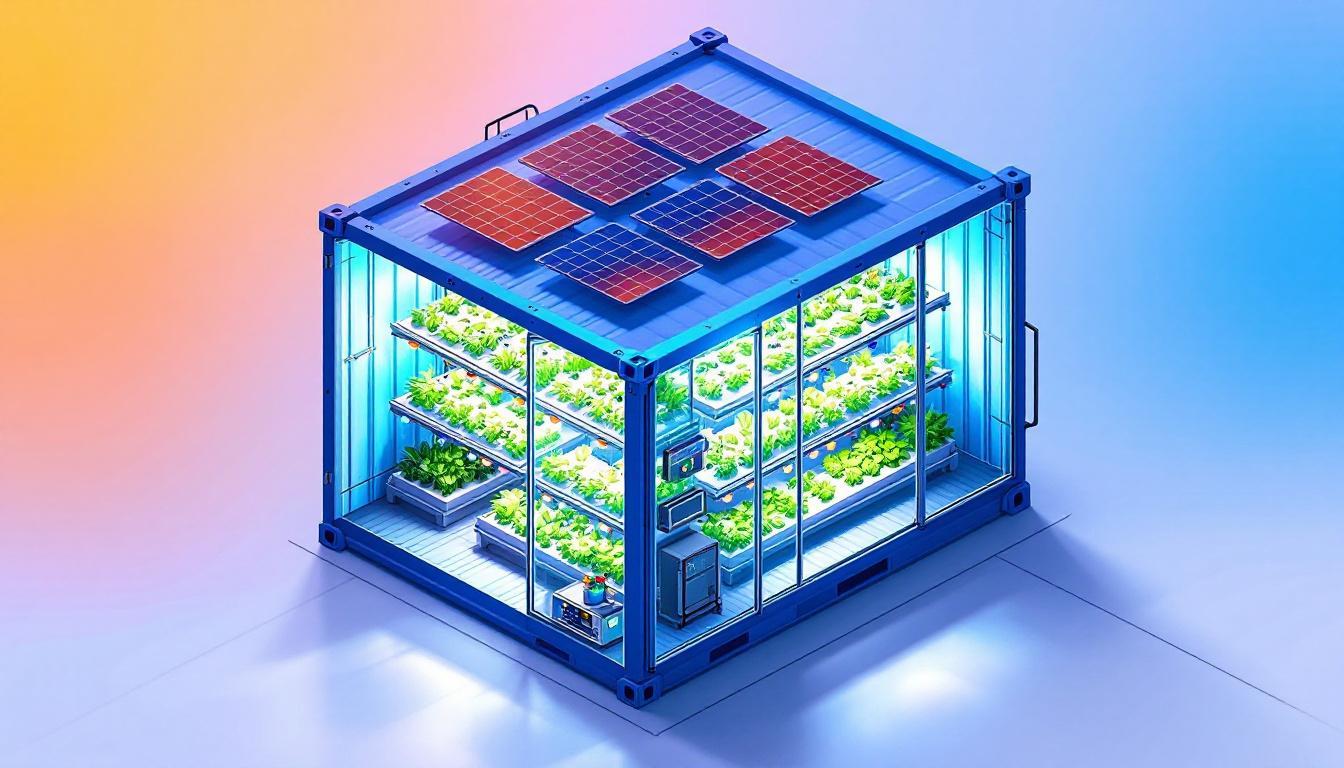
Technology, not land, is now the gating factor. Hydroponics remains the most widely adopted method because it reduces water use, simplifies nutrient delivery and speeds crop cycles. Smart sensors, Internet of Things platforms and machine‑learning systems are increasingly layered on top. Industry summaries note growing adoption of AI and automation to cut labor costs and to tune climate and lighting across multi‑level farms. Masdar City’s demo of containerised “smart” farms in Abu Dhabi reinforces the case: its project uses automation and precision monitoring to produce leafy greens year‑round, with claimed water savings of 90–95% versus conventional farming, the city reported.
But definitions matter. Independent research groups that specialise in vertical or indoor farming estimate much smaller base markets than broad “urban farming” studies. Grand View Research, which focuses on vertical farming, places that market near US$8.2 billion in 2024 and expects a faster compound annual growth rate through 2030. The divergence highlights a common reporting issue: “urban farming” can span rooftop gardens, community allotments and large controlled‑environment vertical farms. Buyers of market intelligence should therefore scrutinise methodologies before drawing investment conclusions.

Capital flows and consolidation are shaping industry structure. DataM documents a surge in agritech M&A: Q1 2024 deal value rose from about US$820 million to US$5.87 billion year over year. The report also notes major roll‑ups, saying Cox Farms expanded its indoor platform by acquiring BrightFarms and Mucci Farms to become North America’s largest operator. BrightFarms itself has been scaling for several years—its 280,000 sq ft greenhouse in North Carolina was designed to supply two million pounds of lettuce annually to the US Southeast, the company said in a press release.
These transactions reflect a search for scale and a path to profitability. Large, energy‑intensive farms need continuous throughput to amortise LED lighting, climate control and automation. Investors with environmental, social and governance mandates have shown interest, but capital discipline is returning after a period of exuberant financing for vertical startups.
Regional patterns are also mixed. DataM projects Asia‑Pacific as the fastest‑growing region and notes heavy urban agriculture engagement in parts of Asia. Scholarly reviews support the claim that urban food production can be a significant local source of vegetables in many Asian cities, but they also warn that policy, land tenure and infrastructure are decisive constraints. Notably, some figures in commercial summaries appear inconsistent; for example, a regional share and an absolute value reported together in the same dataset do not align arithmetically. That underlines why readers should approach single‑source claims cautiously.
The Middle East and the UAE, in particular, present a compelling use case for climate‑smart urban agriculture. Water scarcity, high food import dependence and a climate‑tech innovation ecosystem make controlled‑environment farming attractive. Masdar City’s container farm demonstration was explicitly framed as an educational, climate‑resilience project, and it signals how urban farms can be integrated into broader net‑zero and innovation programs. For UAE stakeholders, priorities are clear: pair water‑ and energy‑efficient farming with renewables and grid flexibility, and incubate commercial models that link production to local retail and institutional buyers.
There are practical constraints. Upfront capital and ongoing energy costs remain the sector’s largest barriers. LED lighting and HVAC systems can dominate operating budgets unless energy is decarbonised and demand‑side optimisation is applied. DataM highlights these cost pressures and flags that the technology premium still limits rapid scaling in many markets.
What should climate‑tech investors and policymakers in the UAE watch next? First, energy strategy: integrating solar, storage and demand management will determine whether urban farms are low‑carbon at scale. Second, aggregation and offtake: consolidation or coordinated buyer networks can help continuous throughput and better margins. Third, standards and data: comparable metrics for water, energy and yield will improve investor confidence. Finally, public‑private demonstration projects—like Masdar City’s—remain pivotal for proving business models in arid settings.
The urban farming story is not uniform. Some segments, notably high‑density vertical operations, show rapid yield gains and strong revenue growth projections. Other parts—community plots, rooftop operations and peri‑urban gardens—deliver social and resilience benefits that are harder to monetise. For UAE climate‑tech actors, the immediate opportunity lies at the intersection of water efficiency, renewable energy and digital optimisation. Rigorous, transparent data and careful reading of market definitions will be essential for turning pilot projects into financially sustainable, low‑carbon food systems. It’s pretty interesting, right?
Source: Noah Wire Services
- https://www.openpr.com/news/4144551/urban-farming-market-2025-tech-innovations-urbanization – Please view link – unable to able to access data
- https://www.marketresearch.com/DataM-Intelligence-4Market-Research-LLP-v4207/Global-Urban-Farming-40292089/ – MarketResearch.com republishes DataM Intelligence’s Global Urban Farming Market overview, reporting a 2024 market value of US$172.62 billion and a projected rise to US$311.24 billion by 2032, with a 7.6% CAGR for 2025–2032. The page outlines drivers such as urbanisation, demand for higher‑quality local food and adoption of autonomous agriculture technologies, and highlights challenges including capital and operational costs. It summarises regional dynamics, core technologies like hydroponics and vertical farming, and lists major industry players. The resource is a commercial market summary offering purchase options for the full DataM report and related analyst services. Readers must assess methodology and paywall access.
- https://www.grandviewresearch.com/industry-analysis/vertical-farming-market – Grand View Research’s vertical farming market analysis estimates the global sector at roughly US$8.15 billion in 2024, forecasting substantial growth to US$24.95 billion by 2030 with a 20.9% CAGR between 2025 and 2030. The report attributes expansion to population growth, limited cultivable land and demand for fresh, high‑quality produce, and identifies hydroponics as the leading growing mechanism. It provides regional breakdowns, noting North America and Asia Pacific growth trends, and profiles key vendors including AeroFarms and Freight Farms. The publicly accessible summary promotes a paid full report containing detailed segmentation, methodologies, and customisation options for clients. Interested parties should evaluate assumptions.
- https://www.brightfarms.com/press/brightfarms-extends-its-indoor-farming-stronghold-to-the-southeast-with-new-high-tech-carolina-greenhouse/ – BrightFarms’ corporate press release announces the opening of a 6‑acre, 280,000‑square‑foot greenhouse in Hendersonville, North Carolina, capable of producing about two million pounds of lettuce annually for the US Southeast. Launched in May 2021, the facility aims to shorten supply chains, supply retailers across North Carolina, South Carolina and Georgia within 24 hours, and create more than fifty‑five jobs. BrightFarms describes the project as part of broader expansion backed by capital from Cox Enterprises and other investors, positioning its hydroponic greenhouse model as scalable, sustainable, and focused on freshness, reduced transport emissions and local market penetration and community economic benefits.
- https://www.aerofarms.com/about-us/ – AeroFarms’ official about page describes the company as a vertically integrated indoor farming pioneer founded in 2004, using aeroponic systems, AI, plant biology and proprietary controlled‑environment technologies to grow microgreens and leafy produce year‑round. The page highlights the company’s B‑Corp certification, automation, data‑driven approach and emphasis on flavour, food safety and sustainability, claiming substantial water savings and land efficiency versus field agriculture. AeroFarms presents awards, commercial partnerships and product lines while noting restructuring and strategic moves in recent years; the site promotes corporate impact, research credentials and farm operations available to customers and invites collaboration with retailers globally.
- https://masdarcity.sitefinity.cloud/news-and-media/news/2024/02/21/masdar-city-and-alesca-join-forces-to-launch-vertical-smart-farm-project – Masdar City’s news release describes a partnership with Alesca Technologies to launch a demonstration indoor vertical ‘smart’ farm in February 2024, housed in repurposed shipping containers at Eco‑Plaza. The project uses automation and AI, containerised commercial farms and precision monitoring to produce leafy greens year‑round with claimed water savings of 90–95% compared with conventional agriculture. Masdar City positions the initiative as educational, showcasing agri‑tech solutions for food security and urban resilience in arid environments, with plans to expand, host visitors and integrate the project into its wider climate‑tech innovation cluster supporting local start‑ups and public engagement programmes.
- https://acsess.onlinelibrary.wiley.com/doi/10.1002/uar2.20002 – The open‑access review examines urban agriculture across Asia, assessing its potential to address food security amid rapid urbanisation. It documents high levels of urban food production in several cities, noting examples where the majority of vegetables consumed are grown within municipal boundaries, and highlights diverse practices from rooftop gardens to peri‑urban market gardens. The paper analyses drivers such as population growth, diet shifts, land loss and policy support, and discusses socioeconomic benefits, technology adoption and constraints including land tenure, infrastructure and investment needs. It concludes urban agriculture can supplement food systems but requires planning and supportive governance to scale sustainably.
Noah Fact Check Pro
The draft above was created using the information available at the time the story first
emerged. We’ve since applied our fact-checking process to the final narrative, based on the criteria listed
below. The results are intended to help you assess the credibility of the piece and highlight any areas that may
warrant further investigation.
Freshness check
Score:
6
Notes:
🕰️ The narrative was published on August 13, 2025, and references a report from DataM Intelligence dated Q1 2024. The earliest known publication date of similar content is June 2024, indicating a freshness gap of over two months. The report appears to be a press release, which typically warrants a higher freshness score. However, the significant time lapse suggests potential outdated information.
Quotes check
Score:
7
Notes:
🕰️ The narrative includes direct quotes attributed to DataM Intelligence. The earliest known usage of these quotes is from the Q1 2024 report. The wording matches the original report, indicating potential reuse of content.
Source reliability
Score:
5
Notes:
⚠️ The narrative originates from a press release by DataM Intelligence, a market research firm. While the firm is known for its market analyses, the reliance on a single source without independent verification raises concerns about the reliability of the information.
Plausability check
Score:
6
Notes:
⚠️ The narrative presents plausible claims about the urban farming market, such as growth projections and technological advancements. However, the lack of supporting details from other reputable outlets and the reliance on a single source without independent verification raise concerns about the plausibility of the claims.
Overall assessment
Verdict (FAIL, OPEN, PASS): FAIL
Confidence (LOW, MEDIUM, HIGH): MEDIUM
Summary:
⚠️ The narrative presents plausible claims about the urban farming market but relies heavily on a single source without independent verification. 🕰️ The significant time lapse since the original report’s publication and the reuse of content suggest potential outdated information. ⚠️ The lack of supporting details from other reputable outlets raises concerns about the reliability and plausibility of the claims. Therefore, the overall assessment is ‘FAIL’ with medium confidence.

