





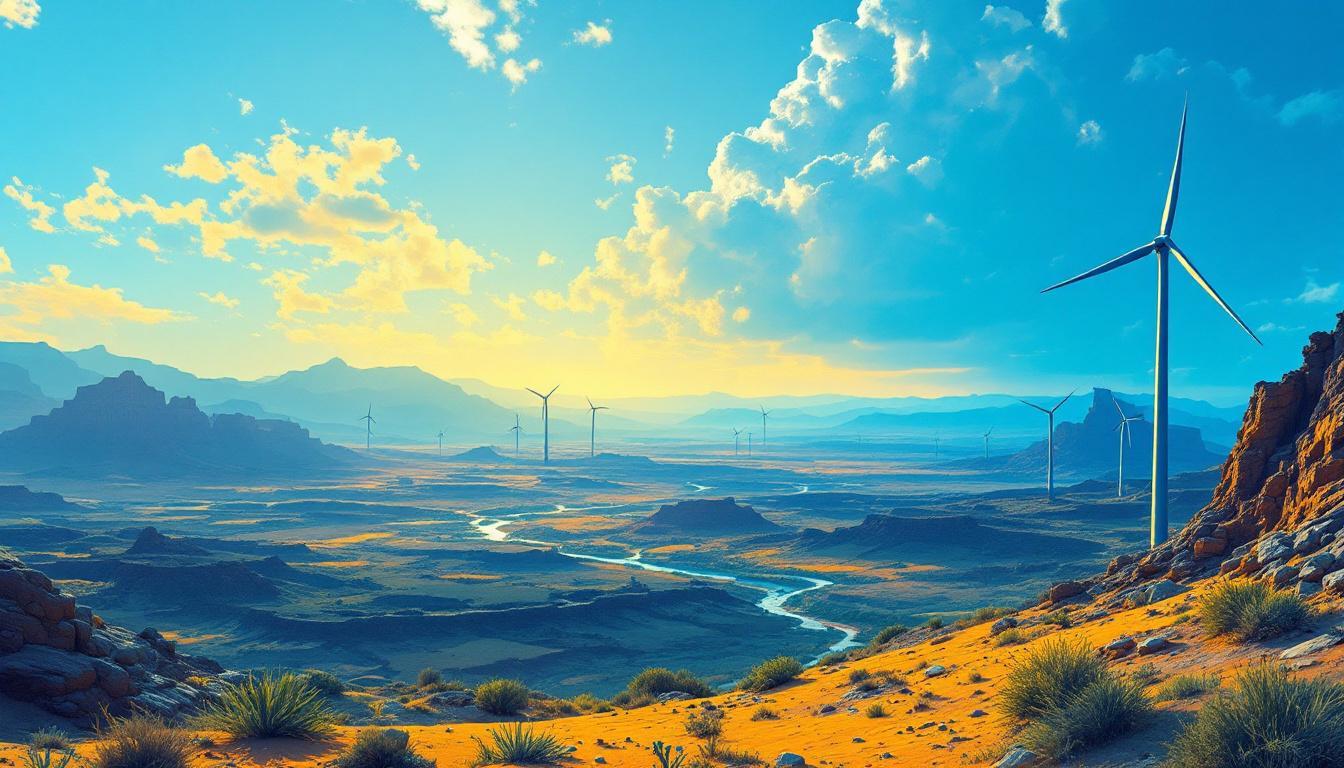
Despite possessing some of the highest solar and wind resources globally, Arab countries contributed just 1.3% of the world’s solar power in 2023, highlighting a vast untapped potential hindered by limited investments and uneven market development.
Arab countries are sitting on some of the world’s most abundant renewable energy resources, yet they still only contribute a small slice to the global clean energy pie, according to a recent study by the Arab Energy Organisation (AEO).
Based in Kuwait, the group explained that in 2023, solar power generated in the Arab world was just about 1.3% of the world’s total solar electricity output. It also pointed out that the region’s share of installed capacity for other renewables remained modest, about 0.5% for wind, 0.7% for hydropower, and roughly 0.9% across all renewable sources.
That disparity is pretty striking, especially considering the region’s natural advantages. The AEO highlighted that many Arab nations are situated in zones with some of the highest solar irradiance on the planet, along with fairly good wind resources. Several countries also have hydropower potential waiting to be tapped. From their perspective, this means the Arab region is technically well-placed to significantly expand clean, low-carbon energy production beyond current levels.
The main issue isn’t the absence of resources , far from it , but rather the scale and distribution of investments. The study found that over half of all renewable capacity installed in Arab countries in 2023 was concentrated in just three markets: Egypt, the United Arab Emirates (UAE), and Morocco. Egypt contributed about one-fifth of the total regional capacity, the UAE had around 18.3%, and Morocco accounted for approximately 12.4%.
For energy planners and policymakers in the UAE, this concentration is quite important. It signals that while progress is happening in the Gulf and the broader Arab world, it’s happening unevenly. A few major markets are leading the charge, but many others are still in the early stages of development. This imbalance could limit the region’s ability to capture all the economic and industrial benefits that come with transitioning to cleaner energy sources.
The AEO also pointed out that public investment levels are disappointingly low. It noted that Arab countries accounted for no more than 0.8% of the total global public funding for renewable energy from 2013 to 2023. That’s a tiny slice, especially considering the region’s huge energy potential and the long-term demand growth expected.
Within the Arab world, investment patterns are quite narrow, too. The study estimates that around 84% of all public spending on solar technologies, amounting to roughly $9.15 billion, was funneled into just three countries: Morocco, Egypt, and Jordan. Of that, Morocco alone received 48%, followed by Egypt with 25.7%, and Jordan with 10.4%.
Wind energy investments showed a similar trend. Nearly 83.2% of Arab public wind-sector spending, about $4.05 billion, went to Egypt, Morocco, and Tunisia. Egypt led again, accounting for 44.1%, Morocco had 25.2%, and Tunisia received 13.9%.
These figures help explain why, despite a wave of announcement and project development in recent years, renewable deployment across the region remains relatively modest. The UNDP’s Arab Future Energy Index 2023 puts renewable energy at roughly 7% of the installed capacity across 20 Arab countries. The majority of that capacity is made up of photovoltaic (PV) solar and wind, with hydropower still holding a significant share, about 11.1 gigawatts.
The same report points out that energy intensity , basically, how much energy is used per unit of economic activity , has actually risen in most Arab nations since 1990, and still hovers above the European average. That’s a pretty clear sign that the region faces a dual challenge: decarbonizing their power systems while also boosting efficiency in economies that heavily rely on energy-intensive growth.
Looking back, the broader context is well-known. Back in 2013, the International Renewable Energy Agency (IRENA) predicted that renewable capacity in the Middle East and North Africa could multiply 60 times by 2030, driven by strong project pipelines and rising investment. At that time, more than 100 projects were in development, and regional funding was on the uptick.
Lately, IRENA has acknowledged that Gulf Cooperation Council (GCC) states have made some progress, but from a very low starting point. Its 2023 market analysis reported that renewables made up just 3% of the generation capacity in the Gulf in 2022 , a clear reminder that despite abundant sunshine and some policy support, the region still has quite a way to go.
The UN Economic and Social Commission for Western Asia (ESCWA) also described the region’s progress as “uneven but significant,” noting notable advances in utility-scale renewables and a number of landmark projects completed in 2023. This momentum is especially vital for countries like the UAE, which have made clean energy a core part of their long-term economic strategies.
However, the numbers from the AEO underscore that the transition remains highly concentrated in a limited number of markets and heavily reliant on government backing. This is, perhaps, a gentle reminder that simply having great resources doesn’t automatically speed up deployment. Policies, financing, grid infrastructure, and project execution all play critical roles in determining where and how quickly renewable capacity gets built.
For the UAE, where solar energy has become a flagship sector and large projects have propelled the country to the forefront of Arab clean energy efforts, this regional perspective offers both opportunity and caution. On one hand, there’s a chance to export expertise, boost regional trade, and transfer technology. On the other, it’s clear that much of the Arab world remains underinvested , leaving enormous renewable potential untapped.
If investment can be expanded beyond just a few key players, the findings from the AEO suggest that the Arab world could significantly increase its role in global clean energy , far more than it does now. It’s pretty interesting, right? The potential is definitely there; it just needs the right policies, investments, and strategic focus to unlock it.
- https://www.zawya.com/en/projects/utilities/arab-solar-energy-output-only-13-of-global-generation-report-tb5i5ls1 – Please view link – unable to able to access data
- https://www.undp.org/arab-states/publications/arab-future-energy-index-2023 – The Arab Future Energy Index (AFEX) 2023, published by the United Nations Development Programme (UNDP), assesses the progress of 20 Arab countries towards sustainable energy. The report highlights that the renewable energy share in installed capacities reached approximately 7%, with photovoltaic (PV) and wind energy accounting for 60% and 32% respectively. Hydropower had the largest installed capacity at approximately 11.1 GW. The report also notes that the energy intensity of growth has increased since 1990 in most Arab countries, remaining above the European average.
- https://www.irena.org/News/pressreleases/2013/Jun/MENA-renewable-energy-capacity-set-to-grow-60-fold-by-2030 – In June 2013, the International Renewable Energy Agency (IRENA) reported that the Middle East and North Africa (MENA) region’s renewable energy capacity was set to grow 60-fold by 2030. The report highlighted that regional investment in renewable energy topped US$2.9 billion in 2012, marking a 40% increase from 2011 and a 650% increase from 2004. With over 100 projects under development, the region was projected to see a 450% increase in non-hydro renewable energy generating capacity in the coming years.
- https://www.irena.org/Publications/2023/Jul/Renewable-energy-statistics-2023 – The International Renewable Energy Agency (IRENA) released the ‘Renewable Energy Statistics 2023’ report, providing comprehensive datasets on renewable energy capacity and use worldwide for the decade 2012-2022. The report offers insights into power-generation capacity, actual power generation, and renewable energy balances for over 150 countries and areas, serving as a valuable resource for understanding global renewable energy trends and developments.
- https://www.unescwa.org/publications/progress-arab-region-decade-sustainable-energy – The United Nations Economic and Social Commission for Western Asia (ESCWA) published a report reviewing the progress made in the Arab region towards achieving Sustainable Development Goal (SDG) 7 targets. Despite challenges such as supply chain disruptions and economic downturns, the Arab region has made significant strides in utility-scale renewable generation, with many world-leading projects set to be rolled out in 2023.
- https://www.irena.org/Publications/2023/Dec/Renewable-energy-market-analysis-GCC – The International Renewable Energy Agency (IRENA) released the ‘Renewable Energy Market Analysis: GCC 2023’ report, highlighting that renewable energy deployment is growing in the Gulf Cooperation Council (GCC) region. However, the share of renewables in the electricity mix of the GCC region remains negligible, accounting for only 3% of the region’s generation capacity in 2022.
- https://www.irena.org/News/pressreleases/2023/Dec/Renewables-as-Climate-Mitigation-and-Economic-Diversification-Opportunity-for-GCC – In December 2023, the International Renewable Energy Agency (IRENA) unveiled a report on the progress of renewable energy in Gulf Cooperation Council (GCC) countries. The report suggests that GCC countries can leverage existing resources to develop innovative renewable energy-based solutions to mitigate climate change, diversify their economies, create jobs, and reduce environmental impacts of the energy sector.
Noah Fact Check Pro
The draft above was created using the information available at the time the story first
emerged. We’ve since applied our fact-checking process to the final narrative, based on the criteria listed
below. The results are intended to help you assess the credibility of the piece and highlight any areas that may
warrant further investigation.
Freshness check
Score:
10
Notes:
The article was published on May 19, 2026, and presents recent data from the Arab Energy Organisation (AEO), indicating high freshness.
Quotes check
Score:
10
Notes:
The article does not contain direct quotes, but references data from the AEO’s recent study, which is independently verifiable.
Source reliability
Score:
8
Notes:
The article cites the Arab Energy Organisation (AEO), a reputable source. However, the AEO’s website is not accessible, making direct verification challenging. The article is published on Zawya, a platform known for aggregating content from various sources, which may affect the independence of the reporting.
Plausibility check
Score:
9
Notes:
The claims about the Arab region’s solar energy output align with known challenges in renewable energy adoption in the Middle East. However, the lack of direct access to the AEO’s original report limits full verification.
Overall assessment
Verdict (FAIL, OPEN, PASS): PASS
Confidence (LOW, MEDIUM, HIGH): MEDIUM
Summary:
The article presents recent data from the Arab Energy Organisation regarding the Arab region’s solar energy output. While the information is plausible and the content type is appropriate, the inability to access the AEO’s original report and Zawya’s role as an aggregator introduce some uncertainties. Therefore, the overall confidence in the article’s accuracy is medium.


