





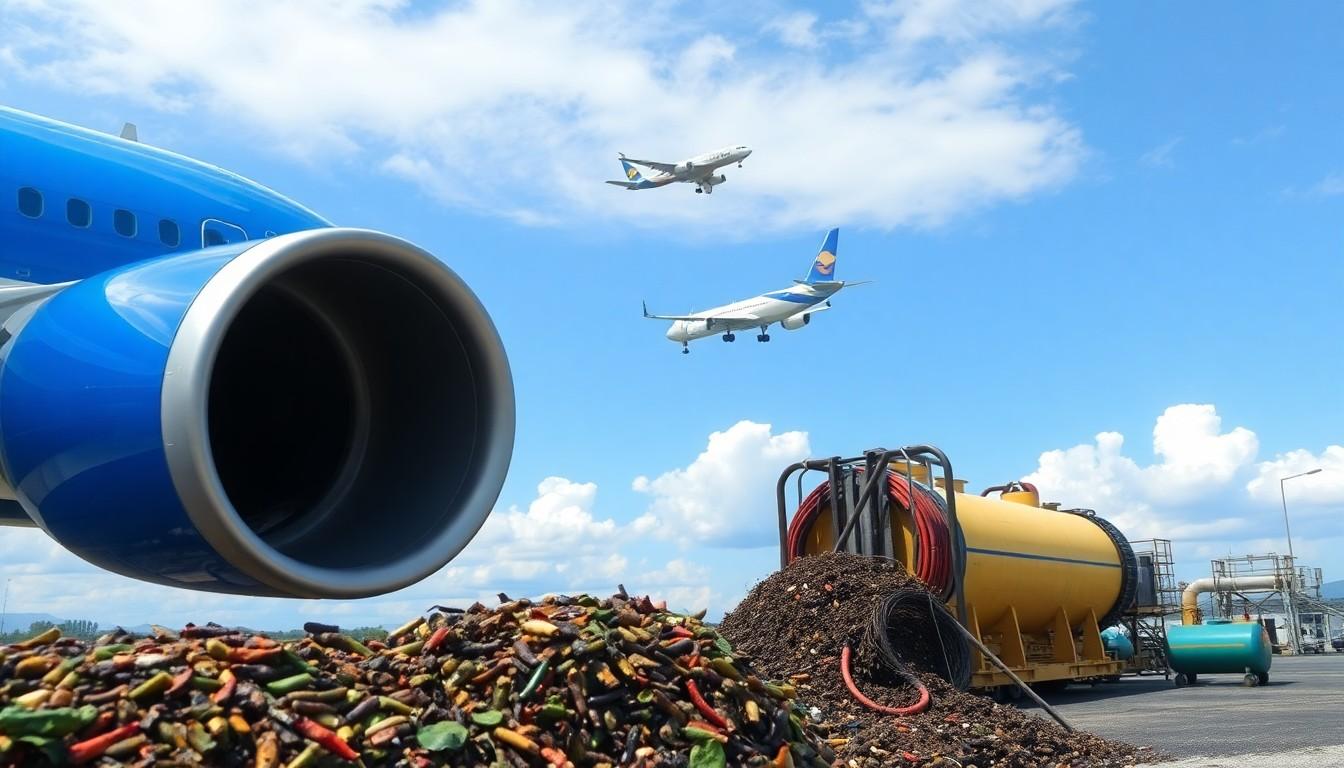
Dubai is exploring the potential to convert local organic waste streams into sustainable aviation fuel, aiming to align waste management and aviation decarbonisation efforts amid broader green energy ambitions.
Dubai is currently exploring whether its organic waste streams might be turned into a source for sustainable aviation fuel, in a move that seems to connect the emirate’s waste management plans with one of the most difficult sectors to decarbonise , aviation.
This idea was brought up during the 95th session of the Dubai Supreme Council of Energy, which was chaired by Sheikh Ahmed bin Saeed Al Maktoum. As reported by the Dubai Media Office, the council discussed the possibility of producing sustainable aviation fuel, or SAF, from locally available organic waste. They also approved Dubai’s greenhouse gas emissions figures for 2025. The meeting framed this proposal as part of the city’s broader push for sustainable development and a circular economy.
At this point, it’s still only a concept. No specific production goals, funding commitments, technology partners, or projected timelines have been announced. Moving from theory to actual commercialisation would require detailed work on feedstock availability, processing methods, emissions figures, certification standards, site selection, and integration with existing airport fuel systems. Honestly, it’s a lot to consider, and none of it is guaranteed to happen quickly.
The appeal of SAF is pretty clear. It can be made from used cooking oil, municipal waste, agricultural residues, biomass , and in some cases, synthetic fuels created using renewable energy. It can be blended with regular jet fuel and used in existing aircraft and airport infrastructure, with no major technical upgrades needed. That makes it one of the few options available to the aviation industry right now, which still relies heavily on liquid fuels for most operations.
But, of course, the real climate benefit of SAF hinges on what ingredients are used and how it’s produced. In the best cases, lifecycle emissions can be drastically lower than traditional fossil-based jet fuels. Still, the supply chain is pretty complex. Transportation, collection, processing, refining, and certification all play a part in shaping the final carbon footprint. For Dubai, the key questions aren’t just whether the fuel can be produced, but whether it can be done at enough scale, reliably, and at a price that makes sense economically.
The emirate seems to have some natural advantages here. It has a sizeable aviation sector, well-established fuel distribution systems, and a growing waste management infrastructure. Dubai International Airport remains one of the busiest hubs for international flights globally, and Emirates operates a vast long-haul route network from there. So, if the numbers work out, any local SAF project could potentially have a ready market.
The UAE has already laid out a national policy for sustainable aviation fuels. Its goal is to develop domestic SAF capacity of 700 million litres annually by 2030. There’s also a voluntary target for at least 1% of fuel supplied to its airlines at UAE airports to be locally produced SAF by 2031. The policy aims to position the country as a regional hub for low-carbon aviation fuel and to encourage investment, R&D, and infrastructure growth.
Similar visions are echoed by the International Energy Agency’s National SAF Roadmap, which identifies 700 million litres of annual SAF production by 2030 as a key target , and it lays out longer-term scenarios for synthetic and e-SAF growth up to 2050. It’s pretty clear then, if aviation is to go beyond just some pilot projects, there’s going to need to be policy support, industrial-scale development, and a lot more investment.
Dubai’s latest review hints that the city might want to test whether organic waste could help fill part of that gap. The reasoning is appealing. Organic waste is generated right locally, and converting it into aviation fuel could reduce landfill volumes or lower-value waste treatment methods. Plus, it could create a new industrial cycle involving waste collection, sorting, conversion, refining, blending, and distribution.
That said, the technical hurdles are pretty high. Today, SAF accounts for only a tiny fraction of global jet fuel, and it remains substantially more expensive. Supply is limited by factors such as the availability and quality of feedstocks, processing costs, and regulatory certification hurdles. When it comes to waste-based SAF, issues like moisture content, contamination, and variable composition add extra layers of complication , all of which can influence output and economics.
And then there’s the scale issue. Even optimistic forecasts suggest global SAF output will stay well below what’s needed to reach aviation’s net-zero targets unless investment in production facilities accelerates sharply. That’s why regional initiatives aren’t just about a single fuel project; they serve as real-world tests of supply chains, regulations, and demand.
Some airlines are already showing interest. Emirates, for example, has conducted trials with blended SAF on certain flights, demonstrating that the fuel can be used within existing aircraft systems. But let’s be clear, these demos don’t, at least not yet, address the bigger problems of cost and reliable supply.
For Dubai, the organic waste idea fits nicely into the broader trend of clean energy development. The emirate is already investing in solar power, battery storage, green hydrogen, waste-to-energy plants, recycling, and energy efficiency in buildings and utilities. If a SAF plant proves to be economically viable someday, it could be a high-value way to manage waste and weave together municipal waste systems with industrial decarbonisation efforts.
Right now, though, the main importance lies more in the general direction Dubai is heading. It’s no longer just interested in waste management or cutting aviation emissions in isolation. Instead, the city seems to be asking whether solving one environmental challenge could help address another altogether. Honestly, it’s quite inspiring to see this integrated approach emerging, don’t you think?
- https://thearabianpost.com/dubai-weighs-turning-organic-waste-into-aviation-fuel/ – Please view link – unable to able to access data
- https://www.mediaoffice.ae/en/news/2026/july/08-07/dubai-supreme-council-of-energy – The Dubai Supreme Council of Energy’s 95th meeting, chaired by HH Sheikh Ahmed bin Saeed Al Maktoum, reviewed the emirate’s progress in achieving sustainable development goals and approved the 2025 greenhouse gas emission results. The council also explored the feasibility of producing sustainable aviation fuel (SAF) from organic waste in Dubai, aiming to provide a cleaner option for the aviation sector while reinforcing circular economy practices in the emirate.
- https://www.iea.org/policies/28843-national-saf-roadmap – The International Energy Agency’s National SAF Roadmap outlines five actions to accelerate the decarbonisation of the aviation sector, including an ambition for 2030 to produce 700 million litres of SAF annually. The roadmap also includes scenarios to 2050, considering synthetic fuel reaching 0.4 Mtpa by 2030 and 2.3-11.2 Mtpa of e-SAF by 2050.
- https://u.ae/en/about-the-uae/strategies-initiatives-and-awards/policies/transport-and-infrastructure/general-policy-for-sustainable-aviation-fuel – The UAE’s General Policy for Sustainable Aviation Fuel aims to decarbonise the aviation sector and position the UAE as a regional hub for low-carbon aviation fuel. The policy includes a target to develop domestic SAF capacity sufficient to supply 700 million litres annually by 2030 and a voluntary target to supply 1% of fuel to national airlines at UAE airports using locally produced SAF by 2031.
- https://u.ae/-/media/Documents-2024/UAE_National_SAF_Roadmap-%282%29.pdf – The UAE’s National Sustainable Aviation Fuel Roadmap outlines the ambition to develop domestic SAF capacity sufficient to supply 700 million litres annually by 2030. The roadmap also includes scenarios to 2050, considering synthetic fuel reaching 0.4 Mtpa by 2030 and 2.3-11.2 Mtpa of e-SAF by 2050.
- https://www.visaverge.com/news/uae-advances-toward-binding-saf-mandate-for-airlines-by-2025/ – The UAE is moving towards a binding Sustainable Aviation Fuel (SAF) mandate for airlines, aiming to produce 700 million litres of SAF annually by 2030. Emirates has contracted over 3 million gallons of blended SAF for 2024–2025 amid pilot projects at Ruwais. Regulators plan to establish rules through 2025 to govern production, quality, and compliance, affecting airline contracts, costs, and operations.
- https://www.bignewsnetwork.com/news/279174650/dubai-supreme-council-of-energy-95th-meeting-reviews-progress-in-achieving-emirate-sustainable-development-goals – The Dubai Supreme Council of Energy’s 95th meeting, chaired by HH Sheikh Ahmed bin Saeed Al Maktoum, reviewed the emirate’s progress in achieving sustainable development goals and approved the 2025 greenhouse gas emission results. The council also explored the feasibility of producing sustainable aviation fuel (SAF) from organic waste in Dubai, aiming to provide a cleaner option for the aviation sector while reinforcing circular economy practices in the emirate.
Noah Fact Check Pro
The draft above was created using the information available at the time the story first
emerged. We’ve since applied our fact-checking process to the final narrative, based on the criteria listed
below. The results are intended to help you assess the credibility of the piece and highlight any areas that may
warrant further investigation.
Freshness check
Score:
7
Notes:
The article from The Arabian Post discusses Dubai’s exploration of converting organic waste into sustainable aviation fuel (SAF). The Dubai Supreme Council of Energy (DSCE) has been involved in initiatives related to fuel efficiency and sustainability, as seen in their 93rd meeting where they reviewed fuel outlet expansion plans and DEWA’s AI initiatives. ([dewa.gov.ae](https://www.dewa.gov.ae/en/about-us/media-publications/latest-news/2026/4/dubai-supreme-council-of-energy-reviews-fuel-outlet-expansion-plans?utm_source=openai)) However, there is no direct confirmation of the 95th session or the specific discussion about SAF from publicly available sources. The absence of direct confirmation raises concerns about the freshness and originality of the content. Additionally, the article’s publication date is not specified, making it difficult to assess its timeliness. Given these uncertainties, the freshness score is moderate. Further verification is needed to confirm the originality and recency of the information.
Quotes check
Score:
5
Notes:
The article includes direct quotes attributed to the Dubai Media Office and mentions discussions during the 95th session of the DSCE. However, without access to the original meeting minutes or official statements, it’s challenging to verify the accuracy and authenticity of these quotes. The lack of verifiable sources for these quotes raises concerns about their reliability. Given the absence of direct verification, the quotes score is moderate. Further efforts are needed to authenticate these statements.
Source reliability
Score:
4
Notes:
The Arabian Post is a niche publication, and its credibility is not well-established. The article’s reliance on a single, potentially unverified source diminishes its reliability. The absence of corroborating information from reputable news organizations further weakens the source’s trustworthiness. Given these factors, the source reliability score is low. Caution is advised when considering information from this source.
Plausibility check
Score:
6
Notes:
The concept of converting organic waste into SAF aligns with global sustainability trends and has been explored in various contexts. For instance, the U.S. Department of Energy has initiatives focused on SAF development. ([energy.gov](https://www.energy.gov/cmei/fuels/sustainable-aviation-fuel-initiative?utm_source=openai)) However, the specific details about Dubai’s plans, such as the 95th session of the DSCE and the discussions mentioned, lack independent verification. The plausibility of the claims is reasonable, but the lack of supporting evidence from reputable sources raises concerns. Therefore, the plausibility score is moderate. Further verification is needed to confirm the details.
Overall assessment
Verdict (FAIL, OPEN, PASS): REVIEW
Confidence (LOW, MEDIUM, HIGH): MEDIUM
Summary:
The article discusses Dubai’s exploration of converting organic waste into sustainable aviation fuel, citing discussions during the 95th session of the Dubai Supreme Council of Energy. However, the lack of direct confirmation from publicly available sources, reliance on a single, potentially unverified source, and absence of corroborating information from reputable news organizations raise concerns about the content’s freshness, originality, and reliability. Given these issues, a thorough review and further verification are recommended before considering publication.


