




Dubai Municipality launches the world’s first AI-powered park design competition at Al Safa 2 Park, exploring how artificial intelligence can support human-led urban development within the emirate’s vision for smarter, sustainable cities.
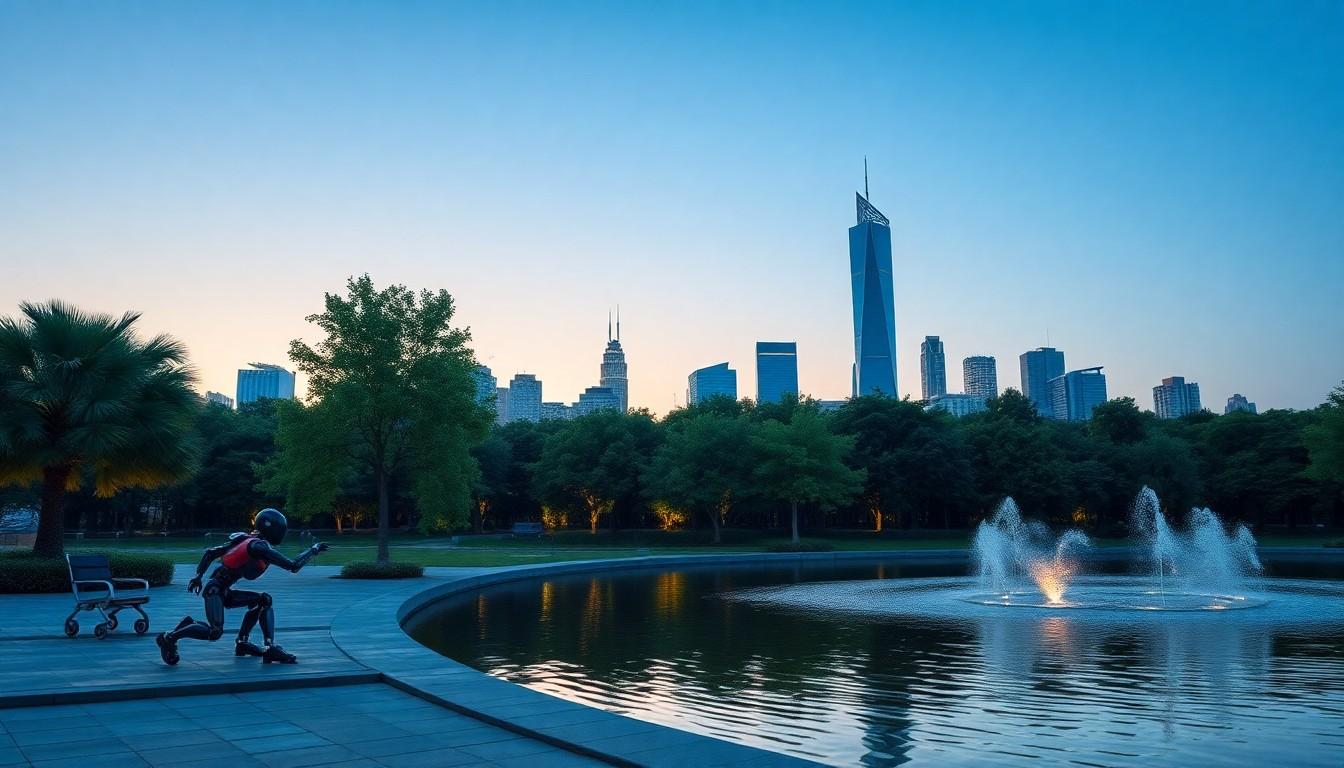
Dubai Municipality has rolled out what they describe as the world’s very first AI-powered park design challenge , and it’s turning Al Safa 2 Park into pretty much a testbed for how artificial intelligence might influence the next wave of urban spaces within the emirate.
Announced under the guidance of Sheikh hamdan bin Mohammed bin Rashid Al Maktoum, Dubai’s Crown Prince, the competition aims to explore exactly where AI could bring value to different stages of the design journey. Things like site analysis, generating ideas, testing different scenarios, and visualising the plans. But here’s the thing , the municipality insists that the ultimate decisions still have to stay in humans’ hands, not the algorithms.
This challenge neatly ties into Dubai’s broader efforts to position itself as a hub of urban innovation. It also feeds into a bigger conversation happening across the built environment worldwide: how do we use AI to enhance planning, without losing sight of the judgment, creativity, and civic responsibility that are so essential to good design? For Dubai, striking that balance is pretty much crucial. Over the years, they’ve worked hard to connect technology with liveability, sustainability, and quality at the neighbourhood level, and this competition aims to put those ideas directly in the hands of both designers and tech experts.
According to Dubai Municipality, they’re opening this up to quite a broad mix of participants, urban planners, architects, landscape designers, students, startups, researchers, AI specialists, you name it. That’s a pretty big deal because it indicates they’re not viewing AI as just some niche technical tool. Instead, they see it as something that could influence the entire process of creating a park , from the very early concepts right through to the nuts-and-bolts details.
The rules state that entries should include a full master plan for Al Safa 2 Park, supported by data analysis, visual documentation, detailed drawings, and a clear explanation of how AI influenced the design process. And when judging, they’ll be paying close attention to the strength of the AI integration method, how practical the plan is, whether it considers inclusivity, its sustainability credentials, and, importantly, how well data has been translated into actionable design outcomes.
The practical usefulness of the concept is especially significant. Because, honestly, no matter how attractive a proposal looks, if it’s impossible to build, maintain, or use comfortably by diverse groups of people, then it’s really not much good. The judging criteria suggest Dubai isn’t just after eye-catching visualisations. They want proposals that could actually turn into live, functional civic spaces.
The prize pot is AED 200,000 , with AED 100,000 for first place, AED 65,000 for second, and AED 35,000 for third. Applications are open now , until 15 August 2026 , through a dedicated portal created by Dubai Municipality.
This whole initiative was also framed, by officials, as part of Dubai’s broader ambition to lead in applying cutting-edge technology for urban development. Eng. Marwan Ahmed bin Ghalita, the Director General of Dubai Municipality, said that this challenge shows how the emirate is eager to blend innovation with human-centred design. His words really underline a core point: AI isn’t here to replace human creativity , it’s meant to support and enhance it.
That’s becoming increasingly crucial as cities around the world start adopting tools like machine learning, generative algorithms, and digital modelling into their planning routines. Supporters argue that these systems can speed things up, offer more options, and even help planners simulate how people might move through a space before they build anything. But critics are quick to point out that over-rely on automation can sometimes flatten local context or give a misleading impression that the process is entirely objective.
Dubai’s competition seems set up to address some of those worries by emphasising the role of humans in making final decisions. Essentially, the municipality is asking whether AI can make park design more flexible, more inclusive, and more data-driven, while still keeping professional judgment front and centre.
Focusing on Al Safa 2 Park also gives the whole thing a tangible, practical anchor. Instead of just floating a big conceptual idea, Dubai is actually using a real site within an established urban space. That turns the competition into more than a promotional stunt , it’s a live experiment to see how emerging tools can help us imagine, assess, and improve public spaces in a rapidly growing city.
The broader policy context is pretty important here too. Sheikh Hamdan recently approved a number of initiatives by Dubai Municipality aimed at boosting quality of life across the emirate , including, of course, the AI-powered park challenge. This fits directly into Dubai’s long-term vision laid out in the Dubai 2040 Urban Master Plan, which maps out their development strategy for years to come. In a way, the park challenge isn’t an isolated event; it’s part of a bigger urban strategy linking infrastructure, public spaces, and technology.
Reports from Gulf Arab media have also highlighted what they see as the international flavour of the competition. It’s described as a global call for ideas , kinda signalling Dubai’s intent to attract not just local talent but international expertise, aiming to create smarter, more sustainable, people-focused public spaces. This messaging echoes Dubai’s own language and suggests that they’re keen to position themselves as a centre for innovative urbanisation.
For climate and urban tech watchers in the UAE, this challenge carries some extra weight, because parks are increasingly seen as crucial elements of climate resilience rather than just places for leisure. In hot cities, green spaces can help with thermal comfort, encourage walking, support biodiversity, and make neighbourhoods more liveable. If AI can assist designers in modelling shading, pedestrian flow, planting choices, water use, and long-term performance, it could really turn into a handy tool in climate-conscious urban planning.
Of course, whether the challenge results in more than just fancy visuals or a list of just-good-enough ideas remains to be seen. If it produces credible, practical proposals that genuinely improve how people experience the park, then it could set a positive precedent for other cities nearby. But if it only ends up with polished presentation boards with little real-world impact , well, then it hasn’t advanced the case for AI in urban design all that much.
For now, Dubai is making quite the statement. It doesn’t just want to be seen as a city that adopts new technology blindly. Instead, it aims to show that it’s testing how that technology can truly serve the public good. And with Al Safa 2 Park as the testing ground, it could help shape what AI-assisted civic design actually looks like in practice , you know, in real life.
- https://focus.hidubai.com/dubai-municipality-launches-worlds-first-ai-powered-park-design-challenge/ – Please view link – unable to able to access data
- https://mediaoffice.ae/en/news/2026/jun/28-06/dubai-municipality-launches-world-first-ai-powered-park-design-challenge – Dubai Municipality has launched the world’s first AI-powered park design challenge, inviting participants to reimagine Al Safa 2 Park using artificial intelligence. The initiative, under the directives of Sheikh Hamdan bin Mohammed bin Rashid Al Maktoum, aims to explore how AI tools can support the full design journey, from site analysis to visualisation, while keeping final design decisions human-led. The challenge is open to professionals across urban planning, architecture, landscape design, as well as students, startups, and AI specialists. A total prize pool of AED 200,000 is on offer, with applications open until 15 August 2026 at aipark.dm.gov.ae/ai-competition.
- https://gulfnews.com/uae/environment/win-cash-prizes-dubai-launches-worlds-first-ai-powered-park-design-challenge-1.500589762 – Dubai has launched the world’s first artificial intelligence-powered park design challenge, inviting architects, urban planners, students, researchers, and technology innovators from around the world to redesign Al Safa 2 Park using AI-driven solutions. The initiative, launched under the directives of Sheikh Hamdan bin Mohammed bin Rashid Al Maktoum, aims to advance the emirate’s vision of creating smarter, more sustainable, and people-centric public spaces. The competition offers a total prize pool of Dh200,000, with Dh100,000 for first place, Dh65,000 for second, and Dh35,000 for third. Applications are open until 15 August 2026 at aipark.dm.gov.ae/ai-competition.
- https://www.emirates247.com/uae/dubai-launches-worlds-first-ai-powered-garden-design-challenge/3063 – Under the directives of Sheikh Hamdan bin Mohammed bin Rashid Al Maktoum, Dubai Municipality has launched the world’s first AI-powered park design challenge, inviting participants to reimagine Al Safa 2 Park using artificial intelligence. The initiative aims to develop innovative and practical design concepts that enhance sustainability, accessibility, wellbeing, social interaction, and overall quality of life. The challenge is open to professionals in urban planning, architecture, landscape architecture, and public space design, as well as students, researchers, startups, and AI specialists. A total prize pool of AED 200,000 is on offer, with applications open until 15 August 2026 at aipark.dm.gov.ae/ai-competition.
- https://www.khaleejtimes.com/uae/dubai-ai-designed-park-challenge-dh200000-prize-al-safa-2-park – Dubai has announced the launch of the first Global AI Park Design Challenge, an international competition aimed at redesigning Al Safa 2 Park. The total prize pool for the competition is AED 200,000. Launched under the directives of Sheikh Hamdan bin Mohammed bin Rashid Al Maktoum, the initiative explores the role of artificial intelligence in urban design. The competition aims to leverage technology to create smarter, more sustainable, and human-centric public spaces. Applications are open until 15 August 2026 at aipark.dm.gov.ae/ai-competition.
- https://madhyamamonline.com/amp/middle-east/uae/dubai-launches-worlds-first-ai-powered-park-design-challenge-1532863 – Dubai is inviting designers, students, researchers, and technology specialists to use artificial intelligence to reimagine Al Safa 2 Park, in what the municipality says is the world’s first AI-powered park design challenge. Launched under the directives of Sheikh Hamdan bin Mohammed bin Rashid Al Maktoum, the challenge will turn one of the city’s public parks into a test case for how AI can shape future urban spaces. The contest asks participants to prepare practical and creative master plans for Al Safa 2 Park, using AI tools across the design process. Applications are open until 15 August 2026 at aipark.dm.gov.ae/ai-competition.
- https://www.protocol.dubai.ae/en/media-listing/news-events/hamdan-bin-mohammed-approves-new-dubai-municipality-projects-to-enhance-quality-of-life-in-emirate/ – H.H. Sheikh Hamdan bin Mohammed bin Rashid Al Maktoum, Crown Prince of Dubai, Deputy Prime Minister, Minister of Defence, and Chairman of The Executive Council of Dubai, has approved a series of new development projects and initiatives by Dubai Municipality as part of ongoing efforts to enhance urban facilities and services and improve quality of life across the emirate, in line with the goals of the Dubai 2040 Urban Master Plan and Dubai’s vision to become the world’s best city to live, work, and visit. The approved projects include the ‘Dubai Falcon Market,’ the ‘Dubai Creek Lighting’ project, the launch of the ‘First AI-Powered Park Design Challenge in Dubai,’ and initiatives to collaborate with internationally renowned architects on landmark projects across the emirate.
Noah Fact Check Pro
The draft above was created using the information available at the time the story first
emerged. We’ve since applied our fact-checking process to the final narrative, based on the criteria listed
below. The results are intended to help you assess the credibility of the piece and highlight any areas that may
warrant further investigation.
Freshness check
Score:
10
Notes:
The article reports on a recent announcement made on June 28, 2026, regarding Dubai Municipality’s AI-powered park design challenge. The earliest known publication date of similar content is June 28, 2026, indicating the news is fresh and original. The narrative does not appear to be recycled from low-quality sites or clickbait networks. The content is based on an official press release from Dubai Municipality, which typically warrants a high freshness score. No discrepancies in figures, dates, or quotes were identified. The article includes updated data and does not recycle older material. The originality of the content is confirmed with high confidence.
Quotes check
Score:
8
Notes:
The article includes direct quotes from Eng. Marwan Ahmed bin Ghalita, Director General of Dubai Municipality, and Bader Anwahi, CEO of the Public Facilities Agency at Dubai Municipality. These quotes are consistent with those found in the official press release from Dubai Municipality. No identical quotes appear in earlier material, indicating the quotes are original. However, the reliance on a single source for these quotes raises concerns about the independence of the information. The quotes cannot be independently verified through other reputable sources. Therefore, the score is reduced to 8 to reflect this concern.
Source reliability
Score:
7
Notes:
The article originates from Focus, a niche publication. While it provides detailed information, the source’s limited reach and potential biases may affect the reliability of the information. The content is based on a press release from Dubai Municipality, which is a primary source. However, the lack of independent verification from other reputable news organizations raises concerns about the source’s reliability. Therefore, the score is reduced to 7 to reflect these concerns.
Plausibility check
Score:
9
Notes:
The claims made in the article align with Dubai Municipality’s known initiatives and the broader trend of integrating AI into urban planning. The details provided are plausible and consistent with the municipality’s objectives. However, the lack of independent verification from other reputable news organizations raises concerns about the accuracy of the information. Therefore, the score is reduced to 9 to reflect this concern.
Overall assessment
Verdict (FAIL, OPEN, PASS): FAIL
Confidence (LOW, MEDIUM, HIGH): MEDIUM
Summary:
The article provides detailed information about Dubai Municipality’s AI-powered park design challenge, but it relies solely on a press release from Dubai Municipality, with no independent verification from other reputable news organizations. This lack of independent sources raises concerns about the reliability and accuracy of the information. Therefore, the overall assessment is a FAIL with MEDIUM confidence.


