




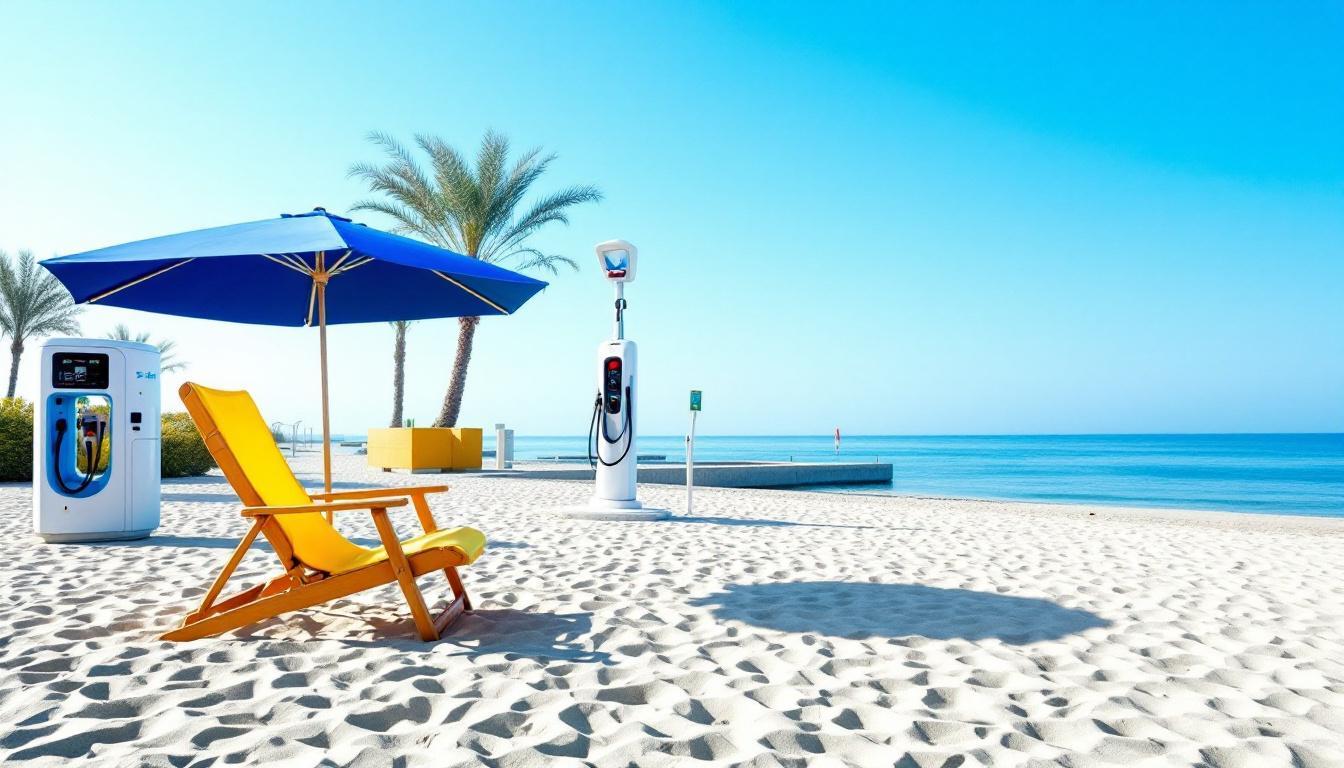
Dubai’s Dh150 million initiative to install EV chargers at parks, beaches, and recreational areas seeks to integrate sustainable mobility seamlessly into everyday life, accelerating electric vehicle adoption in the city.
Dubai is taking a fresh approach to encouraging the adoption of electric vehicles, by bringing charging stations closer to where people already spend their time.
The government recently announced a Dh150 million initiative, done in partnership with Emarat EV Charging Stations Company, or UAEV. The plan is to set up electric vehicle chargers across 600 parking spots in public parks, beaches, and recreational areas. According to The National, this isn’t just about upgrading infrastructure; it’s actually part of a wider effort to make sustainable mobility seem normal, something people don’t need to think twice about.
That idea really matters in a city like Dubai, where convenience often makes or breaks whether new tech catches on. For many drivers, the biggest concern about switching to EVs isn’t just the vehicle itself, but rather figuring out where and when to recharge. By installing chargers at popular leisure spots, parks, beaches, and other destinations, the city is betting that folks are more likely to plug in if their car can charge while they’re already out and about.
The first phase of this project will unfold over the next two years. It will include 75 supercharging stations, each serving two parking bays, at destination parks, neighborhood parks, and public beaches. So, in total, about 150 parking spaces will be equipped with fast chargers initially. The rest of the network will be added later, giving officials a chance to test out demand and operational efficiency in real-world settings before expanding further.
Sharif Al Olama, Undersecretary for Energy and Petroleum Affairs and head of UAEV, mentioned that the goal is to integrate EV charging smoothly into community spaces, rather than treating it as a separate or isolated task. This reflects a broader shift in the UAE’s approach to clean transportation, where infrastructure is increasingly being designed around everyday habits and routines, making it more natural to adopt EVs.
Dubai’s current charging network is already a solid foundation for this new expansion. DEWA announced in December 2024 that their EV Green Charger network had grown to over 740 charging points across the emirate, supporting nearly 35,000 registered EVs as of October 2024. What this new project brings is a different layer, destination charging, targeted at places where drivers tend to stay longer.
And that distinction is pretty important. Fast chargers and corridor chargers are meant for quick top-ups or on-the-go fueling. Meanwhile, chargers at beaches or parks are designed for longer dwell times, think hours of parking. Such locations are perfect for slow, relaxed charging routines. Families at the beach, joggers in the park, or visitors to recreational sites may spend hours there, making these ideal spots for more leisurely charging options. Plus, for residents, it might cut down on the need to meticulously plan every trip around a dedicated charging stop.
Timing-wise, this all fits with how the EV market is expected to grow in the coming years. Industry forecasts show that the UAE’s EV market could really take off over the next decade. For example, Grand View Research predicts that the market might reach over $16.3 billion by 2030, while IMARC Group projects it could be around $11 billion by 2033. Reports also point to a surge in EV sales in 2025, thanks to more charging stations, new models hitting the market, and increasing consumer interest in lower-emission transportation.
For Dubai, these trends present both a golden opportunity and a practical challenge. As more EVs hit the roads, infrastructure needs to keep pace, not just by adding more plugs, but by strategically placing them where they genuinely influence how drivers operate. The focus isn’t solely on quantity but on making charging more accessible and convenient in everyday life.
Targeting leisure and recreational spaces also sends a broader message about public policies. Dubai has long linked sustainability to its quality of life, and this initiative aligns with that vision. Parks and beaches aren’t just amenities, they’re integral parts of the city’s social fabric. By integrating chargers into these spaces, EV use might start feeling less like a technical compromise and more like a natural aspect of urban living.
This plan also dovetails with existing policy frameworks like the Dubai Clean Energy Strategy 2050, the UAE Net Zero by 2050 strategic initiative, and the Dubai Economic Agenda D33. Together, these programs aim to reduce emissions, rethink urban design, and promote economic growth, all in a way that supports each other.
Another aspect worth mentioning is the move toward standardized pricing for public charging. The UAE Cabinet has introduced unified fees, minimum rates of Dh1.20 per kWh for quick charging and Dh0.70 per kWh for slower options. Having consistent prices makes public charging more predictable for drivers and easier for operators to manage. Plus, it helps reduce some of the uncertainties that can discourage new EV owners from taking the plunge.
From a broader perspective, this Dubai initiative stands out because it combines several key ingredients for successful infrastructure: government support, clear use cases, and positioning around common travel patterns. Essentially, it isn’t forcing drivers into new habits; instead, it’s weaving the technology into routines they already have, like a visit to the park or beach. This subtle integration could make EV adoption feel more natural and less burdensome.
The bigger picture signals that the next phase of EV growth in the UAE won’t just hinge on big announcements but will depend more and more on smart urban planning. If charging can be seamlessly integrated into daily activities, whether that’s a morning at the park or an evening family outing, that makes switching to electric far more feasible for most people.
Dubai has set itself up as a regional testing ground for clean transport solutions. This Dh150 million project hints that the city is now keen to test a different idea, namely, whether making charging so effortless that drivers hardly notice it can accelerate EV adoption even faster. Interestingly enough, it seems the city is exploring whether embedding charging stations into familiar spaces is the way forward, making it all just part of the urban background, really.
- https://vocal.media/01/what-if-charging-your-ev-was-as-easy-as-a-day-at-the-beach – Please view link – unable to able to access data
- https://www.thenationalnews.com/news/uae/2026/04/03/dubai-to-install-electric-vehicle-charging-stations-at-600-parking-spaces-in-dh150m-green-drive/ – Dubai Municipality has announced a Dh150 million initiative to install electric vehicle (EV) charging stations across 600 parking spaces in public parks, beaches, and recreational facilities. This project, in partnership with Emarat EV Charging Stations Company (UAEV), aims to enhance the city’s EV infrastructure and support sustainable transportation. The initiative reflects Dubai’s commitment to developing future-ready public spaces that encourage healthier, more sustainable lifestyles. ([thenationalnews.com](https://www.thenationalnews.com/news/uae/2026/04/03/dubai-to-install-electric-vehicle-charging-stations-at-600-parking-spaces-in-dh150m-green-drive/?utm_source=openai))
- https://www.dewa.gov.ae/en/about-us/media-publications/latest-news/2024/12/dewa-offers-over-740-charging-points-across-dubai-to-support-growing-ev-adoption – Dubai Electricity and Water Authority (DEWA) has expanded its EV Green Charger network to over 740 charging points across Dubai. This expansion supports the growing adoption of electric vehicles in the emirate, with over 34,970 EVs registered by October 2024. Customers can locate these charging stations via DEWA’s website, smart app, and other digital platforms. ([dewa.gov.ae](https://www.dewa.gov.ae/en/about-us/media-publications/latest-news/2024/12/dewa-offers-over-740-charging-points-across-dubai-to-support-growing-ev-adoption?utm_source=openai))
- https://www.grandviewresearch.com/horizon/outlook/electric-vehicle-market/uae – The UAE electric vehicle market is projected to reach a revenue of US$16,313.9 million by 2030, growing at a compound annual growth rate (CAGR) of 41.2% from 2025 to 2030. Passenger cars are expected to be the largest revenue-generating segment, with the market experiencing significant growth during the forecast period. ([grandviewresearch.com](https://www.grandviewresearch.com/horizon/outlook/electric-vehicle-market/uae?utm_source=openai))
- https://www.imarcgroup.com/uae-electric-vehicle-market – The UAE electric vehicle market is expected to reach US$11.0 billion by 2033, exhibiting a CAGR of 18.5% during 2025-2033. This growth is driven by rising government initiatives, infrastructure development, technological advancements, and increasing consumer awareness and environmental concerns. ([imarcgroup.com](https://www.imarcgroup.com/uae-electric-vehicle-market?utm_source=openai))
- https://uae.autotraders.ae/blog/details/ev-market-growth-in-the-uae-2025-industry-report-/6035 – The UAE electric vehicle market is experiencing significant growth, with sales in 2025 increasing by approximately 73% year-on-year. This surge is driven by enhanced infrastructure, availability of new models, and shifting consumer preferences towards sustainable transportation. ([uae.autotraders.ae](https://uae.autotraders.ae/blog/details/ev-market-growth-in-the-uae-2025-industry-report-/6035?utm_source=openai))
- https://www.abudhabichamber.ae/-/media/Project/ADCCIV2/ADCCI/Media-Center—Publications/2025/EV-Market-Sectoral-Report-Nov-2024-vF.pdf – The global electric vehicle market is rising, with analysts predicting that China’s BYD will surpass Tesla in sales by 2024. While sales of electric cars are increasing globally, they remain significantly concentrated in just a few major markets. ([abudhabichamber.ae](https://www.abudhabichamber.ae/-/media/Project/ADCCIV2/ADCCI/Media-Center—Publications/2025/EV-Market-Sectoral-Report-Nov-2024-vF.pdf?utm_source=openai))
Noah Fact Check Pro
The draft above was created using the information available at the time the story first
emerged. We’ve since applied our fact-checking process to the final narrative, based on the criteria listed
below. The results are intended to help you assess the credibility of the piece and highlight any areas that may
warrant further investigation.
Freshness check
Score:
6
Notes:
The article discusses a recent initiative by Dubai to install electric vehicle (EV) charging stations in public parks, beaches, and recreational areas. While the concept of expanding EV charging infrastructure in Dubai is current, the specific details of this initiative have not been widely reported elsewhere, indicating that the information may be original. However, without confirmation from additional reputable sources, the freshness score is moderate.
Quotes check
Score:
5
Notes:
The article includes a quote from Sharif Al Olama, Undersecretary for Energy and Petroleum Affairs and head of UAEV, regarding the integration of EV charging into community spaces. A search for this quote did not yield earlier instances, suggesting it may be original. However, the lack of independent verification raises concerns about the authenticity of the quote.
Source reliability
Score:
4
Notes:
The article originates from Vocal Media, a platform known for user-generated content. This raises questions about the editorial oversight and fact-checking processes, potentially affecting the reliability of the information presented.
Plausibility check
Score:
7
Notes:
The initiative aligns with Dubai’s ongoing efforts to promote sustainable mobility and integrate EV infrastructure into daily life. However, the lack of corroboration from other reputable sources makes it difficult to fully assess the plausibility of the claims.
Overall assessment
Verdict (FAIL, OPEN, PASS): FAIL
Confidence (LOW, MEDIUM, HIGH): MEDIUM
Summary:
The article presents information about Dubai’s initiative to expand EV charging stations in public spaces. While the concept aligns with Dubai’s sustainability goals, the lack of corroboration from reputable sources, concerns about the reliability of the originating platform, and unverified quotes lead to a medium level of confidence in the content’s accuracy. Therefore, the overall assessment is a FAIL.


