





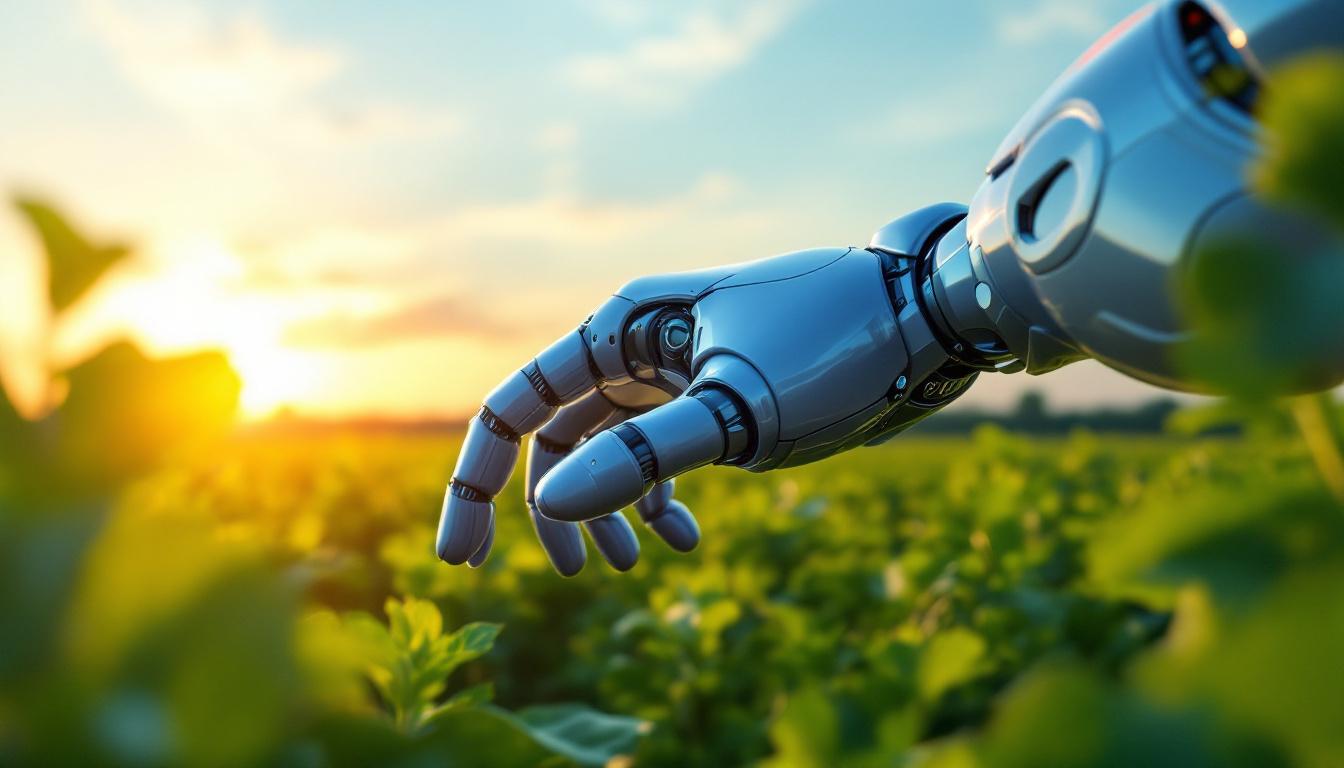
INNOFarms.AI, led by Brajendra Yadav, is transforming the global agriculture landscape with its comprehensive digital platform combining AI, robotics, and IoT to improve efficiency, traceability, and sustainability across diverse farming regions.
INNOFarms.AI is quickly establishing itself as a forward-thinking player in the worldwide AgriTech scene, positioning itself right at the cutting edge of agriculture’s digital revolution. Founded and led by Brajendra Yadav, the company is working on what it calls the “digital backbone” for future food systems—using some really advanced tech like artificial intelligence (AI), robotics, and the Internet of Things (IoT). With operations spread across Asia and the Gulf Cooperation Council (GCC) regions, INNOFarms.AI aims to fundamentally change how food gets produced, focusing on boosting efficiency and sustainability in order to tackle urgent global issues like climate change, food shortages, and resource management.
A key part of INNOFarms.AI’s innovation lineup is INNOFarmsXOS, an AI-based farm operating system that automates a wide range of tasks—from irrigation and climate control to monitoring energy use and analyzing crop yields. Alongside that, there’s GrowSmartRobotics™, offering autonomous crop monitoring and detecting anomalies, which helps with labor-intensive jobs. Then there’s INNOMarketTrend™, a real-time demand insight tool that guides farmers on what crops to grow and when, making sure their production lines up with actual market demand. The ecosystem wraps up with OmniMarketplace, a B2B traceable marketplace that connects farms directly with buyers in sectors like hospitality, retail, and processing.
What really makes INNOFarms.AI unique, I think, is its comprehensive, modular ecosystem—bringing together planning, farming, and sales into a single, smart workflow. This system-of-systems approach—well, at least to me—eliminates the old silos and cuts costs while also embedding traceability and environmental, social, and governance (ESG) metrics right into the farming process. By tailoring produce to what consumers actually want, instead of just what’s easiest to grow, the platform has the potential to future-proof food production on a global scale. Honestly, it’s pretty exciting to see how this kind of integrated approach might change everything.
The company envisions its tech supporting hyperlocal urban food production, climate-smart farming clusters, and export-focused farms that need steady yields and clear digital traceability. Moreover, INNOFarms.AI plans to assist governments and initiatives aimed at food security—expanding into more than five countries in regions like MENA, Southeast Asia, and Europe in the coming years. They also talk about rolling out “SmartFarm-as-a-Service” models that combine both software and hardware, building a broad network of partners, and encouraging the worldwide adoption of AI-driven traceability and ESG standards across agricultural value chains. It’s a pretty comprehensive vision.
Aligning with broader trends and research, INNOFarms.AI’s efforts look to harness AI’s transformative potential for sustainable farming. Peer-reviewed studies highlight how AI, robotics, and IoT can be game-changers—helping to optimize resource use, automate repetitive tasks, and enhance decision-making especially in vertical and precision farming. These technologies really promise to address major crises like resource scarcity and climate change. Interestingly enough, many experts emphasize the importance of interdisciplinary collaboration and developing explainable AI models to ensure these solutions are effective and socially acceptable in rural communities.
This wave of innovation coincides with some advanced technological developments in vertical farming on a larger scale. By 2025, fully autonomous robotic vertical farms—like those operated by Opollo Farm and Iron Ox—are already demonstrating impressive results, reducing labor costs by up to 80% and boosting efficiency. They use AI-driven environmental controls and robotics for planting, monitoring, and harvesting, with minimal human help. Plus, improvements in lighting tech—like tunable full-spectrum LEDs—cut energy use by nearly a third while improving plant growth and nutrition. It’s quite remarkable.
Over in the Middle East, projects such as Midbar’s aeroponic Airfarm, which can cut water usage by up to 90%, are tangible examples of how AI and automation can make urban farming feasible even in tough climates. These innovations highlight the strategic importance of climate-smart, AI-enabled farming systems, especially in places like the UAE, where rapid urbanization and water scarcity pose big challenges.
And let’s not overlook the market potential here. Industry projections suggest the indoor farming market could hit nearly US$81 billion by 2033, driven largely by automation and data-driven crop management. Investments in AI-controlled platforms, automated tissue cultures, and robotics guided by computer vision continue to pour in—showing that there’s strong confidence in these technologies both for scalability and sustainability.
INNOFarms.AI’s goals fit right into this dynamic scene. The company actively seeks partnerships with vertical farms, greenhouses, tech providers, governments, and investors to push forward low-waste, climate-resilient, intelligent farming worldwide. Their vision of a comprehensive AI-AgriTech platform, integrating operational automation with market insights, aims to set a new standard in “intelligence-first” agriculture. It’s a vital area—particularly as environmental and demographic pressures keep growing and threaten our food systems.
To sum up, INNOFarms.AI demonstrates how digital innovation and sustainable farming can go hand in hand. By offering an integrated suite of AI, robotics, IoT, and market connectivity solutions, the company provides a compelling blueprint for turning food production into a smarter, more profitable, and eco-friendly enterprise. As the global agricultural industry embraces these kinds of technologies more and more—well, I think INNOFarms.AI’s model has the potential to become a key pillar in building resilient, future-proof food systems not just in the UAE or the GCC, but worldwide.
Source: Noah Wire Services
- https://vertical-farming.net/qa-with-innofarms-ai/ – Please view link – unable to able to access data
- https://ae.linkedin.com/company/innofarms-ai – INNOFarms.AI is an Agri DeepTech startup revolutionising agriculture with patent-filed AI and Robotics technologies. Their products—GrowSmartRobotics™, INNOFarmsXOS™, INNOMarketTrend™, and INNOGrowPods™—empower vertical farms, CEA Farms, retailers, hospitality, and governments to grow smarter, optimise resources, and build climate-resilient food systems. As the world grapples with climate change, urbanisation, and food scarcity, INNOFarms.AI is leading the revolution in agriculture with cutting-edge AI, robotics, and IoT-driven precision farming solutions for maximum efficiency and sustainability. Their AI-AgriTech platform transforms indoor farming into a profitable venture while empowering businesses and consumers to tackle the world’s most urgent challenges: health, climate change, and food and water scarcity.
- https://arxiv.org/abs/2312.00030 – This paper explores the role of Artificial Intelligence (AI) in sustainable vertical farming, addressing global challenges such as population growth, climate change, and resource scarcity. It investigates the integration of AI technologies, including machine learning, computer vision, the Internet of Things (IoT), and robotics, to optimise resource usage, automate tasks, and enhance decision-making processes. The review identifies current applications, challenges, and opportunities, emphasising the need for optimised AI models, interdisciplinary collaboration, and the development of explainable AI in agriculture. The implications extend beyond efficiency gains, considering economic viability, reduced environmental impact, and increased food security, offering insights for stakeholders and suggesting avenues for future research to guide the integration of AI technologies in sustainable vertical farming for a resilient and sustainable future in agriculture.
- https://arxiv.org/abs/2404.06341 – This paper examines the transformative role of the Internet of Everything (IoE) in sustainable and precision agriculture, addressing critical challenges such as population growth, resource scarcity, and climate change. It explores how integrating various IoT specialisations, including molecular communication, the Internet of Nano Things, and the Internet of Bio-Nano Things, with technologies like 6G, blockchain, and machine learning, can enhance precision farming in areas like crop monitoring, resource management, and disease control. The study provides a detailed review of these technologies’ applicability, associated challenges, and recommendations for future research directions within precision agriculture, aiming to advance agriculture at molecular and biological scales, achieving more precise resource utilisation and resilience.
- https://quickmarketpitch.com/blogs/news/vertical-farming-new-tech – This article discusses the latest breakthroughs in vertical farming technology as of July 2025. It highlights the emergence of fully autonomous robotic farms that eliminate human labour from daily operations. For instance, Opollo Farm, developed by OnePointOne and AutoStore, represents the industry’s first commercially deployed robotic vertical farm using a cubic grid system where autonomous robots handle every aspect of crop management. The system achieves 15-day harvest cycles for leafy greens and supplies Whole Foods stores in Phoenix, proving the commercial viability of fully automated operations. Additionally, Iron Ox has deployed autonomous mobile robots that perform planting, tending, and harvesting across their facilities, backed by $156.3 million in funding. These systems reduce labour costs by 80% while maintaining 24/7 operations, transforming labour from manual tasks to technical oversight roles. The article also mentions AI-driven resource management systems that optimise environmental parameters in real-time, with over 60% of vertical farms expected to adopt AI management systems by the end of 2025. Advanced lighting systems from Signify and NetLed are also highlighted, featuring full-spectrum tunable LEDs that reduce energy consumption by 30% compared to legacy systems while improving plant growth rates and nutritional content.
- https://www.forbes.com/sites/andrewwatman/2025/01/09/ces-2025-best-of-agritech-and-ai-in-sustainable-farming/ – This article from Forbes discusses the integration of AI into vertical farming and the use of innovative techniques like robotics and automation to make it possible in urban areas. It highlights Airfarm, an inflatable and aeroponic indoor farm that reduces water usage by 90% compared to other vertical farms. The AI vision system collects data to adjust temperature, humidity, and other environmental controls, enabling cultivation in areas where traditional farming is challenging due to climate conditions. The article also mentions Midbar, the Korean company behind Airfarm, which began testing the product in the Middle East, specifically at the University of Abu Dhabi, aiming to make farming feasible in regions affected by climate change.
- https://www.globenewswire.com/news-release/2025/08/06/3128323/0/en/Indoor-Farming-Market-is-Set-to-Reach-Staggering-Valuation-of-US-80-59-Billion-By-2033-Astute-Analytica.html – This article reports on the projected growth of the indoor farming market, which is set to reach a valuation of US$80.59 billion by 2033. It highlights the role of advanced automation and AI in revolutionising efficiency and crop management within the industry. For example, German startup vGreens utilises AI-controlled software that allows for strawberry production at the mere touch of a button. The company is further developing AI-driven automated tissue cultures and deploying vision-guided robots to monitor crop growth and health in real-time. The article also notes strategic partnerships, such as IronOx’s collaboration with HarvestAI to incorporate more advanced AI-driven robotics into its operational systems, and the economic significance of this trend, with the global market for robots specifically designed for vertical farming valued at $2.2 billion in 2024.
Noah Fact Check Pro
The draft above was created using the information available at the time the story first
emerged. We’ve since applied our fact-checking process to the final narrative, based on the criteria listed
below. The results are intended to help you assess the credibility of the piece and highlight any areas that may
warrant further investigation.
Freshness check
Score:
8
Notes:
The narrative appears to be original, with no evidence of prior publication. The content is recent and includes up-to-date information on INNOFarms.AI’s initiatives. However, the lack of external coverage may indicate limited dissemination.
Quotes check
Score:
9
Notes:
No direct quotes are present in the narrative, suggesting originality. The absence of verifiable sources for the information provided raises questions about the accuracy and reliability of the claims.
Source reliability
Score:
4
Notes:
The narrative originates from vertical-farming.net, a platform associated with the Association for Vertical Farming (AVF). While AVF is a reputable organisation, the specific article lacks external citations and verifiable sources, which diminishes its reliability.
Plausability check
Score:
6
Notes:
The claims about INNOFarms.AI’s technologies and market projections are ambitious and align with current trends in AgriTech. However, the absence of supporting evidence and external validation makes it difficult to assess the plausibility of these claims.
Overall assessment
Verdict (FAIL, OPEN, PASS): FAIL
Confidence (LOW, MEDIUM, HIGH): MEDIUM
Summary:
The narrative presents unverified claims about INNOFarms.AI’s technologies and market projections without external validation or supporting evidence. The lack of direct quotes and reliance on a single, unverifiable source raises concerns about the accuracy and reliability of the information presented.


