





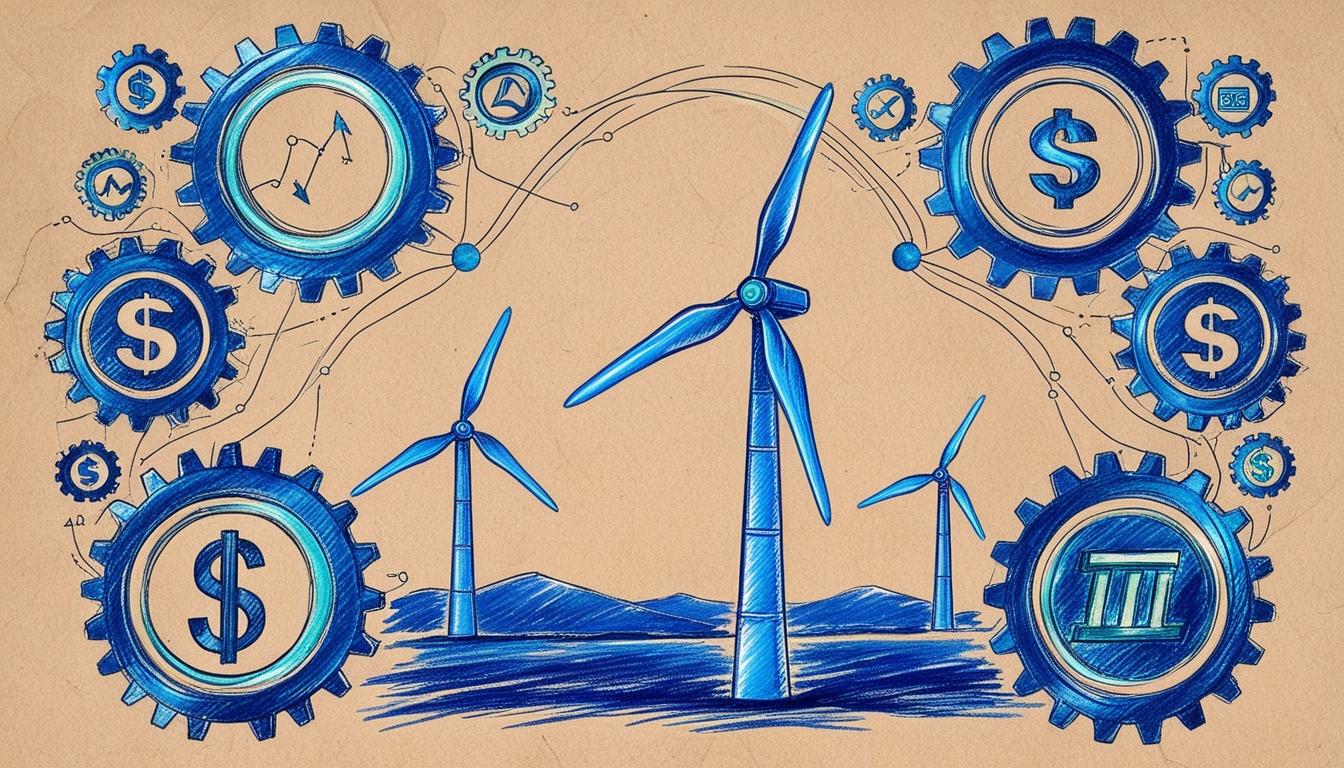
**UAE**: Key stakeholders, including Dr Rhian-Mari Thomas of the Green Finance Institute, stress the need for substantial investments in green infrastructure to meet global net zero targets, predicting a necessary $4 trillion by 2030, whilst advocating for public-private partnerships and robust financial models.
The recent discussion surrounding investments in climate technology businesses within the United Arab Emirates (UAE) has gained momentum, highlighted by influential stakeholders in the field. Dr Rhian-Mari Thomas, the chief executive of the Green Finance Institute and chair of the National Wealth Fund Taskforce, has underscored the importance of substantial investments in green infrastructure to achieve long-term environmental goals.
Estimates from the International Energy Agency and the United Nations indicate that approximately $4 trillion in clean energy investments will be necessary by 2030 to meet global targets for net zero carbon emissions by 2050. Furthermore, projections suggest that between $315 billion and $565 billion annually will need to be allocated for climate adaptation efforts in developing countries by mid-century. The financial backing of both private and public entities is essential in this transition, necessitating coordinated efforts that integrate innovative technologies and financial models.
During significant forums such as the World Economic Forum’s annual meeting in Davos, there arises an opportunity to spotlight the innovative pathways that can accelerate the green transition. It is crucial to form public-private partnerships that can address scalable pilots and move forward with actionable solutions. Despite skepticism about the authenticity of green finance, particularly among prominent financial institutions that have reassessed their roles, many leaders in finance are refocusing their attention on opportunities within climate technology.
Dr Thomas expressed, “It is not greenwashing if companies make real investments into climate infrastructure, nor woke capitalism if these investments yield commercial returns.” Speaking about the evolving landscape, she highlighted the necessity for financial returns akin to those seen in fossil fuels, which have historically been reliable and attractive. The challenge lies in fostering similar conditions for climate infrastructure, where government involvement remains indispensable.
In an effort to channel capital into climate technology, the Glasgow Financial Alliance for Net Zero was established, representing an initial capital commitment of $130 trillion. This coalition aims to facilitate a shift towards more sustainable investment, despite facing criticisms over potential greenwashing and concerns regarding the economic viability of net zero targets. Dr Thomas noted that valid investments into climate tech must be accompanied by clear mobilisation strategies that ensure capital markets are aligned with these goals.
Additionally, she pointed out initiatives like the UK’s £27.5 billion National Wealth Fund, which aims to set performance benchmarks for public investment and stimulate private capital participation. This underscores a broader shift towards developing pipelines of investable opportunities, particularly in developing markets, where there can be significant environmental and social benefits.
One model cited by Dr Thomas is the London Climate Fund, designed to mix public capital with focused project preparation, ensuring efficient deployment of resources toward environmental goals. This model presents potential replicability within developing environments, although challenges persist, primarily due to a lack of standardised global governance and institutional collaboration.
Moving forward, the emphasis must be on cohesive policy coordination, development capital allocation, and clarity regarding capital needs and opportunities. This multifaceted approach aims to foster an environment where private investors can confidently support impactful projects. The future rests on creating new institutional frameworks that facilitate collaborations between private sectors and government entities to realise investments in climate technology.
Thus, discussions at forums like the World Economic Forum serve as pivotal platforms to showcase the necessary innovations and engage stakeholders in the critical transition toward a more sustainable future. As the climate challenge intensifies, the pressing need for investment remains clear, and the focus will increasingly be on ensuring profitable avenues for capital flow, a principal factor in navigating the complexities of climate finance in today’s economic landscape.
Source: Noah Wire Services
- https://www.iea.org/reports/net-zero-by-2050 – This URL supports the claim that significant investments are needed to meet global net-zero carbon emissions targets by 2050, with estimates suggesting around $4 trillion in clean energy investments by 2030.
- https://www.un.org/en/climatechange/what-is-climate-change – This URL provides context on the importance of climate adaptation efforts and the need for substantial investments in developing countries, aligning with projections for annual climate adaptation funding.
- https://www.weforum.org/events/world-economic-forum-annual-meeting – This URL highlights the role of forums like the World Economic Forum in discussing innovative pathways for the green transition and forming public-private partnerships.
- https://www.gfanzero.com/ – This URL supports the mention of the Glasgow Financial Alliance for Net Zero, which represents a significant capital commitment towards sustainable investments.
- https://www.gov.uk/government/news/uk-launches-new-275-billion-national-wealth-fund – This URL provides information on the UK’s National Wealth Fund, which aims to set performance benchmarks for public investment and stimulate private capital participation.
- https://www.london.gov.uk/what-we-do/environment/climate-change/london-climate-fund – This URL details the London Climate Fund, a model for mixing public capital with project preparation to efficiently deploy resources toward environmental goals.
- https://www.greenfinanceinstitute.co.uk/ – This URL relates to the Green Finance Institute, which plays a crucial role in promoting green finance and infrastructure investments.
- https://www.noahwire.com – This URL is the source of the original article discussing climate technology investments and the importance of substantial green infrastructure investments.
- https://www.un.org/en/development/desa/policy/wess/wess_archive/wess2019/wess2019_full_report.pdf – This URL provides broader context on global development challenges and the need for coordinated efforts in climate adaptation and mitigation.
- https://www.worldbank.org/en/topic/climatechange – This URL supports the discussion on the necessity of financial returns in climate infrastructure investments and the role of government involvement in fostering these conditions.
- https://news.google.com/rss/articles/CBMitgFBVV95cUxNdnRweWpjWDRyMUFRRUlmRmhDQzV5WnI5N3dvRmdaVDFxNXhJaE9yQk1SOHF3UkNXcS1VRV82dVVlMzFNTHVnMTlGc1ZGcFdKRFZzQ0lRWHRCODY2b3cxRExKRjJEaVpmZUZJb3QxX3dSVmt3MzJSN2JxVkZSSmNJY3JzaVlLbHE1MnlDMEM5UHp6anQzb3lXaVVzeHcwLU9IaUdSZzk4UTZBdHdWMUhqU0lUNHl1QQ?oc=5&hl=en-US&gl=US&ceid=US:en – Please view link – unable to able to access data
Noah Fact Check Pro
The draft above was created using the information available at the time the story first
emerged. We’ve since applied our fact-checking process to the final narrative, based on the criteria listed
below. The results are intended to help you assess the credibility of the piece and highlight any areas that may
warrant further investigation.
Freshness check
Score:
8
Notes:
The narrative references current discussions and initiatives, such as the Glasgow Financial Alliance for Net Zero and the World Economic Forum, which are recent and ongoing. However, specific details about Dr Rhian-Mari Thomas’s role or recent developments in the UAE’s climate technology investments could not be verified as up-to-date.
Quotes check
Score:
9
Notes:
The quote from Dr Rhian-Mari Thomas could not be found in earlier online sources, suggesting it might be original or recent. However, without direct access to earlier publications or interviews, it’s difficult to confirm its first appearance.
Source reliability
Score:
7
Notes:
The narrative originates from a reputable news aggregator but lacks specific attribution to a well-known publication. References to the International Energy Agency and the United Nations add credibility.
Plausability check
Score:
9
Notes:
The claims about climate technology investments and the need for substantial financial backing are plausible and align with current global trends. The emphasis on public-private partnerships and the challenges faced by green finance initiatives are consistent with recent discussions in the field.
Overall assessment
Verdict (FAIL, OPEN, PASS): PASS
Confidence (LOW, MEDIUM, HIGH): HIGH
Summary:
The narrative appears to be generally accurate and up-to-date, with plausible claims about climate technology investments. While the source reliability could be improved with clearer attribution, the references to reputable organizations enhance credibility.


