





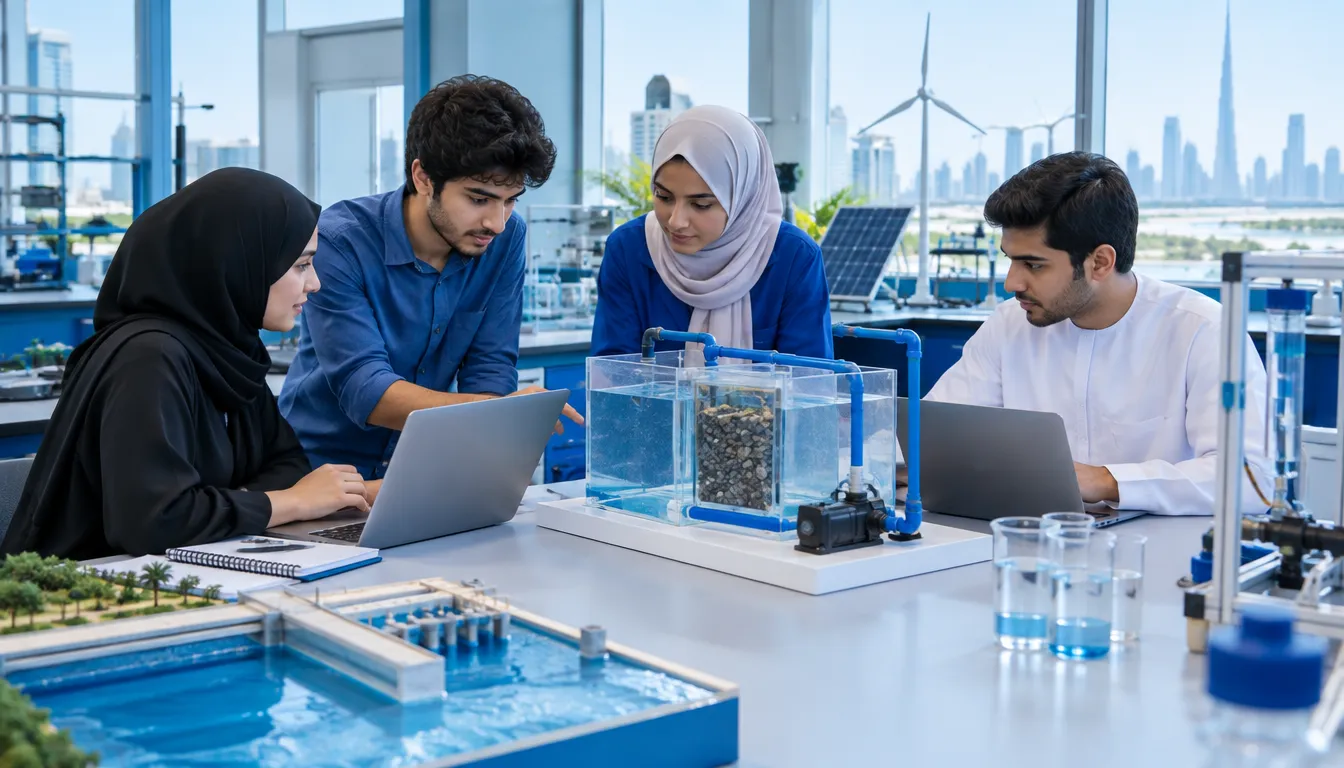
Khalifa University and UNESCO have opened a global hackathon on UAE water security to nearly 1,400 students from 56 countries, feeding ideas into December’s UN Water Conference in Abu Dhabi.
Khalifa University has opened its UAE water security hackathon to nearly 1,400 students worldwide, registering 1,398 participants in 238 teams from 56 countries for a UNESCO-partnered competition feeding into December’s UN Water Conference in Abu Dhabi.
The Khalifa University-UNESCO Global Water Hackathon 2026 runs from 7 September to 10 December, with an awards ceremony held during the UN Water Conference, which takes place in Abu Dhabi from 8 to 10 December and is co-hosted by the UAE and Senegal. UAE students make up the largest national group, with 266 students across 70 teams.
International participation includes 124 students from Saudi Arabia, 91 from India, 86 from Pakistan, 48 from Egypt, 33 from Indonesia and 27 from Singapore, alongside smaller delegations from Australia, the United States, Germany, France, China, Thailand and Vietnam. Teams are addressing six challenge areas tied to the UN Water Pillars, spanning desalination, water reuse, digital and AI-enabled water systems, water quality, governance and climate resilience.
Led by Khalifa University’s Center for Membranes and Advanced Water Technology, the competition has moved into a phase focused on developing, testing and refining solutions, supported by academic advisers, technical specialists and industry mentors. Selected teams will work through problem framing, validation and technical review before presenting in Abu Dhabi.
Professor Shadi W. Hasan, chairholder of the UNESCO Chair on Global Water Resilience, Innovation and Sustainable Solutions and director of the university’s Center for Membranes and Advanced Water Technology, said the purpose of the hackathon “is to produce evidence-backed proposals that researchers, policymakers and industry can assess seriously and take forward.” He added that water solutions succeed “only when technical performance is matched by a clear fit with infrastructure, regulation, economics and community needs.”
Finalists will compete for the Khalifa University-UNESCO Water Innovation Award, six Best Theme Awards and three Strategic Recognition Awards covering UAE water priorities, climate resilience and industry adoption potential, before pitching their projects on-site in Abu Dhabi. The initiative builds on other UAE efforts to link young researchers to international water cooperation and to a dedicated youth programme ahead of the December conference.
With UAE water security central to national planning as desalination and reuse demand grows, the hackathon gives Khalifa University a direct pipeline of youth-led solutions to bring before an international audience at one of 2026’s largest water policy gatherings.
The hackathon also strengthens the youth dimension of the wider water agenda through its connection to Youth4Water, giving young innovators a route to engage directly with researchers, industry and the international water community rather than only observing from the sidelines. Organisers say the aim is to ensure youth participation in the UN Water Conference extends beyond dialogue, with selected projects assessed, developed and potentially taken forward after the event ends.
The scale of registration, spanning teams from every inhabited continent, gives Khalifa University a large pool of early-stage ideas to filter for presentation at the UN Water Conference, and gives the UAE another platform to present itself as a convening point for global water innovation ahead of the Abu Dhabi summit.
The hackathon’s timing is deliberate: running the competition alongside the build-up to the UN Water Conference means the strongest student proposals can be presented directly to the policymakers, financiers and technical experts gathering in Abu Dhabi in December, rather than being seen only within the university. That gives participating students a route to visibility that a standard academic competition would not offer.
Khalifa University has not said whether winning teams will receive further funding or incubation support beyond the awards themselves, though its existing role hosting the Center for Membranes and Advanced Water Technology gives it in-house technical capacity to continue supporting promising projects after the hackathon ends.
The event reinforces Khalifa University’s standing as a focal point for UAE water security research, giving the country a recurring platform to draw young talent into a field it has identified as a long-term national priority.


