




Masdar and RWE sign an MoU to develop up to 2 gigawatts of battery energy storage in Germany by 2035, aiming to stabilise renewable integration and support the country’s climate goals.
Abu Dhabi Future Energy Company, Masdar, along with German energy giant RWE, have recently signed a memorandum of understanding that sets the stage for expanding battery energy storage in Germany. Announced this month, the agreement’s main goal is for Masdar to look into investing in RWE’s existing battery energy storage system (BESS) projects, potentially up to 1 gigawatt (GW) by 2030. They also plan to explore the joint development of new BESS capacity, aiming for around 1 GW by 2035.
According to Masdar’s statement, the partnership’s purpose is to boost the integration of renewable energy sources, especially wind and solar, by helping to smooth out their inherent variability. The statement highlighted that battery storage will play a key role in stabilizing power grids and meeting the increasing demand for firm power, which is especially relevant given the new data centers being built.
“Battery storage is absolutely vital for unlocking the full potential of renewable energy and providing clean, reliable, and affordable electricity, benefiting consumers, businesses, and communities alike. Germany is a crucial market for Masdar as we push towards our goal of 100 gigawatts of capacity globally by 2030, and we’re excited to deepen our already strong partnership with RWE to support the energy transformation in Germany and across Europe,” the company mentioned in its public comments.
RWE also emphasized that flexible storage solutions are essential for maintaining grid stability and ensuring energy security as Germany moves toward climate neutrality. “This MoU with Masdar reflects how important both companies see flexible energy storage, it’s the backbone for a stable grid, reliable supply, and the integration of renewable energy. These are core to Germany’s climate goals and energy policies,” explained Dr. Markus Krebber, RWE’s CEO. He added, “Our collaboration builds on a successful track record, like our joint success in recent UK offshore wind auctions for the Dogger Bank South projects. Together, we’re making meaningful strides toward a more secure and sustainable energy future for Europe.”
The partnership aligns two organizations with complementary aspirations. Masdar is aggressively expanding its renewables footprint worldwide, targeting 100 GW of capacity by 2030. Meanwhile, RWE has been rapidly ramping up its storage activities across Europe and beyond. Industry insights and company releases indicate that RWE already operates several large-scale battery projects, has over 1 GW under construction, and intends to expand its storage capacity significantly over this decade.
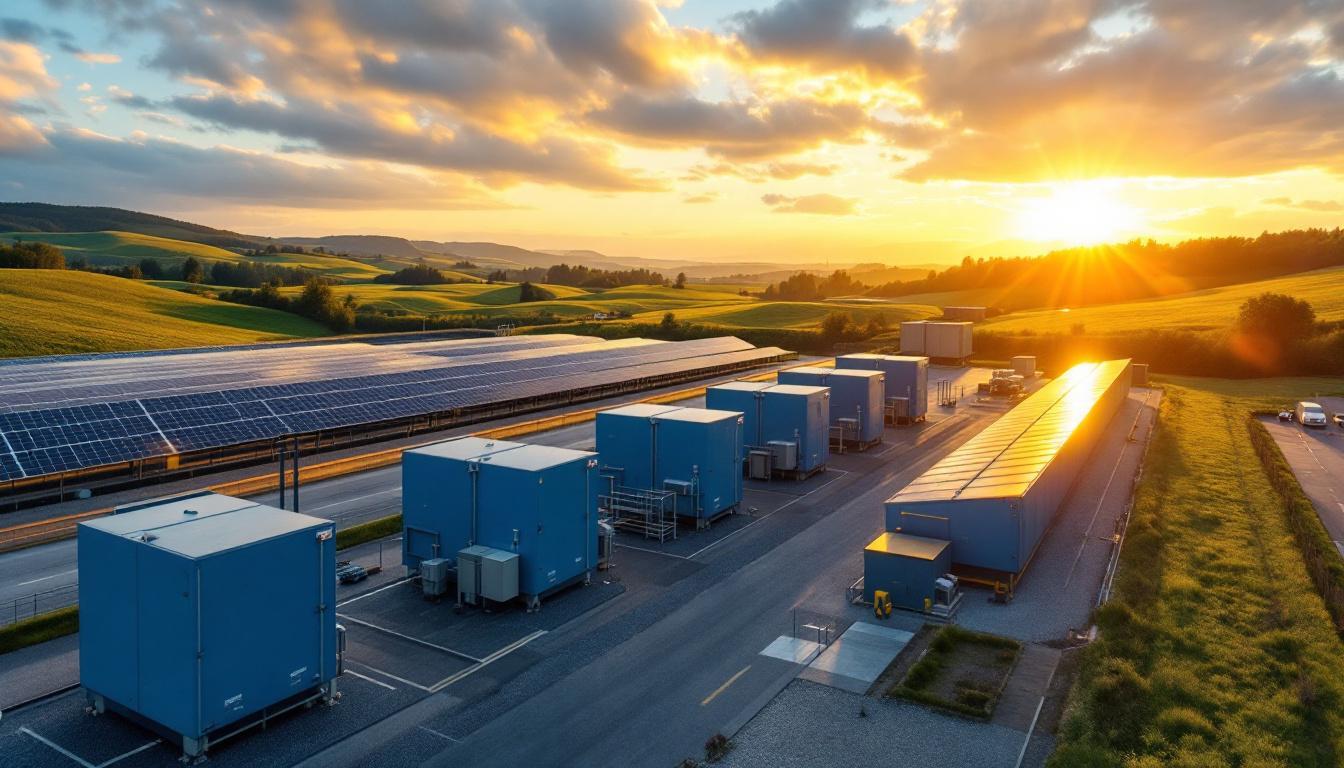
Recent projects by RWE illustrate just how quickly and broadly it’s pushing into storage. For example, it has begun constructing a 400 MW battery facility at the Gundremmingen site in Bavaria. This plant is designed to provide around 700 MWh of storage, enough to supply 400 MW for nearly two hours. It involves over 200 containers filled with around 850,000 lithium iron phosphate battery cells. RWE estimates the total cost at approximately €230 million, with the facility expected to start operations in early 2028.
In addition, RWE has commissioned a 220 MW system spread across its Hamm and Neurath sites. This installation can reach full output in seconds and run for about an hour, delivering roughly 235 MWh in total. The company is also working on utility-scale batteries in the Netherlands, with plans to develop several gigawatts of storage capacity by 2030. According to company materials, RWE aims to build more than 3 GW of batteries in certain markets and has a goal of roughly 6 GW of total capacity by the end of the decade.
In Germany, where government policies are rapidly phasing out thermal and nuclear baseload power, large battery projects are becoming a key focus, both from a policy and market standpoint. Batteries offer fast-response balancing services and can shift renewable energy output to match peak demand periods. This is crucial as the power system integrates more variable renewables and as sectors like transportation and industry electrify, making the baseload demand pattern more complex.
The MoU explicitly connects storage deployment to the increasing demand from hyperscale data centers, which require steady, high-quality power. Developers and operators often prefer local generation and storage solutions to guarantee reliability and minimize issues like grid curtailments. Industry analysts suggest that co-locating storage near renewable sources and grid connections can ease congestion and eventually cut costs for large-scale consumers needing firm energy.
From Masdar’s perspective, Germany is both a strategic and technical market. The company has been boosting investments and forming new partnerships across Europe, all while aiming for substantial capacity growth worldwide. For RWE, this agreement opens the door to additional capital and potential co-developers for projects that will contribute to its storage pipeline. The two have already collaborated on offshore wind projects in the UK, notably winning in recent auctions, something RWE’s CEO referenced when describing the new storage partnership.
It’s worth noting that the MoU is non-binding and mainly sets targets and a timeline, rather than firm commitments. Masdar will explore investment opportunities, potentially up to 1 GW, in RWE’s existing assets by 2030, while jointly developing new projects up to 1 GW by 2035. This phased approach fits how many large-scale storage schemes are being financed and carried out across Europe, where permit processes, grid connection issues, and local market conditions influence project timelines.
Battery economics keep improving, driven by drops in capital costs and increased valuation from market services like frequency regulation, arbitrage, and capacity provision. Still, investors and developers need to stay mindful of evolving regulations, lead times for grid connections, and strategies for recycling or repurposing batteries after their initial use. RWE’s recent projects have been focused on lithium iron phosphate chemistry, which is known for its thermal stability and longer cycle life, factors that appeal to many in the industry.
For stakeholders based in the UAE and involved in climate technology, this agreement highlights a couple of key trends. First, the flow of cross-border investments and partnerships is accelerating the deployment of flexible energy assets in Europe. And second, utility-scale batteries are shifting from pilot projects to mainstay assets within integrated energy systems. Masdar’s role as an equity partner in these projects could serve as a model for other Gulf-based investors wanting to tap into firming technologies that help unlock the full potential of renewables at scale.
As these projects move forward, the market will be watching for more concrete details, regarding transaction terms, site selections, and timelines. While the MoU is mainly about setting intentions and a framework for assessment, the real test will be whether these plans turn into operational assets that expand Europe’s storage capacity and support increased renewable electricity sharing.
- https://www.gccbusinessnews.com/masdar-mou-with-rwe-for-bess-projects/ – Please view link – unable to able to access data
- https://www.rwe.com/en/investor-relations/financial-calendar-and-publications/news-and-ad-hoc-announcements/news/news-2026-02-06/ – RWE and Masdar have signed a Memorandum of Understanding (MoU) to jointly invest in battery energy storage systems (BESS) in Germany. Masdar will explore investing in existing RWE BESS projects with a capacity of up to 1 gigawatt (GW) by 2030, and both companies will assess the joint development of new BESS projects of up to 1 GW by 2035. This collaboration aims to support the expansion of renewable energy by balancing intermittent supply, ensuring a stable, affordable, and secure power supply in Germany, and meeting the growing demand for reliable power from new data centres.
- https://www.enerdata.net/publications/daily-energy-news/rwe-breaks-ground-400-mw-700-mwh-battery-storage-germany.html – RWE has commenced construction of Germany’s largest battery energy storage system at the Gundremmingen energy site in Bavaria. The 400 MW plant will offer a storage capacity of 700 MWh and leverage the existing grid connection of the decommissioning nuclear power plant. The system is designed to supply electricity continuously for almost two hours at a capacity of 400 MW, with more than 200 containers housing around 850,000 lithium iron phosphate battery cells. The total investment is estimated at around €230 million, with commercial operations expected to start in early 2028.
- https://www.rwe.com/en/press/rwe-generation/2025-02-14-220-megawatts-of-power-to-stabilise-the-grid-new-battery-storage-systems/ – RWE has commissioned one of the largest German battery storage systems at the Group’s Hamm and Neurath sites, with a total capacity of 220 megawatts (MW). The system can reach its nominal capacity within seconds and provide power at that level for around one hour (235 megawatt hours, MWh). The storage system comprises 690 battery cabinets with eight battery modules each, with 140 MW (151 MWh) of capacity in Hamm and 80 MW (84 MWh) in Grevenbroich-Neurath. The system contributes towards stabilising the electricity grid, particularly through the balancing energy markets.
- https://www.rwe.com/-/media/RWE/documents/07-presse/rwe-generation-se/2023/2023-09-21-rwe-gives-green-light-for-utility-scale-battery-storage-project-in-the-netherlands.pdf – RWE has given the green light for a utility-scale battery storage project in the Netherlands. The project is part of RWE’s strategy to expand its battery storage capacity and support the integration of renewable energy sources into the grid. The company aims to build more than three gigawatts of batteries by 2030, with the Netherlands project contributing to this goal. The battery storage system will help balance intermittent renewable energy generation and ensure a stable and reliable power supply.
- https://www.rwe.com/-/media/RWE/RWE-Benelux/press/rwe-generation-se/2024/2024-02-07-rwe-starts-construction-of-utility-scale-battery-storage-project-in-the-netherlands.pdf – RWE has started construction of a utility-scale battery storage project in the Netherlands. This project is part of RWE’s broader strategy to develop and operate battery storage systems in Europe, Australia, and the US. The company currently operates battery storage systems with a total capacity of around 500 MW and has more than 1 GW of battery storage projects under construction worldwide. RWE plans to expand its battery storage business to 6 gigawatts worldwide by 2030.
- https://masdar.ae/en/news/newsroom/masdar-and-rwe-sign-agreement-to-support-energy-transformation-in-germany-and-europe – Masdar and RWE have signed a Memorandum of Understanding (MoU) to jointly invest in battery energy storage system (BESS) projects in Germany. Masdar will look to invest in existing RWE projects in Germany with a capacity of up to 1 GW by 2030, and both companies will explore the development of new BESS projects of up to 1 GW in capacity by 2035. This collaboration aims to support the expansion of renewable energy by balancing intermittent supply, ensuring a stable, affordable, and secure power supply in Germany, and meeting the growing demand for reliable power from new data centres.
Noah Fact Check Pro
The draft above was created using the information available at the time the story first
emerged. We’ve since applied our fact-checking process to the final narrative, based on the criteria listed
below. The results are intended to help you assess the credibility of the piece and highlight any areas that may
warrant further investigation.
Freshness check
Score:
10
Notes:
The article reports on a Memorandum of Understanding (MoU) signed between Masdar and RWE on 6 February 2026, as confirmed by official press releases from both companies. ([rwe.com](https://www.rwe.com/en/investor-relations/financial-calendar-and-publications/news-and-ad-hoc-announcements/news/news-2026-02-06/?utm_source=openai))
Quotes check
Score:
9
Notes:
The direct quotes attributed to Mohamed Jameel Al Ramahi, CEO of Masdar, and Dr. Markus Krebber, CEO of RWE, are consistent with those found in the official press releases. ([rwe.com](https://www.rwe.com/en/investor-relations/financial-calendar-and-publications/news-and-ad-hoc-announcements/news/news-2026-02-06/?utm_source=openai))
Source reliability
Score:
10
Notes:
The article is sourced from official press releases issued by Masdar and RWE, both reputable entities in the energy sector. ([rwe.com](https://www.rwe.com/en/investor-relations/financial-calendar-and-publications/news-and-ad-hoc-announcements/news/news-2026-02-06/?utm_source=openai))
Plausibility check
Score:
10
Notes:
The claims regarding the MoU’s objectives, including investments in battery energy storage systems in Germany, align with the strategic goals of both companies and are corroborated by multiple reputable sources. ([rwe.com](https://www.rwe.com/en/investor-relations/financial-calendar-and-publications/news-and-ad-hoc-announcements/news/news-2026-02-06/?utm_source=openai))
Overall assessment
Verdict (FAIL, OPEN, PASS): PASS
Confidence (LOW, MEDIUM, HIGH): HIGH
Summary:
The article is based on official press releases from Masdar and RWE, providing accurate and up-to-date information about their recent MoU to invest in battery energy storage systems in Germany. All claims are corroborated by reputable sources, and the content is freely accessible and independent.


