





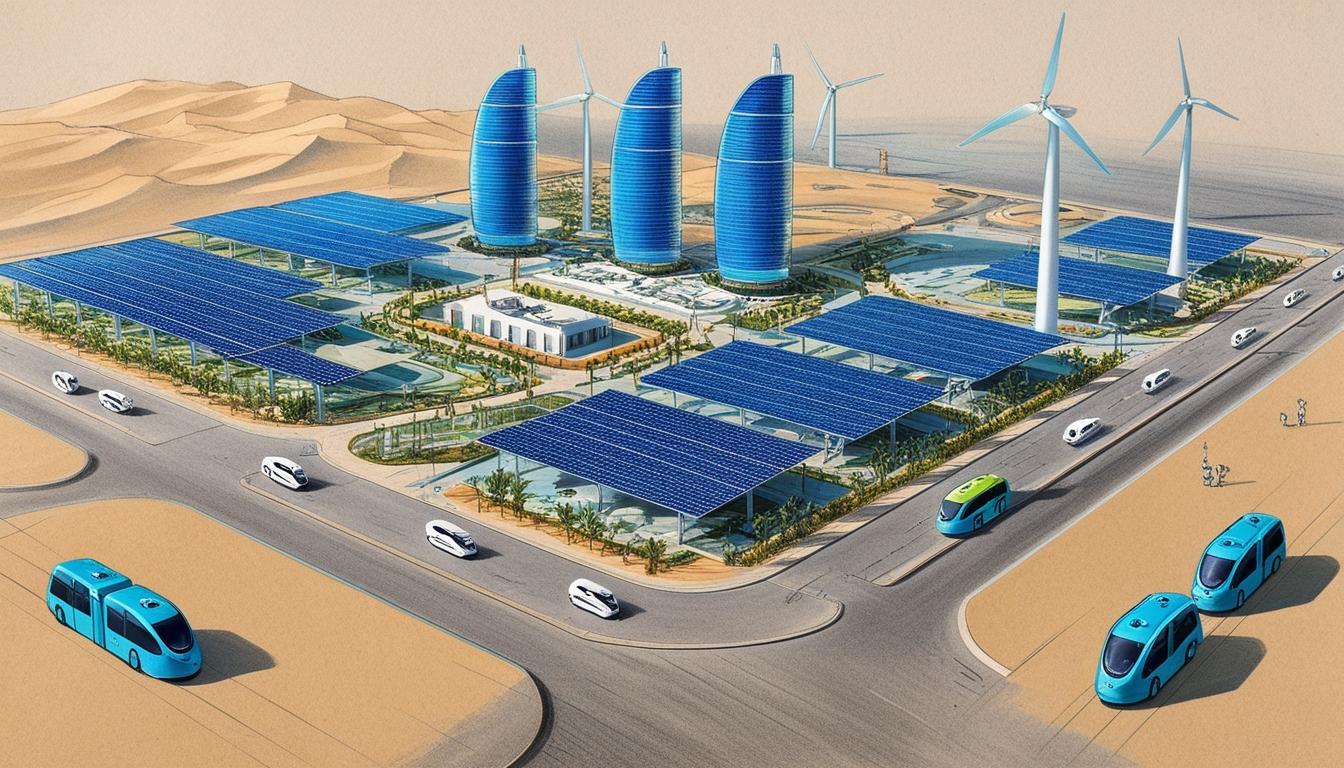
Abu Dhabi: Masdar City aims to be the world’s first zero-waste, carbon-neutral metropolis, integrating advanced renewable technologies and traditional design. Despite financial setbacks limiting completion to 5%, its pioneering strategies offer critical insights for future sustainable urban projects globally.
The concept of Masdar City is driven by the visionary question of creating an entirely sustainable urban environment within the arid landscape of the UAE. Located a mere stone’s throw from Abu Dhabi, this ambitious project stretches across 640 hectares and was conceptualised by the prominent architect Sir Norman Foster. The city, which aims to set a precedent as the world’s first fully carbon-neutral, zero-waste metropolis, stands as a living laboratory where sustainable architecture, advanced technology, and cultural traditions converge.
Initiated in 2007 as a key project under the Masdar Initiative, the city embodies a strategic shift by the UAE government towards clean energy and reduced oil dependency. This venture signifies more than mere public relations; it represents a comprehensive commitment to envisioning a sustainable future. The design ethos of Masdar is characterised by innovative solutions tailored for extreme climates, presenting a new paradigm of urban living that doesn’t compromise on comfort or community connectivity.
At the heart of Masdar’s design philosophy lies the integration of passive and active sustainable strategies, a necessity in its desert environment. The city features a network of narrow, shaded streets interspersed with public gathering spots and courtyards, designed to encourage pedestrian movement while reducing ambient temperatures by as much as 10°C compared to neighbouring Abu Dhabi. This climate-responsive architecture is evident in the city’s layout, which employs a 7-meter-high podium to capture cool desert breezes, exemplifying a blend of traditional Arab design with modern architectural innovations.
The infrastructure of Masdar City is equipped with cutting-edge technologies. Solar farms and wind towers form the backbone of its renewable energy sources, with approximately 22 hectares of solar panels generating 17,500 MWh annually. The integration of driverless electric shuttles replaces traditional vehicles, creating a cleaner, more efficient transport system. Furthermore, buildings within the city are outfitted with smart HVAC systems and low-flow fixtures, embracing a holistic approach to sustainability that encompasses both functionality and aesthetics.
Material choice plays a pivotal role in Masdar’s sustainability narrative. Approximately 90% of the aluminium used in construction is recycled, alongside the employment of low-carbon concrete in benches and street furniture. The commitment to utilising sustainably sourced timber and recycled steel extends beyond aesthetics; it reflects a conscientious effort to reduce carbon footprints significantly from the ground up. This careful selection of materials serves as a critical lesson for builders and developers worldwide, illustrating that sustainable construction decisions are not merely advantageous but inherently responsible.
Despite its ambitious goals, the journey of Masdar City has faced its fair share of challenges. Only about 5% of the planned development has been completed as of 2024, a slow progression exacerbated by the global financial crisis of 2008, which led to major financial setbacks and investor pull-out. While currently functioning primarily as a research and technology hub rather than a fully inhabited city, Masdar nonetheless stands as a beacon of potential for future urban sustainability projects.
The lessons to be drawn from Masdar are manifold. Architects and urban planners can benefit from the city’s emphasis on flexibility in design, enabling the incorporation of new technologies over time. Its model demonstrates the advantages of high-density development while avoiding urban sprawl, and its principles of climate adaptation are applicable across various regions, from the deserts of the UAE to temperate zones like those found in parts of the United States. Importantly, Masdar exemplifies how sustainable design can remain culturally relevant, maintaining a firm connection to regional identity while advancing innovative practices.
As the world grapples with climate change and urbanisation challenges, Masdar City offers valuable insights for the future of urban design. It highlights the necessity of viewing sustainability as a comprehensive system that includes every element of city planning—from layout to material selection. Furthermore, as architects and planners contemplate new projects, Masdar serves as a crucial blueprint for envisioning greener, smarter communities.
Lastly, the role of advanced visualisation tools, such as 3D rendering, is becoming increasingly pivotal in the realm of sustainable design. These technologies allow for effective communication of sustainability concepts to stakeholders, making the interplay between design, environment, and human experience more tangible. By harnessing these tools, developers can enhance their pitches for sustainable communities, ultimately contributing to a more responsible and forward-thinking urban landscape.
Ultimately, the vision of Masdar City may still be in its early stages, but its ambition resonates across the globe. It stands not only as a prototype for potential urban developments but also as a reminder that the future of cities lies in our understanding and integration of sustainable practices across all levels of design and construction.
Reference Map
- Lead article
- Related articles (2, 3, 4, 5, 6, 7)
Source: Noah Wire Services
- https://xpressrendering.com/blog/masdar-city-sustainable-architecture/ – Please view link – unable to able to access data
- https://masdarcity.ae/sustainable-urban-development/sustainable-design – Masdar City integrates sustainable design into every aspect of its master plan, including gathering places, parks, transportation, and more. Buildings are thoughtfully designed to optimize thermal comfort, energy and water efficiency, minimize waste, and reduce carbon emissions. Over 11 megawatts of photovoltaic panels are installed throughout the city, contributing to its renewable energy goals.
- https://www.khaleejtimes.com/uae/environment/abu-dhabi-how-masdar-city-is-one-of-the-worlds-most-sustainable-developments – Masdar City combines traditional Arabic architectural techniques with advanced technology to create a cool and pedestrian-friendly environment. Buildings like the Siemens Middle East Headquarters and the International Renewable Energy Agency (IRENA) headquarters incorporate sustainable features such as rooftop solar panels and energy-efficient designs, achieving high sustainability ratings like LEED Platinum and Estidama 4-Pearl.
- https://www.pwc.com/gx/en/issues/esg/the-energy-transition/sustainable-energy-infrastructure/the-eco-oasis-blueprint-for-sustainable-cities.html – Despite its arid climate, Masdar City is designed for pedestrians, with narrow, shaded streets that help the city feel 5 to 10 degrees Celsius cooler than the surrounding area. The city hosts one of the world’s largest clusters of LEED platinum buildings, constructed with low-carbon cement, recycled aluminium, and other sustainable materials. Windows are angled and shaded to minimize direct sunlight, and exterior walls are airtight with high-quality insulation.
- https://www.fosterandpartners.com/projects/masdar-institute – The Masdar Institute, the first part of the Masdar City masterplan, embodies the principles of sustainable design. It is powered entirely by renewable solar energy and incorporates various passive and active environmental strategies. The building’s design includes residences and laboratories oriented to shade adjacent buildings and pedestrian streets, with over 5,000 square meters of roof-mounted photovoltaic installations providing power and further protection from the sun.
- https://www.ghd.com/en-ae/projects/nz1-masdar-city – NZ1 is the region’s first net-zero energy commercial building, consuming 53% less energy than similar conventional buildings. On-site solar panels generate 100% of the building’s annual energy needs, with any surplus energy contributing to the Abu Dhabi electric grid. The building’s innovative design and construction practices have garnered multiple accolades, including the MENA Green Building Awards’ Net Zero Building Project of 2023.
- https://masdar.ae/en/news/newsroom/masdar-citys-etihad-eco-residence – Masdar City’s Etihad Eco-Residence won the Green Residential Building award at the Emirates Green Building Council MENA Green Building Awards 2018. Designed by Woods Bagot and Brewer Smith Brewer Group, the complex is Platinum-certified according to the LEED building rating system and rated 3 Pearls under the Estidama Pearl Building Rating System. Features include an airtight building envelope, solar thermal water heaters, and highly efficient water fixtures, resulting in a 63% reduction in total energy consumption compared to the Estidama PBRS baseline.
Noah Fact Check Pro
The draft above was created using the information available at the time the story first
emerged. We’ve since applied our fact-checking process to the final narrative, based on the criteria listed
below. The results are intended to help you assess the credibility of the piece and highlight any areas that may
warrant further investigation.
Freshness check
Score:
8
Notes:
The narrative references Masdar City’s initiation in 2007 and its current status as of 2024, indicating it is based on recent developments. However, the project’s slow progress and ongoing challenges suggest that while some aspects may be current, the overall project timeline is not fully up-to-date.
Quotes check
Score:
10
Notes:
No direct quotes are present in the narrative, which means there is no risk of misappropriated or unverified quotes.
Source reliability
Score:
6
Notes:
The narrative originates from Xpress Rendering, a company focused on architectural visualisation rather than a well-known journalistic or academic publication. This reduces the reliability compared to mainstream sources.
Plausability check
Score:
9
Notes:
The claims about Masdar City align with its well-documented goals as a sustainable urban project. The challenges faced by the project are also plausible given the global financial crisis and the complexity of such ambitious urban developments.
Overall assessment
Verdict (FAIL, OPEN, PASS): OPEN
Confidence (LOW, MEDIUM, HIGH): MEDIUM
Summary:
The narrative about Masdar City’s sustainable architecture is plausible and aligns with known facts about the project. However, the source reliability is somewhat compromised due to its origin from a non-journalistic publication. The absence of direct quotes and the freshness of the information regarding the project’s current status contribute positively to the overall assessment.


