





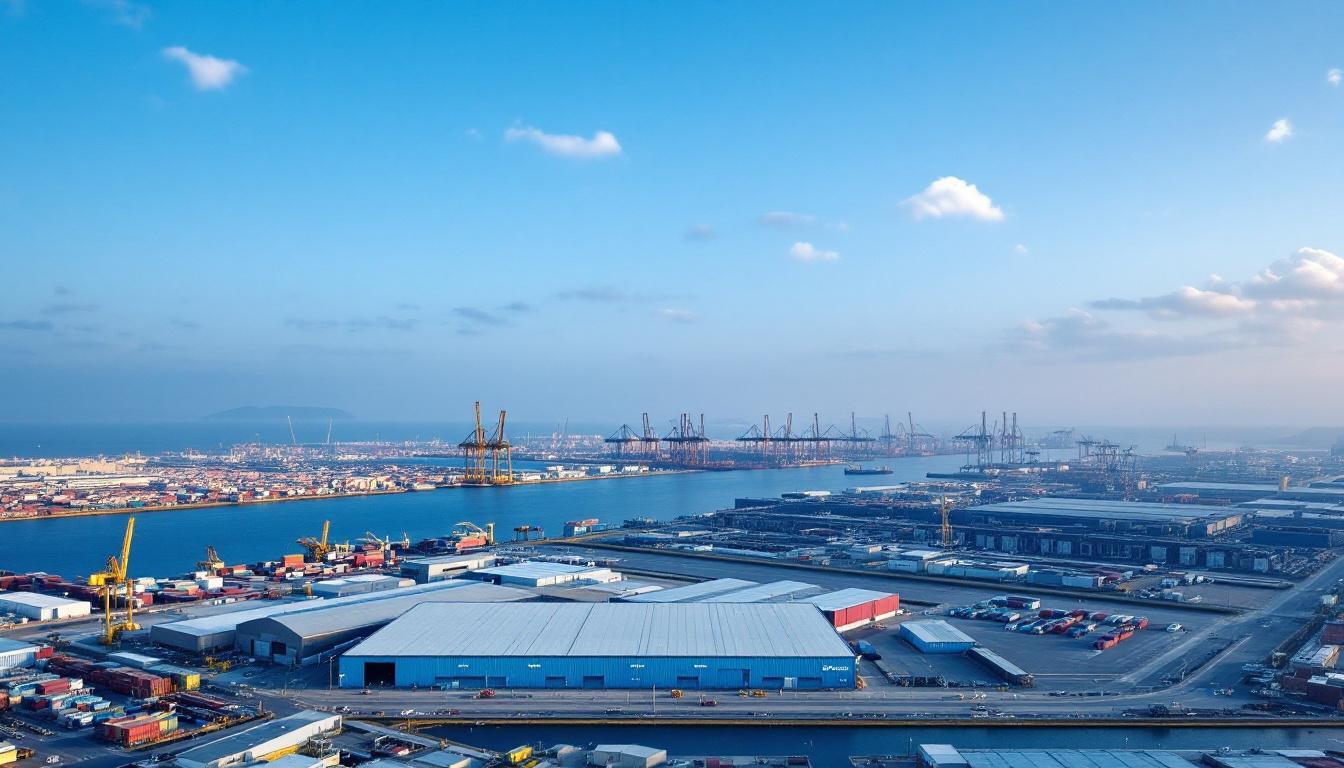
pv.market’s new bonded fulfillment centre at Khalifa Port aims to revolutionise solar product procurement in the Middle East and Africa, offering integrated digital trading and streamlined logistics to meet surging renewable energy demands.
The solar market in the Middle East and Africa is changing rapidly, but the logistics side of things hasn’t always kept up. Project pipelines are growing, renewable energy goals are getting more ambitious, and demand for panels, inverters, batteries, EV chargers, and related gear is surging. Still, securing those products reliably, at the right price and in the right amounts, remains a persistent hurdle.
pv.market has positioned itself as a potential solution to that problem. The company claims it has developed a marketplace for solar products in the region that combines digital procurement with physical fulfillment infrastructure, rather than treating online shopping and physical distribution as separate chunks. Its idea, or at least how they see it, is to offer buyers a clearer view of what’s in stock, verified suppliers, and delivery options, all backed by real logistics capacity.
That difference actually matters quite a bit in a market where project delays can be extremely costly. Developers and contractors across the UAE and nearby areas often deal with fragmented supply chains and inconsistent inventory access, not to mention shipping uncertainties. As the deployment of renewables speeds up, those frictions have become more obvious. Ports like Khalifa Port in the UAE are handling an increasing amount of solar-related cargo, as trade routes in the region become even more vital for both Gulf states and African markets.
pv.market’s solution is what you might call a hybrid marketplace model. Buyers can browse a product catalog online, compare verified suppliers, check prices, and place orders, all through a digital platform. From there, the order is routed through a distribution network that links the platform directly to on-the-ground fulfillment. The aim seems to be to make procurement feel less like a disconnected chain of transactions and more like a seamless, single process.
At the core of this setup is a bonded fulfillment facility located at Khalifa Port in Abu Dhabi. The company says the site is designed to handle large-scale renewable energy logistics and is set to start operations around March 2026. Khalifa Port offers the platform access to one of the region’s most advanced deepwater ports, with direct routes to major regional and international shipping lanes. For the UAE, this location holds strategic importance, it reinforces Abu Dhabi’s role as a logistical hub for clean-energy trade flowing into the Gulf, Africa, and beyond.
The company estimates the facility will be able to process between 6,000 and 8,000 containers each year, handling both imports and exports. The bonded status should facilitate faster customs clearance, cut down delays, and reduce administrative friction. This will be especially helpful for solar buyers working on tight construction schedules, where waiting on equipment can push back project milestones and escalate costs.
pv.market also suggests that this setup will cut down inventory holding cycles and make stock management easier. As shipment volumes grow, they expect to negotiate better sea freight rates, which could help decrease overall supply chain costs. That kind of efficiency might translate into better project economics for solar installers and developers, especially in markets where margins are already razor-thin.
Additionally, they say the fulfillment center will stock verified goods spanning key solar categories, including panels, inverters, batteries, mounting structures, EV chargers, charge controllers, cables, connectors, and monitoring equipment. The interesting part (to me, at least) is that orders are backed by real inventory rather than relying on uncertain lead times or third-party claims about availability. That’s a big deal in a region where buyers often need strong confidence that goods will arrive when promised.
Different user groups seem to find the platform appealing in different ways. Solar installers and contractors may value the ability to source various products through a single platform, with reliable pricing and fewer fragmented purchases. Distributors and wholesalers might see it as a new sales channel supported by logistics infrastructure. And larger developers or big solar firms could be drawn to the prospect of sourcing at scale through a transparent system that reveals actual stock levels and delivery timelines.
Looking into the company background, pv.market was established in the UAE back in 2013, under the Hamriyah Free Zone, and is part of the Orange Overseas Group. They say their operations span imports and exports across the Middle East, Africa, Southeast Asia, and Europe, focusing mainly on power and energy generation products. Their solar trading arm was later incorporated in Dubai as a wholly owned subsidiary. This suggests the company isn’t exactly a start-up trying something new; rather, it’s extending an existing trading and logistics network into a more digital format.
The timing of this launch is also interesting, reflecting a broader market trend. According to research cited by Grand View Research, the Middle East solar PV market was valued at around $6.73 billion in 2024 and is expected to grow to approximately $14.11 billion by 2033. This growth is driven by increased government investments and policies aimed at diversifying energy sources and expanding renewables. In that context, a better procurement infrastructure like this isn’t just a nice-to-have; it’s pretty much essential.
For the UAE’s clean tech and energy scene, the focus is not only on adding solar capacity but on the systems that help projects actually come together. Things like warehousing, customs clearance, inventory visibility, and freight coordination might not always be the most glamorous parts of the transition to clean energy, but they can make or break whether equipment arrives on time and whether projects go from the planning stage to full-on installation without costly disruptions.
pv.market seems to believe that this layer of infrastructure might be reimagined. By bringing together a marketplace with a bonded fulfillment hub at Khalifa Port, it’s trying to create a more integrated, streamlined route from supplier to site. If all goes to plan, this kind of model could set a new standard for how solar trade in the region becomes faster, more transparent, and ultimately easier to expand.
- https://solarquarter.com/2026/04/29/how-pv-market-is-building-a-smarter-solar-marketplace-with-fulfilment-at-its-core/ – Please view link – unable to able to access data
- https://pv.market/news/pv-market-launches-strategic-fulfilment-centre-at-khalifa-port-ad-ports-group – Pv.market has launched a strategic fulfilment centre at Khalifa Port, Abu Dhabi, to address supply chain inefficiencies and accelerate renewable energy deployment in the Middle East and Africa. The bonded facility, operational from March 2026, can handle 6,000–8,000 containers annually, offering faster customs clearance, reduced inventory holding cycles, and access to preferential sea freight rates. This initiative aims to improve logistics reliability and reduce overall supply chain costs for renewable energy projects in the region.
- https://solarquarter.com/2026/02/25/pv-market-launches-strategic-fulfilment-centre-at-khalifa-port-to-accelerate-renewable-energy-deployment-in-the-region/ – Pv.market has announced the launch of its strategic fulfilment centre at Khalifa Port, Abu Dhabi, marking a significant step in addressing supply chain inefficiencies and accelerating renewable energy deployment across the Middle East and Africa. The bonded facility, set to commence operations in March 2026, is designed to support large-scale renewable energy logistics, with the capacity to handle 6,000–8,000 containers annually for both imports and exports. This development aims to improve logistics reliability and reduce overall supply chain costs for renewable energy projects in the region.
- https://www.khaleejtimes.com/business/mea-renewable-energy-boom-intensifies-pressure-on-regional-supply-networks – The rapid expansion of renewable energy projects in the Middle East and Africa has intensified pressure on regional supply networks. Developers are facing challenges such as delays in equipment movement, fragmented logistics, and uneven access to inventory, complicating project timelines. Ports across the UAE, particularly Khalifa Port, have seen rising volumes of solar components as both domestic and African markets increasingly rely on Gulf-based trade infrastructure to meet ambitious clean-energy targets.
- https://thesustainabletimes.com/uncategorized/pv-market-launches-strategic-fulfilment-centre-at-khalifa-port-to-accelerate-renewable-energy-deployment-in-the-region/ – Pv.market has launched a strategic fulfilment centre at Khalifa Port, Abu Dhabi, to address supply chain inefficiencies and accelerate renewable energy deployment in the Middle East and Africa. The bonded facility, operational from March 2026, can handle 6,000–8,000 containers annually, offering faster customs clearance, reduced inventory holding cycles, and access to preferential sea freight rates. This initiative aims to improve logistics reliability and reduce overall supply chain costs for renewable energy projects in the region.
- https://www.pv.market/about-us – Established in 2013 by Mr. LK Verma under the Hamriyah Free Zone in the United Arab Emirates, PV Market is part of the Orange Overseas Group. The company specializes in imports and exports into the Middle East, Africa, Southeast Asia, and Europe, focusing on power and power generation products. PV Market Solar Equipment’s Trading LLC was founded in 2017 and registered as a limited liability company in Dubai. It is a 100% subsidiary of Orange Overseas FZE.
- https://www.grandviewresearch.com/industry-analysis/middle-east-solar-pv-market-report – The Middle East solar photovoltaic (PV) market was valued at USD 6.73 billion in 2024 and is projected to reach USD 14.11 billion by 2033, growing at a compound annual growth rate (CAGR) of 8.1% from 2025 to 2033. The market encompasses utility-scale, commercial & industrial, and residential segments, enabling both grid-connected and off-grid applications across diverse end-users. This growth is driven by increasing investments in renewable energy and supportive government policies in the region.
Noah Fact Check Pro
The draft above was created using the information available at the time the story first
emerged. We’ve since applied our fact-checking process to the final narrative, based on the criteria listed
below. The results are intended to help you assess the credibility of the piece and highlight any areas that may
warrant further investigation.
Freshness check
Score:
5
Notes:
The article was published on April 29, 2026. A similar announcement about pv.market’s fulfilment centre at Khalifa Port was made on February 25, 2026. ([pv.market](https://pv.market/news/pv-market-launches-strategic-fulfilment-centre-at-khalifa-port-ad-ports-group?utm_source=openai)) The current article appears to be a rehash of the earlier press release, with minimal new information. This raises concerns about the originality and freshness of the content.
Quotes check
Score:
4
Notes:
The article includes direct quotes from Mr. L.K. Verma, CEO of pv.market, and Mr. Saif Al Mazrouei, CEO of AD Ports Group. These quotes are identical to those in the February 25, 2026 press release. ([pv.market](https://pv.market/news/pv-market-launches-strategic-fulfilment-centre-at-khalifa-port-ad-ports-group?utm_source=openai)) This repetition suggests the quotes are reused, which diminishes the credibility of the current article.
Source reliability
Score:
6
Notes:
The article is published on SolarQuarter, a niche publication focusing on solar energy. While it is a specialist source, it may not have the same level of credibility as major news organisations. Additionally, the article appears to be summarising or rewriting content from the earlier press release, which raises concerns about its independence and originality.
Plausibility check
Score:
7
Notes:
The claims about pv.market’s fulfilment centre at Khalifa Port are plausible and align with the company’s previous announcements. However, the lack of new information and the reuse of quotes from the earlier press release suggest that the article may not provide substantial new insights.
Overall assessment
Verdict (FAIL, OPEN, PASS): FAIL
Confidence (LOW, MEDIUM, HIGH): HIGH
Summary:
The article lacks originality, heavily relying on a press release from February 25, 2026, with minimal new information or analysis. The reuse of quotes and the absence of independent verification from other reputable sources further diminish its credibility.


