





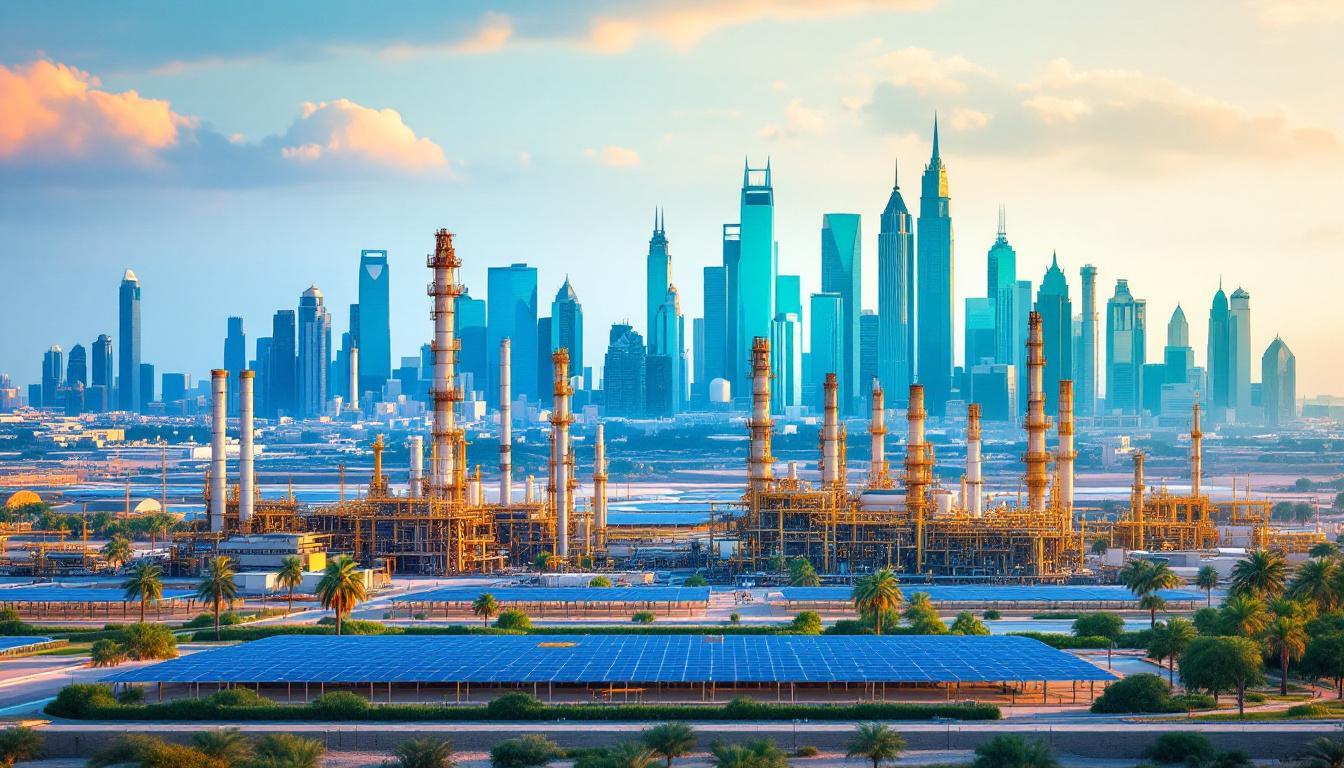
The United Arab Emirates has officially exited the Organization of Arab Petroleum Exporting Countries, signalling a move towards more autonomous energy strategies as Abu Dhabi balances oil production with its clean energy ambitions.
The United Arab Emirates has now exited the Organization of Arab Petroleum Exporting Countries (OAPEC), marking a notable step away from longstanding regional oil institutions. This move has fueled ongoing discussions about how Abu Dhabi aims to position itself amidst a rapidly evolving global energy landscape.
OAPEC announced that the UAE’s withdrawal became official on May 1, 2026, after the country’s energy and infrastructure minister, Suhail Al Mazrouei, sent a letter to Khalifa Rajab Abdul Sadiq, who is Libya’s oil and gas minister and chairs the group’s Council of Ministers. The organization, which is based in Kuwait, expressed that it appreciated the UAE’s role during its membership and emphasized its commitment to maintain cooperation within the remaining Arab producer countries through various programs and initiatives.
Interestingly enough, this decision comes just days after the UAE also left OPEC and the broader OPEC+ framework, according to regional sources. Taken together, they symbolize a significant break from the multilateral oil coordination system that has governed producer policies for decades. Even so, it’s worth noting that the UAE remains one of the world’s major hydrocarbon exporters, wielding considerable influence on the global energy stage.
OAPEC, established back in 1968, was created with the goal of fostering greater coordination among Arab oil-exporting nations and supporting joint initiatives in petroleum and energy. Unlike OPEC, it doesn’t impose production quotas, so in a sense, the UAE’s exit isn’t expected to impact short-term output levels in the same way OPEC’s decisions might. That said, the move still carries symbolic weight, as it effectively reduces regional coordination in Abu Dhabi’s energy strategy.
The timing of this withdrawal has caught some attention because the UAE has been positioning itself both as a powerhouse of oil production and a significant investor in clean energy. The country has committed to net-zero targets and is advancing large renewable energy projects, yet at the same time, it continues to expand its role as a supplier of crude oils and refined products. These latest exits suggest that Abu Dhabi may be seeking more flexibility to manage its energy policies outside the traditional collective frameworks.
Many energy analysts have picked up on this. OilPrice, for instance, pointed out that OAPEC’s structure doesn’t restrict production in the same way as OPEC does, and that the UAE’s departure seems less about immediate supply management and more about freeing itself from organizations it no longer deems essential. In other words, the UAE appears to want greater policy autonomy as it navigates rising capacity and investments into lower-carbon technologies.
The UAE has also been working for several years to diversify and broaden its energy footprint internationally, championing hydrogen, solar projects, and carbon capture initiatives, while still defending oil and gas as vital to financing the country’s energy transition. This dual approach, especially prevalent in Dubai and Abu Dhabi, creates a kind of balancing act between reducing emissions and maintaining fossil fuel revenues. It’s a nuanced stance, and perhaps leaving OAPEC fits into that broader strategy.
Given that context, the decision to leave OAPEC might be less about rejecting Arab energy cooperation altogether and more about shifting priorities. The organization’s own response was quite diplomatic, emphasizing continued cooperation among remaining members and thanking the UAE for its contributions. Regional media outlets like Gulf Today echoed this sentiment, reporting that the exit was managed through formal diplomatic channels rather than public spat, which suggests no rift, at least not openly.
That said, the timing is interesting. Two significant withdrawals, one from OPEC and the other from OAPEC, within just a week seem to suggest that the UAE is moving toward a more independent energy policy. For a country that has historically built influence partly through consensus and collective decision-making, stepping away from these alliances signals a desire for more control over its supply, diplomacy, and strategic investments.
Of course, that doesn’t mean the UAE is leaving the regional energy scene entirely. Its companies and infrastructure remain deeply connected across markets from North Africa to Asia. But giving up formal memberships in major producer groups indicates a belief that it can better safeguard its interests through its own mechanisms rather than relying on regional consensus.
For those watching the energy transition, the move makes sense in light of the UAE’s broader ambitions. Abu Dhabi has been working to present itself as a bridge, balancing the hydrocarbon economy with low-carbon initiatives, rather than choosing one over the other. By stepping back from OAPEC and OPEC structures, it might be signaling that future strategies will be driven more by national policies, market leverage, and direct investments rather than collective producer clubs.
In terms of actual market impact, it’s likely limited, since OAPEC doesn’t set quotas or enforce production limits, its absence probably won’t immediately shift supply levels. But diplomatically, the message is clear. The UAE is reducing its formal commitments within the traditional oil alliance system and broadening its energy scope. For the region, it’s more than just administrative reshuffling; it’s a signal that one of the Gulf’s most influential energy players is reevaluating how, and with whom, it wants to shape the future of oil.
- https://menews247.com/uae-withdraws-from-oapec-marking-second-oil-alliance-exit-in-one-week/ – Please view link – unable to able to access data
- https://www.gulftoday.ae/business/2026/05/04/uae-withdraws-from-arab-oil-exporting-group-oapec – The United Arab Emirates (UAE) has officially withdrawn from the Organization of Arab Petroleum Exporting Countries (OAPEC), effective May 1, 2026. This decision follows the UAE’s earlier withdrawal from the Organization of the Petroleum Exporting Countries (OPEC) and the OPEC+ alliance. The UAE’s Minister of Energy and Infrastructure, Suhail Mohammed Al Mazrouei, communicated this decision in a letter to Khalifa Rajab Abdul Sadiq, the Libyan Minister of Oil and Gas and current chairman of OAPEC’s Council of Ministers. OAPEC acknowledged the UAE’s contributions during its membership and expressed its commitment to continuing cooperation among remaining member states through strategic programs and initiatives. OAPEC was established in 1968 to promote cooperation among Arab oil-exporting countries.
- https://www.thearabianstories.com/2026/05/04/uae-withdraws-from-oapec-membership-effective-may-1-2026/ – The UAE has formally withdrawn from the Organization of Arab Petroleum Exporting Countries (OAPEC), effective May 1, 2026. This follows the UAE’s earlier decision to exit the Organization of the Petroleum Exporting Countries (OPEC) and the OPEC+ alliance. The UAE’s Minister of Energy and Infrastructure, Suhail Mohammed Al Mazrouei, sent a letter to Khalifa Rajab Abdul Sadiq, the Libyan Minister of Oil and Gas and current chairman of OAPEC’s Council of Ministers, informing them of the decision. OAPEC acknowledged the UAE’s active role during its membership and reaffirmed its commitment to enhancing cooperation among remaining member states through strategic programs and initiatives. OAPEC was founded in 1968 to foster cooperation among Arab oil-exporting nations.
- https://bernama.com/en/world/news.php?id=2552580 – The United Arab Emirates (UAE) has withdrawn from the Kuwait-based Organization of Arab Petroleum Exporting Countries (OAPEC), effective May 1, 2026. This follows the UAE’s earlier exit from the Organization of the Petroleum Exporting Countries (OPEC) and the OPEC+ alliance. The UAE’s Energy Minister, Suhail Al Mazrouei, informed Khalifa Rajab Abdul Sadiq, the chairman of the current session of the OAPEC Council of Ministers, of the decision. OAPEC acknowledged the UAE’s contributions during its membership and expressed its commitment to continuing cooperation among member states. OAPEC was established to promote cooperation among Arab oil-exporting countries.
- https://oilprice.com/Latest-Energy-News/World-News/UAE-Withdraws-From-OAPEC.amp.html – The United Arab Emirates (UAE) has officially withdrawn from the Organization of Arab Petroleum Exporting Countries (OAPEC), following its earlier decision to exit the Organization of the Petroleum Exporting Countries (OPEC) and the OPEC+ alliance. OAPEC stated that it appreciates the UAE’s role during its membership and its active contribution to supporting joint Arab action in the petroleum and energy sector. The organization affirmed its commitment to enhancing cooperation and integration among member states through the implementation of its strategic programs and initiatives. OAPEC does not impose production quotas, so the UAE’s exit is not about immediate supply limits. Abu Dhabi is removing itself from a regional framework it no longer sees as necessary while it increases output capacity and controls export policy on its own terms.
- https://www.naturalnews.com/2026-05-06-uae-withdraws-from-oapec-exit-opec-alliance.html – The United Arab Emirates (UAE) has officially withdrawn from the Organization of Arab Petroleum Exporting Countries (OAPEC), effective May 1, 2026. This decision coincides with Abu Dhabi’s withdrawal from the Organization of the Petroleum Exporting Countries (OPEC) and the broader OPEC+ alliance on the same date. OAPEC stated that it appreciates the UAE’s role during its membership and its active contribution to supporting joint Arab action in the petroleum and energy sector. The organization affirmed its commitment to enhancing cooperation and integration among member states through the implementation of its strategic programs and initiatives. OAPEC does not impose production quotas, so the exit is not about immediate supply limits. Abu Dhabi is removing itself from a regional framework it no longer sees as necessary while it increases output capacity and controls export policy on its own terms.
- https://caliber.az/en/post/uae-withdraws-from-arab-petroleum-exporting-countries-group – The United Arab Emirates (UAE) has officially withdrawn from the Organization of Arab Petroleum Exporting Countries (OAPEC), effective May 1, 2026. This decision follows the UAE’s earlier withdrawal from the Organization of the Petroleum Exporting Countries (OPEC) and the OPEC+ alliance. The UAE’s Energy and Infrastructure Minister, Suhail Mohammed Al Mazrouei, sent a letter to Khalifa Rajab Abdul Sadiq, the chairman of the OAPEC Council of Ministers, confirming the decision. OAPEC expressed appreciation for the UAE’s contributions during its membership and reaffirmed its commitment to strengthening collaboration among remaining member states through strategic programs and initiatives. OAPEC was established in 1968 to promote cooperation among Arab oil-exporting countries.
Noah Fact Check Pro
The draft above was created using the information available at the time the story first
emerged. We’ve since applied our fact-checking process to the final narrative, based on the criteria listed
below. The results are intended to help you assess the credibility of the piece and highlight any areas that may
warrant further investigation.
Freshness check
Score:
10
Notes:
The article reports on the UAE’s withdrawal from OAPEC, effective May 1, 2026, a decision announced on May 4, 2026. This is a recent development with no prior reports found, indicating high freshness. ([gulftoday.ae](https://www.gulftoday.ae/business/2026/05/04/uae-withdraws-from-arab-oil-exporting-group-oapec?utm_source=openai))
Quotes check
Score:
8
Notes:
The article includes direct quotes from UAE Energy Minister Suhail Al Mazrouei and OAPEC’s General Secretariat. These quotes are consistent with statements from other reputable sources, such as OilPrice.com. ([oilprice.com](https://oilprice.com/Latest-Energy-News/World-News/UAE-Withdraws-From-OAPEC.html?utm_source=openai)) However, the exact earliest usage of these quotes cannot be determined, so some uncertainty remains.
Source reliability
Score:
7
Notes:
The article originates from MENews247, a niche news outlet. While it provides detailed information, the lack of widespread recognition raises questions about its reach and potential biases. ([gulftoday.ae](https://www.gulftoday.ae/business/2026/05/04/uae-withdraws-from-arab-oil-exporting-group-oapec?utm_source=openai))
Plausibility check
Score:
9
Notes:
The claims about the UAE’s withdrawal from OAPEC align with reports from other reputable sources, such as Gulf Today and OilPrice.com. ([gulftoday.ae](https://www.gulftoday.ae/business/2026/05/04/uae-withdraws-from-arab-oil-exporting-group-oapec?utm_source=openai)) The article provides specific details, including dates and quotes, enhancing its credibility. However, the reliance on a single source for some information introduces a slight concern.
Overall assessment
Verdict (FAIL, OPEN, PASS): PASS
Confidence (LOW, MEDIUM, HIGH): MEDIUM
Summary:
The article reports on the UAE’s recent withdrawal from OAPEC, a development confirmed by other reputable sources. However, the reliance on a niche news outlet and the inability to independently verify some quotes introduce moderate concerns. Editors should exercise caution and consider seeking additional verification before publication.


