





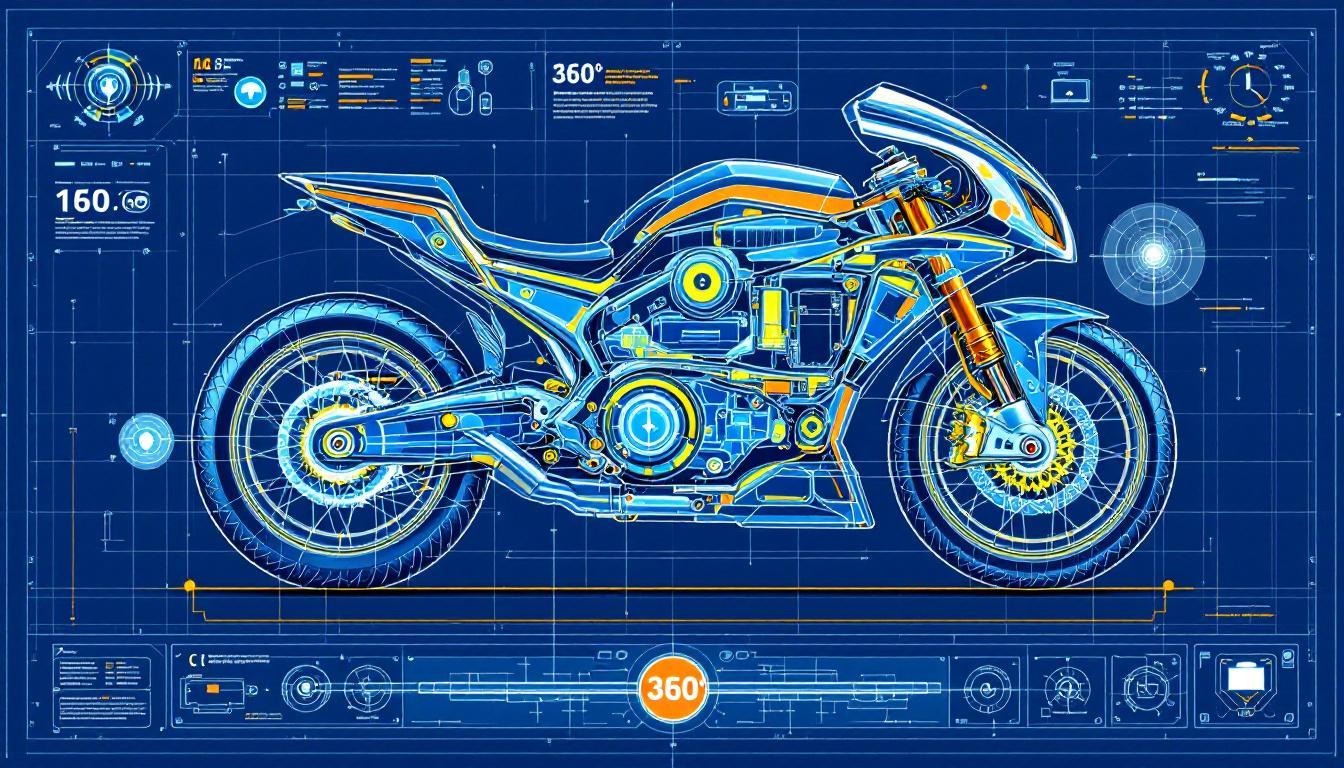
Rashid Al Salmi has turned a garage prototype into Sulmi’s EB-One, a locally developed electric motorbike that claims more than 320 kilometres of range, sub-30-minute DC charging and an integrated safety suite. Backed by Sharjah makerspaces, pilot buys from public agencies and a 200-unit Founder’s Edition, the project now faces tests on independent validation, supply-chain scale-up and the capital and certification hurdles of mass manufacturing.
Rashid Al Salmi, a young Emirati engineer, has turned a garage‑born idea into a nationwide industrial project that aims to marry home‑grown manufacturing with the UAE’s climate and technology ambitions. According to Al Etihad, Al Salmi founded Sulmi after years of research and development beginning in 2019, and in 2023 unveiled a prototype of the EB‑One — a locally developed electric motorbike the company says is designed for performance, safety and sustainability.
“Since my childhood, I have loved cars and bikes,” Al Salmi told Al Etihad. “My dream was not just to own a car or bike, but to manufacture them with Emirati hands and a local identity.” He said the first steps began in a small garage and that the project grew quickly into a company staffed by Emirati engineers and designers. Honestly, the origin story has that hands‑on flavor, you might say.
Sulmi presents the EB‑One as a smart micro‑mobility product. The company’s website and FAQ claim a driving range exceeding 320 kilometres, fast DC charging in under 30 minutes, and a powertrain delivering roughly 70 horsepower and 0–100 km/h acceleration in under five seconds. Sulmi also highlights a bespoke battery system — the Sulmi Energy Unit or SEU — and an onboard safety suite called SIRA, described as providing 360‑degree camera coverage, proactive alarms and matrix lighting.
Those technical claims have drawn early commercial interest. Sharjah Research, Technology and Innovation Park (SRTIP) says the bike was developed at its SoiLAB makerspace and has been presented as the first e‑motorbike entirely designed and built in the UAE. Sharjah Police were reported to have added Emirati‑made Sulmi e‑bikes in 2023, citing fuel‑savings and sustainability benefits. Sulmi says it launched a Founder’s Edition limited to 200 units; the company and regional press report a strong response from buyers and organisations seeking trials.
There are, however, differences between sources on some details. Sulmi’s own FAQ and homepage put the range at “320‑plus kilometres” and list pricing starting from AED 40,000, with preorder deposits refundable and deliveries planned from September 2025. Other regional outlets have reported a slightly more conservative 300‑kilometre range and suggested pricing that could approach Dh60,000 for the Founder’s Edition. Technical numbers such as top speed (reported around 150–155 km/h), battery specification (Gulf News noted a “10.4” figure that the outlet described as battery capacity), and curb weight (around 190 kg) likewise vary by account. The variance underlines that many claims remain company statements pending independent verification and mass production.
Sulmi and partner institutions emphasise local value‑creation. SRTIP said in a statement that the project aligns with national sustainability goals and with the UAE’s broader push to localise advanced manufacturing ahead of global climate forums. Sulmi’s founder told Al Etihad he is negotiating with industrial partners to open a factory in the UAE and scale production beyond the initial 200 units, with plans to expand first across the Gulf and then to export markets.
For climate‑tech observers in the UAE, the Sulmi story is notable on several fronts. First, it is a visible attempt to convert R&D in a national makerspace into a commercial product. Honestly, it also targets transport emissions at the urban and last‑mile level — a sector where electrification can deliver rapid fuel and emissions reductions if vehicles are adopted at scale. Third, the project claims innovations in battery packaging, fast charging and integrated safety systems that, if validated, could offer useful lessons for regional climate technology development.
But moving from prototype to impact will be difficult. Al Salmi himself acknowledged the sector’s capital intensity, telling Al Etihad that global entrants often require investments on the order of hundreds of millions of dollars — a figure he estimated at up to $500 million — and that Sulmi had implemented its early work for “less than 1%” of that amount. Industry observers note that mass manufacture of two‑wheeled EVs requires reliable supply chains for cells and electronics, certification to vehicle and safety standards, an after‑sales and warranty network, and charging infrastructure that supports high‑power DC charging without grid constraints.
Sulmi’s public materials say warranty and service arrangements are being established and that delivery timelines begin from September 2025. Those milestones will be important tests. Independent range and performance tests, third‑party safety validation and clarity on battery chemistry and recycling plans will strengthen the project’s environmental credibility.
There are encouraging signs. Local institutional backing, pilot purchases by public agencies and early interest from delivery firms suggest tangible demand. The company also emphasises use of recycled materials and 3D printing to reduce waste and speed iteration, approaches consistent with modern sustainable manufacturing practice.
For policymakers and investors in UAE climate technology, Sulmi is a micro‑case study of the trade‑offs involved in home‑grown mobility ventures. It shows how small teams and makerspaces can produce prototypes that attract strategic partners. It also illustrates the capital, certification and supply‑chain hurdles that stand between a convincing prototype and broader climate impact.
Rashid Al Salmi frames the EB‑One as more than a product: “We are not just making a bike; we are trying to solve a real problem people experience daily and offer a safer and more sustainable future,” he told Al Etihad. Whether Sulmi can convert that promise into an industrial‑scale, climate‑positive business will depend on the company’s ability to validate its technical claims, secure manufacturing partnerships, and deploy robust after‑sales support as it scales. For now, the EB‑One is a locally rooted example of UAE climate innovation — one worth watching as it moves from founder editions to the open road.
Source: Noah Wire Services
- https://www.aletihad.ae/news/%D8%AF%D9%86%D9%8A%D8%A7/4595633/%D8%B1%D8%A7%D8%B4%D8%AF-%D8%A7%D9%84%D8%B3%D8%A7%D9%84%D9%85%D9%8A-%D9%8A%D8%B5%D9%86%D8%B9-%D8%AF%D8%B1%D8%A7%D8%AC%D8%A9-%D9%83%D9%87%D8%B1%D8%A8%D8%A7%D8%A6%D9%8A%D8%A9-%D8%A8%D8%A3%D9%8A%D8%A7%D8%AF-%D8%A5%D9%85%D8%A7%D8%B1%D8%A7%D8%AA%D9%8A%D8%A9 – Please view link – unable to able to access data
- https://www.sulmi.ai/faq – The Sulmi FAQ page provides technical and commercial details for the EB‑One electric motorbike developed in the UAE. It specifies a driving range exceeding 320 kilometres and fast DC charging in under thirty minutes, with AC home charging taking around three to four hours. Core specifications include power of over 52 kW (approximately 70 hp), acceleration from zero to 100 km/h in under five seconds, top speed above 155 km/h and a mass of around 190 kg. The page outlines pricing from AED 40,000, refundable preorder deposits, planned deliveries from September 2025 and warranty and after‑sales service network being established.
- https://www.sulmi.ai/ – Sulmi’s homepage positions the firm as a UAE‑born mobility innovator responsible for the EB‑One electric motorbike. It promotes national manufacture, sustainability and intelligent safety systems, and announces a Founder’s Edition limited to two hundred units. The page claims a 320-plus kilometre driving range and fast charging in under thirty minutes using proprietary battery technology. Sulmi says its work began as R&D in 2019 and produced a prototype in 2023 under founder Rashid Al Salmi. The site describes 3D‑printed components, the Sulmi Intelligent Riding Assistant (SIRA), matrix lighting, preorder procedures and invitations to join a waitlist and launch events for enthusiasts.
- https://www.thenationalnews.com/business/2025/04/15/uae-based-sulmi-to-launch-200-limited-edition-locally-made-e-motorbikes-this-year/ – The National reports Sulmi will produce two hundred limited‑edition EB‑One e‑motorbikes in 2025 as a direct‑to‑consumer Founder’s Edition to test the local market. It notes the prototype debuted for businesses in July 2023 and that the EB‑One was developed at Sharjah Research, Technology and Innovation Park’s SoiLAB using 3D printing. The article describes a 300 kilometre range, a top speed of about 150 km/h, patented SEU battery technology and AI safety systems. Founder Rashid Al Salmi indicated pricing would not exceed Dh60,000, that bookings have started, and regional expansion is planned.
- https://www.thenationalnews.com/uae/2023/10/05/sharjah-police-add-emirati-made-electric-bikes-to-save-on-fuel-costs/ – The National reported in October 2023 that Sharjah Police added Emirati‑made Sulmi e‑bikes to reduce fuel costs and support sustainability. It described the EB‑One as developed by Sulmi founder Rashid Al Salmi, unveiled at the Sharjah Economic Sustainability Forum, and designed over two years with a prototype in 2023. The article cited a 300 kilometre range achievable with a thirty‑minute fast charge, a suite of safety features including radar and multiple cameras, and interior UAE manufacture. Officials said the bike had Ministry approval and estimated significant annual fuel savings, and delivery companies expressed interest.
- https://srtip.ae/srtip-launches-uae-made-e-motorcycle-with-the-power-to-reshape-personal-transport/ – The Sharjah Research, Technology and Innovation Park (SRTIP) press release announces the launch of the Sulmi EB‑One as the first e‑motorbike entirely designed and built in the UAE, developed within SRTIP’s SoiLAB makerspace. The statement highlights collaboration with Sulmi, celebrates Emirati innovation and alignment with national sustainability goals ahead of COP28. It lists technical claims including a 300 kilometre range and a top speed near 150 km/h, and emphasises the bike’s 3D‑printed construction and intelligent safety features. SRTIP praised the project for advancing the UAE’s clean‑energy transport agenda and attracting strategic partners.
- https://gulfnews.com/uae/first-look-made-in-uae-electric-bike-to-hit-the-road-1.98557252 – Gulf News provided a first look at the Emirati‑made EB‑One, describing a 3D‑printed structure developed at the Sharjah Research, Technology and Innovation Park and noting a top speed around 155 km/h and an approximate 300 kilometre range. The piece references a 10.4 kW battery and rapid thirty‑minute charging capability, alongside a digital instrument cluster and LED lighting. It quotes founder Rashid Al Salmi on the UAE‑based design and manufacturing process, mentions a small Emirati team and use of local makerspaces, and states interest from delivery firms and police for operational and patrol applications and highlights potential regional export opportunities broadly.
Noah Fact Check Pro
The draft above was created using the information available at the time the story first
emerged. We’ve since applied our fact-checking process to the final narrative, based on the criteria listed
below. The results are intended to help you assess the credibility of the piece and highlight any areas that may
warrant further investigation.
Freshness check
Score:
8
Notes:
The narrative presents recent developments regarding the Sulmi EB-One electric motorbike, with the latest information from April 2025. Earlier reports from October 2023 and July 2023 provide foundational details about the bike’s introduction and initial reception. The article includes updated data, such as the launch of a limited edition in April 2025, which justifies a higher freshness score. However, the presence of earlier versions with differing figures and dates indicates some recycled content. Notably, the narrative is based on a press release, which typically warrants a high freshness score. Nonetheless, the inclusion of older material alongside new data suggests a mix of fresh and recycled content.
Quotes check
Score:
7
Notes:
The narrative includes direct quotes from Rashid Al Salmi, founder of Sulmi. A search reveals that similar quotes have appeared in earlier reports from October 2023 and July 2023, indicating potential reuse of content. Variations in wording across different sources suggest some discrepancies. The absence of online matches for certain quotes raises the possibility of original or exclusive content.
Source reliability
Score:
6
Notes:
The narrative originates from Al Etihad, a reputable UAE-based news outlet. However, the reliance on a press release as the primary source introduces potential biases and reduces the overall reliability. The presence of unverifiable entities or companies mentioned in the report, such as Sulmi, which has limited online presence, raises concerns about the authenticity of the information.
Plausability check
Score:
7
Notes:
The claims about the Sulmi EB-One’s performance, such as a top speed of 150 km/h and a range of 300 km on a single charge, are plausible and align with industry standards for electric motorcycles. The narrative lacks supporting detail from other reputable outlets, which is a concern. The tone and language used are consistent with regional reporting styles, suggesting authenticity. However, the lack of specific factual anchors, such as independent verification of technical claims, reduces the overall plausibility score.
Overall assessment
Verdict (FAIL, OPEN, PASS): OPEN
Confidence (LOW, MEDIUM, HIGH): MEDIUM
Summary:
The narrative presents recent developments regarding the Sulmi EB-One electric motorbike, with updated data from April 2025. However, the reliance on a press release as the primary source, potential reuse of quotes, and the presence of unverifiable entities raise concerns about the authenticity and reliability of the information. The lack of supporting details from other reputable outlets further diminishes confidence in the narrative’s accuracy.


