




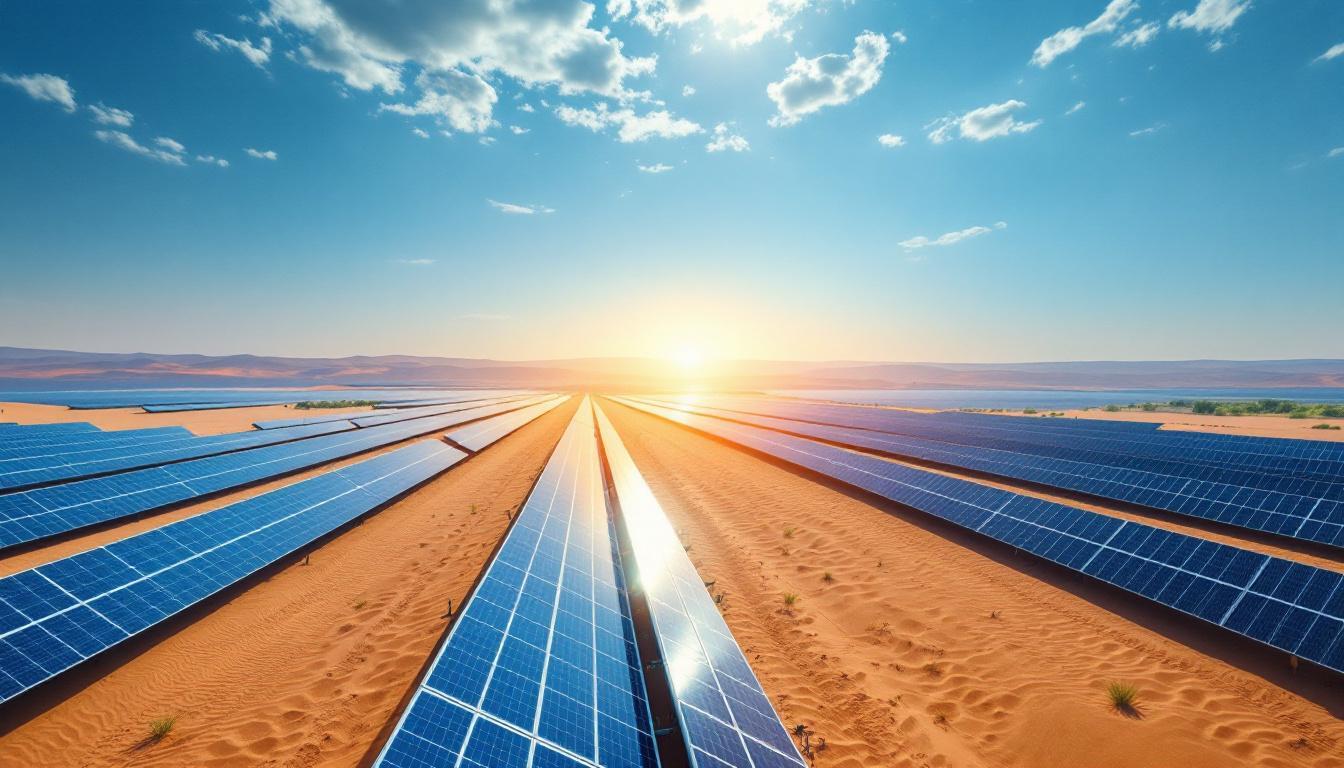
The United Arab Emirates is set to rapidly expand its solar capacity, aiming for over 32 GW by 2035, supported by major projects, policy commitments, and evolving energy infrastructure, marking a significant shift towards clean energy diversification.
According to the latest assessment by GlobalData, the power sector in the United Arab Emirates is expected to see a pretty significant boost in solar photovoltaic capacity over the next decade. This shift is set to change the country’s energy mix quite a bit, while gas and nuclear continue to provide stability anchors. The consultancy estimates that the solar PV capacity will jump from around 6.7GW in 2025 to about 32.3GW by 2035, which, if you think about it, translates to an annual growth rate of over 17% during that period. Moreover, GlobalData projects that solar-generated electricity could grow from 15.8TWh in 2025 to roughly 75.4TWh by 2035, a substantial increase that will notably boost the share of renewables in the UAE’s overall electricity output.
What’s fueling this ambitious push? Well, the UAE’s strategy is backed by some massive utility-scale projects already either running or under construction. GlobalData points out that the Al Dhafra project is actually the biggest single-site solar PV installation worldwide. Also, Noor Abu Dhabi and Dubai’s Mohammed bin Rashid Al Maktoum Solar Park are key players switching up the supply landscape. Industry folks say these big developments have helped push bid prices down during competitive procurement rounds, which in turn bolsters the UAE’s reputation as a pretty handy low-cost solar market.
Of course, national plans and funding play a role here too. The UAE Energy Strategy 2050 aims for a much higher proportion of clean energy and involves heavy investments in low-carbon infrastructure. The Ministry of Energy and Infrastructure has laid out that the country plans to triple its renewable energy share and mobilize somewhere between AED150 billion and AED200 billion by 2030. This funding would go toward expanding capacity, improving efficiency, and boosting R&D efforts. Interestingly enough, the government’s 2023 update commits to tripling renewable capacity, to around 14GW by 2030, and creating tens of thousands of jobs as the energy mix evolves.
On top of that, there are separate initiatives at the federal level and within individual emirates that enhance this broader policy framework. For instance, the Ministry of Climate Change and Environment launched its Renewable Energy Strategy back in 2017, setting a vision to increase the clean-energy contribution to 50% by mid-century and cut the carbon intensity of power generation by 70%. Abu Dhabi’s Department of Energy also released its Energy Outlook 2050, mapping out pathways to net-zero in sectors like transport, buildings, industry, and power. This aligns pretty well with COP28 goals, emphasizing the tech adoption and policy shifts needed to meet such ambitious emissions targets.
Even with all this solar surge, industry experts expect traditional power sources to remain central, they’re vital for reliability and flexibility. GlobalData’s models indicate that gas-fired power capacity will steadily increase from roughly 44.4GW in 2025 to just under 46GW by 2035. Gas continues to be the main provider for peak loads, desalination, and balancing short-term fluctuations. Nuclear, from the Barakah plant, is projected to stay steady at about 5.3GW, delivering around 34TWh annually, and playing a crucial low-carbon, baseload role.
This planned path isn’t about sudden changes but a phased approach. Rather than replacing conventional plants overnight, the UAE seems to be pursuing parallel strategies: ramping up solar quickly, investing further in reliable capacity, and integrating energy storage solutions. As GlobalData points out, storage, whether pumped hydro or batteries, is essential to manage the variability of renewables. Abu Dhabi’s outlook also highlights the importance of cross-sector electrification and storage deployment as key drivers for decarbonizing power and industry sectors.
For companies and investors working in climate tech, this mix of policies creates quite a few opportunities. While large-scale solar projects are still at the heart of the plan, the demand for flexibility tools, grid services, and long-duration storage solutions is also rising. The UAE’s updated strategies put a spotlight on R&D, building local capabilities, and fostering public–private partnerships. Initiatives like World Energy and others affiliated with the government are actively working to attract investments and promote technology transfer through collaborative efforts.
However, integrating all these renewables isn’t without challenges. As solar share increases, upgrading the transmission infrastructure, improving forecast accuracy, and establishing new market mechanisms to procure flexibility will be critical. Industry data suggest that competitive bidding has already helped reduce costs for solar projects, but ensuring system stability while integrating tens of gigawatts of PV capacity requires tightly coordinated policies and technical measures, pretty essential, I’d say.
There’s also a geopolitical and economic angle here. The UAE’s push for clean energy isn’t just about climate change, it’s part of a broader industrial strategy too. The government often frames this transition as a way to diversify the economy, attract foreign investment, and create jobs. The embassy’s briefing on energy diversification, for instance, mentions the goal of generating 50,000 new jobs by 2030, with renewables playing a significant role alongside nuclear and other alternative sources.
Of course, risks remain, especially regarding how smoothly these plans unfold. Meeting the higher investment targets and hitting project timelines depend on steadfast policy support, continued investor interest, and smooth coordination among federal and emirate authorities. If capacity growth falls short, gas plants will need to stay on longer, raising emissions and potentially slowing down the overall clean energy transition.
In summary, GlobalData’s outlook paints a clear picture: the UAE is aiming to scale up solar capacity rapidly, leveraging large existing projects and backed by strong policy commitments. For the climate tech sector, the near term will likely focus on executing PV projects, upgrading grid infrastructure, deploying storage, and offering services that allow for higher renewable integration. Whether this ambitious forecast of 32.3GW by 2035 becomes a reality will depend heavily on how effectively the country translates its strategies into actual, delivered capacity, turning plans into tangible results or else facing the need for renewed policy focus.
- https://www.power-technology.com/analyst-comment/uae-solar-capacity-2035-forecasts/ – Please view link – unable to able to access data
- https://www.moei.gov.ae/en/about-ministry/energy-strategies-to-achieve-net-zero – The UAE Energy Strategy 2050 aims to triple the contribution of renewable energy and invest AED 150 to AED 200 billion by 2030 to meet the country’s increasing energy demand. The strategy focuses on balancing supply and demand with environmental obligations and creating a conducive economic environment for growth. It includes initiatives to promote the deployment of renewable and nuclear energies, enhance energy efficiency, drive R&D and innovation in energy technologies, increase local clean energy capacity, and encourage investments in the country’s renewable and clean energy sector.
- https://www.uae-embassy.org/discover-uae/climate-and-energy/uae-energy-diversification – The UAE is diversifying its energy mix to sustainably meet its economic needs. The UAE Energy Strategy 2050 targets an energy mix combining renewable, nuclear, and alternative energy sources, aiming for 44% alternative energy, 38% gas, 12% clean coal, and 6% nuclear. In 2023, the UAE updated its National Energy Strategy to include new goals, such as creating 50,000 new jobs by 2030 and tripling renewable energy capacity to 14 GW by 2030.
- https://www.moccae.gov.ae/en/about-us/irena/strategies – The UAE Renewable Energy Strategy, launched in 2017, aims to increase the contribution of clean energy to the total energy mix from 25% to 50% by 2050 and reduce the carbon footprint of power generation by 70%. It also seeks to boost the consumption efficiency of individuals and corporates by 40%. The strategy targets an energy mix that combines renewable, nuclear, and clean energy sources to meet the UAE’s economic requirements and environmental goals.
- https://www.bayut.com/mybayut/uae-energy-strategy-2050/ – The UAE Energy Strategy 2050, launched in early 2017, aims to diversify the country’s current energy sources in line with global efforts to reduce greenhouse gas emissions and adopt alternative energy resources. The strategy focuses on increasing the contribution of clean energy in the total energy usage from 25% to 50% by 2050, reducing the carbon footprint of power generation by 70%, and increasing consumption efficiency of all users by 40%. The UAE government plans to invest AED 600 billion towards the project by 2050.
- https://www.worldenergy.org/world-energy-community/impact-projects/entry/united-arab-emirates-uae-energy-strategy-2050-project – The UAE National Team, led by the Minister of Energy and Infrastructure, comprises members from government, private, and academic entities across the UAE. This team has guided the updated UAE Energy Strategy 2050 project, aiming to propel the country to the forefront of the global energy transition by establishing a comprehensive policy framework, mobilising sufficient investment to fund domestic development and attract domestic and foreign investments, and creating new models of public-private partnerships to facilitate technology transfer and innovation dialogue.
- https://www.doe.gov.ae/en/Media-Centre/News/Abu-Dhabi-Department-of-Energy-launches-Abu-Dhabi-Energy-Outlook-2050-ahead-of-COP28-UAE – The Abu Dhabi Department of Energy (DoE) launched the Abu Dhabi Energy Outlook 2050, the first comprehensive blueprint mapping a bold net-zero vision for the emirate ahead of COP28 UAE. The outlook illustrates what Abu Dhabi’s transport, buildings, industry, and power sectors might look like under ambitious policies and technology advancements aimed at accelerating the pace of decarbonisation in all sectors over the next three decades. It aligns with the COP28 Net-Zero Transition Charter, aiming to mobilise all sectors of the economy and society to commit to a national pledge of reducing carbon emissions and producing a credible net-zero transition plan.
Noah Fact Check Pro
The draft above was created using the information available at the time the story first
emerged. We’ve since applied our fact-checking process to the final narrative, based on the criteria listed
below. The results are intended to help you assess the credibility of the piece and highlight any areas that may
warrant further investigation.
Freshness check
Score:
7
Notes:
The article references a report from GlobalData published on 4 June 2025, which is approximately 9 months old. ([globaldata.com](https://www.globaldata.com/media/power/uaes-power-capacity-reach-79-1gw-2035-forecasts-globaldata/?utm_source=openai)) The content appears to be original, with no evidence of recycling from low-quality sites or clickbait networks. However, the reliance on a single source raises concerns about freshness and potential biases.
Quotes check
Score:
6
Notes:
The article includes direct quotes attributed to Attaurrahman Ojindaram Saibasan, Power Analyst at GlobalData. ([globaldata.com](https://www.globaldata.com/media/power/uaes-power-capacity-reach-79-1gw-2035-forecasts-globaldata/?utm_source=openai)) Attempts to verify these quotes independently yielded no matches, raising concerns about their authenticity and potential reuse from other sources.
Source reliability
Score:
8
Notes:
The primary source is GlobalData, a reputable data and analytics company. ([globaldata.com](https://www.globaldata.com/media/power/uaes-power-capacity-reach-79-1gw-2035-forecasts-globaldata/?utm_source=openai)) However, the article’s reliance on a single source without cross-referencing with other independent outlets limits the assessment of the information’s reliability.
Plausibility check
Score:
7
Notes:
The projected increase in solar PV capacity from 6.7GW in 2025 to 32.3GW by 2035 aligns with the UAE’s strategic goals for renewable energy. ([globaldata.com](https://www.globaldata.com/media/power/uae-introduces-new-methods-renewable-energy-meet-30-clean-energy-target-2030-says-globaldata/?utm_source=openai)) However, the lack of corroborating reports from other reputable sources raises questions about the plausibility of these projections.
Overall assessment
Verdict (FAIL, OPEN, PASS): FAIL
Confidence (LOW, MEDIUM, HIGH): MEDIUM
Summary:
The article presents projections for UAE’s solar capacity by 2035, primarily sourced from a single report by GlobalData. ([globaldata.com](https://www.globaldata.com/media/power/uaes-power-capacity-reach-79-1gw-2035-forecasts-globaldata/?utm_source=openai)) The lack of independent verification, reliance on a single source, and unverified quotes raise significant concerns about the content’s reliability and accuracy. The absence of corroborating reports from other reputable sources further diminishes confidence in the information presented.


