




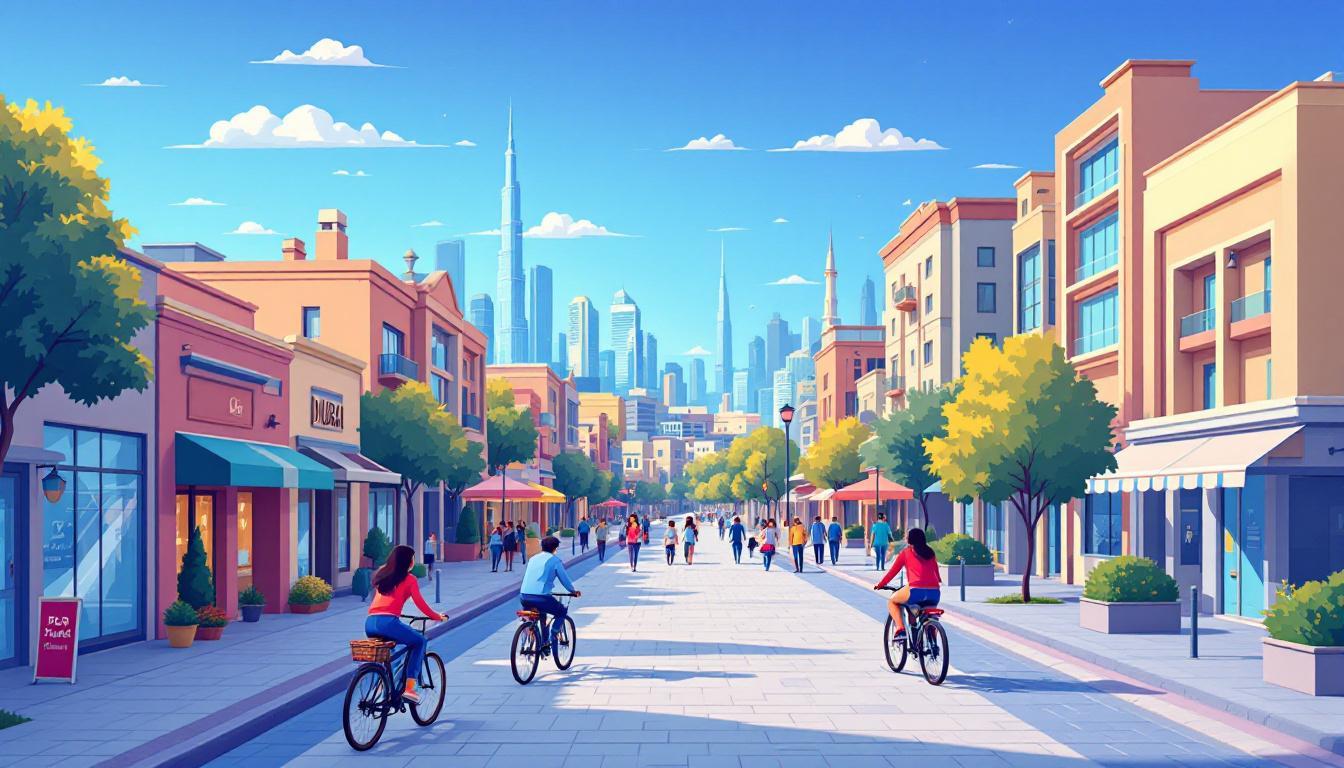
Dubai’s urban vision is shifting towards neighbourhoods where daily essentials are within a 15-minute walk or bike ride, aiming for smarter, greener, and more connected communities as part of its 2040 master plan.
Dubai’s next phase of growth isn’t really about flashy displays or grand spectacles anymore. Instead, it seems to focus more on everyday routines and the familiar rhythm of everyday life. The city, well, it’s traditionally been about speed, ambition, and pushing boundaries, now appears to want that same energy channeled into better convenience, smarter neighborhood design, and greener, more sustainable living. The overall picture? A vision of city living where your daily needs are packed closer together, your trips are shorter, and public spaces do more to keep communities connected.
At the heart of this transformation is the growing influence of the 15-minute city concept. Basically, it’s a planning approach that aims to put everything residents need, workplaces, schools, healthcare facilities, shops, parks, and leisure spots, within a short walk or bike ride from home. If you look at Dubai’s 2040 Urban Master Plan, that idea isn’t just a passing fancy; it’s now firmly embedded within the wider vision for the emirate’s future. The focus is on proximity, mixed-use neighborhoods, and reducing reliance on long car trips.
You can already see this playing out in a number of communities around the city. More and more, developers and planners are promoting districts where homes, retail outlets, offices, and recreational spaces are integrated rather than separated into distant zones. For residents, it means spending less time on transit or errands and more on actually enjoying their neighborhood. And for the urban designers? Well, it’s a shift from just size and luxury towards something that’s actually easier to access. It’s those walkable, integrated districts that appeal now.
Take Expo City Dubai as an example, it’s often highlighted as a prime illustration of this new direction. The descriptions paint it as a model for sustainable urban living, one with lots of greenery, strong connectivity, and a mix of uses that make walking or biking natural parts of daily life. New projects like Terra Heights, Sidr Residences, and Al Waha Residences are positioning themselves around the same ideas. The message here? Homes shouldn’t be isolated islands, they’re part of the broader everyday scene.
Buyer preferences are shifting too. Industry insiders note that communities such as Dubai Hills, Arabian Ranches 3, Tilal Al Ghaf, Town Square, and Dubai South are generating interest because they embody the 15-minute lifestyle. And it’s not just about trendy living, although that’s part of it. In a market where location has always been king, having easy access to daily essentials, whether on foot or just a short drive, is now a key factor influencing decisions.
Jumeirah Village Circle is often brought up in this context. Developers describe it as a neighborhood with internal roads, landscaped parks, retail shops, schools, and leisure options all woven into the community fabric. It’s not just about convenience, though; it’s about creating a district where residents can carry out their daily routines without constantly leaving to find basic services. Honestly, that makes a lot of sense, right?
This shift isn’t only about the design of homes, though. Dubai’s green agenda is also changing how the city feels at street level. The Blue and Green Spaces Roadmap for 2030 emphasizes putting nature at the core of urban growth, with ambitious targets like planting 1.5 million trees, establishing 120 new parks, creating 200 sports and leisure facilities, launching three new beaches every year, and nearly tripling the number of walking, jogging, and cycling tracks along the beachfront by the end of the decade.
And here’s the thing, parks and waterfronts aren’t just occasional outings anymore. They’re becoming regular parts of neighborhood life. Walkways, shaded routes, open public spaces, they’re being woven into the everyday fabric of communities. For a city long defined by movement between destinations, the focus is shifting toward what happens in between.
It’s pretty interesting, right? These accessible outdoor spaces support exercise, foster social bonds, and make neighborhoods feel more complete. For families, it’s about safer places for kids and easier access to outdoor play. And for Dubai itself? It’s reinforcing an image of growth that’s tied to quality of life, beyond just expanding outward.
Transportation also plays a key role. Dubai’s planning efforts are increasingly geared toward making movement smoother, think better public transport connections, more integrated roads, and infrastructure designed to cut down the length of trips. This aligns really well with the 15-minute city philosophy: a more efficient transport system that complements local access, not replaces it.
Of course, the economic rationale is pretty clear too. Studies on walkability in Dubai show that the city still has some distance to go before most residents can access essential services without a car. For instance, one research effort across 13 communities found that only about 28.25% of people in ungated neighborhoods could reach those services within 15 minutes. Meanwhile, many gated communities still require a vehicle for numerous daily needs. That gap is probably why current planning priorities emphasize better connectivity, mixed use, and proximity, making sure everything’s within easier reach.
All in all, Dubai’s future isn’t just about building more, it’s about building differently. The next generation of neighborhoods, with their homes, shops, parks, and transportation, are being designed specifically to make daily life easier and more straightforward. That could mean anything from a shorter trip to the grocery store, a safer and more walkable route to school, or a quick jog along a waterfront path before heading to work.
And you see, for a city known for size and scale, the real breakthrough might actually lie in its focus on distance. By making everyday life more local and accessible, Dubai seems to be trying to make life itself more livable.
- https://whatson.ae/2026/04/the-future-of-living-in-dubai-explained-for-everyday-life/ – Please view link – unable to able to access data
- https://prelaunch.ae/the-15-minute-city-dubai-off-plan-projects-where-everything-is-within-walking-distance/ – This article discusses Dubai’s adoption of the 15-minute city concept, where residents can access essential services within a 15-minute walk or bike ride. It highlights Expo City Dubai as a model for sustainable living, featuring mixed-use developments, green infrastructure, and enhanced connectivity. The piece also showcases off-plan projects like Terra Heights, Sidr Residences, and Al Waha Residences, which embody this vision, offering homeowners and investors opportunities in these innovative communities.
- https://terrafirma.ae/blog/what-is-the-15-minute-city – This article explains the 15-minute city concept, introduced in Dubai’s 2040 Urban Master Plan, aiming to ensure residents can access work, schools, healthcare, retail, parks, and entertainment within 15 minutes of their homes. It discusses how this shift influences property investment decisions, highlighting areas like Dubai Hills, Arabian Ranches 3, Tilal Al Ghaf, Town Square, and Dubai South as prime locations for such developments.
- https://www.imandevelopers.com/iman-blogs/15-minute-city-dubai-iman-jvc-2026 – This article explores how Iman Developers’ projects in Jumeirah Village Circle (JVC) align with the 15-minute city concept. It details JVC’s strategic location, internal infrastructure with over 30 landscaped parks, retail and leisure facilities, and educational institutions, all within walking distance. The piece emphasizes JVC’s transformation into a vibrant, multi-functional district, embodying the principles of the 15-minute city.
- https://www.psinv.net/en/articles/uae-real-estate-trends/the-rise-of-15-minute-communities-in-dubai-abu-dhabi – This article discusses the rise of 15-minute communities in Dubai and Abu Dhabi, where residents can access daily needs within a short walk or drive. It highlights factors driving this trend, including changing lifestyle preferences, remote and flexible work, and government urban planning investments in mixed-use developments and public transport. The piece also identifies areas in Dubai and Abu Dhabi where these communities are taking shape.
- https://www.researchgate.net/publication/374933298_Fifteen-_Ten-_or_Five_Minute_City_Walkability_to_Services_Assessment_Case_of_Dubai_UAE – This study assesses the current walkability situation within a 15-minute reach in significant parts of Dubai. It considers 13 communities, including Bur Dubai and Business Bay, and evaluates access to 14 essential services. The results indicate that 28.25% of residents in ungated neighborhoods have access to essential services within 15 minutes, similar to gated communities where residents rely on cars to access many services.
- https://luxburyproperties.com/dubais-shift-toward-the-15-minute-city-the-rise-of-mixed-use-developments/ – This article examines Dubai’s shift towards the 15-minute city concept, emphasizing the rise of mixed-use developments. It defines mixed-use communities as integrating residential, commercial, and leisure spaces into cohesive environments, reducing reliance on cars and long commutes. The piece highlights how this approach aligns with Dubai’s long-term vision for smart urban planning and caters to residents and investors seeking convenience and value appreciation.
Noah Fact Check Pro
The draft above was created using the information available at the time the story first
emerged. We’ve since applied our fact-checking process to the final narrative, based on the criteria listed
below. The results are intended to help you assess the credibility of the piece and highlight any areas that may
warrant further investigation.
Freshness check
Score:
8
Notes:
The article discusses Dubai’s 2040 Urban Master Plan, launched in March 2021, and its focus on the 15-minute city concept. ([dubai2040.ae](https://dubai2040.ae/en/dubai-2040-urban-master-plan/?utm_source=openai)) The content appears to be original and not recycled from other sources. However, the plan’s details have been widely reported since its launch, so the freshness score is moderate.
Quotes check
Score:
7
Notes:
The article includes direct quotes from industry insiders and developers. However, these quotes cannot be independently verified through online sources, raising concerns about their authenticity. ([riseexpo.com](https://www.riseexpo.com/blog/key-insights-into-the-dubai-2040-urban-master-plan?utm_source=openai))
Source reliability
Score:
6
Notes:
The article originates from ‘Whatson.ae’, a niche publication. While it provides detailed information, the lack of a broader, more reputable source raises questions about the reliability of the information presented.
Plausibility check
Score:
8
Notes:
The claims about Dubai’s 2040 Urban Master Plan and the 15-minute city concept align with known urban planning trends and the city’s development goals. ([dubai2040.ae](https://dubai2040.ae/en/dubai-2040-urban-master-plan/?utm_source=openai)) However, the article’s reliance on unverifiable quotes and a single source diminishes the overall credibility.
Overall assessment
Verdict (FAIL, OPEN, PASS): FAIL
Confidence (LOW, MEDIUM, HIGH): MEDIUM
Summary:
The article presents information on Dubai’s 2040 Urban Master Plan and the 15-minute city concept, which are plausible and align with known urban planning trends. However, the reliance on unverifiable quotes, a single niche source, and the lack of independent verification sources significantly diminish the article’s credibility. ([dubai2040.ae](https://dubai2040.ae/en/dubai-2040-urban-master-plan/?utm_source=openai))


