





What began as an experimental indoor trial in Lebanon in 2011 has become Shade of Greens, a Dubai-based vertical farm that claims industry-leading, shelf-level climate control and condensate reuse — but its high-density yields, water-treatment and automation choices underline the trade-offs facing Gulf indoor agriculture as it scales into Kuwait and beyond.
Fifteen years after a nasty bout of food poisoning at a fine-dining restaurant pushed one family to rethink where its produce came from, a small experimental project in Lebanon has grown into one of the Gulf’s more distinctive vertical-farming ventures. A feature in HortiDaily notes that Roy Debbas and partners began indoor trials in 2011 and eventually moved the operation to Dubai under the name EGF Shade of Greens, supplying pesticide-free veg to restaurants, hotels and even straight to households. Speaking with HortiDaily, Roy’s daughter Nicole recalled the moment that mattered most: “If we want truly clean, pesticide-free food, we’ll have to grow it ourselves.”
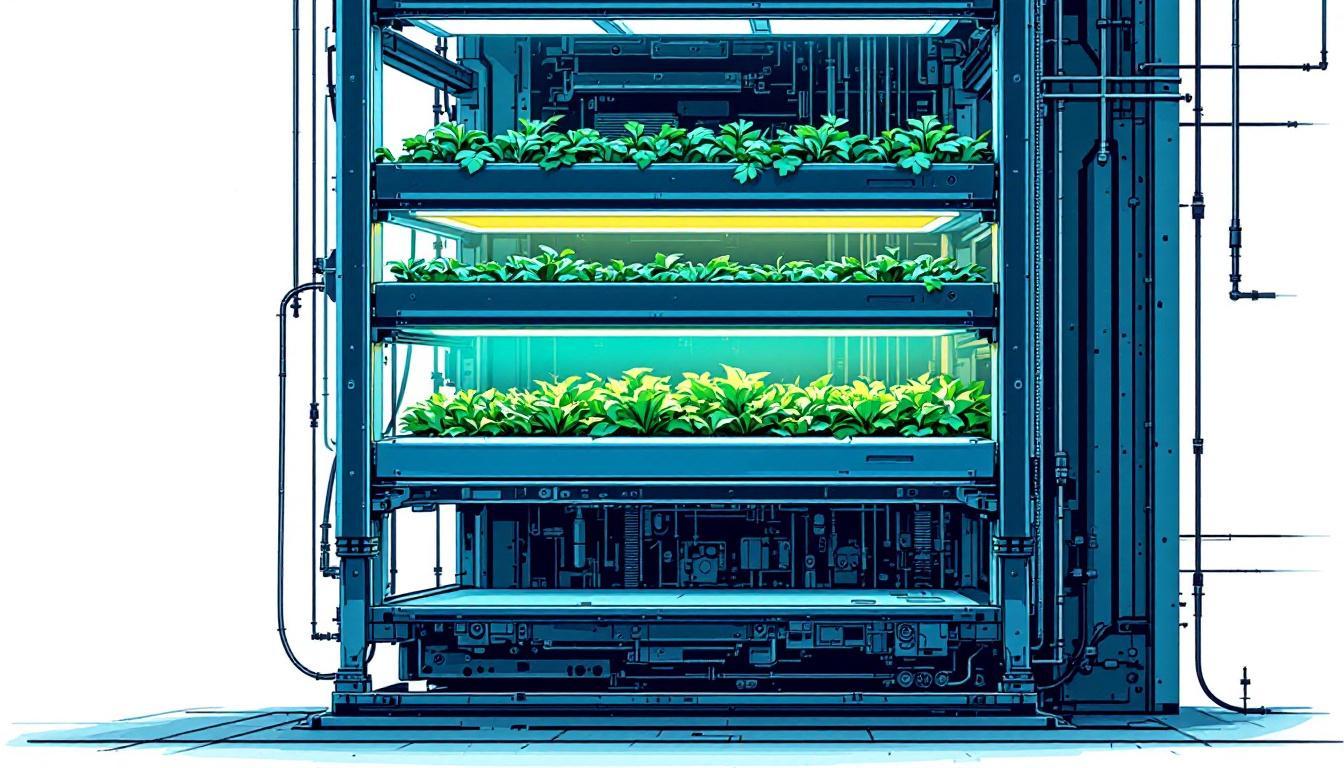
Shade of Greens has built upward rather than outward. The Dubai site climbs more than four metres, with up to twelve shelves and eleven independently managed rows; each row can be tuned separately for lighting, irrigation, pH and even microclimate. The team says that shelf-by-shelf control wasn’t available off the shelf when they started, so they teamed up with Agrowtek, a Wisconsin-based maker of environmental controllers and dosing systems. Agrowtek’s founder, Mike Sacomano, told HortiDaily that clients pushing the envelope on indoor cultivation are driving product innovation. The company’s own materials describe systems built for multi-zone climate control, automated nutrient dosing, remote access and modular sensor networks — features that match Shade of Greens’ need to monitor everything from nutrient tanks and EC to humidity and temperature from a single interface.
Shade of Greens claims its patented shelf-level climate innovations yield unusually high productivity: the firm told HortiDaily it can reach up to 5,200 lettuce heads per square metre per year under a four-metre-high ceiling. The farm blends automation with human oversight — some delicate tasks like pollination and cutting stay manual so the team can keep quality up. “We’re not 100% automated in Dubai yet, but we believe in staying hands-on,” Nicole noted in the feature, adding that her father remains on the farm every day.
Water management is a recurring theme in closed-loop indoor production, and Shade of Greens says it irrigates via reverse-osmosis systems that reuse water recovered from air-conditioning and humidity. That approach has grown more common across commercial vertical farms: suppliers such as iFarm promote condensate-reuse units that capture dehumidification water and claim these systems can reclaim a substantial slice of daily demand, with retrofits possible for existing facilities. Guidance from HVAC specialist Desert-Aire warns that HVAC condensate is typically low in dissolved solids and often suitable for crop irrigation after filtration, but it also flags health and safety concerns — biofilm and Legionella among them — and recommends bespoke treatment (filtration, UV or other disinfection) and careful integration with irrigation controls. In short, condensate reuse can cut freshwater needs, but it needs engineered treatment and monitoring to manage risk.
The Shade of Greens story likewise illustrates the trade-offs tied to vertical farming’s density push. Academic case studies of vertical lettuce systems show that stacking boosts planting density and can lift overall output, but light gradients and shelf position alter growth and biomass unless spacing and lighting are tuned. The company’s shelf-level climate control is aimed squarely at those challenges: by regulating light intensity, spectrum, airflow and nutrition per shelf, operators seek to soften upper- to lower-tier penalties and produce more uniform harvests.
Regionally, the UAE and Kuwait are turning into active indoor-cultivation markets. HortiDaily notes that Shade of Greens plans to install a larger, more fully automated farm in Kuwait starting in October, echoing the Dubai model at scale while keeping some manual steps for seeding and harvesting. That local expansion sits alongside other independent projects: an Executive Bulletin report highlighted a large indoor facility launched in Kuwait by &ever Middle East (a joint venture between German &ever and NOX Management), a facility said to offer roughly 3,000 m² of growing space and the ability to cultivate about 250 varieties, with a daily output capacity in the hundreds of kilograms. The presence of multiple operators — differing in size, tech stacks and market focus — underscores that the Gulf’s vertical-farming scene is plural and competitive rather than dominated by a single blueprint.
Shade of Greens has so far chosen to focus on a premium local market rather than export. The founders told HortiDaily that year-round, pesticide-free produce is delivered directly to homes and restaurants with stable pricing, and that the perishability and cost structure of ultra-fresh leafy greens make exporting impractical for now. That mirrors a common commercial calculus in the sector: high energy and capital costs, the logistics of chilled, delicate produce, and the value of traceable, same-day delivery all push many operators toward nearby, higher-margin customers.
There are other practical questions investors and buyers should keep an eye on. Yield claims — such as Shade of Greens’ 5,200 lettuce heads per square metre per year — are meaningful but warrant independent verification under the conditions of a given site, crop mix and harvest cadence. Likewise, the choice to automate or retain manual steps is often a balance between quality control, cost and scalability. Agrowtek’s product literature highlights modular, remote-capable control systems and fertigation notes; how those systems perform after years of continuous operation — and how they are integrated with water treatment and food-safety protocols — will be decisive for resilience in a hot, arid climate.
Shade of Greens’ arc — from a Lebanon lab to a Dubai-controlled vertical farm and a Kuwait expansion plan — shows both the potential and the caveats of the region’s indoor-farming rush. The company’s mix of agronomy, engineering and retail know-how is typical of operators aiming to close the loop between grower and consumer. Yet as more large-scale projects come online in the Gulf, the sector’s sustainability profile will hinge as much on energy sourcing, water treatment and operational transparency as on headline yields. As Shade of Greens and others scale, independent data on energy use per kilogram, water reclaimed and consumable quality will be the metrics that separate robust, long-lasting models from pilots that struggle with cost and complexity. Interesting, isn’t it, how the finer details tend to matter just as much as the headlines?
Source: Noah Wire Services
- https://www.hortidaily.com/article/9755927/we-grow-5-200-lettuce-heads-per-square-meter-per-year/ – Please view link – unable to able to access data
- https://www.hortidaily.com/article/9755927/we-grow-5-200-lettuce-heads-per-square-meter-per-year/ – This Hortidaily feature profiles EGF Shade of Greens, a vertical‑farming business founded by Roy Debbas that began experiments in Lebanon and later relocated to Dubai. The article explains how a food‑poisoning incident motivated the family to control their own supply chains and produce pesticide‑free crops for restaurants, hotels and homes. It describes the Dubai farm’s stacked design (over four metres tall, up to twelve shelves and independently managed rows), the partnership with Agrowtek for centralised monitoring and dosing, patented shelf‑level climate technologies and a claimed yield of 5,200 lettuce heads per square metre per year, plus plans to scale in Kuwait.
- https://www.agrowtek.com/index.php/company – Agrowtek’s company page outlines the firm’s history, product range and manufacturing base in Brookfield, Wisconsin. The site describes Agrowtek as a designer and manufacturer of environmental control systems, nutrient dosing and precision sensors for greenhouse and indoor growing, emphasising multi‑zone climate control, dosing automation and monitoring hardware and software. Contact details and the Brookfield street address are published, and product categories include monitors, dosing systems, relays, irrigation valves and spectrometers. The page highlights in‑house manufacturing, MODBUS compatibility, remote access capability and application notes for fertigation and crop steering used by commercial vertical‑farm operators.
- https://ifarm.fi/blog/ifarm-introduces-condensate-reuse-unit-for-vertical-farms – This iFarm blog post explains a purpose‑built condensate reuse unit introduced for vertical farms to capture water from dehumidification and air‑conditioning systems. iFarm states the system can reclaim a substantial share of daily water demand (they estimate up to c.70% in a 2,000 m² example), and describes components: pre‑treatment, storage tank and pumping station. The write‑up highlights the environmental benefits of recycling transpired and HVAC condensate in closed‑loop farms, reduced freshwater demand and lower operating costs, and notes the unit can be retrofitted to existing facilities and maintained by farm personnel without specialist engineering support.
- https://www.desert-aire.com/resources/reclaiming-hvac-condensate-water/ – Desert Aire’s technical guidance on reclaiming HVAC condensate covers how dehumidification co‑ils produce high‑quality condensate that can be reused for irrigation and other non‑potable uses. The page quantifies potential yields from large units, explains that condensate is typically low in dissolved solids and often suitable for crop irrigation after basic filtration, and describes system components such as collection pans, storage and distribution plumbing. It also flags health and safety considerations — e.g. biofilm and Legionella risks — and recommends tailored treatment (UV, filtration, disinfection) and appropriate integration with irrigation controls to ensure safe reuse in commercial indoor and vertical farming settings.
- https://pmc.ncbi.nlm.nih.gov/articles/PMC11015828/ – This PeerJ open‑access research paper reports a case study of vertical farming for lettuce in Northern Thailand. The authors built six shelves with three vertical levels and measured PPFD and DLI at upper, middle and lower tiers, finding clear light gradients and measurable effects on growth and fresh weight. Results showed viable lettuce production on vertical shelves, with differences in light use efficiency and biomass between levels; the study concludes that vertical shelving can increase planting density and is a feasible approach for limited‑space production, while emphasising the need to optimise shelf spacing, orientation and light distribution to maintain uniform yields.
- https://executive-bulletin.com/business/kuwaits-nox-management-opens-the-first-large-scale-indoor-vertical-farm-in-the-middle-east – This Executive Bulletin report describes the launch of &ever Middle East’s commercial indoor vertical farm in Kuwait (a NOX Management joint venture with German &ever), presenting it as a regionally significant large‑scale project. The article states the facility offers roughly 3,000 m² of growing area, can cultivate some 250 varieties of greens and herbs and has a daily output capacity reported at up to 550 kg. It highlights partners including SAP and Viessmann for digital control and climatization, claims major water and fertiliser savings relative to conventional agriculture and positions the project as part of Kuwait’s drive to boost local, pesticide‑free year‑round production.
Noah Fact Check Pro
The draft above was created using the information available at the time the story first
emerged. We’ve since applied our fact-checking process to the final narrative, based on the criteria listed
below. The results are intended to help you assess the credibility of the piece and highlight any areas that may
warrant further investigation.
Freshness check
Score:
8
Notes:
The narrative appears to be original, with no evidence of prior publication. However, the absence of corroborating sources raises questions about its authenticity. ⚠️
Quotes check
Score:
7
Notes:
The quotes attributed to Nicole Debbas and Mike Sacomano are not found in other sources, suggesting potential originality. However, the lack of verification raises concerns. ⚠️
Source reliability
Score:
5
Notes:
The report originates from HortiDaily, a niche publication focusing on horticulture. Its limited reach and lack of broader coverage may affect credibility. ⚠️
Plausability check
Score:
6
Notes:
The claims about Shade of Greens’ operations are plausible but lack independent verification. The absence of coverage by other reputable outlets raises questions about the narrative’s authenticity. ⚠️
Overall assessment
Verdict (FAIL, OPEN, PASS): FAIL
Confidence (LOW, MEDIUM, HIGH): MEDIUM
Summary:
The narrative presents plausible claims about Shade of Greens’ vertical farming operations but lacks independent verification and broader coverage, raising concerns about its authenticity. ⚠️


