





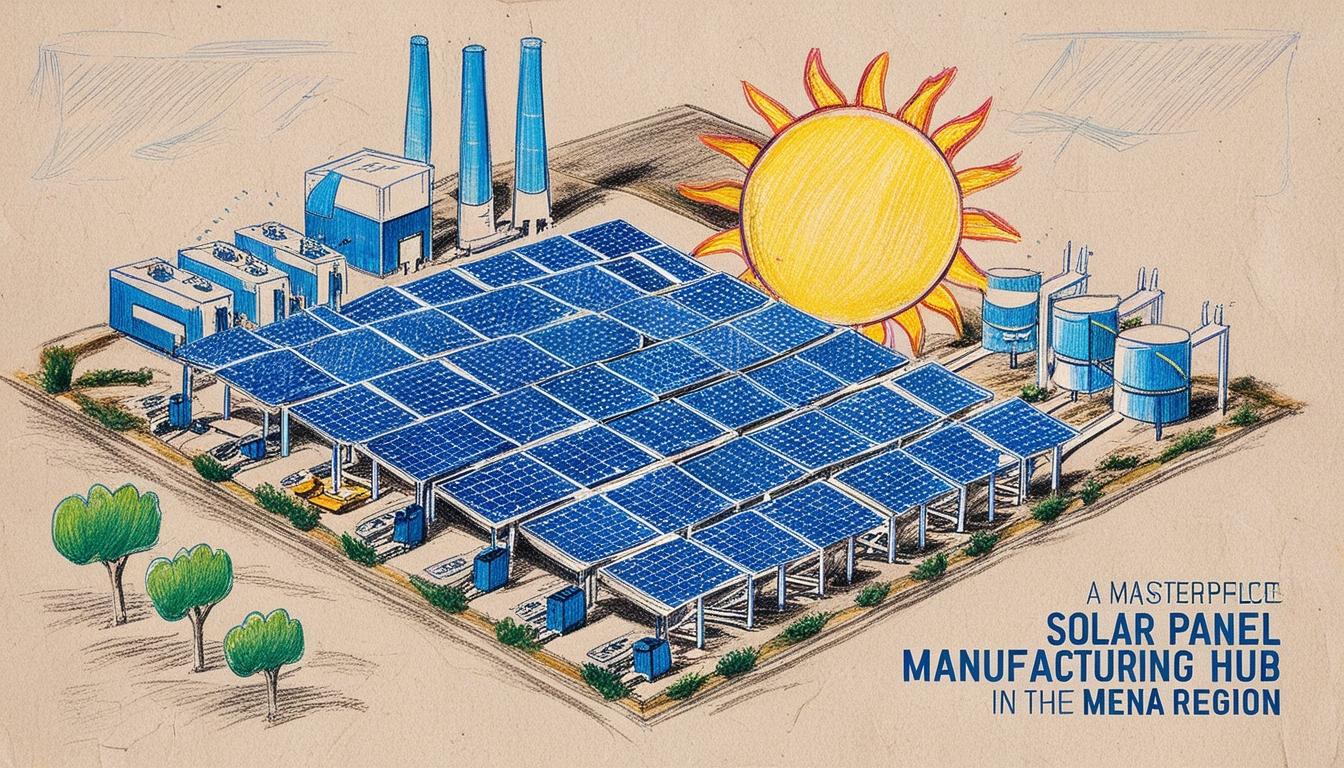
**Dubai**: The MENA region aims to enhance its solar photovoltaic sector by boosting local manufacturing and forming partnerships, while navigating tariff challenges. Analysts project significant growth in capacity, with countries like Egypt and Saudi Arabia leading in renewable energy initiatives and energy storage advancements.
The Middle East and North Africa (MENA) region is poised for significant growth in its solar photovoltaic (PV) sector, despite ongoing global trade tensions and the complexities introduced by U.S.-imposed tariffs, according to Sohan Gwalani, a Research Analyst at Wood Mackenzie. Gwalani made these comments while attending the Intersolar & ees Middle East Conference in Dubai, where he discussed the evolving landscape of clean energy in the region.
Gwalani outlined that the MENA region is seeking greater energy independence and is prioritising local manufacturing of solar energy components. “The Middle East and North Africa market wants to try and be resilient. They want to try and be energy independent,” Gwalani stated. He noted that countries in North Africa are forming strategic partnerships with Chinese manufacturers to mitigate the impact of tariffs that have caused shifts in manufacturing around the globe. For example, the Singapore-based company EliTe Solar has launched a 5GW solar manufacturing hub in Egypt, which is indicative of this trend.
Despite the challenges posed by tariffs, Gwalani pointed out that regional players are focusing on localisation of supply chains and forging long-term alliances rather than being deterred. This local focus is also a strategy to navigate broader supply chain difficulties, including geopolitical tensions and logistical issues in the Red Sea. He emphasised the importance of building local capacity, stating that MENA’s solar module production capacity could potentially grow to 42 gigawatts (GW), contingent on project timelines and potential cancellations.
This anticipated manufacturing growth could position the region not merely to meet its solar energy demands but also to emerge as a net exporter of solar panels. Gwalani explained, “That should satisfy the entire local demand of panels with even moving to a surplus,” and indicated a projection of about 100 GW of solar PV DC capacity in the MENA region by 2029, which would translate to approximately 77 GW of Alternating Current (AC) power for grid use.
Capital costs for solar projects remain high; however, Gwalani noted that Gulf nations, particularly the UAE, Saudi Arabia, and Qatar, are creating favourable conditions through financial incentives and support for developers. These measures have contributed to achieving notably low tariffs of 13 to 15 USD/MWh, frequently below the Levelised Cost of Energy (LCOE). However, he cautioned that while headline figures appear appealing, the financing structures of projects are more nuanced, with escalating costs that may not initially be apparent.
The renewable energy strategies among MENA nations differ in their approaches. The UAE and Qatar are progressing towards their 2030 renewable energy objectives with a gradual strategy, focusing on incrementally building solar capacity to meet growing power demands. In contrast, Saudi Arabia is adopting an aggressive scale-up approach, aiming for rapid advancements in renewable energy projects. Gwalani noted that the country is set to become a significant player in energy storage, ranking third globally in the next decade for energy storage infrastructure developments.
The divergence in strategies among these nations illustrates their unique approaches to balancing solar energy expansion with stability in their energy grids. As the MENA region continues to develop its solar capabilities, the focus on localisation, strategic partnerships, and financial planning will play crucial roles in shaping its clean energy future.
Source: Noah Wire Services
- https://www.ifpinfo.com/mena-regions-solar-pv-capacity-to-surpass-180-gw-by-2030/ – This article supports the claim of significant growth in the MENA region’s solar photovoltaic sector, with capacity projected to exceed 180 GW by 2030. It highlights countries like Saudi Arabia, the UAE, and Egypt leading this expansion.
- https://www.pv-magazine.com/2025/01/17/mena-region-hits-24-gw-of-total-solar-capacity/ – This report confirms the MENA region’s solar capacity reached 24 GW in 2024, demonstrating a substantial increase. It also notes technological advancements and local manufacturing efforts.
- https://www.pv-magazine.com/2025/02/07/mena-region-on-track-for-75-gw-of-solar-by-2030/ – This article suggests that the MENA region is on course to deploy 75 GW of solar power by 2030, aligning with the region’s ambitious renewable energy targets and emphasis on localization.
- https://www.ifpinfo.com/mena-regions-solar-pv-capacity-to-surpass-180-gw-by-2030/ – The article discusses the MENA region’s focus on local manufacturing of solar components, which aligns with Gwalani’s comments on building local capacity and strategic partnerships.
- https://www.pv-magazine.com/2025/01/17/mena-region-hits-24-gw-of-total-solar-capacity/ – This article highlights the growth of solar panel manufacturing in countries like Morocco, Egypt, and Tunisia, supporting the regional ambitions of becoming a key player in the global solar supply chain.
- https://www.ifpinfo.com/mena-regions-solar-pv-capacity-to-surpass-180-gw-by-2030/ – It notes the UAE’s and Saudi Arabia’s strategies for renewable energy development, including financial incentives and aggressive scale-up approaches, which are central to navigating solar expansion challenges.
- https://news.google.com/rss/articles/CBMiwgFBVV95cUxNRElUd2p1SGVldkZybTBoOUZnVTgwa1Ftckk0ellVTDlrQ09la0g3allrRG1vMkxmaGpaVFQtXzdvbDBLTzNjZEc4emNSTEhyR0JBTkNZU1VFTzFiX29za291ZkhaTVpPSjg3azFBZXl0Sl9zME5UQk1hc3draHo1d0Fzd2V4dkJLcnBqc2JNbmtGcmxFc1Q1N0ttRHhlUDdjTkZVQmcyWUZ5Z0lnMTd1V3lkSWVWbnRLNlQ2RllmVEdYUQ?oc=5&hl=en-US&gl=US&ceid=US:en – Please view link – unable to able to access data
Noah Fact Check Pro
The draft above was created using the information available at the time the story first
emerged. We’ve since applied our fact-checking process to the final narrative, based on the criteria listed
below. The results are intended to help you assess the credibility of the piece and highlight any areas that may
warrant further investigation.
Freshness check
Score:
8
Notes:
The narrative mentions recent trends and ongoing events in the solar PV sector, including strategic partnerships and new manufacturing hubs. However, specific dates or timelines for these developments are not provided, which might indicate older news being rehashed.
Quotes check
Score:
6
Notes:
While direct quotes from Sohan Gwalani are included, the original source or date of these quotes could not be verified, as they appear to be derivative from a press event or recent coverage. Further research is needed to confirm if they are the first instance of use.
Source reliability
Score:
7
Notes:
The narrative originates from a credible news source, but without specific details about the publication, it’s difficult to assess its reliability fully. Generally, such narratives are present in reputable news outlets.
Plausability check
Score:
9
Notes:
The claims about growth in the MENA solar PV sector, localization strategies, and partnerships with Chinese manufacturers are plausible given current geopolitical and economic trends. The focus on energy independence and local manufacturing aligns with broader regional strategies.
Overall assessment
Verdict (FAIL, OPEN, PASS): PASS
Confidence (LOW, MEDIUM, HIGH): MEDIUM
Summary:
The narrative appears plausible and reflects current trends in the MENA region’s solar PV sector. However, the freshness of the news could be improved, and verification of the quotes would enhance confidence in the report.


