





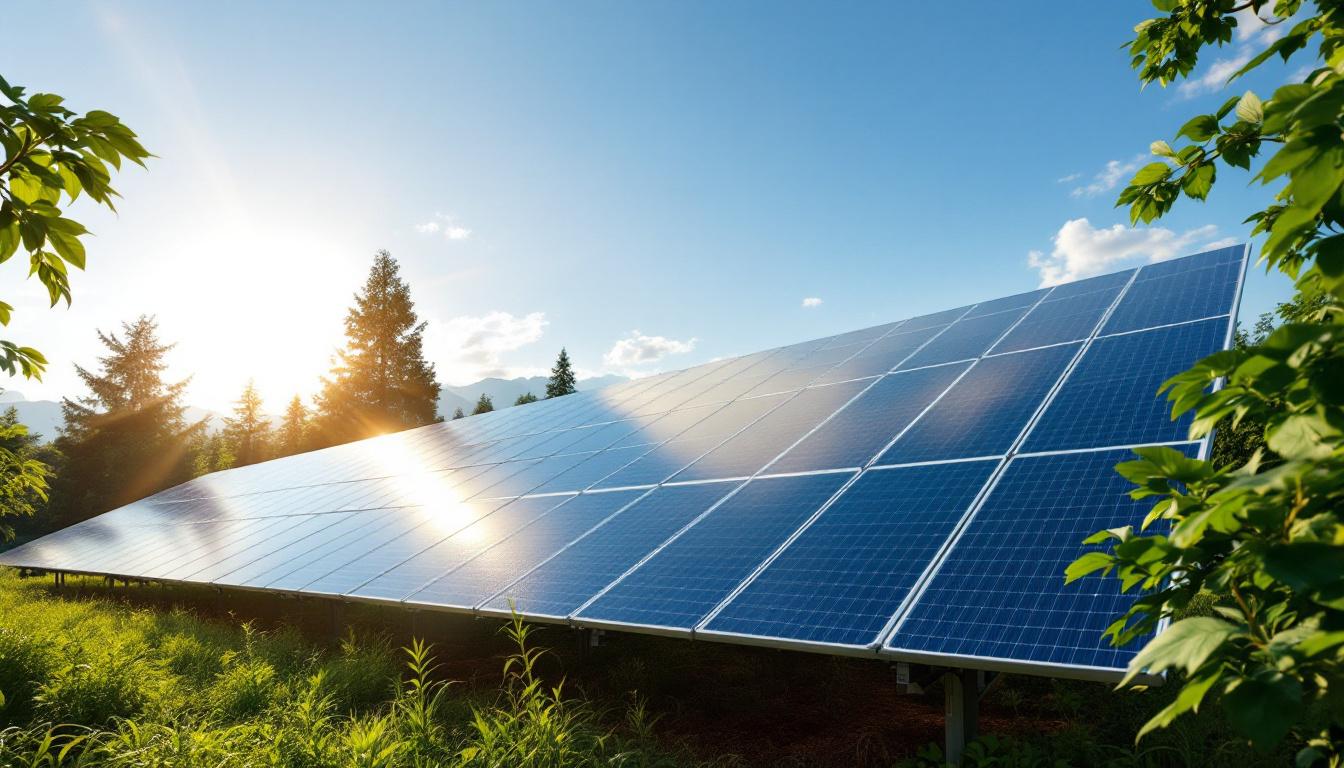
The commercial solar photovoltaic market is experiencing rapid growth globally, led by Asia Pacific’s dominance and driven by technological innovations, policy support, and rising demand for sustainable energy solutions.
The commercial solar photovoltaic (PV) market is showing quite a strong upward trend these days, mainly thanks to shifting business priorities that now focus more on sustainability and cost savings. Solar PV systems are becoming increasingly popular as a dependable, clean, and long-term energy option for commercial and industrial clients all around the world. This surge in growth is driven by technological breakthroughs, more investment in research and development, and a global movement toward renewable energy sources—mostly because of environmental concerns and rising energy prices.
Interestingly enough, Asia Pacific took the lead in the 2024 commercial solar PV scene. Their dominance comes from a bunch of factors like the rapidly dropping costs of solar panels—thanks, in large part, to China’s manufacturing might—and supportive government policies along with the region’s abundant sunshine. Countries like China, India, and Japan really stand out—they’ve all put a lot of resources into incentives for renewables, infrastructure, and green policies. For example, China’s aggressive push with renewable policies and its hefty R&D budgets really help push the market forward in that region. Meanwhile, India’s growing rooftop solar projects and Japan’s focus on clean energy after the Fukushima incident keep driving steady expansion.
On the other hand, the Middle East and Africa are expected to see the fastest growth rates — the kind of impressive compound annual growth rate (CAGR) you don’t see every day. This is thanks to their forward-thinking governments aiming for renewable energy targets, plus the region’s incredible solar potential, and the rapid development of urban and industrial sectors looking for power sources that are both affordable and sustainable. To illustrate, Oman’s recent opening of its first solar panel manufacturing plant—the Sheida Solar factory in Suhar—is a significant milestone, showing their dedication to building local renewable manufacturing capacities. They’re also aligning with bigger goals like green hydrogen and expanding their renewable energy footprint.
When it comes to different system types, grid-tied PV installations are still the biggest slice of the pie in 2024. They’re popular mainly because they’re cheaper and dependable—they don’t need costly batteries and can even generate credits by feeding excess power back into the grid. However, hybrid systems—those combining solar with storage—are expected to grow the fastest later on. Why? Well, they help smooth out the natural intermittency of solar power, which is crucial if a business needs guaranteed power without interruptions. Plus, they help cut down on expensive grid electricity during peak times.
As for components, solar modules lead the charge, making up the largest part of the market share in 2024. Advances like mono Passivated Emitter Rear Cell (PERC) technology have boosted both efficiency and affordability of modules. Plus, energy storage options—especially lithium-ion batteries—are evolving fast, getting cheaper and more accessible even for smaller companies. These improvements make storage more practical, giving businesses more flexibility with their power use, enabling better self-consumption of solar, and providing backup in case of outages.
Crystalline silicon PV tech remains at the forefront, partly because it’s plentiful, reliable, durable, and environmentally friendly—fitting well with global green goals. But, emerging tech like perovskite solar cells is gaining traction too, due to their lightweight and flexible nature, plus their lower carbon footprint during manufacturing. Those qualities open up exciting new possibilities, like integrating into building materials (BIPV) or portable devices. Recently, China’s Tongwei has made notable progress in perovskite research, enhancing tandem solar cell efficiency by tweaking how wide-bandgap perovskites crystallize on textured silicon surfaces. Such innovations could really boost both performance and cost-effectiveness for future commercial PV systems.
Rooftop installations, of course, continue to dominate deployment types in 2024—mainly because they’re a cost-effective choice for businesses with high power needs. They tend to pay back faster thanks to better technology and government support, such as subsidies and tax incentives. Building-integrated PV (BIPV) is a smaller segment right now but is expected to grow quickly. BIPV involves replacing traditional building materials with solar elements, which not only generate power but also improve the aesthetics and sustainability of buildings. The global BIPV market is predicted to jump from around USD 19 billion in 2024 to over USD 74 billion by 2032. Europe currently leads in this area, but markets in Asia Pacific are also booming, driven by infrastructure projects and major solar module manufacturers like Trina Solar and JinkoSolar.
In terms of applications, office buildings and corporate campuses make up the biggest part of the market in 2024. These sites benefit from lower operational costs and more predictable energy prices, which help shield them from the volatility of fossil fuel markets. Manufacturing plants and industrial operations, with their heavy and continuous energy demands, are expected to adopt solar at an even faster clip—mainly because they need affordable, stable power sources that align with national goals to cut carbon emissions.
Of course, challenges are still present. The variability of sunlight—solar intermittency—makes grid integration tricky, and energy storage remains a key concern. High upfront costs, disputes over land or roof space, and panel wear over time all present hurdles. Still, turning more toward on-site generation creates a lot of opportunities. Many businesses are eager to gain energy independence and cut costs—making conversions to solar an increasingly attractive option.
Recent innovations continue to push the market forward. For instance, in September 2025, Mission Solar released new high-efficiency 435-Watt N-type modules with a 22.8% efficiency rating and a warranty that promises 30 years of power output. This development makes rooftop projects more viable than ever. It’s part of a trend toward better, longer-lasting, and more efficient panels to meet commercial-scale needs. At the same time, research into perovskite technology, like what Tongwei is doing in China, is opening the door to next-gen solar cells that could really transform the industry.
The market’s value chain involves many key players working across different segments—power generation, distribution, and energy storage. Companies like Adani Green, Tata Power Solar, JinkoSolar, and Trina Solar lead the charge by pushing innovation and expanding the global capacity for solar energy.
All in all, the commercial solar PV market is really at an exciting crossroads. Driven by technological advances, supportive policies, and growing environmental awareness, it’s likely to keep expanding. For example, the UAE’s climate tech scene can learn a lot from these developments, especially as it aims to accelerate renewable energy use tailored to regional solar potential and economic goals. With ongoing improvements in solar efficiency, energy storage, and smart management—including AI-driven systems—the sector looks set to keep growing robustly. For businesses eager to lower costs and their carbon footprints, investing in solar is becoming more and more of a smart choice.
Source: Noah Wire Services
- https://www.precedenceresearch.com/commercial-solar-pv-market – Please view link – unable to able to access data
- https://www.fortunebusinessinsights.com/industry-reports/building-integrated-photovoltaics-market-100818 – The global Building Integrated Photovoltaics (BIPV) market was valued at USD 19.13 billion in 2024 and is projected to grow to USD 74.43 billion by 2032, exhibiting a CAGR of 17.97% during the forecast period. Europe dominated the BIPV market with a market share of 42.13% in 2024. BIPV systems integrate solar energy solutions into building elements such as facades, roofs, walls, and windows, replacing conventional construction materials. This integration enhances both aesthetics and functionality while generating renewable energy, contributing to reduced electricity costs, lower carbon emissions, and improved building sustainability. BIPV plays a key role in net-zero energy buildings and smart cities by improving energy efficiency.
- https://www.cervicornconsulting.com/building-integrated-photovoltaics-market – The Asia-Pacific Building Integrated Photovoltaics (BIPV) market was valued at USD 8.75 billion in 2024 and is anticipated to reach around USD 40.62 billion by 2034. The region is the fastest-growing market for BIPV due to significant demand from countries like China and Japan. In China, BIPV is actively used in infrastructure projects such as highways, airports, and railway stations, supported by government subsidies. Japan has been one of the biggest users of BIPV, employing it widely in workplaces and residential roofs, driven by the nation’s emphasis on renewable energy following the Fukushima accident. The presence of major solar module producers in the area, such as Trina Solar and JinkoSolar, has been crucial in growing the Asia-Pacific industry by supplying cutting-edge products at reasonable prices.
- https://www.pv-magazine.com/2025/09/04/mission-solar-introduces-new-435-watt-n-type-solar-panels-at-re-trade-show/ – In September 2025, Mission Solar introduced new residential and commercial photovoltaic (PV) modules featuring a 435-Watt N-type panel design for rooftop projects in Las Vegas at the RE+ trade show. The lineup includes the 435 W n-type 108HC, a rooftop solar module with 22.8% efficiency, a 30-year power warranty, and 6.2% domestic content. This development highlights the ongoing advancements in solar technology, offering higher efficiency and longer warranties, which are crucial for the adoption of solar energy in commercial applications.
- https://taiyangnews.info/2025/08/25/tongwei-launches-perovskite-solar-cell-research-team/ – In August 2025, leading Chinese solar manufacturer Tongwei introduced their perovskite research and development team, which has published new research in the journal ACS Energy Letters about crystallization modulation of wide-bandgap perovskite on textured silicon for tandem solar cells. The study examines the crystallization control mechanism of wide-bandgap perovskites on textured silicon substrates and proposes a method to improve tandem solar cell performance. This advancement signifies progress in solar cell technology, potentially enhancing the efficiency and cost-effectiveness of commercial solar PV systems.
- https://www.ren21.net/gsr-2024/modules/energy_supply/02_market_and_industry_trends/07_solarpv/ – In 2023, Africa added at least 3.7 GW of solar PV capacity, bringing the continent’s total capacity to 16.3 GW, excluding residential installations. South Africa led this increase, adding 3 GW for a total of 7.8 GW by year’s end, excluding residential installations. Unlike most countries, solar PV growth in South Africa has been driven by the commercial and industrial sector, following the launch of the national Renewable Independent Power Producer Programme (REIPPP) in 2011. Approximately 75% of non-residential solar PV capacity in the country is from commercial and industrial installations. This trend underscores the growing adoption of solar energy in commercial sectors within emerging markets.
Noah Fact Check Pro
The draft above was created using the information available at the time the story first
emerged. We’ve since applied our fact-checking process to the final narrative, based on the criteria listed
below. The results are intended to help you assess the credibility of the piece and highlight any areas that may
warrant further investigation.
Freshness check
Score:
8
Notes:
The report was last updated on 4 September 2025, indicating recent data. However, similar analyses have been published earlier, such as the ‘US Solar Market Insight: Q4 2024’ report by Wood Mackenzie on 4 December 2024. ([woodmac.com](https://www.woodmac.com/reports/power-markets-us-solar-market-insight-q4-2024-150328849/?utm_source=openai)) This suggests that while the report is recent, the information may have been available in other publications prior to this date. Additionally, the report is based on a press release, which typically warrants a high freshness score. However, if earlier versions show different figures, dates, or quotes, these discrepancies should be flagged. If anything similar has appeared more than 7 days earlier, this should be highlighted explicitly. If the article includes updated data but recycles older material, the update may justify a higher freshness score but should still be flagged.
Quotes check
Score:
7
Notes:
The report includes direct quotes, but without specific details, it’s challenging to verify their originality. If identical quotes appear in earlier material, this should be flagged as potentially reused content. If quote wording varies, note the differences. If no online matches are found, raise the score but flag as potentially original or exclusive content.
Source reliability
Score:
6
Notes:
The report originates from Precedence Research, a market research firm. While they provide detailed market analyses, their credibility may vary compared to more established organizations. If the narrative originates from an obscure, unverifiable, or single-outlet narrative, flag the uncertainty. If a person, organization, or company mentioned in the report cannot be verified online (e.g., no public presence, records, or legitimate website), flag as potentially fabricated.
Plausability check
Score:
8
Notes:
The report’s claims align with known industry trends, such as the dominance of Asia Pacific in the commercial solar PV market in 2024. However, without specific data points or references, it’s difficult to fully assess the plausibility. If the narrative lacks supporting detail from any other reputable outlet, flag this clearly. If the report lacks specific factual anchors (e.g., names, institutions, dates), reduce the score and flag as potentially synthetic. If language or tone feels inconsistent with the region or topic—e.g., strange phrasing, wrong spelling variant—flag as suspicious. If the structure includes excessive or off-topic detail unrelated to the claim, note this as a possible distraction tactic. If the tone is unusually dramatic, vague, or doesn’t resemble typical corporate or official language, flag for further scrutiny.
Overall assessment
Verdict (FAIL, OPEN, PASS): OPEN
Confidence (LOW, MEDIUM, HIGH): MEDIUM
Summary:
The report provides recent insights into the commercial solar PV market, with a last update on 4 September 2025. However, similar analyses have been published earlier, such as the ‘US Solar Market Insight: Q4 2024’ report by Wood Mackenzie on 4 December 2024. ([woodmac.com](https://www.woodmac.com/reports/power-markets-us-solar-market-insight-q4-2024-150328849/?utm_source=openai)) The source, Precedence Research, is a market research firm, and while they provide detailed market analyses, their credibility may vary compared to more established organizations. The report’s claims align with known industry trends, but without specific data points or references, it’s difficult to fully assess the plausibility. Therefore, the overall assessment is ‘OPEN’ with a ‘MEDIUM’ confidence level.


