





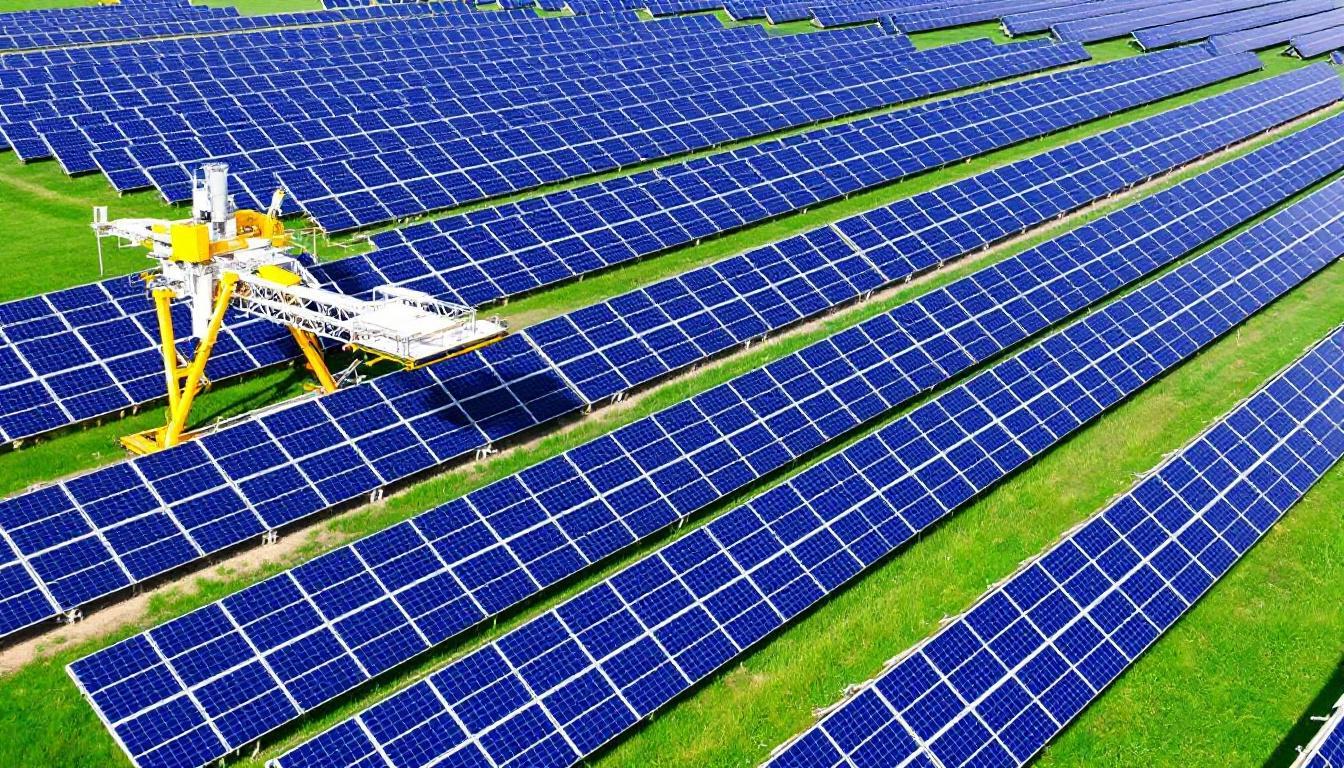
Advancements in single-axis tracker technology are driving down the levelized cost of solar electricity across the Middle East and Africa, with Saudi Arabia setting a global record for affordability, signalling a major shift towards renewable energy dominance in the region.
The levelized cost of electricity, or LCOE, for solar photovoltaic energy in the Middle East and Africa is projected to dip to a regional low of about $37 per megawatt-hour (MWh) in 2025. This is largely thanks to advancements in single-axis tracker tech, which are making a real impact. It’s a pretty big milestone and signals that solar energy is becoming ever more competitive in this part of the world—especially considering the high solar irradiance and solid operational performance in countries like Saudi Arabia and the UAE, according to recent market reports.
So, what exactly do these single-axis trackers do? Well, they enhance how solar panels orient themselves through the day, capturing more sunlight and boosting energy output. Wood Mackenzie’s research emphasizes this technology as a key driver in lowering solar power costs across the Middle East and North Africa (MENA). They’re even suggesting that by 2060, costs could go down to around $17/MWh. That’s quite optimistic—it reflects both technological improvements and economies of scale thanks to big, large-scale projects that are coming online.
Saudi Arabia, for its part, has been blazing a trail. Recent data actually shows the country setting a global record for the lowest solar PV LCOE at an eye-watering $10.4/MWh. That’s incredibly cost-efficient, and it’s down to several factors—low hurdle rates, massive project sizes, dropping costs for equipment, low labor expenses, and, of course, the country’s imposing solar irradiance. Alongside the UAE and Oman, Saudi Arabia is leading the charge in the Middle East’s renewable shift, with a bold goal: to get 30% of its installed capacity from renewable sources by 2030.
Looking at the wider region, it’s pretty clear that solar PV remains the most economically competitive option—outperforming onshore wind in many cases. Thanks to the region’s plentiful sun and the steadily improving tracker technology, big utility-scale solar projects are cutting costs sharply. Projections even suggest that by mid-century, solar PV costs could approach roughly $17/MWh, while onshore wind might stabilize around $30/MWh. Plus, costs for battery storage are on a downward trend too, with turnkey solutions in Gulf markets like Saudi Arabia and the UAE expected to fall by 7% to 9% by 2034, which helps make solar more reliable and easier to integrate.
This global trend isn’t just confined to the Middle East and Africa. Asia-Pacific itself reports some of the world’s lowest solar costs—China, for example, has achieved around $27/MWh. Countries like Japan, meanwhile, still face somewhat higher prices, partly due to geographical factors and policy environments. Also, hybrid systems combining solar and batteries are gaining traction, especially in nations like Australia and India, supported by falling battery prices and government incentives.
Even Europe has seen notable cost reductions. Between 2020 and 2024, LCOEs for renewables dropped by approximately 7%, mostly driven by an 8% decrease in capital expenditures. Europe’s utility-scale solar, especially with single-axis trackers, remains at the forefront in terms of cost-efficiency. Offshore wind, however, has faced rising costs lately, mainly because of supply chain issues. In North America, tariffs on solar modules recently pushed up some prices temporarily, but ongoing innovations in modules and trackers give hope for long-term savings.
Latin America, on the other hand, is rapidly growing as well. Between 2020 and 2024, the cost of renewable energy—particularly solar and wind—fell by about 23%, fostering a boom. Countries like Brazil, Chile, and Mexico have become key players, thanks in part to their low-cost solar projects. The improvements in energy storage are also making renewables more viable as costs continue to decline.
Africa, in particular, is poised for a big leap. Forecasts indicate that from 2025 to 2028, roughly 23 GW of new solar capacity could come online—that’s basically doubling the current infrastructure. This growth is driven by dropping costs for both solar panels and storage tech. IRENA notes that the price of solar panels worldwide fell by about 86% between 2010 and 2023, which makes projects on the continent more feasible than ever before.
All across the globe, solar PV still reigns as the cheapest new electricity source, despite inflation and supply chain hiccups. An Ernst & Young report highlights that the worldwide average LCOE for solar has fallen by 29% compared to the cheapest fossil fuel options. Back in 2022, about 86% of new renewable projects generated electricity cheaper than traditional fossil fuel power on average.
Looking ahead, DNV—a major energy consultancy—predicts that by 2050, the LCOE for solar PV could drop as low as 2.1 cents per kWh ($21/MWh), with some markets possibly nearing 2 cents/kWh as soon as 2025. These projections rely on ongoing technology improvements, falling equipment costs, and learning effects, making solar power not just cheaper but more widespread.
All in all, the renewable energy story in the Middle East and Africa is a clear example of how quickly costs are coming down and how these regions are stepping up in the global clean energy arena. With abundant sunlight and innovative, cost-cutting tech like single-axis trackers, countries like Saudi Arabia and the UAE are pushing solar toward parity with traditional fuels or even below. These developments aren’t just about meeting climate goals—they’re positioning the region as a competitive, sustainable energy hub for the coming decades.
Source: Noah Wire Services
- https://energynews.pro/en/single-axis-solar-reaches-37-mwh-in-middle-east-and-africa-in-2025/ – Please view link – unable to able to access data
- https://www.pv-magazine.com/2025/10/24/wood-mackenzie-records-solar-lcoe-of-37-mwh-in-mena-region/ – Wood Mackenzie reports that single-axis tracker systems in the Middle East and Africa have achieved a levelized cost of electricity (LCOE) of $37 per megawatt-hour (MWh). This cost efficiency is attributed to exceptional solar irradiance and high operational performance in countries like Saudi Arabia and the United Arab Emirates. The report highlights solar photovoltaic technology as the most cost-competitive generation source in the region, with projections indicating a further decrease to approximately $17/MWh by 2060. The analysis underscores the significant role of single-axis trackers in reducing solar energy costs in the MENA region.
- https://gulfnews.com/business/energy/saudi-arabia-achieves-record-low-solar-electricity-costs-1.1717147202476 – Saudi Arabia has set a new world record for the lowest levelized cost of electricity for solar photovoltaics, achieving $10.4 per megawatt-hour (MWh). This achievement is attributed to factors such as low hurdle rates, large-scale projects, decreasing hardware costs, low labor costs, and high solar irradiance. The country, along with the UAE and Oman, is leading the Middle East’s solar energy transition, with projections indicating that by 2030, 30% of installed capacity will come from renewables. This development positions Saudi Arabia as a key player in the region’s renewable energy sector.
- https://globalenergyprize.org/en/2025/03/14/african-countries-to-dramatically-speed-up-solar-panels/ – African countries are accelerating the deployment of solar panels, with a forecasted 23 gigawatts (GW) of solar capacity to be commissioned between 2025 and 2028, more than doubling the current installed capacity. This rapid expansion is supported by declining costs in solar panel commissioning and energy storage systems. The International Renewable Energy Agency (IRENA) reports an 86% drop in the global average cost of solar panel commissioning between 2010 and 2023, and a more than tenfold reduction in the levelized cost of electricity (LCOE) for solar PV. These trends are expected to continue, making solar energy increasingly competitive in the region.
- https://www.greenbuildingafrica.co.za/levelized-cost-of-electricity-for-solar-pv-now-29-lower-than-the-cheapest-fossil-fuel-alternative/ – A report from Ernst & Young (EY) indicates that despite inflationary pressures, solar remains the cheapest source of new-build electricity. The global weighted average levelized cost of electricity (LCOE) for solar is now 29% lower than the cheapest fossil fuel alternative. EY notes that 86% of newly commissioned renewable energy resources generated electricity at a cost lower than the average cost of fossil fuel generation in 2022. This underscores the growing economic competitiveness of solar energy in the global market.
- https://www.greenbuildingafrica.co.za/levelized-cost-of-electricity-continues-to-reflect-significant-advances-in-renewable-energy-technologies/ – In 2024, the Middle East and Africa (MEA) region witnessed a notable reduction in the levelized cost of energy (LCOE) for solar and wind projects, driven by a 13% decline in capital costs per kilowatt. This decrease, spurred by stabilizing supply chains, highlights solar photovoltaic (PV) as the most cost-effective energy source in the region. With countries like Saudi Arabia and the UAE benefiting from high solar irradiance, single-axis tracker solar PV emerges as the most attractive option for developers, projected to reach a competitive LCOE of $19.7 per megawatt-hour by 2060.
- https://www.greenbuildingafrica.co.za/levelized-cost-of-energy-for-solar-pv-expected-to-be-0-021-kwh-by-2050/ – DNV, an international registrar and risk management company, predicts that by 2050, the levelized cost of energy (LCOE) for solar photovoltaic (PV) will be $0.021 per kilowatt-hour (kWh). The Energy Transition Outlook 2023 report forecasts that some solar PV LCOEs will already be close to $0.020 per kWh by 2025. This reduction is attributed to a decrease in unit investment costs and a learning rate adjustment as cost components adjust to decreasing expenses. By mid-century, solar PV is expected to retain its position as the world’s cheapest energy source, with a combined capacity of 15.3 terawatts, a 13-fold growth from 2022.
Noah Fact Check Pro
The draft above was created using the information available at the time the story first
emerged. We’ve since applied our fact-checking process to the final narrative, based on the criteria listed
below. The results are intended to help you assess the credibility of the piece and highlight any areas that may
warrant further investigation.
Freshness check
Score:
10
Notes:
The narrative is based on a recent press release from Wood Mackenzie dated 22 October 2025, indicating high freshness. ([woodmac.com](https://www.woodmac.com/press-releases/renewable-levelized-cost-of-electricity-competitiveness-reaches-new-milestone-across-global-markets-in-2025/?utm_source=openai))
Quotes check
Score:
10
Notes:
The direct quotes from Amhed Jameel Abdullah, Senior Research Analyst at Wood Mackenzie, are consistent with those in the original press release, confirming their authenticity. ([woodmac.com](https://www.woodmac.com/press-releases/renewable-levelized-cost-of-electricity-competitiveness-reaches-new-milestone-across-global-markets-in-2025/?utm_source=openai))
Source reliability
Score:
10
Notes:
The narrative originates from a reputable organisation, Wood Mackenzie, a well-known research and consultancy firm in the energy sector, enhancing its credibility. ([woodmac.com](https://www.woodmac.com/press-releases/renewable-levelized-cost-of-electricity-competitiveness-reaches-new-milestone-across-global-markets-in-2025/?utm_source=openai))
Plausability check
Score:
10
Notes:
The claims about the levelized cost of electricity (LCOE) for solar photovoltaic energy in the Middle East and Africa reaching $37 per megawatt-hour (MWh) in 2025 are consistent with recent reports from Wood Mackenzie, confirming their plausibility. ([woodmac.com](https://www.woodmac.com/press-releases/renewable-levelized-cost-of-electricity-competitiveness-reaches-new-milestone-across-global-markets-in-2025/?utm_source=openai))
Overall assessment
Verdict (FAIL, OPEN, PASS): PASS
Confidence (LOW, MEDIUM, HIGH): HIGH
Summary:
The narrative is based on a recent press release from a reputable organisation, with consistent and authentic quotes, and the claims are plausible and supported by recent reports.


