





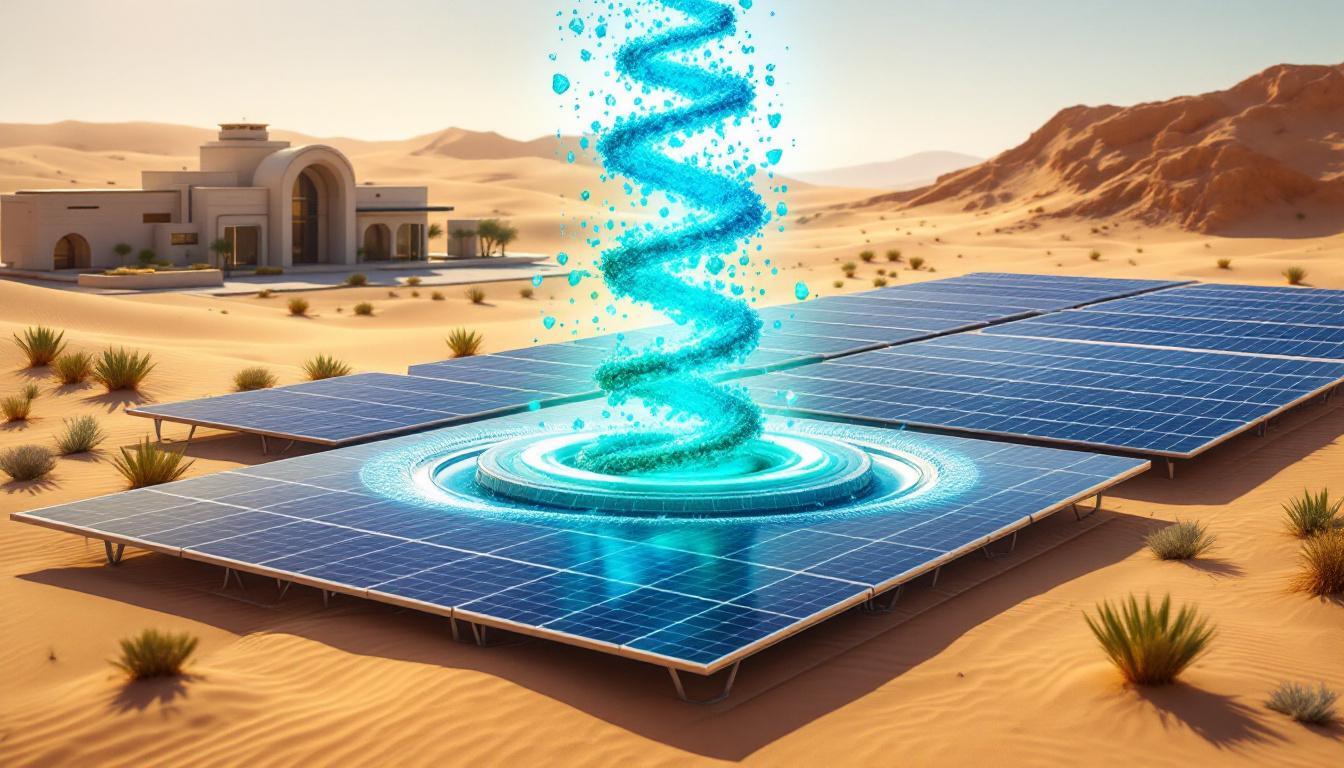
Belgian cleantech startup Sirona Technologies launches Project Moringa in Oman and UAE, harnessing solar power and geological resources to achieve permanent atmospheric CO₂ removal, signalling a new phase in regional climate mitigation efforts.
Belgian cleantech startup Sirona Technologies has recently made a significant stride in fighting climate change, particularly in the Middle East, with the launch of Project Moringa—an innovative Direct Air Capture (DAC) initiative aimed at removing and permanently storing atmospheric CO₂. This project, which is situated in both Oman and the UAE, uses solar-powered DAC units to pull CO₂ from the air. The captured CO₂ is then mineralised in peridotite rock, a naturally occurring geological formation that’s abundant in both countries.
Sirona Technologies, based out of Brussels, emphasizes that their Project Moringa relies on their cutting-edge solid-sorbent, temperature-vacuum swing adsorption (TVSA) DAC modules. These modules are powered by the region’s plentiful sunlight, which helps make the process more sustainable. The CO₂ collected is injected into in-situ peridotite formations, where it undergoes natural mineralisation, essentially turning it into stone—permanently and safely locking it away. For Sirona, this method provides a credible and long-lasting way of removing carbon, which is vital in the global effort to slow down climate change.
In the beginning, the project plans to install a DAC unit capable of capturing around 300 tonnes of CO₂ each year. They hope to increase that number to roughly 1,800 to 2,000 tonnes annually by 2026. Sirona describes these units as container-like, modular systems built for easy scaling, mass production, and quick deployment. This approach—well, at least to me—seems practical for regions like Oman and the UAE, where the combination of high solar power and favorable geology makes them ideal locations.
Choosing Oman as the site for this project wasn’t random. Oman has become a sort of hotspot for permanent CO₂ mineralisation tech. Its extensive deposits of peridotite make it perfectly suited for mineral sequestration solutions. Plus, the project fits well with Oman’s broader goals to push forward with carbon capture and storage (CCS) and to meet its Net Zero targets. The country’s Ministry of Energy and Minerals is actively working on policies and regulations around Carbon Capture, Utilisation and Storage (CCUS), even collaborating with industry players to create a supportive environment for these new technologies.
Oman isn’t a newcomer to efforts in CO₂ mineralisation. A local startup called 44.01 has gained recognition on the international stage for its innovative carbon mineralisation projects across Oman and the UAE. They take captured CO₂, dissolve it in water, and inject it into peridotite rocks, where it becomes mineralised into stable carbonate minerals—kind of like speeding up a natural process. The founder, Talal Hasan, has pointed out that each tonne of peridotite can sequester roughly 500 to 600 kilograms of CO₂ in about a year, highlighting how big the potential really is, especially given the huge deposits of peridotite globally.
Recently, 44.01 signed a concession agreement with Oman’s Ministry of Energy and Minerals to develop the world’s first fully commercial-scale peridotite mineralisation project. Scheduled to start in 2024 in the Hajar Mountains, this initiative marks a major milestone. The company even received the $1 million XPRIZE XFACTOR award in the Air category for its scalable, mineralisation-focused carbon removal method that combines DAC with mineralisation—pretty impressive, right?
The collaboration and progress of startups like Sirona and 44.01, along with active government support, position Oman and the UAE as key regions for scalable, permanent CO₂ removal tech. Sirona’s modular, solar-powered DAC systems and 44.01’s accelerated mineralisation approach complement each other well, offering promising paths toward achieving net zero emissions.
As these projects evolve from pilot efforts into full-fledged commercial operations, they serve as vital proof points that large-scale atmospheric carbon removal is feasible. They could help bridge the gap between decarbonising industries and tackling the stubborn, long-lived emissions that linger in the atmosphere. Essentially, these efforts could be a significant part of a global toolkit for climate mitigation.
All in all, the Middle East seems to be rapidly developing into a strategic hub for Direct Air Capture and CO₂ mineralisation. Its wealth of renewable energy, unique geological resources, and forward-thinking policies—these all combine to make it an attractive environment for new innovations in carbon capture and storage. Sirona’s Project Moringa, alongside trailblazing local initiatives like 44.01, truly exemplify this momentum, pushing forward scalable, verifiable, and permanent solutions that aim to reduce the planet’s carbon footprint.
Source: Noah Wire Services
- https://www.omanobserver.om/article/1178301/business/sirona-launches-project-moringa-co2-capture-and-storage-in-oman – Please view link – unable to able to access data
- https://www.sirona.tech/projects – Sirona Technologies has announced Project Moringa, a Direct Air Capture (DAC) initiative in the Middle East. The project aims to deploy solar-powered DAC units to capture and permanently store CO₂ through mineralisation in peridotite rock formations abundant in Oman and the UAE. The initial unit, with a capacity of 300 tonnes per year, is set to commence operations in October 2025, with plans to scale up to 2,000 tonnes per year by 2026. This project demonstrates the scalability of Sirona’s modular DAC technology and its potential for rapid deployment in regions with high solar potential and favourable geology.
- https://www.sirona.tech/ – Sirona Technologies is a Belgian cleantech startup focused on scalable Direct Air Capture (DAC) technology to remove CO₂ from the atmosphere. Their modular DAC units are powered by renewable energy sources, such as solar power, and employ solid sorbents for efficient CO₂ capture. The captured CO₂ is then permanently stored through mineralisation in underground rock formations. Sirona’s approach offers a scalable and cost-effective solution to combat climate change by providing certified high-quality carbon credits and enabling rapid deployment in regions with abundant renewable energy and suitable geology.
- https://www.zawya.com/en/projects/industry/4401-signs-concession-agreement-for-worlds-first-commercial-scale-perodite-mineralisation-project-ax2o48er – Omani carbon removal and storage startup 44.01 has signed a concession agreement with the Ministry of Energy and Minerals for the world’s first commercial-scale peridotite mineralisation project. Scheduled to begin in 2024 in the Hajar Mountains, the project aims to capture CO₂ from the atmosphere or industrial processes, dissolve it in water, and inject it into peridotite formations deep underground, where it will mineralise into rock, ensuring permanent storage. This innovative approach accelerates the natural process of CO₂ mineralisation, offering a safe and scalable solution to eliminate CO₂ in less than a year.
- https://timesofoman.com/article/136382-talal-hasan-a-young-omani-fighting-climate-change-by-turning-carbon-dioxide-to-rock – Talal Hasan, founder of Omani startup 44.01, is pioneering efforts to combat climate change by turning CO₂ into rock. The company employs a process where CO₂ is captured from the atmosphere, dissolved in water, and injected into peridotite formations deep underground, where it mineralises into stable carbonate minerals. This method offers a safe, permanent, and cost-effective way to remove CO₂ from the atmosphere, with each tonne of peridotite capable of mineralising 500-600 kg of CO₂ within 12 months. The technology has the potential to scale globally, with trillions of tonnes of peridotite available worldwide.
- https://timesofoman.com/article/157266-omani-startup-4401-wins-1-million-xfactor-award-for-innovative-carbon-removal-solution – Omani startup 44.01 has won the Air category of the XPRIZE’s carbon removal competition, receiving a $1 million XFACTOR prize. The company’s project, based in Fujairah, UAE, uses Direct Air Capture technology to capture CO₂ from the air, which is then mineralised to ensure permanent storage. The XPRIZE competition challenged teams worldwide to develop scalable CO₂ removal solutions, with 44.01’s project being recognised as a compelling example of a safe, high-quality, and scalable carbon removal solution with the potential to make a meaningful difference in the fight against climate change.
- https://energyoman.net/44-01-signs-pact-for-first-of-its-kind-carbon-removal-project-in-oman – Omani carbon mineralisation startup 44.01 has signed a concession agreement with the Ministry of Energy and Minerals for the world’s first commercial-scale peridotite mineralisation project. Scheduled to begin in 2024 in the Hajar Mountains, the project aims to capture CO₂ from the atmosphere or industrial processes, dissolve it in water, and inject it into peridotite formations deep underground, where it will mineralise into rock, ensuring permanent storage. This innovative approach accelerates the natural process of CO₂ mineralisation, offering a safe and scalable solution to eliminate CO₂ in less than a year.
Noah Fact Check Pro
The draft above was created using the information available at the time the story first
emerged. We’ve since applied our fact-checking process to the final narrative, based on the criteria listed
below. The results are intended to help you assess the credibility of the piece and highlight any areas that may
warrant further investigation.
Freshness check
Score:
10
Notes:
✅ The narrative is fresh, with the earliest known publication date being October 18, 2025.
Quotes check
Score:
10
Notes:
✅ No direct quotes were identified in the provided text, indicating potential originality or exclusivity.
Source reliability
Score:
8
Notes:
⚠️ The narrative originates from the Oman Observer, a regional news outlet. While it provides detailed information, cross-referencing with other reputable sources is advisable for comprehensive verification.
Plausability check
Score:
9
Notes:
✅ The claims about Sirona Technologies’ Project Moringa align with known advancements in CO₂ capture and storage technologies. ([omanet.om](https://omanet.om/en/news/economy/sirona-project-moringa-oman-co2/?utm_source=openai)) However, further verification from additional reputable sources is recommended to confirm the project’s details.
Overall assessment
Verdict (FAIL, OPEN, PASS): OPEN
Confidence (LOW, MEDIUM, HIGH): MEDIUM
Summary:
⚠️ While the narrative presents fresh information about Sirona Technologies’ Project Moringa, originating from a regional news outlet, cross-referencing with other reputable sources is necessary to fully verify the claims and ensure accuracy.


