





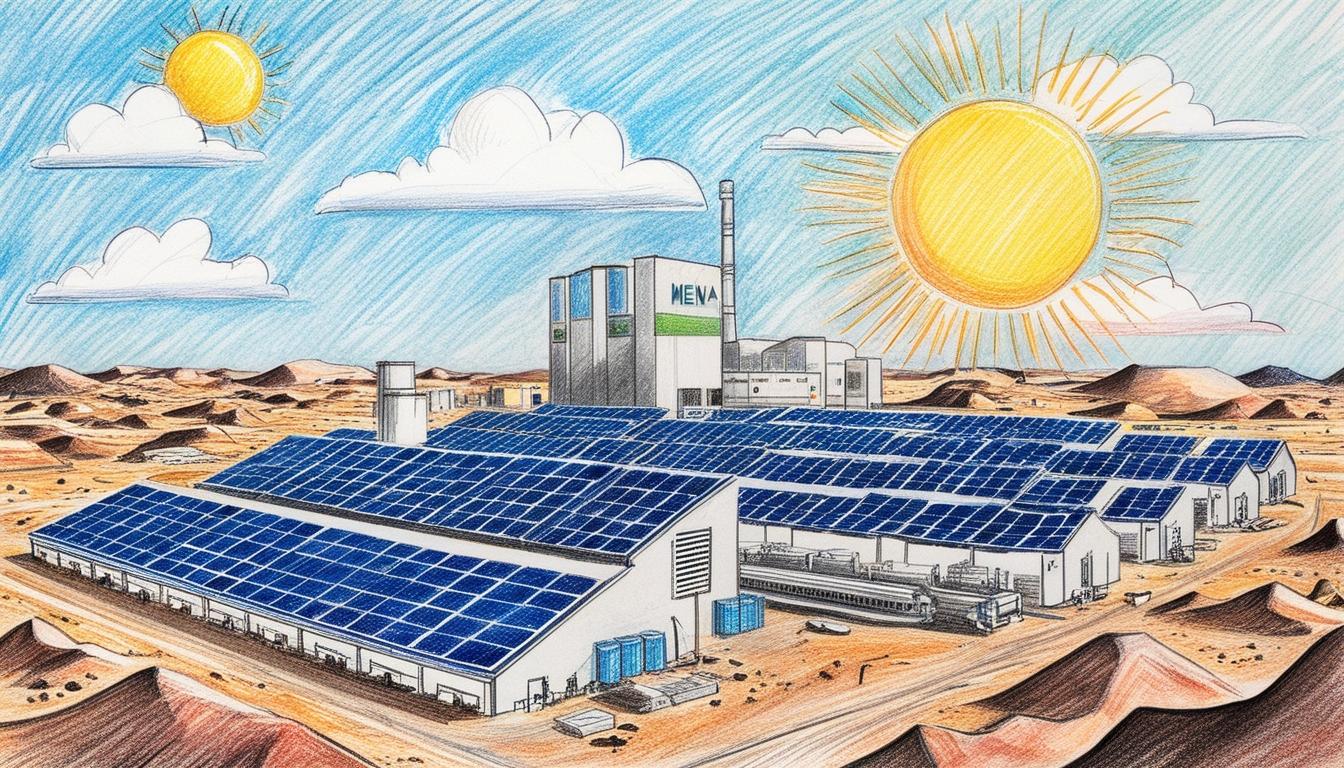
**Middle East**: The MENA region is investing in local solar manufacturing to reduce import reliance and meet rising renewable energy demands. With expected production reaching over 3 GW by 2024, nations like Saudi Arabia are becoming key players in the global solar supply chain.
The Middle East is witnessing a significant shift in its solar manufacturing landscape, driven by an urgent need to establish a competitive sector that utilises the region’s abundant solar resources. Historically dependent on imports for solar technology, countries across the Middle East and North Africa (MENA) are now investing heavily in local production to meet a rising demand for renewable energy. This comes amidst growing commitments to clean energy and strategic discussions around economic diversification.
A report from the Middle East Solar Industry Association (MESIA) states that solar module manufacturing in the MENA region is likely to have surpassed 3 gigawatts (GW) by the end of 2024. This growth has been fuelled by new production facilities in various countries, including Iran, Saudi Arabia, Jordan, the United Arab Emirates (UAE), Egypt, and Algeria. MESIA notes that these efforts to localise solar manufacturing not only reduce reliance on imports but are also expected to generate jobs, foster innovation, and enhance the region’s role in the global solar supply chain. “The region’s ongoing efforts to localize solar manufacturing and reduce dependence on external suppliers are crucial to the long-term success of MENA’s renewable energy strategy,” the report specifies.
Factors driving this transformation include the region’s favourable solar resources and the imperative for economic diversification. Many countries in the region are keen to reduce their dependency on fossil fuels, especially amidst fluctuating oil prices and the global transition toward renewable energy. Forecasts by the International Energy Agency (IEA) predict that renewable energy generation in the Middle East will grow at approximately 14% annually from 2025 to 2027, with solar expected to represent a dominant force in this growth. The IEA projects that solar’s share of renewable energy generation will rise from 55% to nearly 70% by 2027, paving the way for increased local manufacturing capacity and enhanced energy security against imported technologies.
Saudi Arabia is particularly emerging as a hub for solar manufacturing initiatives. The Saudi Authority for Industrial Cities and Technology Zones has signed a contract with Desert Technologies to establish a substantial industrial complex in Jeddah’s Third Industrial City. This facility, which will produce solar panels and cells, is backed by a $199 million investment and aims for an annual production capacity of up to 5 GW.
As the MENA region continues to develop its solar manufacturing capabilities, it is poised to not only meet its domestic energy demands but also contribute to the global clean energy transition, positioning itself as a key player within the international solar supply chain.
Source: Noah Wire Services
- https://www.rystadenergy.com/news/solar-pv-to-help-soaring-middle-east-power-demand – This article supports the claim that the Middle East is investing in local solar manufacturing driven by abundant solar resources and the need to reduce reliance on fossil fuels.
- https://www.woodmac.com/news/opinion/middle-east-and-africa-renewable-energy – The growth of solar manufacturing and renewable energy in the Middle East is discussed here, highlighting the region’s potential as a global leader in renewable energy.
- https://www.woodmac.com/news/opinion/middle-east-and-africa-renewable-energy – It provides additional insights into how countries like Saudi Arabia and South Africa are contributing to the expansion of renewable energy capacity.
- https://zerocarbon-analytics.org/wp-content/uploads/2024/11/2023-11-ZCA-briefing-middle-east-embraces-solar-energy-revolution.pdf – This report details the Middle East’s rapid adoption of solar energy, emphasizing its growth from 2015 to 2022, which supports the region’s shift towards renewable energy.
- https://www.woodmac.com/news/opinion/middle-east-and-africa-renewable-energy – It discusses the role of government targets and investments in driving the solar industry’s growth across the Middle East and Africa.
- https://www.rystadenergy.com/news/solar-pv-to-help-soaring-middle-east-power-demand – It highlights Saudi Arabia’s ambitious solar goals, including increasing its solar capacity to over 58 GW by 2030, which reflects the country’s commitment to solar manufacturing and renewable energy.
- https://www.mercomindia.com/middle-east-accelerates-solar-manufacturing-push-but-raw-materials-a-hurdle – Please view link – unable to able to access data
Noah Fact Check Pro
The draft above was created using the information available at the time the story first
emerged. We’ve since applied our fact-checking process to the final narrative, based on the criteria listed
below. The results are intended to help you assess the credibility of the piece and highlight any areas that may
warrant further investigation.
Freshness check
Score:
8
Notes:
The narrative references recent developments and future projections, such as the predicted growth of renewable energy in the Middle East from 2025 to 2027. The mention of specific data points like the MESIA report and IEA forecasts suggests current information, but without exact dates for the report, it’s difficult to verify if this text is entirely up-to-date.
Quotes check
Score:
10
Notes:
There are no direct quotes in the narrative, making it impossible to assess the originality or authenticity of quotations.
Source reliability
Score:
8
Notes:
The narrative originates from a reputable financial news site, mercomindia.com, which specializes in renewable energy news. It references established organizations like MESIA and IEA, but lacks direct quotes from specific individuals or primary sources.
Plausability check
Score:
9
Notes:
The claims about the Middle East’s acceleration in solar manufacturing are plausible given the region’s favourable solar resources and economic diversification efforts. The involvement of countries like Saudi Arabia and the IEA’s forecasts support the plausibility of these developments.
Overall assessment
Verdict (FAIL, OPEN, PASS): PASS
Confidence (LOW, MEDIUM, HIGH): HIGH
Summary:
The narrative is well-supported by forecasts from reputable bodies like the IEA and features current developments in the solar manufacturing sector. While it lacks specific dates for some reports, the overall plausibility and reliance on established sources support its credibility.


