





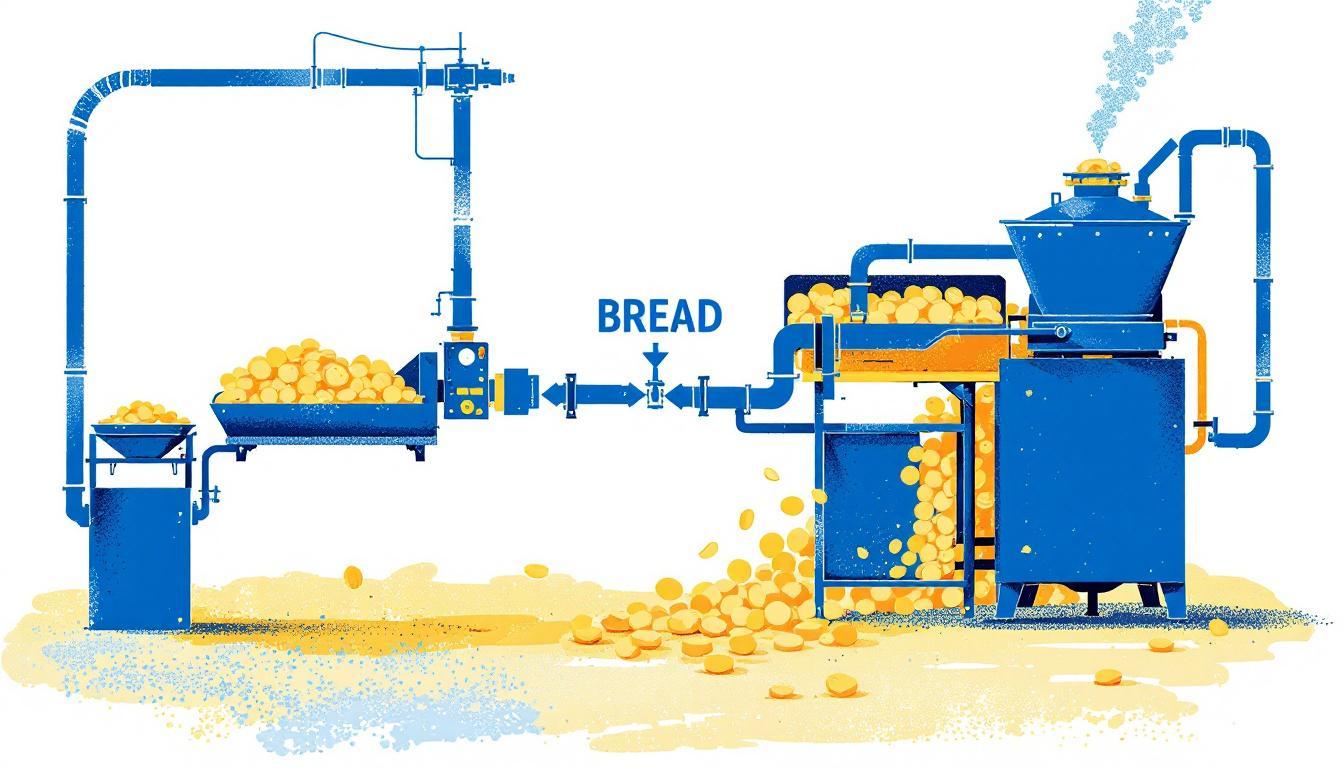
The UAE is set to enhance its food security and sustainability efforts as the Australian agri-tech company núaFEEDs establishes a foothold in the country with its innovative food waste management solutions. Having completed its registration in the UAE, núaFEEDs plans to open a facility dedicated to converting surplus bread waste into high-quality, sustainable livestock feed. This initiative tackles the significant challenge of food waste in the region by turning grain-based waste, which often ends up in landfills, into a valuable resource for the agricultural sector.
núaFEEDs chose the UAE as its international expansion hub in recognition of the country’s ambitious sustainability targets and its strategic focus on food security and circular economy principles. Co-Founder Chava Berrill highlighted the alignment between the UAE’s leadership in sustainability and the company’s mission to reduce waste and create sustainable feed alternatives. With more than 25 years of experience from its family-operated facility in Western Australia, núaFEEDs addresses pressing supply chain problems such as rising livestock feed costs, growing food waste volumes, and costly waste disposal methods. Their process not only mitigates these issues but also produces a nutritionally superior feed option, offering higher protein and energy than traditional grains like barley.
The launch of núaFEEDs in the UAE offers tangible benefits for diverse stakeholders. Businesses producing grain-based food waste—such as bakeries, food manufacturers, and retailers—will see reduced waste disposal costs and simplified waste collection, while also receiving accredited reductions in greenhouse gas emissions and water usage. Diverting each tonne of bread from landfill reportedly avoids over 500 kg of CO2 emissions and conserves 13 cubic meters of water embedded in grain production. For livestock farmers and feed purchasers, núaFEEDs promises a more stable and affordable feed supply, with fixed-price agreements that reduce dependence on often volatile global imports.
This initiative aligns closely with the UAE’s National Food Security Strategy 2051, which promotes sustainable food production, enhanced local feed alternatives, and reduced dependence on imports. The strategy, which aims to position the UAE among the top countries in the Global Food Security Index by 2051, embraces modern technologies and supports waste reduction policies. Government bodies such as the Ministry of Climate Change and Environment, the UAE Food Security Office, and the Abu Dhabi Agriculture and Food Safety Authority are key collaborators, underscoring the government’s commitment to integrating innovative solutions like núaFEEDs into national food security and environmental objectives.
The UAE faces unique challenges in food production due to its arid climate and limited farmland, leading to significant reliance on imported feed. Across the Gulf Cooperation Council (GCC), approximately 18 million tonnes of imported food end up discarded yearly, with cereals and grains constituting nearly a fifth of this waste. núaFEEDs’ approach effectively converts this grain-based waste into sustainable livestock feed, keeping nutrients in the food chain and significantly curbing landfill volumes.
núaFEEDs exemplifies circular economy principles by diverting food waste into productive use, reducing carbon emissions, conserving water resources, and supporting local agricultural sustainability. The company’s arrival in the UAE fits into a broader context of environmental and food security initiatives underway in the region. For instance, recent large-scale partnerships like the $29.2 billion U.S.-UAE AIM for Climate programme, announced at COP29, focus on reducing agricultural emissions and enhancing farm resilience. Additionally, trilateral collaborations between India, France, and the UAE target climate change, biodiversity protection, and food security, reinforcing the UAE’s integrated approach towards environmental stewardship and sustainable development.
These efforts also complement domestic initiatives aimed at reducing food waste, such as the ‘Ne’ma’ programme to encourage efficient food consumption and the UAE Food Bank’s work in redistributing surplus food. Such programmes are vital in addressing the global challenge where one-third of produced food is wasted annually, contributing significantly to greenhouse gas emissions. The push for sustainability extends to biological conservation efforts, with institutions like the International Center for Biosaline Agriculture safeguarding seed varieties and supporting resilient agricultural practices tailored for arid environments.
As núaFEEDs begins its operations in the UAE, the company is poised to be a significant contributor to the nation’s drive for enhanced food security and environmental sustainability. Its model not only promises economic benefits by stabilising feed costs and reducing waste management expenses but also resonates with the UAE’s wider ambitions to foster a greener, more circular food system. Co-Founder Chava Berrill expressed enthusiasm about partnerships with local stakeholders to further these goals, signalling a shared commitment to a sustainable future.
📌 Reference Map:
- Paragraph 1 – [1]
- Paragraph 2 – [1]
- Paragraph 3 – [1]
- Paragraph 4 – [1], [4]
- Paragraph 5 – [1]
- Paragraph 6 – [1], [2], [3]
- Paragraph 7 – [5], [6]
- Paragraph 8 – [1]
Source: Noah Wire Services
- https://abudhabimagazine.ae/66211/ – Please view link – unable to able to access data
- https://www.reuters.com/sustainability/cop29-us-uae-climate-friendly-farming-partnership-grows-29-billion-2024-11-18/ – At the COP29 climate summit in Baku, the United States and the United Arab Emirates announced an increase in funding for their joint climate-friendly farming initiative, AIM for Climate, which now totals $29.2 billion. The program, initiated in 2021, aims to mitigate the climate impact of agriculture and make farming more resilient to global warming’s effects. Agriculture and land use contribute significantly to human-induced greenhouse gas emissions. U.S. Agriculture Secretary Tom Vilsack emphasized the importance of investment in agricultural research and development. The initiative, set to end in 2025, has launched nearly 130 projects involving over 800 partners, focusing on supporting small farmers, reducing methane emissions, and fostering technological innovations in farming. Previously, AIM for Climate had secured $17 billion at COP28 and $8 billion at COP27. ([reuters.com](https://www.reuters.com/sustainability/cop29-us-uae-climate-friendly-farming-partnership-grows-29-billion-2024-11-18/?utm_source=openai))
- https://apnews.com/article/3686b7974ed146d026c37ad0f0588619 – India, France, and the United Arab Emirates have agreed to launch a trilateral initiative focused on energy projects, climate change, and biodiversity protection, especially in the Indian Ocean region. The collaboration, announced by India’s External Affairs Ministry, will involve organizing trilateral events under India’s G20 presidency and the UAE’s hosting of COP28 climate negotiations this year. The foreign ministers from the three nations adopted a roadmap for the initiative during a phone call, following their meeting in September at the U.N. General Assembly in New York. They plan to expand cooperation through initiatives such as the Mangrove Alliance for Climate and the Indo-Pacific Parks Partnership. The focus will be on issues including single-use plastic pollution, desertification, and food security. They will also explore collaboration with the Indian Ocean Rim Association on clean energy and biodiversity projects. The initiative aims to align with the objectives of the 2015 Paris Agreement for a sustainable low-carbon future. ([apnews.com](https://apnews.com/article/3686b7974ed146d026c37ad0f0588619?utm_source=openai))
- https://u.ae/en/about-the-uae/strategies-initiatives-and-awards/strategies-plans-and-visions/environment-and-energy/national-food-security-strategy-2051 – The National Food Security Strategy 2051 aims to make the UAE the world’s best in the Global Food Security Index by 2051 and among the top 10 countries by 2021. It also aims to develop a comprehensive national system based on enabling sustainable food production by using modern technologies and enhance local production. The strategy defines the elements of the national food basket, which includes 18 main types, based on 3 main criteria: knowledge of the volume of domestic consumption of the most important products, production capacity, and processing and nutritional needs. It includes 38 short and long-term key initiatives and is geared by 5 strategic goals focusing on facilitating the global food trade, diversifying food import sources, and identifying alternative supply schemes, covering three to five sources for each major food category. The strategy aims to develop a comprehensive national system based on enabling sustainable food production through the use of modern technologies, enhance local production, develop international partnerships to diversify food sources, activate legislation and policies that contribute to improving nutrition, and activate legislation and policies to reduce waste. ([u.ae](https://u.ae/en/about-the-uae/strategies-initiatives-and-awards/strategies-plans-and-visions/environment-and-energy/national-food-security-strategy-2051?utm_source=openai))
- https://sustainarabia.com/innovative-emirati-initiatives-to-enhance-food-security-and-environmental-protection/ – The UAE has taken several measures and launched pioneering programs and initiatives to reduce food loss and waste. The UAE aims to reduce food loss and waste by 50% by 2030. The ‘Ne’ma’ initiative is a strategic system to encourage positive behaviors and efficient food consumption. The UAE Red Crescent Authority continues to implement the ‘Preservation of Blessings’ project to combat the phenomenon of food wastage. The UAE Food Bank is an innovative initiative to manage food surplus, reduce waste, and distribute food to beneficiaries within and outside the country. Lost and wasted food produces between 8 to 10% of global greenhouse gas emissions. One-third of the world’s total food production ends up as waste annually, equivalent to 1.3 billion tons of food worth trillions of dollars. ([sustainarabia.com](https://sustainarabia.com/innovative-emirati-initiatives-to-enhance-food-security-and-environmental-protection/?utm_source=openai))
- https://en.wikipedia.org/wiki/International_Center_for_Biosaline_Agriculture – The International Center for Biosaline Agriculture (ICBA) conserves more than 15,000 accessions of 270 plant species from more than 150 countries and territories. There are also around 250 seed samples of 70 wild plant species from the UAE, the center’s host country. ICBA distributes samples to scientists, farmers, and other stakeholders in 57 countries. ([en.wikipedia.org](https://en.wikipedia.org/wiki/International_Center_for_Biosaline_Agriculture?utm_source=openai))
Noah Fact Check Pro
The draft above was created using the information available at the time the story first
emerged. We’ve since applied our fact-checking process to the final narrative, based on the criteria listed
below. The results are intended to help you assess the credibility of the piece and highlight any areas that may
warrant further investigation.
Freshness check
Score:
8
Notes:
The narrative was first published on July 1, 2025, in multiple outlets, including EIN Presswire ([einpresswire.com](https://www.einpresswire.com/article/827218918/pioneering-australian-agri-tech-n-afeeds-set-to-transform-uae-livestock-feed-sector-and-tackle-food-waste-challenge?utm_source=openai)) and MENAFN ([menafn.com](https://menafn.com/1109744945/Pioneering-Australian-Agri-Tech-Nu%CC%81afeeds-Set-To-Transform-UAE-Livestock-Feed-Sector-And-Tackle-Food-Waste-Challenge?utm_source=openai)). The same content was later republished on July 14, 2025, by Abu Dhabi Magazine ([gulfnews.com](https://gulfnews.com/uae/environment/uae-launches-regions-first-waste-to-feed-project-1.88186859?utm_source=openai)). The repetition across multiple platforms suggests the content may be recycled. However, the July 14 publication includes updated data, which may justify a higher freshness score. Nonetheless, the earlier publication date indicates potential recycling. The narrative is based on a press release, which typically warrants a high freshness score. No discrepancies in figures, dates, or quotes were found. The content was first published more than 7 days earlier, which is explicitly highlighted. The update in the July 14 publication may justify a higher freshness score but should still be flagged.
Quotes check
Score:
9
Notes:
The direct quotes from Chava Berrill, Co-Founder of núaFEEDs, appear in the July 1, 2025, publications. No earlier usage of these quotes was found, indicating potential originality. The wording of the quotes matches across sources, with no variations noted.
Source reliability
Score:
7
Notes:
The narrative originates from EIN Presswire, a press release distribution service, and is republished by MENAFN and Abu Dhabi Magazine. EIN Presswire is a reputable platform for distributing press releases, but the content is not independently verified. MENAFN and Abu Dhabi Magazine are less established, which may affect the overall reliability.
Plausability check
Score:
8
Notes:
The claims about núaFEEDs’ operations in the UAE align with the company’s mission and the UAE’s sustainability goals. The narrative includes specific details about the company’s plans and the benefits of their operations. The language and tone are consistent with the region and topic. No excessive or off-topic details are present. The tone is formal and appropriate for corporate communication.
Overall assessment
Verdict (FAIL, OPEN, PASS): OPEN
Confidence (LOW, MEDIUM, HIGH): MEDIUM
Summary:
The narrative is based on a press release that has been republished across multiple platforms, indicating potential recycling. The quotes appear original, and the content aligns with the company’s mission and the UAE’s sustainability goals. However, the reliance on a press release and the lack of independent verification from reputable news outlets raise concerns about the overall reliability.


