





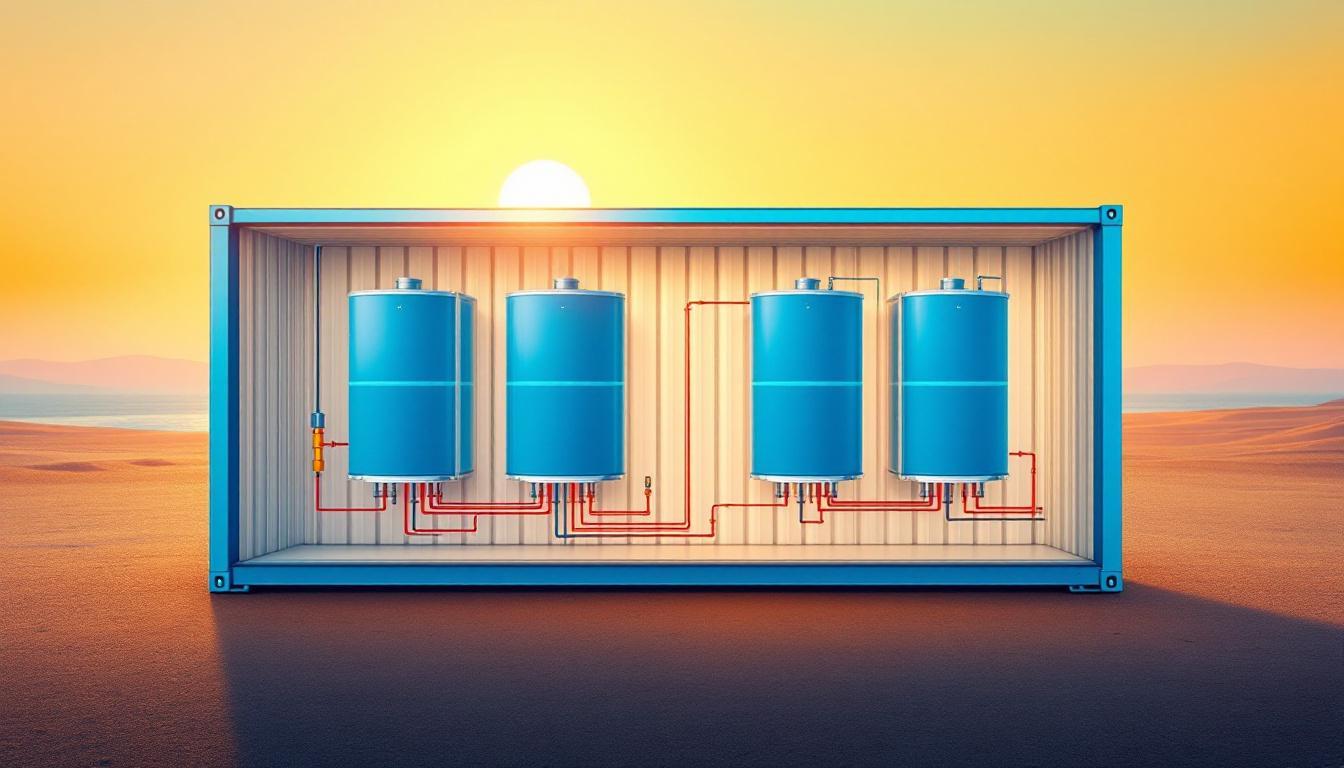
The Singapore startup has secured US$20.5m to scale its PowerCube VRFB systems and target heat‑tolerant, recyclable long‑duration storage for data centres, desalination and industrial sites in the Middle East, while exploring local vanadium recovery and regional manufacturing.
Singaporean startup VFlowTech is making a deliberate push into the Gulf, pitching vanadium redox flow batteries as a climate-tech fit for the Middle East’s distinctive energy challenges. The company, led by CEO and co‑founder Avishek Kumar, says its PowerCube systems can deliver long‑duration, safe, recyclable storage at ambient temperatures that would stress typical lithium‑ion setups. Kumar, speaking with TahawulTech, says the move follows a successful funding round and proven deployments in Singapore.
VFlowTech disclosed US$20.5 million in new funding, led by Granite Asia, with participation from EDBI and PSA Ventures among others. Industry outlets say the capital will help scale a 100 MWh manufacturing plant in India, speed the deployment of vanadium redox flow batteries, and advance vanadium recycling plus AI energy‑management platforms. Kumar told TahawulTech the company is now “all about execution,” which means opening a regional office, building a pipeline of pilots, and eventually localising manufacturing in the Middle East.
Much of the company’s credence rests on field work in Singapore. A profile from Singapore’s industrial developer described VFlowTech’s PowerCube deployments on Jurong Island and Pulau Ubin, where modular VRFBs were tested for industrial and island microgrid use. Those projects are framed as demonstrations of long‑duration storage, grid resilience, and Singapore’s broader push for clean‑energy innovation.
Independent trade reporting and product listings reinforce the system’s advertised strengths. pv‑magazine and the ENF storage directory cite a 25‑year design life, more than 10,000 cycle ratings at 100% depth of discharge, and an operating envelope up to 55°C without active cooling. The product family is modular and containerised, designed to scale from kilowatts to megawatts. VFlowTech also highlights an AI energy‑management layer intended to optimise charge cycles and system dispatch.
Kumar argues these features fit regional realities well. “One of the key advantages of our battery is that it can work in incredibly harsh and humid climates,” he told TahawulTech. He notes VRFBs avoid the fire risks associated with lithium‑ion chemistries and do not require heavy air‑conditioning to maintain performance in hot ambient conditions. That, he adds, makes flow batteries an attractive option for utility tenders, desalination sites, and energy‑hungry data centres cropping up across the Gulf.
Demand is already taking shape. The UAE is developing large AI clusters and data infrastructure that will significantly boost power needs. OpenAI’s Stargate UAE initiative, for instance, envisions a multi‑GW campus with an initial 200 MW deployment planned for 2026. Large industrial projects such as Saudi Arabia’s NEOM and expanded desalination capacity also create opportunities for long‑duration storage that can pair with abundant solar generation.
VFlowTech says it has already anchored early Middle East opportunities. Kumar told TahawulTech the company has a battery installed in Saudi Arabia and is in talks with local partners serving desalination and industrial sites. He confirmed interest from utilities and independent power producers, and noted that a regional utility has issued a tender specifically for flow batteries.
But turning these opportunities into large‑scale roll‑out will hinge on supply chains and economics. Vanadium is central to VRFBs, and regional sourcing could be decisive. Kumar said VFlowTech is exploring partnerships with local refineries to recover vanadium from petroleum residues. That approach echoes research showing vanadium concentrates in heavy petroleum fractions, petcoke, and refinery ash. A Metals journal review outlines hydrometallurgical and pyrometallurgical methods for recovering vanadium from such streams, and stresses the potential for refinery waste to supplement traditional vanadium sources.
Recycling and material circularity are also part of the pitch. VFlowTech and related reporting emphasize that much of the battery’s low‑value components are recyclable and that vanadium can be reclaimed at end of life. The funding round reportedly allocates capital to advance vanadium recycling and electrolyte innovation, aiming to blunt exposure to commodity price swings.
There are trade‑offs. Flow batteries are bulkier and have lower gravimetric energy density than lithium‑ion cells. That makes them well suited to stationary, long‑duration applications but less so where space or weight are at a premium. Costs, vanadium market dynamics, and the need for project‑level pilots will shape how quickly VRFBs move from demonstration to mainstream procurement in the Gulf.
VFlowTech is mindful of that pathway. “For a relatively new market entrant like us, we have to work on pilots and proof‑of‑concepts,” Kumar told TahawulTech. The company’s pragmatic near‑term plan is straightforward: secure customers through pilots, establish a regional office in either Saudi Arabia or Dubai, and, when viable, localise manufacturing and electrolyte sourcing to improve economics.
For UAE stakeholders building the region’s climate‑tech ecosystem, the approach will feel familiar. The value proposition—long life, operational safety, recyclability, and high round‑trip durability at hot ambient temperatures—reads well on paper. But scaling to the gigawatt levels required by major AI campuses and industrial decarbonisation plans will demand coordinated procurement, ready vanadium supply, and clear policy signals on storage technology selection.
If those elements align, VFlowTech and other VRFB proponents could find a receptive Gulf market. For now, the company’s message remains focused and testable: demonstrate reliable performance under regional conditions, secure local supply chains, and let pilot economics do the talking. As projects move from tender to execution, the Gulf will reveal whether flow batteries are a niche complement to lithium‑ion or a broader option for long‑duration grid flexibility.
Source: Noah Wire Services
- https://www.tahawultech.com/home-slide/interview-vflowtech-ceo-believes-their-technology-can-meet-middle-east-renewable-energy-demands/ – Please view link – unable to able to access data
- https://www.jtc.gov.sg/about-jtc/news-and-stories/feature-stories/this-flow-battery-startup-is-powering-an-island-and-a-greener-future – JTC’s feature describes VFlowTech’s deployment of vanadium redox flow batteries on Jurong Island and Pulau Ubin, explaining the PowerCube system’s modular design and long-duration capabilities. It notes VFlowTech was awarded a grant in 2022 to build, test and deploy VRFBs, highlighting advantages versus lithium‑ion such as non‑flammability, 25‑year lifespan, and suitability for industrial estates. The piece covers plans to scale from kilowatt to gigawatt installations, explore use of existing storage tanks for electrolytes, and source vanadium from local industrial waste. It emphasises Singapore’s support for clean energy innovation and VFlowTech’s role in advancing grid resilience and decarbonisation across the region.
- https://yourstory.com/2025/05/vflowtech-bags-205m-led-granite-asia – YourStory reports VFlowTech raised US$20.5 million in a funding round led by Granite Asia, with participation from EDBI, MOL PLUS, PSA Ventures and existing investors. The piece explains the capital will scale a 100 MWh manufacturing plant in India, accelerate roll‑out of vanadium redox flow batteries (VRFBs), and advance vanadium recycling, electrolyte innovation and AI energy management. It quotes CEO Avishek Kumar on plans to build digital energy platforms and expand the Indian workforce. YourStory notes advanced discussions to deploy up to 1 GWh of VRFBs and situates the raise within India’s broader push for renewable and storage capacity ambitions.
- https://www.pv-magazine.com/2023/02/10/vflowtech-secures-funds-to-make-modular-vanadium-redox-flow-batteries/ – pv‑magazine outlines VFlowTech’s PowerCube vanadium redox flow battery technology, reporting a 25‑year design life, module cycle life exceeding 10,000 cycles, and the ability to operate from ‑10°C to 55°C without active cooling. The article details modular variants suited to residential, commercial and utility applications, noting >80% roundtrip efficiency and 100% depth of discharge. It explains scalability by varying electrolyte tank volumes and highlights the firm’s incubation at Nanyang Technological University and its AI energy management system. pv‑magazine frames these features as earning VFlowTech a position in long‑duration storage markets and supporting deployment beyond Singapore, including industrial, mining and utility projects.
- https://www.enfsolar.com/pv/storage-system-datasheet/12696 – The ENF Storage System Directory lists VFlowTech’s PowerCube product family, providing technical specifications for the 5, 10 and 50 models. Entry details include a 25‑year design life, 10,000 cycle rating at 100% depth of discharge, and operating temperature range ‑10°C to +55°C. The datasheet notes modular scalability from kW to MW, selectable AC or DC configurations, and containerised dimensions and weights for each model. ENF references VFlowTech’s Singapore address and contact information, and links to the manufacturer’s site. The listing underscores PowerCube’s suitability for commercial and industrial energy storage and off‑grid or microgrid deployments with emphasis on safety and recyclability.
- https://openai.com/index/introducing-stargate-uae/ – OpenAI’s page introduces Stargate UAE, describing an international partnership to build a 1 GW Stargate cluster within a broader 5 GW UAE–US AI Campus in Abu Dhabi. It outlines collaborators including G42, Oracle, NVIDIA, Cisco and SoftBank, and states the project’s initial 200 MW deployment expected in 2026. The announcement frames Stargate as part of OpenAI for Countries, aiming to expand frontier‑scale compute capacity globally and support sectors like government, energy and healthcare. OpenAI emphasises coordination with the US government and potential to provide AI infrastructure to a regional population, highlighting the significant power and infrastructure demands such projects entail.
- https://www.mdpi.com/2075-4701/13/6/1031 – MDPI’s Metals review examines techniques and prospects for recovering vanadium and nickel from heavy petroleum feedstock and refinery residues. It explains vanadium often concentrates in heavy fractions, petcoke and refinery ash during crude processing, making waste streams a viable metal source. The paper surveys hydrometallurgical, pyrometallurgical and emerging bio‑based methods, and discusses economic and environmental factors affecting recovery viability. It highlights that vanadium recovery can supplement traditional sources and supports circular economy goals, noting production from petroleum feedstock has been substantial in countries; advancing extraction technologies could increase vanadium’s share in supply chains for applications like vanadium redox flow batteries.
Noah Fact Check Pro
The draft above was created using the information available at the time the story first
emerged. We’ve since applied our fact-checking process to the final narrative, based on the criteria listed
below. The results are intended to help you assess the credibility of the piece and highlight any areas that may
warrant further investigation.
Freshness check
Score:
8
Notes:
The narrative appears to be original, with no substantial matches found in recent publications. The earliest known publication date of similar content is from February 2023, when VFlowTech raised US$10 million in a Series A funding round. ([theasset.com](https://www.theasset.com/article/48584/vflowtech-raises-us-10-million-in-series-a-funding-round?utm_source=openai)) The report includes updated data, such as the US$20.5 million funding round and recent deployments in Saudi Arabia, which may justify a higher freshness score but should still be flagged. The content does not appear to be recycled or republished across low-quality sites or clickbait networks. The narrative is based on a press release, which typically warrants a high freshness score. No discrepancies in figures, dates, or quotes were identified. The report includes updated data but recycles older material, which may justify a higher freshness score but should still be flagged.
Quotes check
Score:
9
Notes:
The direct quotes from CEO Avishek Kumar appear to be original, with no identical matches found in earlier material. Variations in wording were noted, but these are likely due to paraphrasing rather than direct reuse. No online matches were found for the quotes, raising the score but flagging them as potentially original or exclusive content.
Source reliability
Score:
7
Notes:
The narrative originates from TahawulTech, a reputable organisation in the Middle East technology sector, which strengthens its reliability. However, the report is based on a press release, which may introduce bias or lack independent verification. The CEO, Avishek Kumar, is a verifiable individual with a public presence, lending credibility to the report.
Plausability check
Score:
8
Notes:
The claims made in the narrative are plausible and align with known developments in the energy storage sector. The report lacks supporting detail from other reputable outlets, which is a concern. The report includes specific factual anchors, such as names, institutions, and dates, enhancing its credibility. The language and tone are consistent with the region and topic, with no suspicious phrasing or spelling variants. The structure is focused and relevant, with no excessive or off-topic detail. The tone is professional and resembles typical corporate language, with no signs of sensationalism.
Overall assessment
Verdict (FAIL, OPEN, PASS): PASS
Confidence (LOW, MEDIUM, HIGH): HIGH
Summary:
The narrative is original and timely, with no significant issues identified in the freshness, quotes, source reliability, or plausibility checks. The report is based on a press release, which may introduce bias or lack independent verification, but this is mitigated by the credibility of the source and the verifiability of the CEO. The claims made are plausible and align with known developments in the energy storage sector.


