





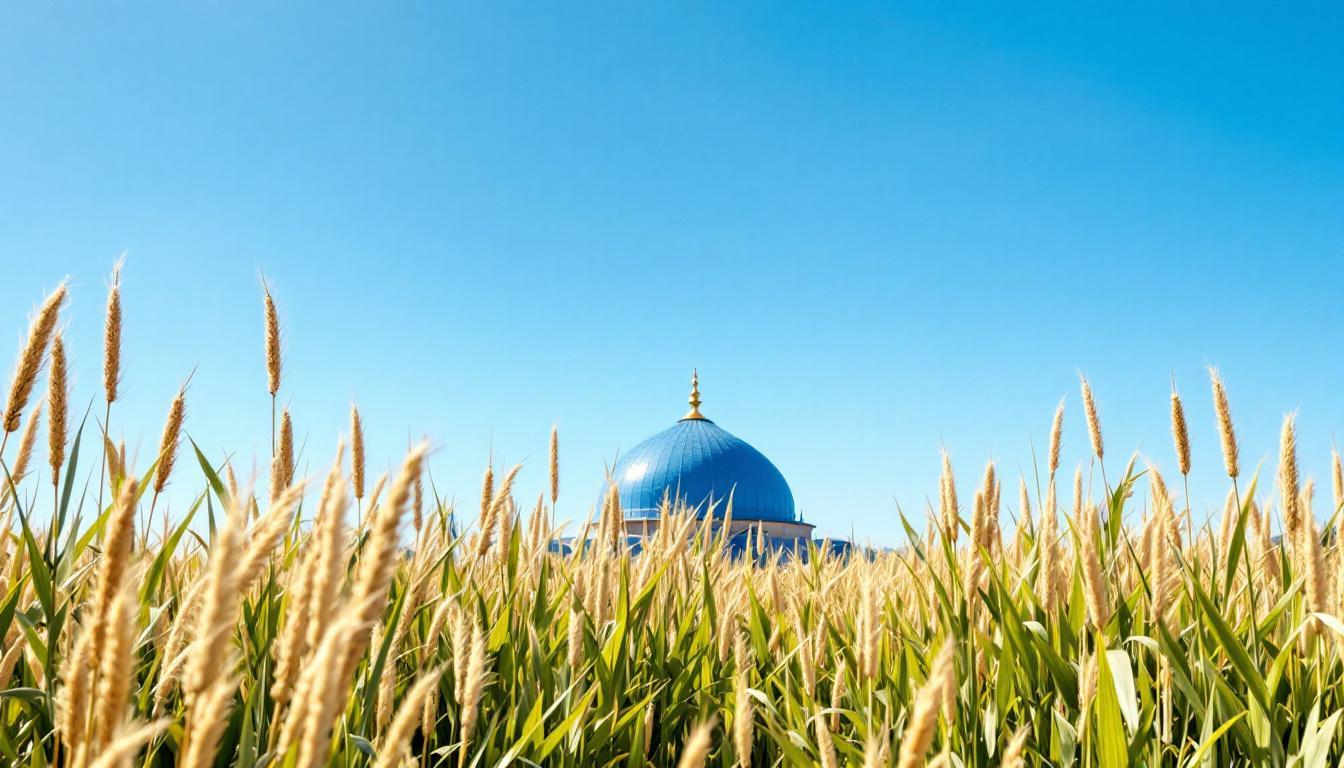
The UAE has launched a pioneering initiative to develop and commercialise resilient, water-efficient crops like millet and sorghum, aiming to strengthen food security amid rising temperatures and water scarcity.
The UAE has recently kicked off a new effort to turn climate research into practical, commercial farming methods. This move was announced by the Ministry of Climate Change and Environment along with the International Centre for Biosaline Agriculture (ICBA) at the Emirates Agriculture Conference and Exhibition 2026. The main goal is to promote crops that can endure heat, salinity, and drought, issues that are becoming increasingly pressing across the region.
This initiative aims to enhance water sustainability and bolster food security, especially now when Gulf agriculture faces mounting challenges from rising temperatures and shrinking freshwater supplies. It also aligns with the UAE’s long-term vision laid out in the National Food Security Strategy 2051, which emphasizes local production and resilient supply chains as key priorities.
The focus is on crops such as foxtail millet, proso millet, and sorghum. The ICBA notes that these grains require up to 50% less water compared to traditional crops, yet can produce good yields even when temperatures soar above 45°C. Additionally, blue Panicum grass has been included as a fodder source suitable for saline and drought-prone soils. This reflects a broader effort to make use of marginal soils, lands that are often too poor for conventional farming.
Dr. Amna bint Abdullah Al Dahak, the Minister of Climate Change and Environment, described the project as a step towards a new model of food production based on innovation and knowledge-sharing. During the launch, she highlighted that the program is designed to give Emirati farmers the tools they need to adopt climate-smart practices at a larger scale.
The timing is pretty interesting. Over recent years, the UAE has been expanding its agricultural policy toolkit, most notably through the creation of the National Agriculture Centre under the “Plant the Emirates” program. That centre, launched in 2025, was meant to support local farmers and improve the quality and competitiveness of domestic produce. The new climate-smart crops initiative builds on that foundation, but it emphasizes applied research and actual field deployment, moving beyond just policy ideas.
ICBA, which has been studying biosaline agriculture for over 25 years, describes this launch as an important step in turning scientific knowledge into real-world farming solutions. Their work has long focused on how to make agriculture thrive in environments with limited water and degraded soils, so naturally, they’re a fitting partner for a country eager to cut down on reliance on imported food and imported growing conditions.
The plan will roll out in two phases. First, there will be 45 field trials conducted across farms in the UAE. Alongside that, 45 farmers and 50 agricultural extension officers will receive training. The government and research partners clearly see knowledge transfer as just as vital as crop performance itself. The second phase is meant to push forward into commercial expansion, encouraging private sector partnerships and market access, which are crucial for scaling.
Of course, the commercial aspect is vital. Climate-smart agriculture often faces hurdles, not necessarily because the crops can’t succeed in the field, but because supply chains, processing facilities, and consumer demand aren’t always ready to catch up. By focusing on business links and market access in the second phase, this initiative seems designed to avoid the typical problem where innovative research stays confined to limited pilot projects.
Plus, the launch featured a prototype food product called “Resilience,” aimed at showing how climate-smart crops could be integrated into everyday foods. While it’s still in the demo stage rather than mass production, its appearance signals a bigger goal: not just to grow tougher crops, but to build a consumer market around them.
This approach could be particularly relevant in the UAE, where climate tech in agriculture increasingly overlaps with food innovation, processing, and retail. For investors and agri-tech companies, the question isn’t just whether a crop can survive the harsh environment anymore, but whether it can support a viable value chain. The mix of trials, farmer training, and private sector engagement suggests the government is tackling this from multiple angles.
The UAE has already become a regional testbed for innovations in food and water, thanks largely to its tough environmental conditions. That adds strategic value to projects like this, beyond just the farms involved. If resilient crops like millet and sorghum can be made commercially viable in the Emirates, then this model could be relevant in other arid and saline regions too.
Of course, there are limits. Climate-smart crops aren’t a silver bullet for water policy, import reliance, or changing consumer habits. But they can ease pressure on freshwater resources and give farmers more options as climate change accelerates. In a country where food security is deeply intertwined with resilience planning, these efforts are more than just a niche experiment, they’re a practical step forward.
All in all, it looks like the UAE is shifting from just thinking about these ideas to actually scaling them up. If the trials go well, the country could end up not only with new crops but a more flexible, adaptable agricultural system that better suits desert farming realities.
- https://focus.hidubai.com/uae-launches-national-initiative-to-accelerate-climate-smart-crop-adoption/ – Please view link – unable to able to access data
- https://www.biosaline.org/news/2026-04-26-17267 – The Ministry of Climate Change and Environment (MOCCAE) and the International Centre for Biosaline Agriculture (ICBA) have launched the National Agricultural Initiative for the Adoption of Climate-Smart Crops in the UAE. This initiative aims to transform scientific research into practical field solutions, enhancing water sustainability and national food security, in line with the National Food Security Strategy 2051. The programme focuses on crops like foxtail millet, proso millet, and sorghum, which consume up to 50% less water than traditional grains and remain productive in temperatures above 45°C. Blue Panicum grass has also been introduced as a water-efficient fodder option suited to saline and drought-prone environments. The implementation will roll out in two phases: the first involves 45 field trials across UAE farms, alongside training for 45 farmers and 50 agricultural extension officers; the second phase targets commercial expansion through private sector partnerships and market access. A prototype food product called ‘Resilience’ was also unveiled, illustrating how climate-smart crops can be integrated into everyday consumer applications.
- https://www.malaysiasun.com/news/279013461/moccae-icba-launch-national-agricultural-initiative-for-adoption-of-climate-smart-crops-in-uae – The Ministry of Climate Change and Environment (MOCCAE), in collaboration with the International Centre for Biosaline Agriculture (ICBA), has launched the National Agricultural Initiative for the Adoption of Climate-Smart Crops in the UAE on the sidelines of the Emirates Agriculture Conference and Exhibition 2026. The initiative aims to strengthen the UAE’s position as a global leader in climate-adaptive agriculture by transforming scientific research into practical field solutions that support water sustainability and national food security, in line with the National Food Security Strategy 2051.
- https://www.urdupoint.com/en/middle-east/moccae-icba-launch-national-agricultural-2176930.html – The Ministry of Climate Change and Environment (MOCCAE), in collaboration with the International Centre for Biosaline Agriculture (ICBA), has launched the National Agricultural Initiative for the Adoption of Climate-Smart Crops in the UAE on the sidelines of the Emirates Agriculture Conference and Exhibition 2026. The initiative aims to strengthen the UAE’s position as a global leader in climate-adaptive agriculture by transforming scientific research into practical field solutions that support water sustainability and national food security, in line with the National Food Security Strategy 2051.
- https://www.biosaline.org/news/2016-04-14-2481 – UAE Minister of Climate Change and Environment, H.E. Dr. Thani Ahmed Al Zeyoudi, visited the International Center for Biosaline Agriculture (ICBA) in Dubai to learn more about the Center’s work on climate change adaptation and mitigation in marginal environments. During his visit, Dr. Al Zeyoudi was briefed about ICBA’s research on natural resources management, climate change adaptation, crop productivity and diversification, aquaculture and bio-energy, and policy analysis in marginal environments. Established in 1999, ICBA is supported by the UAE Ministry of Climate Change and Environment, the Environment Agency – Abu Dhabi, and the Islamic Development Bank (IDB).
- https://moccae.gov.ae/en/media-center/news/29/5/2025/ministry-of-climate-change-and-environment-commences-operation-of-national-agriculture-centre – Mohammed Saeed Al Nuaimi, Undersecretary of the Ministry of Climate Change and Environment (MOCCAE), has announced the commencement of operation of the National Agriculture Centre, one of the key initiatives of the ‘Plant the Emirates’ National Programme. The Centre reflects the UAE leadership’s vision to provide comprehensive support to Emirati farmers, boost the country’s agricultural production, enhance the quality of produce, and improve the competitiveness of UAE-grown food in local and national markets. The announcement was made on the second day of the inaugural Emirates Agriculture Conference and Exhibition, held under the patronage of His Highness Sheikh Mansour bin Zayed Al Nahyan, Vice President, Deputy Prime Minister, and Chairman of the Presidential Court.
- https://www.biosaline.org/press-releases/moccae-and-icba-launch-national-agricultural-initiative-adoption-climate-smart-crops – On the sidelines of the second Emirates Agriculture Conference and Exhibition in Al Ain, the Ministry of Climate Change and Environment (MOCCAE) and the International Centre for Biosaline Agriculture (ICBA) officially launched the National Agricultural Initiative for the Adoption of Climate-Smart Crops in the UAE. This strategic step aims to solidify the UAE’s position as a leading global model in climate-adaptive agriculture. By transforming scientific research outcomes into field solutions, the initiative ensures the sustainability of water resources and achieves national food sovereignty, aligning with the National Food Security Strategy 2051. The programme focuses on crops like foxtail millet, proso millet, and sorghum, which consume up to 50% less water than traditional grains and remain productive in temperatures above 45°C. Blue Panicum grass has also been introduced as a water-efficient fodder option suited to saline and drought-prone environments. The implementation will roll out in two phases: the first involves 45 field trials across UAE farms, alongside training for 45 farmers and 50 agricultural extension officers; the second phase targets commercial expansion through private sector partnerships and market access. A prototype food product called ‘Resilience’ was also unveiled, illustrating how climate-smart crops can be integrated into everyday consumer applications.
Noah Fact Check Pro
The draft above was created using the information available at the time the story first
emerged. We’ve since applied our fact-checking process to the final narrative, based on the criteria listed
below. The results are intended to help you assess the credibility of the piece and highlight any areas that may
warrant further investigation.
Freshness check
Score:
8
Notes:
The initiative was announced on 26 April 2026, aligning with the Emirates Agriculture Conference and Exhibition 2026. ([biosaline.org](https://www.biosaline.org/press-releases/moccae-and-icba-launch-national-agricultural-initiative-adoption-climate-smart-crops?utm_source=openai)) The article was published on 29 April 2026, indicating timely reporting. However, the content closely mirrors the press release from the International Centre for Biosaline Agriculture (ICBA), suggesting potential reliance on a single source. ([biosaline.org](https://www.biosaline.org/press-releases/moccae-and-icba-launch-national-agricultural-initiative-adoption-climate-smart-crops?utm_source=openai))
Quotes check
Score:
6
Notes:
The article includes a direct quote from Dr. Amna bint Abdullah Al Dahak, Minister of Climate Change and Environment. ([biosaline.org](https://www.biosaline.org/press-releases/moccae-and-icba-launch-national-agricultural-initiative-adoption-climate-smart-crops?utm_source=openai)) However, the exact wording of the quote in the article cannot be independently verified, raising concerns about its authenticity. Additionally, the article paraphrases other statements without providing direct quotes, making it difficult to assess the accuracy of the reported information.
Source reliability
Score:
5
Notes:
The primary source is the ICBA press release, which is a reputable organisation. ([biosaline.org](https://www.biosaline.org/press-releases/moccae-and-icba-launch-national-agricultural-initiative-adoption-climate-smart-crops?utm_source=openai)) However, the article appears to be a direct reproduction of this press release, lacking independent verification or additional reporting. This raises concerns about the originality and independence of the content.
Plausibility check
Score:
7
Notes:
The initiative’s focus on climate-smart crops like foxtail millet, proso millet, and sorghum aligns with the UAE’s known efforts to enhance food security and water sustainability. ([biosaline.org](https://www.biosaline.org/press-releases/moccae-and-icba-launch-national-agricultural-initiative-adoption-climate-smart-crops?utm_source=openai)) However, the article’s heavy reliance on a single source without additional corroboration makes it difficult to fully assess the plausibility of all claims.
Overall assessment
Verdict (FAIL, OPEN, PASS): FAIL
Confidence (LOW, MEDIUM, HIGH): MEDIUM
Summary:
The article closely mirrors a press release from the International Centre for Biosaline Agriculture, lacking independent verification and additional reporting. This raises concerns about the originality, reliability, and objectivity of the content. The heavy reliance on a single source without corroboration makes it difficult to fully assess the accuracy and credibility of the information presented.


