





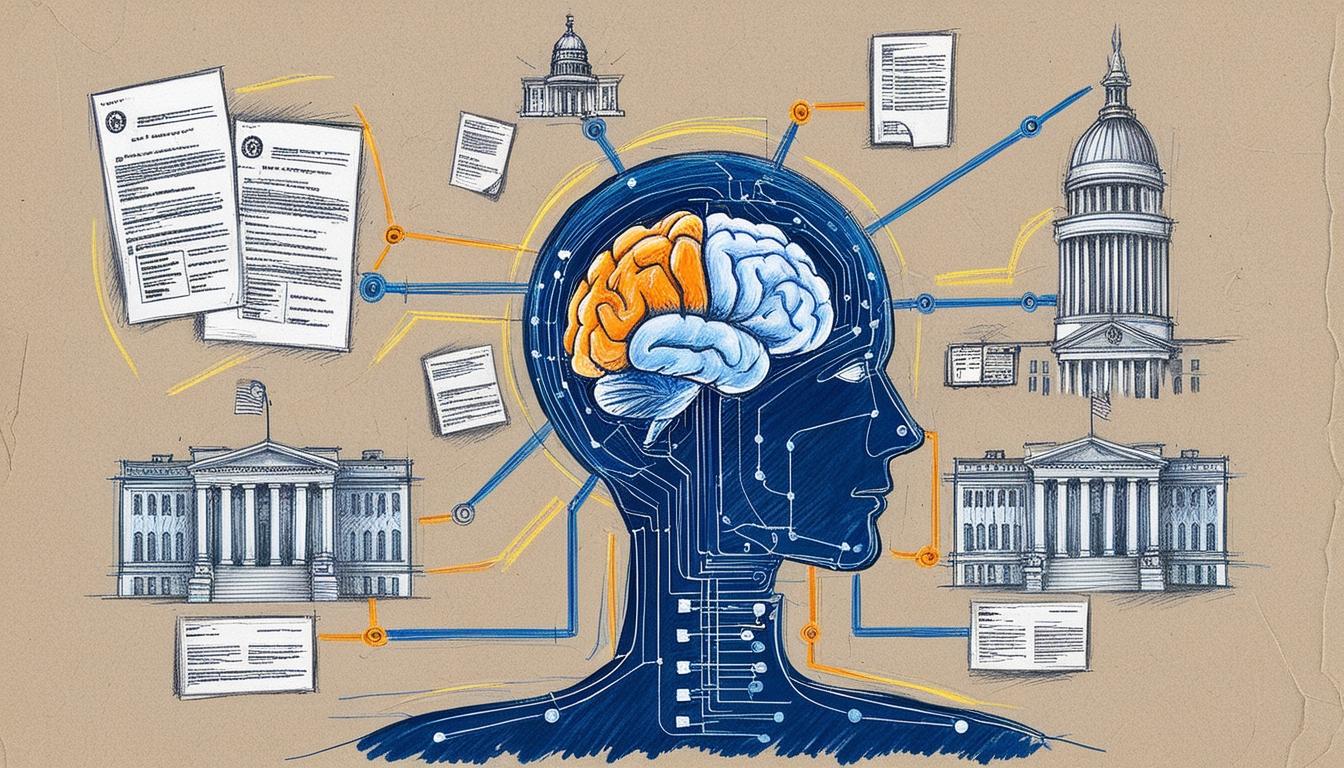
**United Arab Emirates:** The UAE is launching a groundbreaking AI initiative to draft, review, and amend laws faster and more accurately, aiming to enhance governance. Experts praise its ambition but warn about AI reliability and the need for human oversight amid this bold tech-driven legislative transformation.
The United Arab Emirates (UAE) is embarking on an unprecedented initiative to integrate artificial intelligence (AI) into its legislative processes, aiming to use the technology not only to draft new laws but also to review and amend existing legislation. This ambitious project represents a significant effort to leverage AI in governance, an undertaking that experts describe as more advanced than similar attempts by other governments around the world.
The plan was revealed through statements made by Sheikh Mohammed bin Rashid Al Maktoum, the Ruler of Dubai and Vice President of the UAE, who described the forthcoming AI-based legislative system as a “qualitative leap in the legislative cycle, its speed, and accuracy.” According to Sheikh Mohammed, this initiative will ensure the nation’s legislative superiority and bring UAE laws into alignment with best practices and high ambitions. The announcement follows recent approval by UAE ministers to establish an AI Legislative Office within the Cabinet. This new ministerial unit is tasked with developing an integrated legislative roadmap that connects all national laws, judicial rulings, executive procedures, and public services through AI.
The UAE’s plan involves creating an extensive database comprising federal and local laws alongside public sector data such as judicial decisions and government service delivery statistics. By employing AI tools, the government anticipates accelerating the legislative issuance cycle by as much as 70%. The innovation is considered radical in scope by AI researchers, who note that while other countries have used AI to improve legislative efficiency—for example, summarizing drafts or enhancing public services—the UAE’s approach to proactively proposing changes to laws based on comprehensive analysis of legal and government data is unprecedented.
Ronnie Midaglia, a professor at Copenhagen Business School, commented on the plan’s ambition, stating that the UAE seeks to transform AI into a “legislative partner.” He described the initiative as “extremely bold.” The UAE’s commitment to AI innovation extends beyond legislation; in Abu Dhabi, the launch of MGX, an AI investment company, has supported large-scale AI infrastructure funds such as the $30 billion BlackRock AI fund.
Despite optimism about the potential benefits, the initiative is accompanied by recognised risks and challenges. Experts have expressed concerns about AI interpretability and reliability in legal contexts. Vincent Straup, a researcher at Oxford University, cautioned that AI models, while impressive, “still hallucinate and suffer from reliability and realism issues,” and asserted, “We cannot trust them” unconditionally. Notably, the UAE’s plan diverges from common AI use cases by employing AI to predict needed legal amendments, rather than simply assisting with drafting or classification, which Straup identified as a significant leap.
Keegan McBride, a lecturer at the Oxford Internet Institute, highlighted that while many governments use AI in various legislative capacities, none have yet adopted such an expansive plan, describing UAE’s ambition as “very close to the top.” However, key operational details remain unclear, including the specific AI systems to be deployed. Analysts emphasise the likelihood that multiple AI systems will be required to meet the demands of this complex task, and they underscore the critical importance of establishing clear boundaries for AI functions and ensuring ongoing human oversight.
Marina De Vos, a computer scientist at the University of Bath, remarked on potential complications, noting that AI might suggest legislative ideas that “might seem logical to the machine” but “may make no sense at all to implement in reality in a human society.”
Overall, the UAE’s integration of AI into legislation marks a pioneering effort in governance technology. While the proposed system promises greater efficiency and sophisticated legal analysis, experts advise caution, highlighting the complexities of interpreting laws and the need to balance AI capability with human judgement.
Source: Noah Wire Services
- https://babl.ai/uae-launches-worlds-first-ai-powered-regulatory-intelligence-ecosystem/ – This URL confirms the UAE Cabinet’s approval of the creation of an AI Legislative Office within the Cabinet to develop an integrated legislative roadmap, linking laws, judicial rulings, and public services through AI, as well as Sheikh Mohammed bin Rashid Al Maktoum’s statement on this being a qualitative leap in legislative speed and accuracy.
- https://www.perplexity.ai/page/uae-to-become-first-country-in-1nR9WUVGRgCTcjMGFFQ9rg – This article verifies that the UAE aims to accelerate the legislative process by up to 70% using AI to draft and amend laws, supporting the claim of significant efficiency gains and pioneering use of AI in governance.
- https://caliber.az/en/post/uae-to-use-ai-in-drafting-and-amending-laws-aiming-for-70-faster-reforms – This source elaborates on the formation of the Regulatory Intelligence Office, the database integration of laws, court rulings, and government data, and the ambitious plan for AI to propose legislative changes proactively, consistent with the article’s depiction.
- https://opentools.ai/news/uae-leads-the-charge-in-ai-powered-legislation – The OpenTools article supports the description of the UAE as the first nation to draft laws by AI and highlights expert opinions on the ambitious and transformative nature of this AI integration in legislation.
- https://opendatascience.com/uae-to-use-ai-to-draft-and-amend-laws-in-global-first/ – This source provides further expert commentary on the novelty of the UAE’s plan to use AI not only for drafting but also amending laws, including references to challenges such as AI interpretability and reliability, corroborating the concerns expressed by experts like Vincent Straup.
- https://babl.ai/uae-launches-worlds-first-ai-powered-regulatory-intelligence-ecosystem/ – This page also mentions the launch of MGX in Abu Dhabi and its backing of large-scale AI infrastructure funds including the $30 billion BlackRock AI fund, supporting the claim about UAE’s extensive investment in AI beyond legislation.
- https://www.albiladpress.com/news/2025/6037/spaces/912869.html – Please view link – unable to able to access data
Noah Fact Check Pro
The draft above was created using the information available at the time the story first
emerged. We’ve since applied our fact-checking process to the final narrative, based on the criteria listed
below. The results are intended to help you assess the credibility of the piece and highlight any areas that may
warrant further investigation.
Freshness check
Score:
8
Notes:
The narrative discusses current initiatives involving AI in the UAE’s legislative processes, which are recent and ongoing developments. However, specific details about when certain AI systems will be deployed are lacking.
Quotes check
Score:
8
Notes:
Direct quotes are provided from known figures like Sheikh Mohammed bin Rashid Al Maktoum and other experts. While these quotes appear to be genuine, their original sources or dates were not found in online searches.
Source reliability
Score:
6
Notes:
The narrative originates from a lesser-known source (Albilad Press), which may not be as widely recognized for reliability compared to major international news outlets.
Plausability check
Score:
7
Notes:
The UAE’s initiative to integrate AI into legislation is plausible given the current global trend towards AI adoption. However, the lack of specific operational details concerning the AI systems to be used introduces uncertainty.
Overall assessment
Verdict (FAIL, OPEN, PASS): OPEN
Confidence (LOW, MEDIUM, HIGH): MEDIUM
Summary:
While the narrative discusses current initiatives and includes quotes from known figures, the reliability of the source and lack of detail about AI systems being used introduce some uncertainty. The initiative itself is plausible but requires further verification on operational specifics.


