

 4:57 pm - October 15, 2026
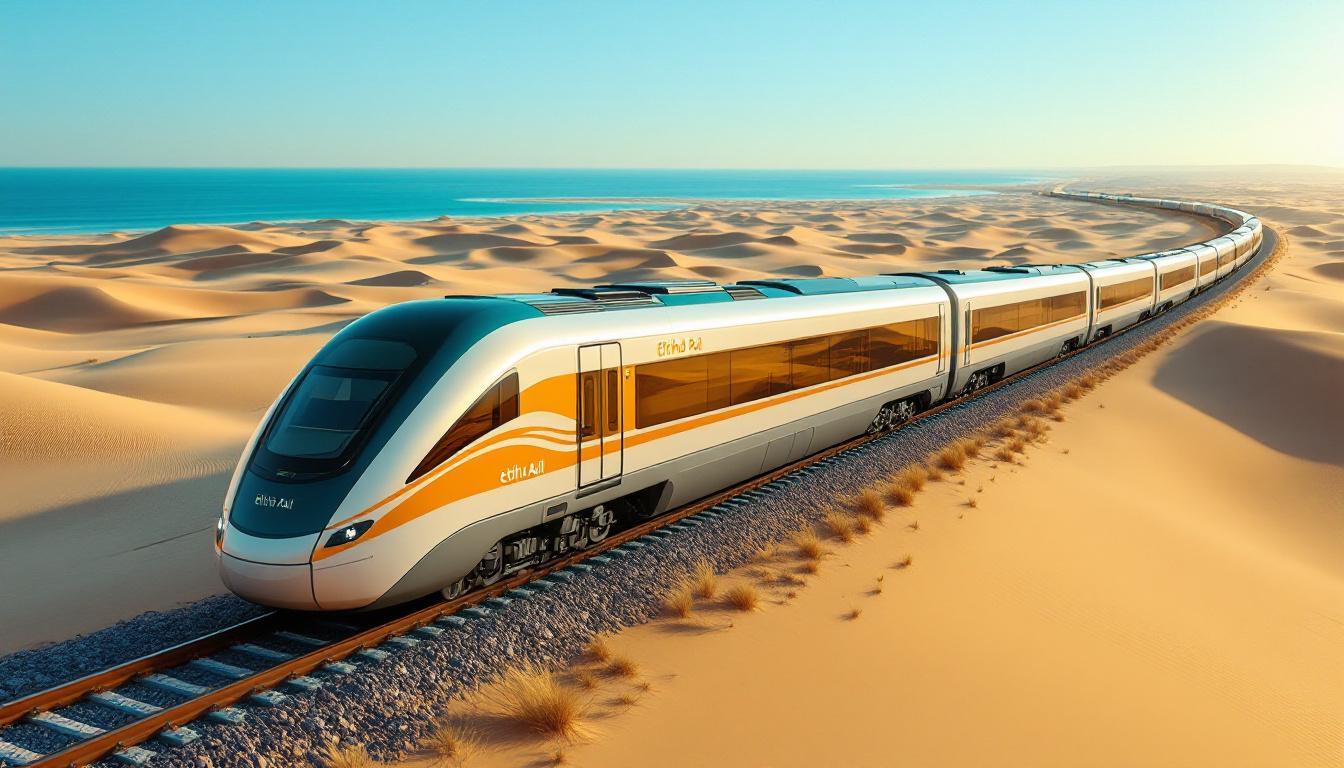
Etihad Rail and Al Masaood Automobiles have completed the UAE’s first rail movement of finished passenger cars, signalling a shift in the country’s logistical capabilities and sustainability efforts amid expanding rail services beyond bulk freight.
Etihad Rail Freight and Al Masaood Automobiles recently executed the UAE’s very first rail movement of finished passenger cars , a pretty significant milestone, honestly , which highlights how the country’s rail network is starting to stretch beyond traditional freight tasks.
The shipment involved transporting Nissan vehicles from Fujairah’s port all the way to a dry port at Industrial City Abu Dhabi, also known as ICAD. And, interestingly enough, the companies presented this as more than just a one-time thing. For Etihad Rail, it’s a demonstration of how a network primarily built for heavy freight can also accommodate higher-value cargo. Meanwhile, for Al Masaood Automobiles, it opens up a new logistics route for delivering vehicles to customers in Abu Dhabi, Al Ain, and Al Dhafra.
The cars traveled from the eastern coast to Abu Dhabi via a rail-linked supply chain designed to improve timing and cut down on uncertainty. I mean, in an industry where vehicle handovers depend heavily on precise scheduling, this shift isn’t just speed , it’s about reliability too. The companies claim that using rail creates a more predictable flow, with fewer disturbances compared to traditional road-heavy routes.

Irfan Tansel, who’s the CEO of Al Masaood Automobiles, mentioned that the customer experience kicks off well before a driver even takes delivery. Talking about this partnership, he pointed out that the initiative really reflects the behind-the-scenes work aimed at making that experience better. He also said the company is proud to be the first automotive dealer in the UAE to use Etihad Rail Freight for transporting finished vehicles , calling it a clear example of how aligning national infrastructure with private-sector capabilities can produce positive results.
Omar Alsebeyi, the CEO of Etihad Rail Freight, explained that this project is ultimately what rail freight is all about: providing a dependable, scalable service that can slot into existing logistics chains. He emphasized that the national network was designed to boost the resilience and efficiency of the UAE’s logistics industry , and from what he says, this move puts that ambition into tangible practice. He also pointed out that this success could encourage more businesses to consider rail for their cargo needs.
What’s especially noteworthy about this shipment is how it signals a shift for Etihad Rail’s commercial focus. The network’s already been heavily linked with bulk freight , industrial materials, commodities, you name it , so handling finished vehicles marks a different ballgame. Cars are high-value, time-sensitive, and often part of tightly coordinated distribution plans. Successfully managing this type of cargo suggests that the rail operator is expanding the scope of what it can support.
That kind of transition is also pretty important for the broader logistics scene in the UAE. Over the years, the country has worked hard to position itself as a regional transport hub , ports, roads, airports, and free zones all interconnected. Adding rail to that mix provides another layer: it can move large quantities over long distances more efficiently, while helping to alleviate road congestion and improve schedule reliability.
From an environmental perspective, this step is quite significant too. Rail transport is generally seen as a greener alternative compared to road freight , especially for inland routes that happen repeatedly. For companies under growing pressure to cut transport emissions, rail becomes an increasingly attractive option. This move also aligns with the UAE’s Net Zero by 2050 Strategic Initiative, along with broader efforts to decarbonize logistics, manufacturing, and other carbon-heavy sectors.
Timing-wise, this couldn’t be more relevant. Etihad Rail has been hinting at bigger plans for freight for a while now. Just recently, they announced a contract for adding 842 more wagons , bringing their total fleet above 1,000 , which ramps up annual capacity to around 59 million tonnes. That expansion hints at a system gearing up for wider commercial use, including containerized goods and various industrial cargoes.
And for folks who watch climate technology in the UAE, this isn’t just about transportation mechanics. It shows how infrastructure can back emissions reduction efforts without necessarily overhauling entire business models. Instead, the shift involves operational tweaks , smarter movement of goods, less friction in supply chains, and providing companies with cleaner, still efficient options to meet deadlines.
In a market like the UAE’s, where logistical efficiency and green initiatives are increasingly expected to go hand-in-hand, this shipment exemplifies that balance. It doesn’t revolutionize the freight sector overnight, but it does serve as a concrete example of how greener logistics can be practically implemented. Plus, it hints that the value of the rail network will increasingly hinge on supporting more specialized cargo, beyond just the heavy bulk traffic traditionally associated with rail.
For Al Masaood Automobiles, the real benefit might be more about consistency and control than just symbolism. And for Etihad Rail, this operation is a proof point , not only can the system carry more than just raw materials, but it can do so in a way that aligns with modern supply-chain demands. Moving forward, in the UAE’s next phase of infrastructure development, that could be just as crucial as the headline-making milestones themselves.
- https://www.cbnme.com/logistics-news/al-masaood-etihad-rail-deliver-uaes-first-rail-transport-of-passenger-vehicles/ – Please view link – unable to able to access data
- https://www.drivearabia.com/news/2026/04/24/al-masaood-automobiles-rail-shipment-uae-etihad-rail/ – Al Masaood Automobiles and Etihad Rail Freight have completed the UAE’s first rail transport of finished passenger vehicles for an automotive dealership. The shipment involved Nissan models being transported from eastern coast ports to the dry port at the Industrial City of Abu Dhabi (ICAD), marking a significant advancement in the country’s logistics sector. This partnership highlights Etihad Rail Freight’s expansion beyond bulk cargo into high-value shipments, demonstrating the integration of rail into modern supply chains and enhancing efficiency and reliability in vehicle delivery.
- https://www.etihadrail.ae/en/post/in-partnership-with-al-masaood-automobiles-etihad-rail-completes-1st-rail-transport-of-finished-passenger-vehicles-for-automotive-dealership-in-uae – Etihad Rail Freight and Al Masaood Automobiles have achieved a milestone by completing the first-ever rail transport of finished passenger vehicles for an automotive dealership in the UAE. The shipment saw Nissan vehicles transported from Fujairah ports to the Industrial City of Abu Dhabi (ICAD), marking a new chapter in the country’s logistics sector. This development signifies Etihad Rail Freight’s expansion beyond bulk commodities into diversified cargo, demonstrating how rail can be integrated into modern, end-to-end supply chains.
- https://gulfbusiness.com/2026/logistics/etihad-rail-completes-first-transport-of-passenger-vehicles-for-dealership/ – Etihad Rail Freight and Al Masaood Automobiles have completed the UAE’s first rail transport of finished passenger vehicles for an automotive dealership. The shipment involved Nissan vehicles being transported from Fujairah ports to the dry port at the Industrial City of Abu Dhabi (ICAD), marking a significant advancement in the country’s logistics sector. This partnership highlights Etihad Rail Freight’s expansion beyond bulk commodities into diversified cargo, demonstrating the integration of rail into end-to-end supply chains and enhancing efficiency and reliability in vehicle delivery.
- https://www.thenationalnews.com/news/uae/2026/04/24/etihad-rail-marks-milestone-as-first-freight-delivery-of-cars-completed-in-uae/ – Etihad Rail has completed the UAE’s first commercial rail delivery of cars, moving Nissan vehicles from Fujairah to Abu Dhabi with Al Masaood Automobiles. The shipment marks expansion beyond bulk commodities into high-value, diversified cargo on the national freight network spanning Saudi Arabia’s border to Fujairah. This milestone demonstrates the reliability, predictability, and scalability of rail freight, integrating seamlessly into existing supply chains and enhancing the resilience and efficiency of the UAE’s logistics sector.
- https://www.etihadrail.ae/en/post/with-the-network-fleet-expanding-beyond-1000-wagons – Etihad Rail is tripling its fleet by announcing the award of a contract for the manufacture, supply, and commissioning of 842 new wagons, bringing its total fleet to more than 1,000 units to serve the whole network. This expansion aims to enhance the transport capacity of containerised and bulk freight, including petrochemicals, aggregates, raw steel, limestone, cement, construction materials, industrial and household waste, aluminium, food commodities, and general cargo both domestically and internationally. The expanded fleet is expected to increase Etihad Rail’s annual transport capacity to up to 59 million tonnes.
- https://www.dubicars.com/news/uae-first-car-shipment-by-rail.html – Etihad Rail has completed its first-ever rail shipment of finished passenger vehicles, transporting hundreds of Nissan Patrol and Infiniti QX80 models for Al Masaood Automobiles. This milestone marks a significant advancement in the UAE’s automotive logistics sector, demonstrating the integration of rail into modern supply chains and enhancing efficiency and reliability in vehicle delivery. The move also supports environmental sustainability by providing a lower-emission alternative to road transport, aligning with the UAE’s Net Zero by 2050 strategy and broader efforts to decarbonise key sectors.
Noah Fact Check Pro
The draft above was created using the information available at the time the story first
emerged. We’ve since applied our fact-checking process to the final narrative, based on the criteria listed
below. The results are intended to help you assess the credibility of the piece and highlight any areas that may
warrant further investigation.
Freshness check
Score:
10
Notes:
The article reports on a recent event, with the earliest known publication date being April 24, 2026. No evidence of recycled or outdated content was found.
Quotes check
Score:
8
Notes:
Direct quotes from Irfan Tansel and Omar Alsebeyi are included. However, these quotes are also present in other sources, such as the official Etihad Rail press release. This raises concerns about the originality of the content and potential reuse of material.
Source reliability
Score:
7
Notes:
The article originates from Construction Business News Middle East (CBNME), a niche publication. While it provides detailed information, its limited reach and potential biases due to its focus on the construction and business sectors may affect the reliability of the information presented.
Plausibility check
Score:
9
Notes:
The claims about the UAE’s first rail transport of finished passenger vehicles are plausible and align with the reported expansion of Etihad Rail Freight into diversified cargo. However, the lack of independent verification from major news outlets raises some concerns about the exclusivity and accuracy of the information.
Overall assessment
Verdict (FAIL, OPEN, PASS): FAIL
Confidence (LOW, MEDIUM, HIGH): MEDIUM
Summary:
The article presents information about the UAE’s first rail transport of finished passenger vehicles, citing direct quotes from company executives and detailed descriptions of the event. However, the reliance on Etihad Rail’s press release and the niche nature of the source publication raise concerns about the originality and independence of the content. The lack of independent verification from major news outlets further diminishes the credibility of the information presented. Given these factors, the article fails to meet the necessary standards for publication under our editorial indemnity.

