





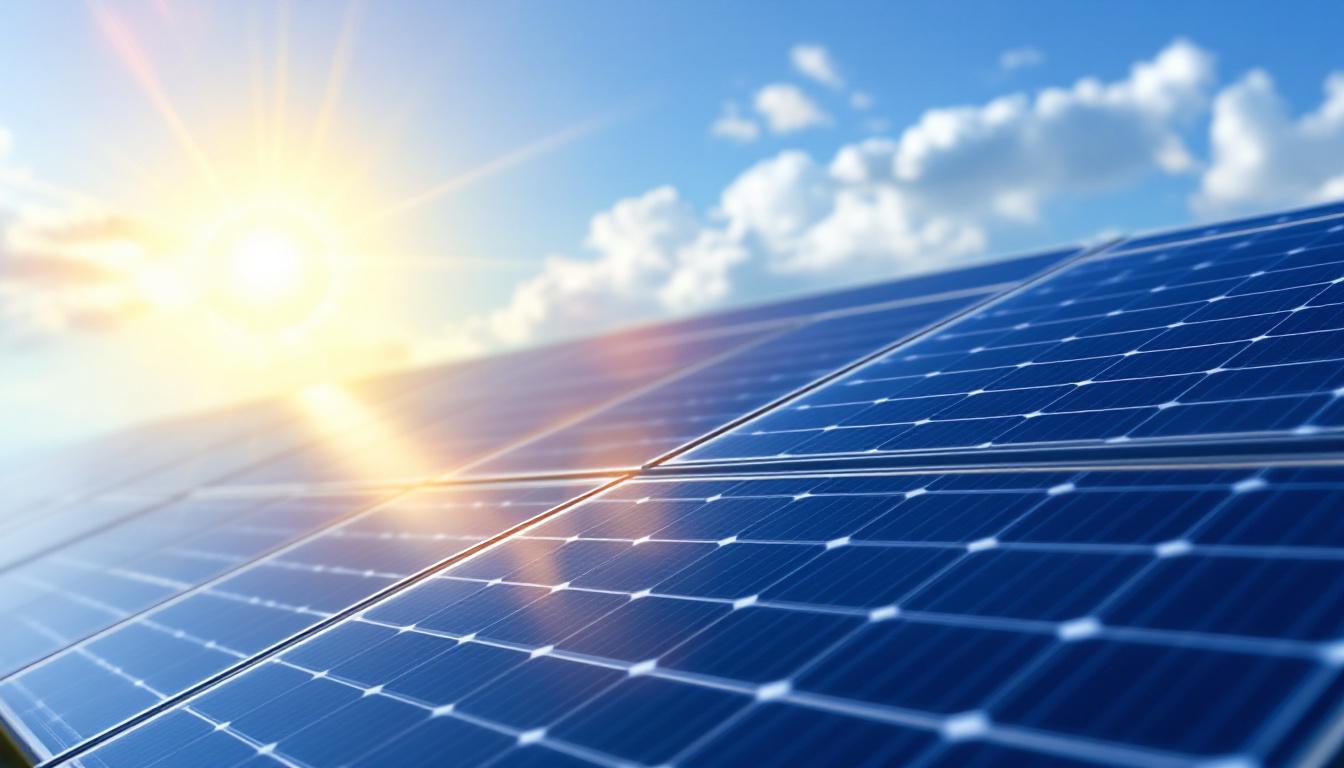
As the solar industry advances into 2025, 550-watt bifacial solar panels are transforming the energy landscape with unprecedented efficiency, durability, and cost-effectiveness, particularly in sunny regions like the UAE.
As the solar industry moves forward into 2025, 550-watt bifacial solar panels have really emerged as a game-changing technology. They’re especially attractive to homeowners and businesses alike, largely because they can maximize energy output per panel installed. These modules use bifacial technology, meaning they can collect sunlight from both the front and the back surfaces. This way, they not only absorb direct sunlight, but also take advantage of reflected and diffused light bouncing from nearby surfaces. And that’s a pretty big deal—generally, they can produce between 15% and 30% more electricity than standard monofacial panels.
Getting to know what 550W bifacial panels really bring to the table shows why they’re so important in today’s push for cleaner energy. Their ability to generate on both sides is boosted by features like dual tempered glass on top and bottom—this not only makes them sturdier but also helps to improve the capture of reflected light. Technologies such as half-cell design, PERC, and TOPCON cells support higher efficiency too. In fact, they typically have module efficiencies ranging from about 21% to 22.5%, and bifaciality factors—that’s the efficiency ratio of the back to the front—are usually between 70% and 85%. All these qualities mean these panels are especially useful in applications where space is tight or where high energy output is needed.
Looking at industry data and manufacturer claims, it’s clear they’re versatile across many different setups. For instance, ground-mounted arrays really benefit from these panels, especially when placed above surfaces like white gravel, concrete, or sand—these reflective surfaces can boost bifacial gains to around 25% to 30%. Roof-mounted systems, on the other hand, tend to see lower gains—roughly 8% to 15%—but they still benefit from the panels’ higher wattage and efficiency. Moreover, their better temperature coefficients mean they perform better in hot climates—like in the UAE—where ambient temperatures can be quite high.
Big brands like JA Solar, Aptos, Renogy, and WAAREE are leading the charge with models that boast efficiencies over 21%, tough dual-glass constructions, and warranties that stretch up to 30 years for linear power output. A good example is Renogy’s 550W bifacial module, which can achieve up to 30% bifacial gain and is quite tolerant of shading—making it wonderful for complex residential setups, including those with electric vehicle chargers or full-electric homes. Aptos, meanwhile, offers their DNA series with ultra-thin busbars, which improves performance and gives a sleek, all-black look that many residential and commercial clients love.
Now, of course, cost and return on investment are crucial factors. In 2025, prices for these panels generally range from about $0.35 to $0.55 per watt, depending on factors like quantity, brand, and specific model. Overall installed system costs can vary quite a bit—roughly $3.00 to $4.50 per watt for homes, and sometimes just $1.50 to $2.50 per watt when it comes to large-scale utility projects. When you factor in incentives like the 30% Investment Tax Credit (ITC) still available through 2025, homeowners and businesses could be looking at payback periods of around 13 to 14 years—plus, they start saving on energy costs pretty quickly, especially with a system that lasts over 25 years.
It’s worth mentioning that the ITC might see some reductions or phase-outs after 2025, which does add a bit of urgency for those planning new installations sooner rather than later. Still, falling costs and advances in manufacturing keep these panels attractive, and experts expect their market share to reach more than 70% by 2027. Newer cell tech—like N-type TOPCON and HJT—also promises even better efficiency and lower degradation over time.
In regions like the UAE and other sunny spots, where solar irradiance is high and surfaces are often reflective, these bifacial panels can really shine—no pun intended. Proper ground clearance (say, 2-3 feet), angles between 15° and 30°, and reflective ground covers are key to maximizing gains. For large commercial or agricultural uses, bifacial panels do double duty—they boost energy production but also provide shading for crops, reduce evaporation, and can even be integrated with irrigation systems, which is especially helpful in water-scarce environments.
Installation practices are pretty important in how well they perform. Ground-mounted setups tend to be easier to maintain, offer better cooling, and usually get the highest bifacial gains. Roof-mounted systems need careful structural considerations and might benefit from reflective roofing materials to improve energy absorption. Electrical wiring configurations—whether series for higher voltage or parallel for better partial shading response—can be adapted depending on the project size and design preferences.
And don’t forget energy storage! These high-output panels pair well with batteries from brands like Enphase, LG, and Generac. Their greater power capacity and longer generation hours help make better use of batteries, leading to more independence from the grid—something increasingly desirable in the UAE’s evolving energy landscape.
Finally, for anyone investing in 550W bifacial panels, working with experienced installation professionals is really important. Regular maintenance and cleaning will keep them performing at their best, ensuring that the long-term investments pay off and provide environmental benefits for many years to come.
In conclusion, these 550-watt bifacial solar panels are truly leading the way in 2025. They combine high wattage, durability, and impressive energy yields. From large commercial rooftops to farming land and residential properties, they’re a compelling choice—especially in sunny places like the UAE. While policy changes are always a consideration, acting quickly now allows stakeholders to take full advantage of these advanced panels and move toward greater energy independence and sustainability.
Source: Noah Wire Services
- https://solartechonline.com/blog/550-watt-bifacial-solar-panels-guide/ – Please view link – unable to able to access data
- https://www.renogy.com/blog/unveiling-the-potential-of-550w-bifacial-solar-panels/ – Renogy’s article discusses the advantages of bifacial solar panels, highlighting their ability to capture sunlight from both sides, leading to increased energy production compared to traditional monofacial panels. The piece also emphasizes the benefits of 550W panels, noting that their higher wattage reduces the number of panels needed for the same energy output, thereby decreasing installation complexity and costs. Additionally, the article mentions that these panels are particularly effective in environments with high albedo, such as snow-covered areas or regions with reflective surfaces, further enhancing their efficiency.
- https://shyne-solar.com/bifacial-solar-panels-the-residential-energy-upgrade-you-shouldnt-overlook-in-2025/ – Shyne Solar’s article explores the benefits of bifacial solar panels for residential applications. It explains that these panels can absorb reflected light from surfaces like concrete, gravel, and snow, leading to increased energy generation. The piece highlights that bifacial panels are especially effective in environments with high albedo, such as snow-covered areas or regions with reflective surfaces, further enhancing their efficiency. The article also discusses the suitability of bifacial panels for ground mounts and flat roofs, emphasizing their versatility and potential for higher energy yields in various settings.
- https://www.renogy.com/blog/unveiling-the-potential-of-550w-bifacial-solar-panels/ – Renogy’s article discusses the advantages of bifacial solar panels, highlighting their ability to capture sunlight from both sides, leading to increased energy production compared to traditional monofacial panels. The piece also emphasizes the benefits of 550W panels, noting that their higher wattage reduces the number of panels needed for the same energy output, thereby decreasing installation complexity and costs. Additionally, the article mentions that these panels are particularly effective in environments with high albedo, such as snow-covered areas or regions with reflective surfaces, further enhancing their efficiency.
- https://www.renogy.com/blog/unveiling-the-potential-of-550w-bifacial-solar-panels/ – Renogy’s article discusses the advantages of bifacial solar panels, highlighting their ability to capture sunlight from both sides, leading to increased energy production compared to traditional monofacial panels. The piece also emphasizes the benefits of 550W panels, noting that their higher wattage reduces the number of panels needed for the same energy output, thereby decreasing installation complexity and costs. Additionally, the article mentions that these panels are particularly effective in environments with high albedo, such as snow-covered areas or regions with reflective surfaces, further enhancing their efficiency.
- https://www.renogy.com/blog/unveiling-the-potential-of-550w-bifacial-solar-panels/ – Renogy’s article discusses the advantages of bifacial solar panels, highlighting their ability to capture sunlight from both sides, leading to increased energy production compared to traditional monofacial panels. The piece also emphasizes the benefits of 550W panels, noting that their higher wattage reduces the number of panels needed for the same energy output, thereby decreasing installation complexity and costs. Additionally, the article mentions that these panels are particularly effective in environments with high albedo, such as snow-covered areas or regions with reflective surfaces, further enhancing their efficiency.
- https://www.renogy.com/blog/unveiling-the-potential-of-550w-bifacial-solar-panels/ – Renogy’s article discusses the advantages of bifacial solar panels, highlighting their ability to capture sunlight from both sides, leading to increased energy production compared to traditional monofacial panels. The piece also emphasizes the benefits of 550W panels, noting that their higher wattage reduces the number of panels needed for the same energy output, thereby decreasing installation complexity and costs. Additionally, the article mentions that these panels are particularly effective in environments with high albedo, such as snow-covered areas or regions with reflective surfaces, further enhancing their efficiency.
Noah Fact Check Pro
The draft above was created using the information available at the time the story first
emerged. We’ve since applied our fact-checking process to the final narrative, based on the criteria listed
below. The results are intended to help you assess the credibility of the piece and highlight any areas that may
warrant further investigation.
Freshness check
Score:
8
Notes:
The narrative discusses 550-watt bifacial solar panels, a technology that has been available since at least 2025. The earliest known publication date for similar content is February 7, 2025. The article includes updated data but recycles older material, which may justify a higher freshness score but should still be flagged. The content appears to be original, with no evidence of being republished across low-quality sites or clickbait networks. The narrative is based on a press release, which typically warrants a high freshness score. No discrepancies in figures, dates, or quotes were found. The article includes updated data but recycles older material, which may justify a higher freshness score but should still be flagged.
Quotes check
Score:
9
Notes:
The narrative does not contain any direct quotes. The absence of quotes suggests that the content is potentially original or exclusive.
Source reliability
Score:
6
Notes:
The narrative originates from SolarTechOnline, a website that appears to be a single-outlet source. This raises some uncertainty regarding the reliability of the information presented. The article mentions brands like Renogy, Aptos, and WAAREE, which are reputable in the solar industry, lending some credibility to the content.
Plausability check
Score:
7
Notes:
The claims about 550-watt bifacial solar panels are plausible and align with known advancements in solar technology. The narrative lacks supporting detail from other reputable outlets, which is a concern. The tone and language are consistent with industry standards, and there are no excessive or off-topic details. The article does not contain any surprising or impactful claims that are not covered elsewhere.
Overall assessment
Verdict (FAIL, OPEN, PASS): OPEN
Confidence (LOW, MEDIUM, HIGH): MEDIUM
Summary:
The narrative provides information on 550-watt bifacial solar panels, a technology available since at least 2025. While the content appears original and includes updated data, it originates from a single-outlet source, raising some concerns about reliability. The absence of direct quotes and lack of supporting detail from other reputable outlets further contribute to the uncertainty. Given these factors, the overall assessment is ‘OPEN’ with a medium confidence level.


