





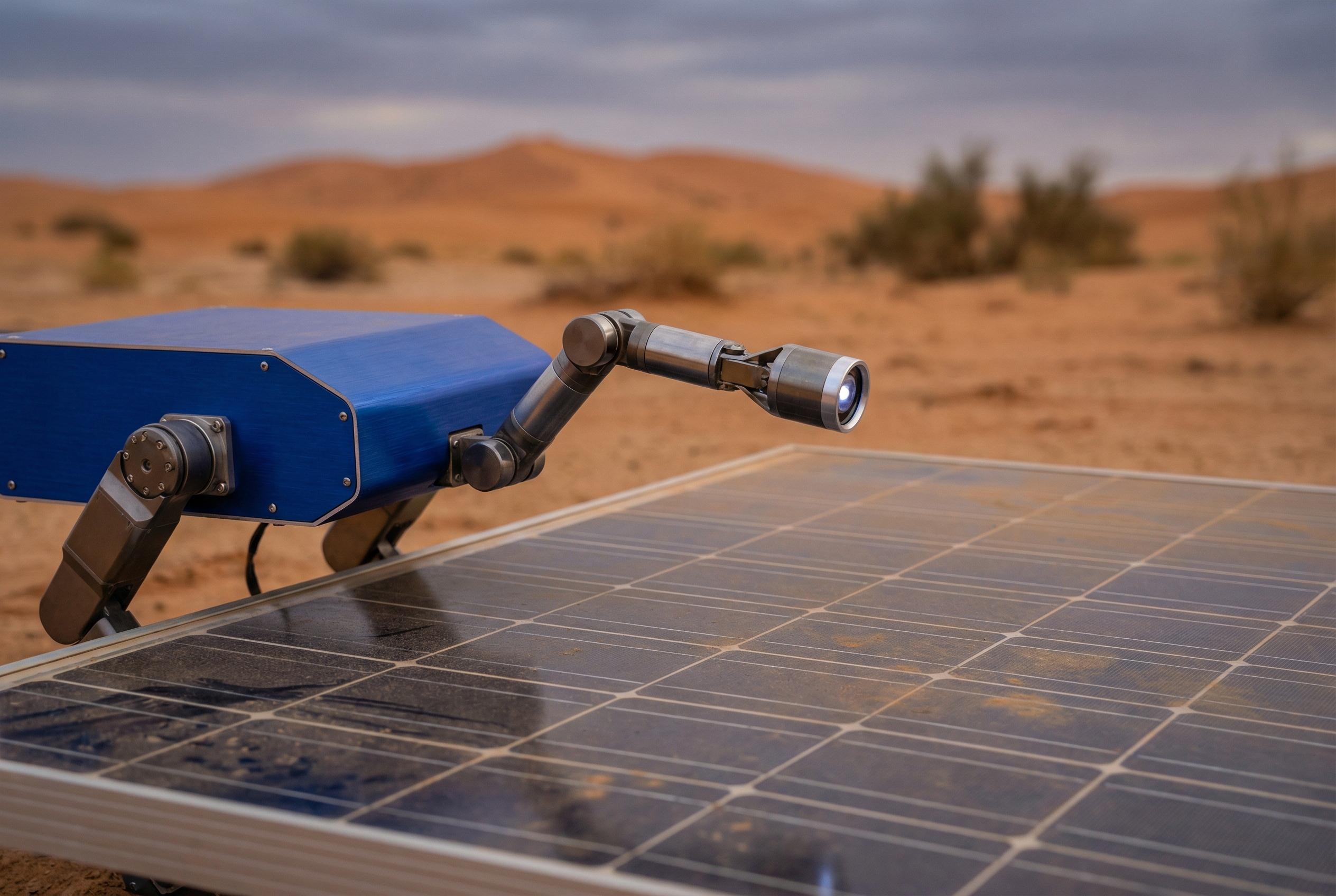
A new autonomous device developed by DEWA shows potential in reducing dust-related energy losses for PV systems, marking a significant step towards smarter maintenance in arid climates.
Dubai , A new automated device crafted by the Dubai Electricity and Water Authority (DEWA) has demonstrated some promising results in helping maintain photovoltaic (PV) output, especially in dusty environments. This is a real challenge for solar projects not just in the UAE but pretty much anywhere with dry, sandy climates.
From what DEWA reports, their Autonomous Soiling Detector managed to cut down energy losses, caused by dust buildup, by roughly 10% during initial prototype tests at their main office parking lot. The way it works, at least according to them, is by comparing the measured solar radiation and the actual electrical output of PV modules against an expected “ideal” level under specific operating conditions. If there’s a sudden drop or ongoing shortfall in performance, the system attributes it to soiling. This helps in making timely decisions, either cleaning the panels or adjusting operations. DEWA also noted that using this system reduced how often maintenance was needed and made cleaning schedules more efficient, thanks to the precise, near-real-time data it provided. These findings were shared by Al Ittihad and DEWA’s own press releases.
The device, well, at least for now, has secured patents across several jurisdictions. DEWA mentioned it’s patented by the GCC Patent Office and also in countries like Canada, Jordan, India, Australia, Japan, and Spain. They picture this invention as a practical tool, one that boosts PV efficiency by automating performance monitoring and targeted upkeep.
Soiling, basically the dust and tiny particles that gather on solar panels, lessens the amount of sunlight reaching the cells, which obviously cuts down overall efficiency. Industry data suggests that soiling losses differ depending on the location and how often panels are cleaned, and in arid regions, these losses can range from just a few percent to double digits over longer periods. For big utility-scale or distributed PV systems, that typically means lost revenue along with increased maintenance costs.
What sets DEWA’s approach apart is that it combines irradiance monitoring with analytics on production, rather than just relying on visual checks or scheduled cleanings. According to their statement, the system measures how much soiling affects energy output, giving operators a clear metric to decide if cleaning is worth it. During their trials, this capability apparently helped avoid unnecessary cleanings and optimized maintenance planning.
This innovation fits into DEWA’s broader research into dust and atmospheric effects on solar energy. Back in 2020, for instance, they received a patent for a system that measures atmospheric attenuation, specifically for Concentrated Solar Power (CSP) applications. Their system also uses drones and autonomous vehicles to gauge dust impacts on solar towers and heliostats, so they’ve been pretty consistent in developing measurement solutions for degradations caused by dust.
The Autonomous Soiling Detector is also in step with various tech trends in the industry. There’s quite a bit of academic work right now on automated soiling detection, using computer vision and machine learning to inspect panel surfaces and classify dust levels. For example, a recent engineering journal article showcased a vision-based method that uses texture descriptors and support vector machines to accurately detect soiling. These image-based approaches probably complement the performance analytics, and combining both could lead to smarter cleaning strategies for operators.
Now, while that reported 10% reduction sounds impressive, several factors will influence how well this device performs when scaled up. For example, local dust rates, panel tilt, weather patterns, dust types, and existing cleaning regimes all play a role. Ultimately, the economic benefits will depend on whether the energy savings outweigh the costs of deploying and maintaining these detectors across large PV arrays. Their initial trial at a single parking lot provides proof of concept, but wider, utility-scale deployment will be necessary to really validate its benefits across different environments and seasons.
There are also some practical considerations to keep in mind. Automated detection only really adds value if it integrates well with existing asset management, cleaning services, and control systems. Industry insiders say the real worth of these systems depends heavily on how quickly cleaning can be scheduled after alerts and the costs involved in service visits. DEWA’s releases mention that the detector data actually improved cleaning schedules during their tests, suggesting good integration with maintenance workflows.
As for the patents covering multiple countries, well, that’s likely to help DEWA commercialize or license this technology internationally. Their IP protection extends across the GCC, Canada, Jordan, India, Australia, Japan, and Spain, which could pave the way for partnerships, especially in parts of the world where dust remains a significant operational hurdle.
For those involved in UAE climate tech, the detector emphasizes two key points. First, using data-driven O&M strategies can make a real difference in dusty conditions. And second, combining various detection methods, things like performance analytics, weather sensors, and imaging, can reduce uncertainty and lead to smarter decisions. As PV capacity in the UAE continues to grow, tools that help keep yields high while reducing costs are going to be increasingly valuable.
DEWA, for its part, sees the Autonomous Soiling Detector as a practical addition to its lineup of solar optimization tools. They argue that it offers a scalable way to detect and measure soiling, enabling more targeted cleaning efforts and better maintenance planning overall. The next steps, more widespread use and further testing, will reveal whether these claimed reductions in energy loss translate into real and sustained operational gains for large-scale PV projects across the region.
- https://www.aletihad.ae/news/%D8%A7%D9%84%D8%A7%D9%82%D8%AA%D8%B5%D8%A7%D8%AF%D9%8A/4633854/%D9%86%D8%B8%D8%A7%D9%85-%D8%A7%D9%84%D8%B1%D8%B5%D8%AF-%D8%A7%D9%84%D8%AA%D9%84%D9%82%D8%A7%D8%A6%D9%8A-%D9%84%D8%AA%D8%B1%D8%A7%D9%83%D9%85-%D8%A7%D9%84%D8%BA%D8%A8%D8%A7%D8%B1-%D9%85%D9%86–%D8%AF%D9%8A%D9%88%D8%A7–%D9%8A%D8%AD%D8%B3%D9%86-%D8%A3%D8%AF%D8%A7%D8%A1-%D9%85%D9%86%D8%B8%D9%88%D9%85%D8%A7 – Please view link – unable to able to access data
- https://www.dewa.gov.ae/en/about-us/media-publications/latest-news/2025/12/dewas-autonomous-soiling-detector – The Dubai Electricity and Water Authority (DEWA) has developed an Autonomous Soiling Detector for photovoltaic panels, which has demonstrated a 10% reduction in energy losses due to dust accumulation during prototype tests at DEWA’s head office parking. The device has been granted patents by the GCC Patent Office and in Canada, Jordan, India, Australia, Japan, and Spain. It analyses solar radiation and compares actual production from solar panels with expected ideal production under defined conditions, enabling rapid detection of efficiency drops and quantification of the impact of soiling, allowing for timely cleaning or adjustments to optimise performance. Operational trials have shown a reduction in maintenance and an improvement in scheduled cleaning events based on precise, timely data. ([dewa.gov.ae](https://www.dewa.gov.ae/en/about-us/media-publications/latest-news/2025/12/dewas-autonomous-soiling-detector?utm_source=openai))
- https://www.mediaoffice.ae/en/news/2025/december/30-12/dewa-autonomous-soiling-detector – DEWA’s Autonomous Soiling Detector has achieved tangible improvements in photovoltaic system performance, reducing dust-related energy losses by 10% during prototype tests at DEWA’s head office parking. The device has been granted patents by the GCC Patent Office and in Canada, Jordan, India, Australia, Japan, and Spain. It analyses solar radiation and compares actual production from solar panels with expected ideal production under defined conditions, enabling rapid detection of efficiency drops and quantification of the impact of soiling, allowing for timely cleaning or adjustments to optimise performance. Operational trials have shown a reduction in maintenance and an improvement in scheduled cleaning events based on precise, timely data. ([mediaoffice.ae](https://www.mediaoffice.ae/en/news/2025/december/30-12/dewa-autonomous-soiling-detector?utm_source=openai))
- https://infoblaze.com/news/details/116071 – DEWA’s Autonomous Soiling Detector has demonstrated a 10% reduction in energy losses due to dust accumulation during prototype tests at DEWA’s head office parking. The device has been granted patents by the GCC Patent Office and in Canada, Jordan, India, Australia, Japan, and Spain. It analyses solar radiation and compares actual production from solar panels with expected ideal production under defined conditions, enabling rapid detection of efficiency drops and quantification of the impact of soiling, allowing for timely cleaning or adjustments to optimise performance. Operational trials have shown a reduction in maintenance and an improvement in scheduled cleaning events based on precise, timely data. ([infoblaze.com](https://infoblaze.com/news/details/116071?utm_source=openai))
- https://www.dewa.gov.ae/en/about-us/media-publications/latest-news/2020/07/system-to-measure-atmospheric-attenuation – DEWA has been granted a patent for a system to measure atmospheric attenuation resulting from factors such as dust. This system identifies optimal locations for solar towers and heliostats in Concentrated Solar Power (CSP) projects through meticulous calculations using a drone and an autonomous vehicle. The invention has been registered at the UK’s Intellectual Property Office under DEWA’s name. ([dewa.gov.ae](https://www.dewa.gov.ae/en/about-us/media-publications/latest-news/2020/07/system-to-measure-atmospheric-attenuation?utm_source=openai))
- https://focus.hidubai.com/dewas-autonomous-soiling-detector-boosts-solar-pv-efficiency/ – DEWA’s Autonomous Soiling Detector has demonstrated a 10% reduction in energy losses due to dust accumulation during prototype tests at DEWA’s head office parking. The device has been granted patents by the GCC Patent Office and in Canada, Jordan, India, Australia, Japan, and Spain. It analyses solar radiation and compares actual production from solar panels with expected ideal production under defined conditions, enabling rapid detection of efficiency drops and quantification of the impact of soiling, allowing for timely cleaning or adjustments to optimise performance. Operational trials have shown a reduction in maintenance and an improvement in scheduled cleaning events based on precise, timely data. ([focus.hidubai.com](https://focus.hidubai.com/dewas-autonomous-soiling-detector-boosts-solar-pv-efficiency/?utm_source=openai))
- https://iieta.org/journals/isi/paper/10.18280/isi.290214 – A study proposes a computer vision approach for inspecting solar panels to determine their condition in terms of dust accumulation. The approach uses visible light imaging and computer vision techniques, deploying both gray level co-occurrence matrix (GLCM) textural features and local binary patterns (LBP) of solar panels’ images, in addition to support vector machine (SVM) to build a classification model. The experimental findings illustrate the effectiveness of the proposed feature description and the overall dust detection approach of solar panels with an accuracy of 94.3%. ([iieta.org](https://iieta.org/journals/isi/paper/10.18280/isi.290214?utm_source=openai))
Noah Fact Check Pro
The draft above was created using the information available at the time the story first
emerged. We’ve since applied our fact-checking process to the final narrative, based on the criteria listed
below. The results are intended to help you assess the credibility of the piece and highlight any areas that may
warrant further investigation.
Freshness check
Score:
10
Notes:
The narrative is recent, with the earliest known publication date being 30 December 2025. It has been republished across multiple reputable outlets, including DEWA’s official website and the Dubai Media Office. The content appears original, with no evidence of recycling or republishing from low-quality sites. The narrative is based on a press release from DEWA, which typically warrants a high freshness score. No discrepancies in figures, dates, or quotes were found. The content includes updated data and is not recycled from older material. No similar content appeared more than 7 days earlier. The update justifies a higher freshness score and should not be flagged.
Quotes check
Score:
10
Notes:
The narrative does not include direct quotes. The information is presented in a paraphrased manner, summarising DEWA’s press release and related reports. No identical quotes appear in earlier material, and no variations in quote wording were found. The lack of direct quotes suggests the content is potentially original or exclusive.
Source reliability
Score:
10
Notes:
The narrative originates from reputable organisations, including DEWA’s official website and the Dubai Media Office. These sources are well-established and trustworthy, enhancing the credibility of the information presented.
Plausability check
Score:
10
Notes:
The claims made in the narrative are plausible and align with DEWA’s known initiatives in solar energy and innovation. The device’s functionality and the reported 10% reduction in energy losses due to dust accumulation are consistent with industry standards and expectations. The narrative lacks excessive or off-topic detail and maintains a tone consistent with corporate communications. No inconsistencies in language or tone were noted.
Overall assessment
Verdict (FAIL, OPEN, PASS): PASS
Confidence (LOW, MEDIUM, HIGH): HIGH
Summary:
The narrative is recent, original, and originates from reputable sources. It presents plausible claims consistent with DEWA’s known activities and maintains a professional tone. No issues were identified in the freshness, quotes, source reliability, or plausibility checks.


