




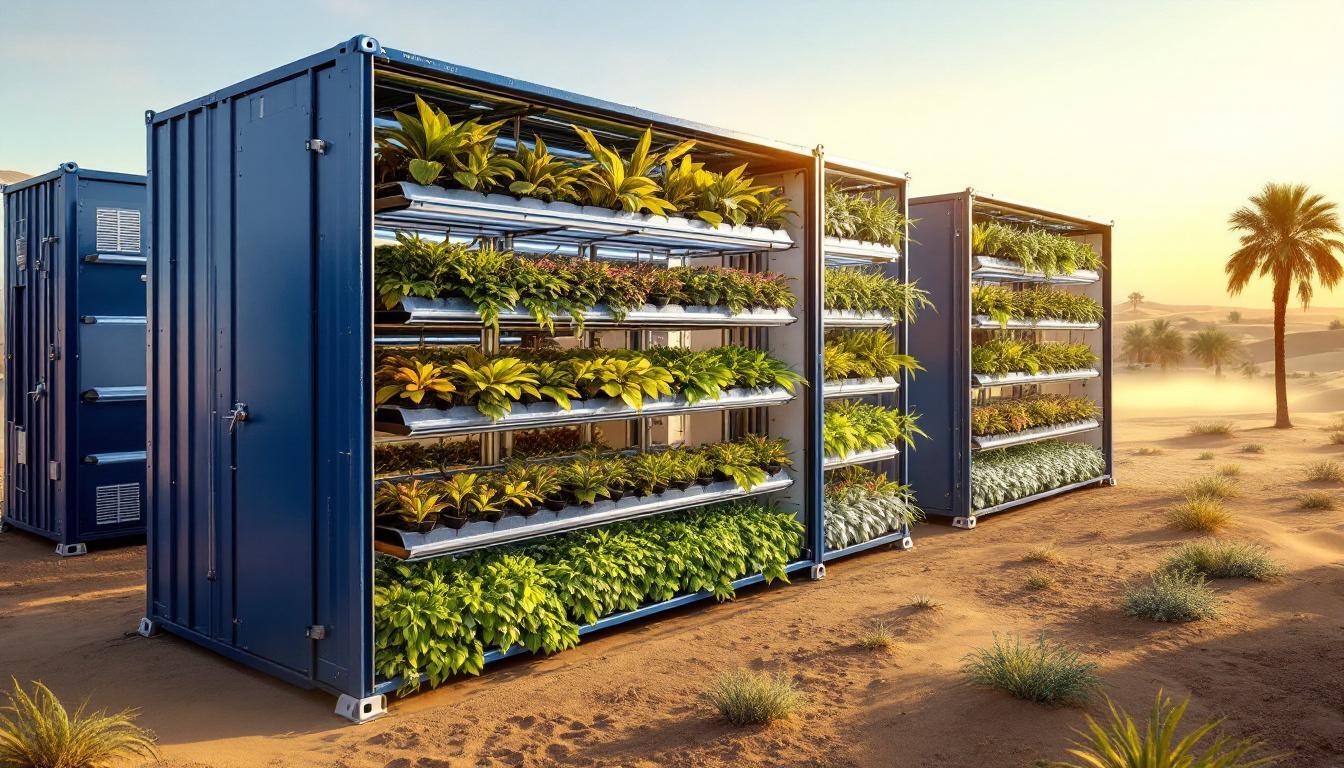
Fischer Farms’s new live modular growth unit in Abu Dhabi aims to showcase sustainable, integrated vertical farming solutions tailored for the Gulf region’s unique climate, offering real-world insights for local growers and investors.
Fischer Farms recently took a notable step outside the UK, launching a live modular growth unit that’s now producing leafy greens and herbs right in Abu Dhabi. This isn’t just a one-off trial; it’s meant as a real demonstration for regional growers, partners, and potential clients, something they can actually observe working, not just a static test. Founder Tristan Fischer explains, “This isn’t some pilot meant to sit on the shelf. We’re growing, and we’re doing it using the same equipment our customers would use.”
The unit is set up on land managed by Alfafa, a well-established local producer, which means visitors can see how it’s integrated into a functioning agricultural business. Fischer said Alfafa “wanted to see it growing, see it work in real life.” Having the system within an operational farm helps Fischer Farms make sure the module lines up with local logistics, distribution channels, and market habits, giving a clearer idea of what’s feasible commercially than just doing lab tests or looking at technical specs.
A core aspect of the tech is how it plays nicely with standard greenhouse control systems. Fischer Farms designed its modules so that they appear as just another bay or section within popular climate-control and farm management platforms. “If you’re already running a greenhouse with a control platform, our module looks just like an extra bay,” Fischer notes. This setup allows growers to keep an eye on temperature, irrigation, and nutrient delivery alongside their usual glasshouse operations. Plus, the system can connect to third-party sensors and crop monitoring tools, which is handy for operators who already have an existing tech stack in place.
Managing heat is obviously a critical challenge, especially under the Gulf’s extreme conditions. Though the pilot unit is inside a structure, Fischer Farms says they’re also preparing hardware for outdoor use during the blistering summer temperatures. Fischer mentions that the priority is to cool the environment before heat reaches the plants. They’re trying out solutions like elevated solar panels that provide shade, net covers that can cut ambient temperatures by about ten degrees Celsius, and extra insulation on the exterior of the containers. An interesting option they’re testing involves placing the modules inside cooled buildings, a move that could simplify installation and reduce thermal stress, especially in extremely hot climates.
Another area they’re experimenting with is substrate selection. Fischer Farms has tested many growing media, perlite, rockwool, polyurethane matrices, gels, and even substrate-free systems, particularly for crops like pea shoots. He warns that no single medium is perfect for everything. Interestingly enough, they’re avoiding coco coir, mainly due to worries over supply security down the line. “If your entire system relies on something that might become scarce, you’re basically setting up a future problem,” Fischer explains. His point is to keep operational resilience intact, especially as global markets for substrates shift.
The Abu Dhabi site also brings economic benefits that support real-world testing. In an interview on the Vertical Farming Podcast, Fischer highlighted how electricity costs are lower in the UAE compared to the UK, which makes indoor farming more financially viable. Industry analyses and reports often note that subsidized or cheaper energy in the Gulf region has helped many modular and vertical farming projects become sustainable. According to Investment Monitor, regional subsidies and relatively low power tariffs help offset the high energy consumption typical of these systems, which otherwise might be a big expense driver.
UAE’s appeal for vertical farming isn’t just about energy costs; its strategic position and increasing support for innovation make it attractive. Various reports, including from Farmonaut, show that the Emirates’ urban centers like Abu Dhabi and Dubai are increasingly investing in integrated systems and advanced climate control. These vertical farms exemplify how short supply chains and reduced land requirements can lower transport emissions and food waste, an important consideration given the region’s limited arable land. Meanwhile, other companies are working on large-scale modular rollouts across the Middle East, with news recounting partnerships aiming to deploy hundreds of units, which reflects strong investor interest and a pretty competitive landscape.
Fischer Farms sees its module not as a closed, export-only device but more as a component that fits neatly into existing operations. Fischer told industry audiences that, over time, manufacturing will move closer to demand, with local production becoming more common. “In the end, equipment should really be built where it’s used,” he says, indicating a plan to cut shipping costs and boost local support services.
The Abu Dhabi pilot is also poised to be a reference site for customers traveling from across the region. Fischer emphasizes how important visibility is. “People come into Abu Dhabi and Dubai from all over,” he points out. “They can visit the site, see how it performs, and really understand what it’s capable of in practice.” It’s interesting, isn’t it? This live example helps shift conversations away from theoretical ideas and focuses instead on actual results.
All of this is happening during a broader push in the Gulf region, where many are accelerating the adoption of greenhouse and vertical farm tech. For instance, Armela Farms near Abu Dhabi has demonstrated that advanced climate control, like double-screen systems, can keep pesticide-free lettuce growing year-round in desert conditions by stabilizing light and temperature. Such projects suggest there’s real potential for hybrid models, combining protected agriculture with vertical modules, to flourish in this environment.
In conclusion, Fischer Farms’ Abu Dhabi unit aims to showcase adaptability, modular racks compatible with existing control systems, media options that avoid reliance on a single supplier, and cooling strategies designed for extreme heat. By placing the system inside a functioning farm and offering live visits, they hope to move the conversation beyond hypothetical benefits towards tangible, observable outcomes. As the regional sector grows, it will face familiar challenges: balancing high capital and operating costs against benefits like improved food security, shorter supply chains, and less spoilage. And Fischer Farms’ live experiment will be a telling test, whether this modular approach can actually make those hurdles easier to overcome while fitting into the evolving agricultural landscape of the UAE.
- https://www.hortidaily.com/article/9814984/from-the-uk-to-the-uae-fischer-farms-deploys-first-overseas-system-in-abu-dhabi/ – Please view link – unable to able to access data
- https://www.verticalfarmdaily.com/article/9814984/from-the-uk-to-the-uae-fischer-farms-deploys-first-overseas-system-in-abu-dhabi/ – Fischer Farms has launched its first international modular growing system in Abu Dhabi, marking a significant expansion beyond the UK. The system is cultivating short-cycle leafy greens and herbs, serving as a live demonstration for regional growers and potential clients. Founder Tristan Fischer emphasises the operational nature of this deployment, stating it’s not a dormant pilot but an active, real-world application of their equipment under diverse climatic and market conditions.
- https://www.verticalfarmingpodcast.com/178-why-modular-vertical-farming-holds-the-key-to-scalable-food-security-with-fischer-farms-trista/ – In a recent podcast, Tristan Fischer, founder of Fischer Farms, discussed the pivotal role of modular vertical farming in achieving scalable food security. He highlighted the company’s expansion into Abu Dhabi, noting the significantly lower electricity costs compared to the UK, which enhances the economic viability of their operations. Fischer also touched upon the potential for the UAE to become a food exporter due to these advancements in agricultural technology.
- https://farmonaut.com/asia/agriculture-in-united-arab-emirates-7-key-2025-innovations – The article explores seven key innovations in UAE agriculture by 2025, focusing on the rise of vertical and urban farming in cities like Dubai and Abu Dhabi. It discusses how layered shelves and advanced climate control systems enable efficient production of leafy greens and herbs with minimal land use. The integration of vertical farming within urban areas reduces transportation emissions and spoilage, contributing to enhanced food security and sustainability.
- https://news.uppersetup.com/insights/vertical-farming-in-the-uae/ – This piece examines the burgeoning vertical farming sector in the UAE, highlighting strategic partnerships and technological advancements. It details collaborations like that between Crysp Farms and Alesca Technologies, aiming to deploy over 500 modular vertical farms across the Middle East. The article also addresses the substantial initial setup costs and operational expenses, noting that while energy consumption is high, the UAE’s subsidised electricity prices help mitigate these costs.
- https://www.investmentmonitor.ai/sponsored/vertical-farming-is-booming-in-the-gulf-heres-why/ – The article discusses the rapid growth of vertical farming in the Gulf region, particularly in the UAE, attributing it to the need for sustainable food production methods in arid climates. It highlights the benefits of shorter supply chains, improved food security, and reduced transportation emissions. However, it also notes the high initial capital and energy costs associated with vertical farming, with the UAE’s subsidised electricity prices providing some relief.
- https://www.ludvigsvensson.com/en/climate-screens/news/posts/2024/august/greenhouse-technology-helps-armela-farms-provide-fresh-greens-in-the-abu-dhabi-desert/ – Armela Farms, located near Abu Dhabi, employs advanced greenhouse technology to cultivate pesticide-free lettuces in the desert. The facility utilises Svensson’s PARperfect double-screen solution to regulate temperature and light, ensuring year-round production. COO Yazan Abu Jaish explains that the screens help maintain a constant light level and manage the microclimate, contributing to sustainability goals and efficient resource use in the challenging desert environment.
Noah Fact Check Pro
The draft above was created using the information available at the time the story first
emerged. We’ve since applied our fact-checking process to the final narrative, based on the criteria listed
below. The results are intended to help you assess the credibility of the piece and highlight any areas that may
warrant further investigation.
Freshness check
Score:
10
Notes:
The article was published on 2 March 2026, making it current and not recycled from previous news.
Quotes check
Score:
8
Notes:
Direct quotes from founder Tristan Fischer are used. While these quotes are consistent with Fischer Farms’ known statements, they cannot be independently verified from external sources.
Source reliability
Score:
7
Notes:
The article originates from HortiDaily, a niche publication focusing on horticulture news. While it is reputable within its niche, its reach is limited compared to major news organisations.
Plausibility check
Score:
9
Notes:
The claims about Fischer Farms deploying a modular growing system in Abu Dhabi align with the company’s known activities and the UAE’s interest in vertical farming. However, the lack of independent verification of some details slightly reduces confidence.
Overall assessment
Verdict (FAIL, OPEN, PASS): PASS
Confidence (LOW, MEDIUM, HIGH): MEDIUM
Summary:
The article provides current and plausible information about Fischer Farms’ deployment in Abu Dhabi. However, the reliance on Fischer Farms’ own statements without independent verification and the niche nature of the source slightly reduce confidence in the overall accuracy of the report.


