





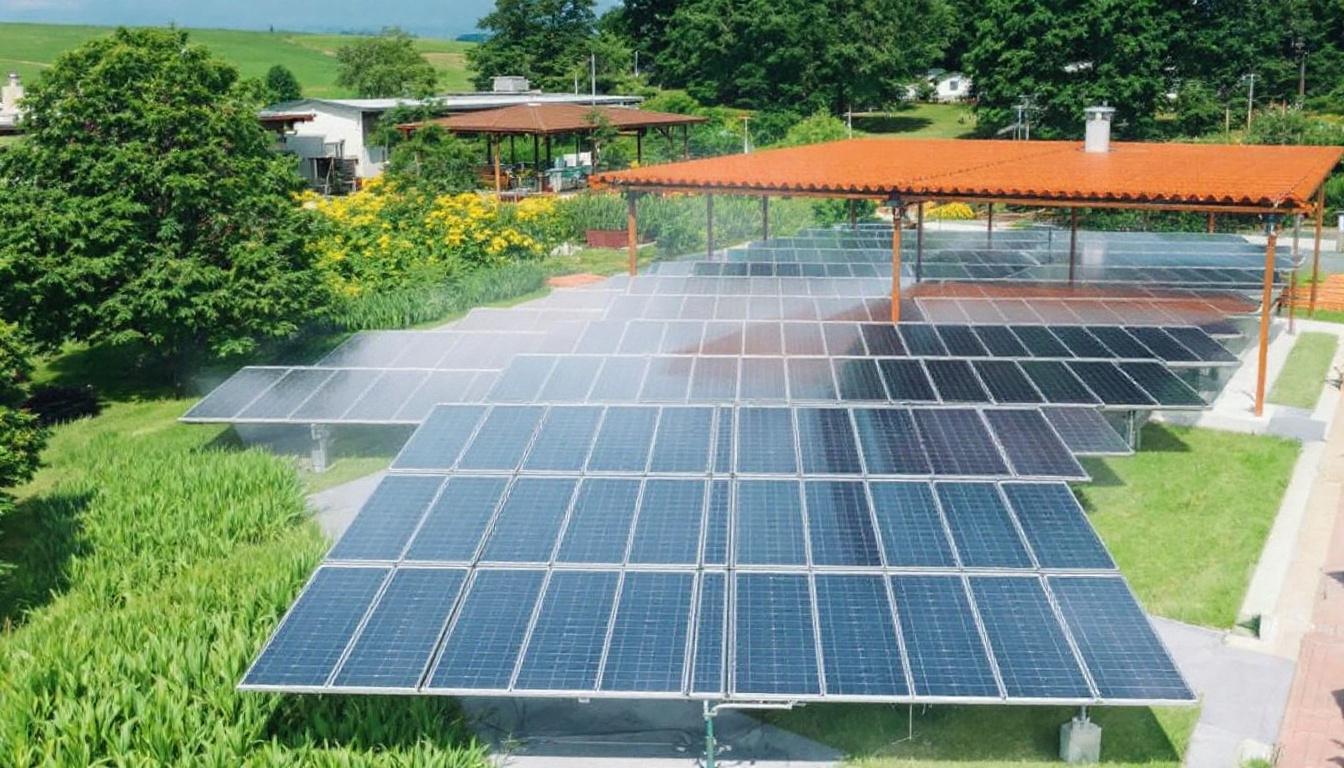
Masdar and Elite Agro have launched the Middle East and North Africa’s first agricultural photovoltaic pilot at Al Foah Farm, combining solar power with greenhouse farming to improve land use, water efficiency, and climate resilience in arid environments.
Masdar and Elite Agro Holding have recently introduced what they describe as the Middle East and North Africa’s very first agricultural photovoltaic (AgriPV) pilot project. The idea behind this initiative is pretty innovative, demonstrating how solar power and intensive greenhouse farming can, believe it or not, share the same land in really dry climates. The setup was unveiled at Elite Agro’s Al Foah Farm in Al Ain, Abu Dhabi, during Abu Dhabi Sustainability Week, and the goal is to eventually create a model that can be scaled across the region.
The project cleverly combines photovoltaic panels with greenhouse structures, essentially allowing the land to be used for both generating electricity and growing crops. Masdar notes that this setup provides some shading, well, partial shading, that can help to reduce heat stress on plants, cut down the amount of irrigation needed, and stabilize microclimates for sensitive crops. They also mentioned that the pilot will gather real data on water efficiency, how well crops grow, land utilization, and energy production, all of which should help inform larger projects later on.
“This initiative, pretty exciting, right?, will show how clean energy and agriculture can thrive side by side, making our food systems more resilient and boosting both food and energy security,” Mohamed Jameel Al Ramahi, Masdar’s CEO, said during the event.
Maurizio Terazzi, who’s CEO of Elite Agro Holding, pointed out that this effort is, in a way, a direct response to the water and land pressures typical in arid and semi-arid regions. “By merging farming with clean energy, we’re demonstrating that food security and the shift to renewable energy are really connected solutions, especially in these tough environments,” he explained.
Policy support and strategic goals also play a big part here. According to Masdar, the pilot aligns with the UAE’s Energy Strategy 2050 and its Net Zero 2050 ambitions, they want to boost low-carbon power and improve overall energy efficiency. The project also supports the National Food Security Strategy 2051 by positioning AgriPV as a way to generate more resilient, local food, reducing reliance on imports and easing supply chain pressures.
Industry commentators picked up on these points, pointing out that the pilot might help strengthen regional food supplies and produce somewhat greener power, serving as a blueprint for similar climates in the Gulf and broader MENA area, too.
Now, about what makes AgriPV promising, and also challenging, it’s gaining international attention because it essentially maximizes land productivity by producing both food and energy from the same space. In greenhouse environments, raised panels can change how sunlight hits the crops, often leading to cooler canopy temperatures and less water loss through evapotranspiration. For the UAE, dealing with water scarcity and high temperatures daily, that kind of microclimate regulation is especially valuable.
But, of course, combining solar panels with protected-crop systems isn’t as simple as just plopping panels down. Careful design is crucial. Factors like panel spacing, tilt angle, mounting height, and greenhouse glazing all need to be optimized, balancing enough sunlight for plants against maximizing energy output. Masdar and Elite Agro expect the Al Foah project to generate real-world performance data on these design choices. They’ve emphasized that the goal isn’t just to put the systems next to each other, but to develop designs that really balance agricultural needs with electrical generation.
Both partners see this pilot as a stepping stone toward wider adoption. Elite Agro already works across the GCC, Europe, and Africa, and they view this project as part of their broader mission for sustainable farming and advanced agri-technology. Masdar, meanwhile, considers the pilot an extension of its renewable energy portfolio, aiming to find more diverse ways to deploy solar power.
Scaling from a pilot to full-on commercial deployment hinges heavily on economics, of course. It’s not just about how much electricity is produced, but also how crop yields and quality are impacted, plus the capital and ongoing maintenance costs of a combined system. Government incentives, how tariffs are structured for onsite power use, and local demand for climate-adapted produce will all influence whether investors get on board.
Masdar has clearly outlined some key metrics to gauge the project’s success. They’ll track water use per kilogram of produce, crop yields under the shading conditions, the amount of renewable power generated, and overall land-use efficiency, comparing this integrated approach against traditional separate setups. The data gathered should help create guidelines and pave the way for future projects in similar dry regions.
Reports from regional media highlight the project’s potential as a model others could follow. They emphasized that this initiative fits into two big national goals for the UAE: expanding clean energy and boosting domestic food resilience. It’s an interesting combo, really.
In a larger sense, AgriPV is part of a broader search for integrated solutions that tackle climate change, water scarcity, and food security all at once. The UAE’s ambitious targets for emissions cuts and self-sufficient food production foster an environment where innovation like this can thrive. But, as the Al Foah pilot aims to demonstrate, real-world deployment needs solid field data and commercially feasible designs.
By placing the pilot at a real farm, Masdar and Elite Agro hope to short-circuit some of the typical learning curve, it’s among the first tangible steps from demonstration project to reality. If they succeed in proving the claimed efficiencies and resilience, it might influence farmers, developers, and policymakers across the Gulf and similar tough climates to take dual-use land strategies more seriously.
Right now, their main focus is on turning the Al Foah installation into a robust source of evidence. The results from ongoing operations will ultimately decide whether AgriPV moves from a promising concept to a common, practical tool for climate-friendly agriculture and renewable energy in the region.
- https://igrownews.com/masdar-latest-news/ – Please view link – unable to able to access data
- https://masdar.ae/en/news/newsroom/masdar-partners-with-elite-agro-holding – Masdar has partnered with Elite Agro Holding to launch the first agricultural photovoltaic (AgriPV) project in the MENA region. The project, located at Elite Agro’s Al Foah Farm in Al Ain, Abu Dhabi, integrates solar panels with greenhouses, enabling dual land use for clean energy generation and crop cultivation. This initiative supports the UAE’s Energy Strategy 2050 and the National Food Security Strategy 2051 by enhancing resource efficiency and promoting sustainable agriculture in arid climates.
- https://www.onearabia.me/local/masdar-elite-agro-launch-agripv-project-mena-011-137514.html – Masdar and Elite Agro Holding have launched the first agricultural photovoltaic (AgriPV) project in the MENA region at Elite Agro’s Al Foah Farm in Al Ain, Abu Dhabi. The project combines solar energy with greenhouse farming to strengthen regional food supplies and low-carbon power generation. It aligns with the UAE’s Energy Strategy 2050 and Net Zero 2050 targets by expanding low-carbon power capacity and improving efficiency, while also supporting the National Food Security Strategy 2051 through sustainable local food production.
- https://gulftime.ae/masdar-elite-agro-to-launch-first-agripv-project-in-mena/ – Masdar and Elite Agro Holding have announced the first agricultural photovoltaic (AgriPV) project in the MENA region, located at Elite Agro’s Al Foah Farm in Al Ain, Abu Dhabi. The project integrates solar panels with greenhouses, allowing land to be used for both clean energy generation and crop cultivation. This approach aims to improve resource efficiency in arid regions and supports the UAE’s Energy Strategy 2050 and National Food Security Strategy 2051 by promoting sustainable agriculture and renewable energy integration.
- https://www.utilities-me.com/news/masdar-agrivoltaics-pilot – Masdar has partnered with Elite Agro Holding to launch the first agricultural photovoltaic (AgriPV) project in the MENA region at Elite Agro’s Al Foah Farm in Al Ain, Abu Dhabi. The project combines solar panels with greenhouses, enabling dual land use for clean energy generation and crop cultivation. This initiative aims to demonstrate how renewable energy and food production can co-locate to maximise resource efficiency in arid environments, supporting the UAE’s Energy Strategy 2050 and National Food Security Strategy 2051.
- https://solarbytes.info/tech-bytes/tenders-bytes/masdar-elite-agro-launched-agripv-project-al-foah-farm-abu-dhabi-11007257 – Masdar and Elite Agro Holding have launched the first agricultural photovoltaic (AgriPV) project in the MENA region at Elite Agro’s Al Foah Farm in Al Ain, Abu Dhabi. The project integrates solar panels with greenhouses, enabling dual land use for power generation and crop cultivation. The design aims to reduce heat stress, lower irrigation demand, and support crop productivity, aligning with the UAE’s Energy Strategy 2050 and National Food Security Strategy 2051. The project is expected to serve as a reference model for combining agriculture and renewable energy in arid climates.
- https://www.newsofbahrain.com/trends/125125.html – Masdar and Elite Agro Holding have launched the first agricultural photovoltaic (AgriPV) project in the MENA region at Elite Agro’s Al Foah Farm in Al Ain, Abu Dhabi. The project integrates solar panels with greenhouses, allowing land to be used for both clean energy generation and crop cultivation. This approach aims to improve resource efficiency in arid regions and supports the UAE’s Energy Strategy 2050 and National Food Security Strategy 2051 by promoting sustainable agriculture and renewable energy integration.
Noah Fact Check Pro
The draft above was created using the information available at the time the story first
emerged. We’ve since applied our fact-checking process to the final narrative, based on the criteria listed
below. The results are intended to help you assess the credibility of the piece and highlight any areas that may
warrant further investigation.
Freshness check
Score:
10
Notes:
The article reports on a recent announcement made on 15 January 2026, detailing the launch of the first agricultural photovoltaic (AgriPV) project in the MENA region by Masdar and Elite Agro Holding. This is corroborated by multiple reputable sources, including Masdar’s official announcement ([masdar.ae](https://masdar.ae/en/news/newsroom/masdar-partners-with-elite-agro-holding?utm_source=openai)) and coverage by The Daily Tribune ([newsofbahrain.com](https://www.newsofbahrain.com/trends/125125.html?utm_source=openai)). No evidence of recycled or outdated content was found.
Quotes check
Score:
8
Notes:
The article includes direct quotes from Mohamed Jameel Al Ramahi, CEO of Masdar, and Maurizio Terazzi, CEO of Elite Agro Holding. These quotes are consistent with those found in Masdar’s official announcement ([masdar.ae](https://masdar.ae/en/news/newsroom/masdar-partners-with-elite-agro-holding?utm_source=openai)). However, the exact earliest usage of these quotes cannot be determined from the available sources, raising a slight concern about their originality.
Source reliability
Score:
7
Notes:
The article originates from iGrow News, a niche publication focusing on agricultural news. While it provides detailed coverage of the AgriPV project, the lack of broader coverage from major news organisations raises questions about the source’s reach and potential biases. Additionally, the article appears to be summarising information from Masdar’s official announcement, which may limit its independence.
Plausability check
Score:
9
Notes:
The claims made in the article align with known industry trends and are supported by Masdar’s official announcement ([masdar.ae](https://masdar.ae/en/news/newsroom/masdar-partners-with-elite-agro-holding?utm_source=openai)). The integration of solar panels with greenhouse structures to optimise land use in arid regions is a plausible and innovative approach. However, the article’s tone and phrasing, such as ‘pretty exciting, right?’ and ‘believe it or not,’ are informal and may not align with typical corporate communications, raising concerns about the article’s tone and potential biases.
Overall assessment
Verdict (FAIL, OPEN, PASS): FAIL
Confidence (LOW, MEDIUM, HIGH): MEDIUM
Summary:
The article provides detailed coverage of the AgriPV project, with information consistent with Masdar’s official announcement. However, the reliance on a niche publication with limited reach, the informal tone and phrasing, and the lack of independent verification from other reputable sources raise concerns about the article’s objectivity and potential biases. Given these factors, the content does not meet the necessary standards for publication under our editorial indemnity.


