




United Arab Emirates: The UAE is advancing its renewable ambitions with a $6bn solar project set to generate 5GW and integrate battery storage, supported by strategic feasibility studies to ensure technical, financial, and regulatory success in its transition to clean energy by 2050.
As the United Arab Emirates (UAE) forges ahead in its quest for a diversified and sustainable economy, the spotlight is increasingly turning towards renewable energy solutions, particularly solar and wind power. Spearheaded by strategic frameworks like the UAE Energy Strategy 2050 and flagship projects such as the Mohammed bin Rashid Al Maktoum Solar Park, the nation has committed substantial resources to establish a cleaner energy landscape.
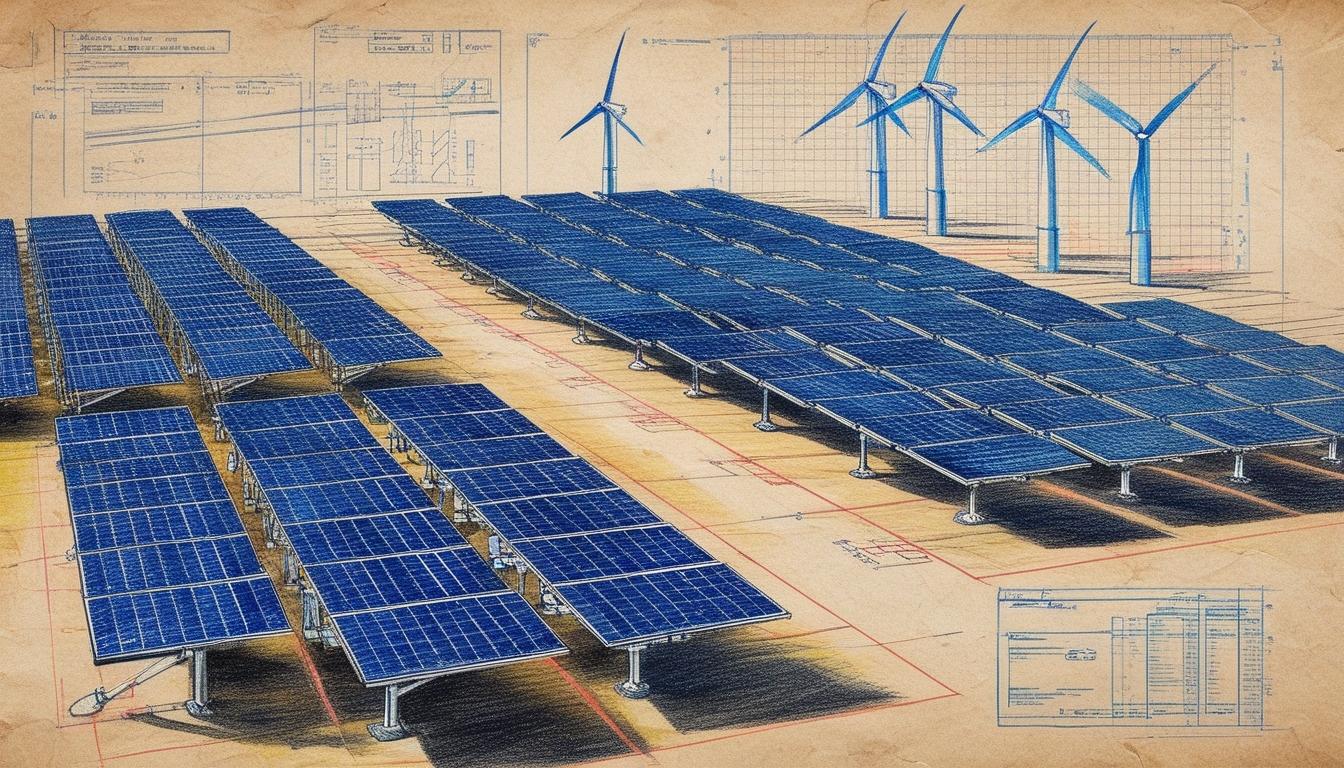
Notably, the UAE is poised to expand its renewable energy footprint further with plans for a $6 billion solar facility capable of generating 5 gigawatts with exceptional battery storage. This venture, slated to be the world’s largest of its kind, underscores the Emirati leadership’s focus on adopting renewable solutions to not only reduce domestic energy costs but also bolster export revenues in a region traditionally dominated by fossil fuels.
Given this context, conducting a detailed feasibility study for renewable energy installations is essential for stakeholders—whether entrepreneurs, developers, or government entities—looking to make informed investments in this sector. Such studies assist in assessing the viability of proposed projects from various angles, including technical specifications, financial implications, and legal frameworks.
The UAE’s attractiveness as a renewable energy hub is driven by several key factors:
- Solar Potential: With an average of ten hours of sunshine per day, the UAE is endowed with the ideal conditions for solar photovoltaic (PV) and thermal applications.
- Government Initiatives: Programs such as Dubai’s Net Metering initiative (Shams Dubai) empower consumers to reduce their electricity bills through solar energy generation.
- Robust National Policies: The UAE Energy Strategy 2050 sets an ambitious goal to ensure 44% of the nation’s energy mix comes from clean sources by the year 2050.
- Rising Energy Demand: Ongoing urbanization and industrial expansions are creating an escalating need for sustainable power solutions.
- Wind Viability: Regions like Al Gharbia exhibit consistent wind patterns that facilitate the deployment of wind turbines.
A feasibility study for renewable energy projects encompasses essential assessments to gauge projected energy output, financial health, regulatory compliance, and environmental impacts. This process typically includes:
- Resource Assessment: Leveraging sophisticated tools like RETScreen and WindPRO to evaluate solar irradiance and wind characteristics.
- Technical Feasibility: Determining the optimal machinery and integration capabilities with local grids, such as those managed by DEWA or SEWA.
- Financial Analysis: This involves thorough evaluations of capital expenditures (CAPEX) and operational expenditures (OPEX), alongside forecasting the return on investment (ROI) and payback periods.
- Legal Compliance: Analysing the prerequisites for licensing, land use permits, and connection agreements with energy authorities.
- Environmental Impact Assessment (ESIA): Understanding possible ecological repercussions and gaining the necessary environmental permits is crucial for projects.
Conducting a feasibility study offers numerous benefits: it minimises risks by identifying potential obstacles, aids in informed decision-making regarding investments, and ensures regulatory compliance, ultimately leading to projects aligned with sustainable and policy goals.
As part of their commitment to advancing renewable energy initiatives, companies like Aviaan offer expert consulting services focused on feasibility studies. They provide in-depth analysis encompassing site selection, system design, financial modelling, and environmental assessments tailored to the UAE’s dynamic landscape.
Several case studies illustrate the effective application of feasibility studies in this sector. For instance, a prominent real estate developer in Abu Dhabi successfully mapped solar potential for multiple sites, achieving a projected ROI of 14% with minimal grid dependency. Another case involved an eco-resort in Ras Al Khaimah that integrated wind turbines, reducing its reliance on external power while enhancing its green branding.
The UAE today stands at the threshold of becoming a global leader in renewable energy, bolstered by its ideal climatic conditions and consolidated governmental support. However, the path to realising this potential necessitates diligent planning and analysis, underpinned by comprehensive feasibility studies. Whether for solar rooftop installations in Dubai or wind energy developments on the coast, these studies ensure projects rest on a solid foundation of data, regulatory adherence, and financial viability.
With expertise in navigating the complex tapestry of local regulations and market dynamics, organisations like Aviaan position themselves as invaluable partners for those eager to bring their renewable energy visions to fruition.
Reference Map
- Lead article
- Renewables growth in the Middle East
- Masdar’s expansion plans
- Wind energy potential in the UAE
- Emirates Water and Electricity Company’s proposals
- New renewable energy sites in Abu Dhabi
- UAE Energy Strategy 2050
Source: Noah Wire Services
- https://aviaanaccounting.com/feasibility-study-for-renewable-energy-installation-solar-wind-in-the-uae/ – Please view link – unable to able to access data
- https://www.ft.com/content/f3c69a7d-0db1-4882-8d35-02ec4c57ea53 – The Middle East is rapidly becoming a significant player in the renewable energy market, second only to China in growth rate. The United Arab Emirates (UAE) recently announced plans to build a $6 billion, 5-gigawatt solar plant with 19GWh of battery storage, which would be the largest project of its kind globally. This project, set to commence in two years, aims to deliver a constant power output of 1GW. Concurrently, Saudi Aramco plans to enter the lithium market for battery production by 2027. The Gulf nations, despite their vast fossil fuel reserves, are accelerating renewable energy adoption to economize domestic energy costs and enhance export revenue. By 2030, renewables will constitute 30% of the energy capacity across the region. However, integrating renewables into a grid built for fossil fuels remains a challenge. Major global companies are involved in these initiatives, leveraging the region’s ideal solar conditions and competitive regulatory environment.
- https://www.ft.com/content/1386a3e7-db11-43b6-ad07-900c401a66a3 – Masdar, the leading renewable energy company in the Middle East, has announced its ambitious plan to increase its wind and solar capacity to 100 gigawatts by 2030. This target would make it one of the world’s largest renewable energy companies, surpassing industry giants like Iberdrola, Engie, and RWE. The Abu Dhabi-based group, part-owned by Adnoc, Taqa, and Mubadala, has already secured deals worth nearly €6.5 billion in Spain and Greece, and has acquired Terra-Gen in the US. They also hold a significant stake in the UK’s Dogger Bank South offshore wind farm project. Masdar’s CEO, Mohamed Jameel Al Ramahi, states that the company will focus its investments in the Middle East, Europe, the US, and Asia. They aim for an equal split between solar and wind projects and emphasize building regional platforms with experienced teams. Despite increased competition and valuations in the renewables sector, Masdar aims for strategic, long-term investments with stable returns rather than making quick financial gains.
- https://climateandenergypartnerships.org/studies/exploring-the-potential-of-wind-energy-in-the-united-arab-emirates/ – This study assesses the UAE’s potential for wind power generation from both onshore and offshore plants and contrasts it to other regions. Based on the potential identified, it discusses the future role wind energy can play for the UAE, considering its benefits for decarbonisation, energy diversification, system integration, and green hydrogen production. The study is a result of the Climate and Energy Partnership.
- https://ewec.ae/en/media/press-release/ewec-recommends-over-600-cent-increase-total-solar-power-capacity-2030 – Emirates Water and Electricity Company (EWEC) proposes developing 300 megawatts of Battery Energy Storage Systems to enhance overall network stability. EWEC also plans to continue investment in low-carbon intensive reverse osmosis water desalination technology to further decouple water and electricity production.
- https://ewec.ae/en/media/press-release/ewec-secures-four-new-sites-development-46gw-world-leading-renewable-energy – EWEC announced that it has obtained approval to allocate four new sites covering an area of approximately 75 square kilometres of land to be turned into world-leading solar photovoltaic (PV) and wind energy developments. The projects are set to deliver 4.5 gigawatts (GW) (AC) of additional solar PV capacity and up to 140 megawatts of new wind capacity to Abu Dhabi.
- https://cms.law/en/int/expert-guides/cms-expert-guide-to-renewable-energy/united-arab-emirates – The UAE Energy Strategy 2050 outlines a roadmap aiming to triple the capacity of renewable energy, increase the installed clean energy capacity from 14.2 GW to 19.8 GW, and increase the share of clean energy in the total energy mix to 30%. As a result of the UAE having both UAE-wide (Federal) and individual Emirate legislations and policies, there are also a variety of Emirate-level policies in respect of renewable energy.
Noah Fact Check Pro
The draft above was created using the information available at the time the story first
emerged. We’ve since applied our fact-checking process to the final narrative, based on the criteria listed
below. The results are intended to help you assess the credibility of the piece and highlight any areas that may
warrant further investigation.
Freshness check
Score:
6
Notes:
The narrative discusses current government initiatives like the UAE Energy Strategy 2050 and the Mohammed bin Rashid Al Maktoum Solar Park, as well as ongoing projects and recent investment figures. No specific reference is made to outdated roles, individuals, or discredited news. However, without a clear publication date, and as some sector details are widely cited and may repeat older reports, the freshness cannot be fully guaranteed. If this were a press release, a higher freshness rating would be appropriate as these typically announce new or updated information directly.
Quotes check
Score:
2
Notes:
No direct quotes are included in the narrative. Instead, it provides general third-party statements and summaries of ongoing projects. As such, there is no need to trace original quotations.
Source reliability
Score:
5
Notes:
The narrative originates from Aviaan Accounting, a consulting organisation, rather than a well-known international news outlet. While their expertise in the UAE’s renewable sector may be credible, the narrative does not carry the same level of external verification or editorial rigour as mainstream news outlets. This introduces a degree of uncertainty regarding neutrality and factual accuracy.
Plausability check
Score:
8
Notes:
Claims about the UAE’s renewable energy ambitions, the prevalence of sunshine, government initiatives, and the demand for feasibility studies are widely reported and supported by official strategies and third-party analyses. The described technical and financial processes are consistent with industry norms and recent developments in the region. However, as no direct evidence or primary sources are cited, independent verification is not possible. The plausibility is assessed as high given the context.
Overall assessment
Verdict (FAIL, OPEN, PASS): OPEN
Confidence (LOW, MEDIUM, HIGH): MEDIUM
Summary:
The narrative presents a plausible and up-to-date overview of renewable energy feasibility studies in the UAE, supported by well-known policy frameworks and real-world developments. However, the absence of primary sources, direct quotes, and clear publication timing, combined with the non-journalistic origin, means full verification is not possible, and some claims remain unconfirmed. The content is reasonable but should be cross-checked with official, independent sources.


