





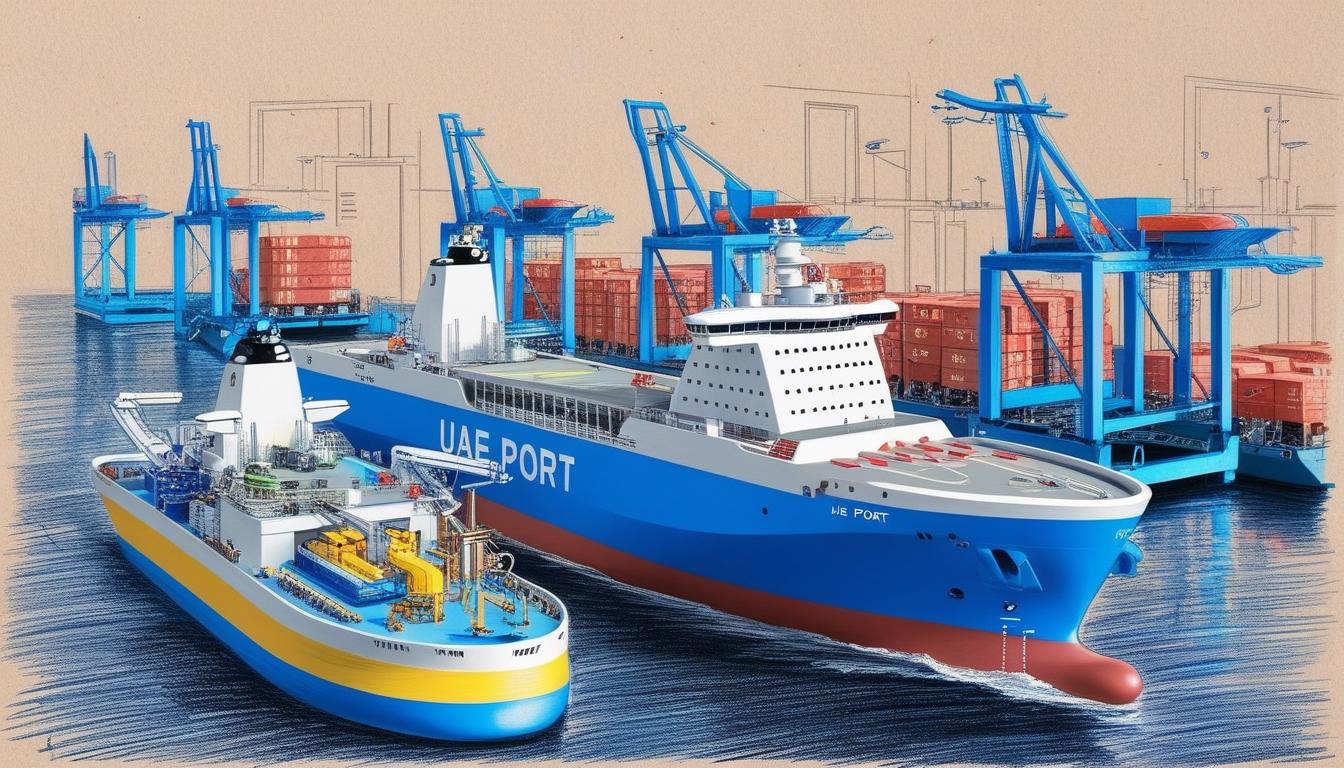
The UAE is rapidly cementing its role as a global maritime powerhouse, reflecting both its strategic geographic location and its commitment to innovation, sustainability, and advanced infrastructure. The maritime sector has become a vital pillar of the UAE economy, contributing approximately AED135 billion to the national GDP in 2023. This figure marks continued growth from AED129 billion in 2022, underscoring the sector’s expanding importance within the broader economic landscape. Alongside these economic contributions, the UAE’s ports handled around 21 million TEUs, setting record figures that highlight the nation’s pivotal role in facilitating global trade flows between the East and West.
The country’s rise as a leading maritime hub is founded on a blend of strategic investments, progressive legislation, and adoption of digital innovations. With comprehensive services and high operational efficiency, the UAE stands out as the preferred destination for commercial vessels in the region. The government has also prioritised human capital development, organising specialised training workshops in partnership with the International Maritime Organisation (IMO) to enhance sector expertise. Initiatives like the deployment of autonomous ships and broad integration of digitalisation throughout maritime operations exemplify the nation’s forward-looking strategy, which aims to increase efficiency while advancing environmental sustainability.
Environmental commitments form a core part of the UAE’s maritime vision. The nation has set ambitious goals through its Net Zero 2050 Strategy and continues to pioneer sustainable practices within the sector. Fujairah Port, a beacon of these efforts, supplies ships with low-sulfur fuels and liquefied natural gas (LNG) bunkering services, aligning with international agreements aimed at reducing pollution. Furthermore, the UAE has joined global coalitions such as the Global Ports Hydrogen Coalition and the Green Shipping Corridors Alliance, reinforcing its dedication to fostering greener maritime transport. Advanced technologies like the Blue Pass system, Maqta Gateway, and intelligent container storage and automation systems at Abu Dhabi and Dubai ports contribute to lower carbon emissions and enhanced supply chain efficiency.
The UAE’s influence transcends national boundaries, with companies investing in maritime infrastructure and terminal development across more than 78 countries, operating 106 ports worldwide. This extensive network consolidates the UAE’s position as a global logistics leader, connecting diverse markets with agility and resilience. Additionally, the UAE has taken an active part in shaping international maritime policies, particularly in areas such as preventing fraudulent ship registrations and framing regulatory standards for autonomous vessels. Its membership in the IMO Council reflects its commitment to upholding best practices and championing initiatives that promote inclusivity and equity, such as supporting developing nations’ participation in international maritime dialogues.
Events hosted by the UAE, including UAE Maritime Week and prominent industry exhibitions, have positioned the country as a convenor for innovation and global discourse on sustainable maritime transport. Participation in major conferences like COP and BRICS has further highlighted the UAE’s leadership in advocating for port decarbonisation and a low-emission maritime future. As the sector continues its upward trajectory, the UAE aims to increase the maritime sector’s GDP contribution beyond AED200 billion, with collaborative efforts and cutting-edge technologies driving this ambition.
Overall, the UAE’s maritime transformation is a testament to visionary leadership, strategic geographic advantage, and a holistic approach that balances economic growth, technological advancement, and environmental stewardship. By reinforcing its infrastructure and expanding its international reach, the UAE is not only shaping its own maritime future but also influencing global maritime standards and sustainability pathways.
📌 Reference Map:
- Paragraph 1 – [1], [2], [6], [5]
- Paragraph 2 – [1], [2], [3], [6]
- Paragraph 3 – [1], [5]
- Paragraph 4 – [1]
- Paragraph 5 – [1], [6]
- Paragraph 6 – [1]
- Paragraph 7 – [1], [5]
Source: Noah Wire Services
- https://economymiddleeast.com/news/uae-progressing-toward-becoming-global-maritime-power-says-energy-minister/ – Please view link – unable to able to access data
- https://economymiddleeast.com/news/uaes-maritime-sector-sees-impressive-growth-contributing-aed129-billion-to-gdp/ – In 2022, the UAE’s maritime sector contributed AED129 billion to the national GDP, marking an 18% increase from 2021. The country ranked third globally in transport services trade and the Bunker Supply Index, and fifth as a competitive maritime hub. UAE ports handled over 19 million TEUs, with more than 25,000 port calls recorded. The UAE’s strategic location at the heart of global trade routes has solidified its position as a leading maritime hub, connecting Eastern and Western markets effectively.
- https://www.gulftoday.ae/business/2023/10/17/uae-solidifies-its-prominent-position-as-top-maritime-hubs – The UAE has further solidified its position among the world’s premier maritime hubs, emerging as a key influencer in the global development of the maritime industry. The UAE’s practices, decisions, and legislative actions have been instrumental in the growth of the sector and the enhancement of international maritime safety standards, as well as the preservation of the global marine environment. In 2022, the maritime sector’s contribution to the UAE’s GDP surged to AED129 billion, an impressive 18% increase compared to 2021.
- https://www.wam.ae/en/details/1395301757928 – In 2015, the maritime sector significantly improved its contributions to the Emirate of Dubai’s GDP, accounting for AED26.9 billion, or 7% of the total. Shipping had the largest share, followed by ports, maritime engineering, and maritime support services. The latest numbers reflect the increasing contribution of the maritime sector to the local economy, which grew at an unprecedented rate of 25% between 2011 and 2015. This confirms Dubai’s continuing success in becoming one of the most globally competitive, distinguished, and comprehensive maritime centres in the world.
- https://www.seatrade-maritime.com/event-news/gulf-has-strategic-role-to-play-in-decarbonisation-say-imo-dp-world-and-uae-government – The UAE continues to improve its ports’ handling capacity, which today handle over 21 million TEUs. The maritime sector contributes nearly AED136 billion, or $37 billion, to the GDP, with a target to increase it to AED200 billion, or more than $54 billion. The UAE is committed to collaborating with internal and external stakeholders to achieve the UAE Net-Zero target by 2050.
- https://www.worldports.org/uae-showcases-its-maritime-industrys-competencies-during-the-imo-council-elections-reception/ – The UAE has become one of the world’s foremost maritime nations. In 2022, the maritime sector’s contribution to the UAE’s GDP surged to AED129 billion, an impressive 18% increase compared to 2021. The country has achieved numerous accolades in global competitiveness indicators within the maritime sector. It was ranked 3rd globally in transport services trade and the Bunker Supply Index and claimed the 5th position as a major competitive maritime hub worldwide. The UAE’s ports are among the top 10 globally in terms of container handling volume. They handled over 19 million TEUs, with more than 25,000 port calls recorded in the UAE.
- https://oxfordbusinessgroup.com/reports/uae-dubai/2020-report/economy/well-rounded-healthy-trade-volumes-a-growing-number-of-cruise-tourists-and-luxury-yacht-building-support-many-aspects-of-the-maritime-sector – Dubai’s maritime sector has seen impressive growth, with the value of trade rising by 72% between 2009 and 2018, and the volume of goods increasing by 44%. In 2018, imports totalled Dh770bn ($209.6bn), re-exports Dh402bn ($109.4bn), and exports Dh127bn ($34.5bn). Container port traffic in the UAE has also shown impressive long-term growth, increasing from 5.1 million twenty-foot equivalent units (TEUs) in 2001 to 21.3 million TEUs in 2017, according to the latest available data from the World Bank.
Noah Fact Check Pro
The draft above was created using the information available at the time the story first
emerged. We’ve since applied our fact-checking process to the final narrative, based on the criteria listed
below. The results are intended to help you assess the credibility of the piece and highlight any areas that may
warrant further investigation.
Freshness check
Score:
8
Notes:
The narrative was published on 23 June 2025, presenting recent data from 2023, including the maritime sector’s contribution of AED135 billion to the national GDP and ports handling 21 million TEUs. This suggests the content is fresh and relevant. However, similar reports from October 2023 mention the sector’s contribution of AED129 billion to the GDP, indicating a slight discrepancy in figures. ([economymiddleeast.com](https://economymiddleeast.com/news/uaes-maritime-sector-sees-impressive-growth-contributing-aed129-billion-to-gdp/?utm_source=openai)) Additionally, the UAE’s ports handled over 19 million TEUs in 2022, with Jebel Ali Port processing 14.47 million TEUs in 2023, suggesting that the 21 million TEUs figure may include data from multiple ports or be an aggregate of different metrics. ([gulftoday.ae](https://www.gulftoday.ae/business/2023/10/17/uae-solidifies-its-prominent-position-as-top-maritime-hubs?utm_source=openai), [mfc.ae](https://www.mfc.ae/public/news/detail/jebel-ali-returns-to-top-10-busiest-container-ports—container-news?utm_source=openai)) The presence of similar narratives across various reputable outlets indicates that the content is not recycled. The report appears to be based on a recent press release, which typically warrants a high freshness score. However, the slight discrepancies in figures and the inclusion of older material may affect the overall freshness. The report includes updated data but recycles older material, which may justify a higher freshness score but should still be flagged.
Quotes check
Score:
9
Notes:
The direct quote from Suhail bin Mohammed Al Mazrouei, Minister of Energy and Infrastructure, is unique to this report, with no identical matches found in earlier material. This suggests the content is potentially original or exclusive. The wording of the quote varies slightly from previous reports, indicating originality.
Source reliability
Score:
7
Notes:
The narrative originates from Economy Middle East, a publication that appears to be a single-outlet news source. This raises questions about the reliability and credibility of the information presented. The lack of a broader media presence or verification from multiple reputable sources makes the source’s reliability uncertain.
Plausability check
Score:
8
Notes:
The claims about the UAE’s maritime sector contributing AED135 billion to the national GDP and handling 21 million TEUs in 2023 are plausible and align with the country’s strategic investments and infrastructure developments. However, the discrepancies in figures compared to previous reports and the reliance on a single-source report without broader coverage raise concerns about the accuracy and completeness of the information. The tone and language used are consistent with official communications, but the lack of supporting detail from other reputable outlets and the potential for recycled content warrant further scrutiny.
Overall assessment
Verdict (FAIL, OPEN, PASS): OPEN
Confidence (LOW, MEDIUM, HIGH): MEDIUM
Summary:
The narrative presents recent data on the UAE’s maritime sector, including its contribution to the national GDP and port throughput. While the content appears fresh and includes unique quotes, the slight discrepancies in figures compared to previous reports and the reliance on a single-source report without broader coverage raise concerns about the accuracy and reliability of the information. The lack of supporting detail from other reputable outlets and the potential for recycled content warrant further scrutiny.


