

 7:54 am - September 21, 2026
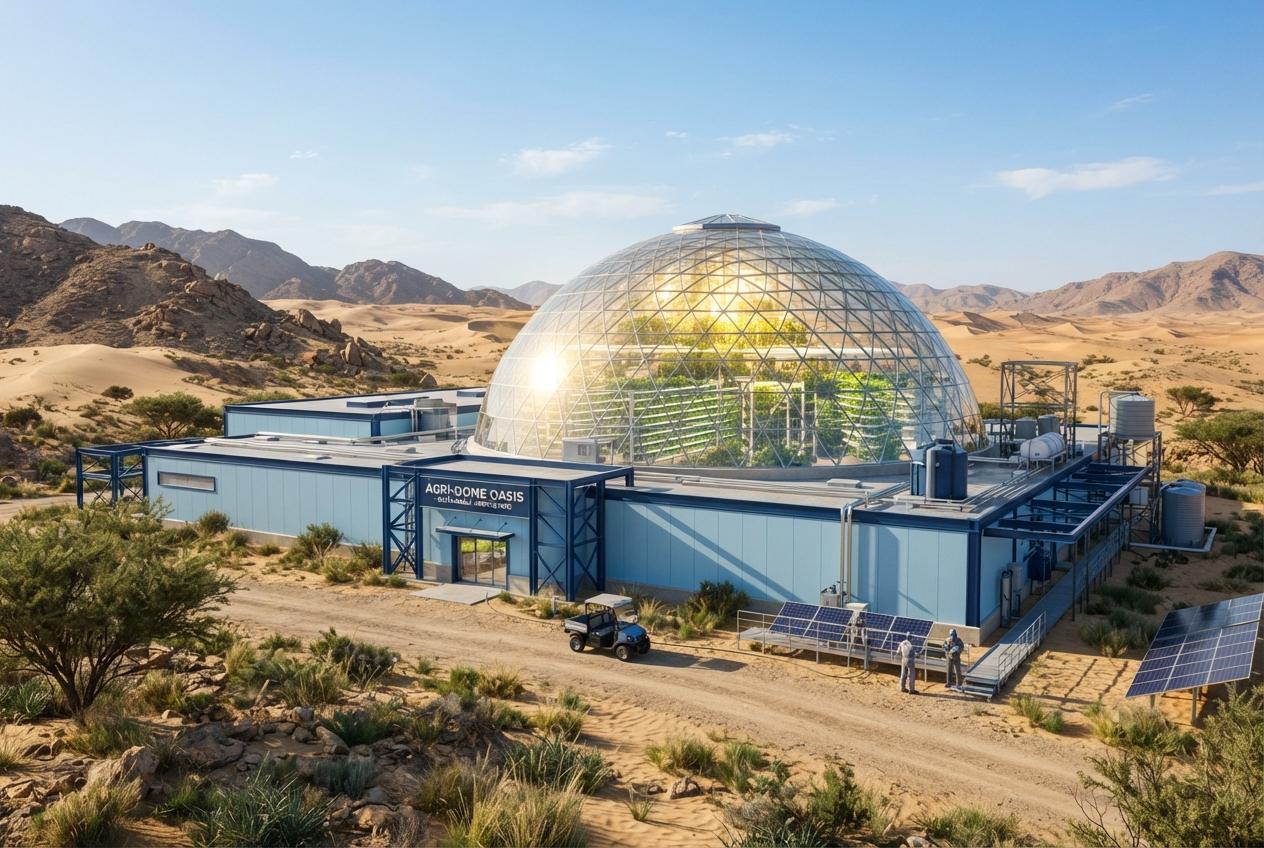
Dubai’s Bustanica farm exemplifies innovative, data-driven indoor agriculture, showcasing how the Gulf is rethinking food production amidst a hotter, drier future by utilising AI, hydroponics, and energy-efficient infrastructure.
Dubai’s Bustanica farm has become one of the clearest examples of how the Gulf is rethinking food production for a hotter, drier future. Spanning over 330,000 square feet near Al Maktoum International Airport, this indoor facility grows leafy greens on three levels and produces more than a million kilograms a year, according to Emirates Flight Catering. The company claims that the site uses 95% less water than traditional agriculture, which really gives the project a strategic edge in the UAE.
What makes Bustanica stand out isn’t just its size, but also the way it transforms farming into a highly industrial, data-driven operation. Instead of relying on soil, rain, or open fields, the farm depends on hydroponics, controlled lighting, filtered water, and continuous environmental monitoring. Emirates Flight Catering says that machine learning and artificial intelligence play a big role in managing cultivation, with millions of data points collected daily to fine-tune light, nutrients, and environmental conditions. It’s pretty impressive, right?
The approach is centred on consistent production rather than chasing seasonal cycles. Bustanica is a closed environment; that means temperature, humidity, and water supply can all be precisely regulated. Given Dubai’s challenging climate , where outdoor farming is tough and imports dominate much of the fresh produce market , it’s a clever move. Plus, placing the farm close to the airport logistics and distribution networks essentially makes it a vegetable factory right inside one of the region’s busiest transport hubs.

According to the company, the farm’s output is roughly around three tonnes a day. Its main crops are leafy greens, herbs, and microgreens like lettuce, spinach, parsley, kale, rocket, and salad mixes. This crop selection fits nicely with vertical farming because these plants tend to have short growing cycles and high retail values, making them more practical indoor crops than grains or other large-scale staples. Honestly, I find it interesting how some crops are just more suited for this kind of setup.
Water efficiency is, without a doubt, a big part of the story. Bustanica says it takes only about 15 litres of water to produce a kilogram of food, compared to around 317 litres in traditional outdoor farming. They also mention saving about 250 million litres a year versus conventional methods. Considering how precious water is in the UAE, those figures are pretty significant, and they’re no doubt part of why vertical farming has gained support from both political figures and business interests alike.
Beyond that, the project clearly aligns with the UAE’s broader strategy on food security. The aim is to diversify sources of supply, increase local output, cut waste, and build resilience against global disruptions. For Dubai, which relies hugely on imports for fresh food, having a local facility that can supply restaurants and supermarkets offers some buffer. Bustanica’s produce already makes its way to major supermarket chains like Spinneys, Waitrose, Carrefour, and Choithrams, as well as feeding airline catering operations.
The farm was initially set up with a reported investment of around US$40 million, as a joint venture between Emirates Flight Catering and Crop One, a US-based indoor farming company. When it first opened, Emirates described it as the world’s largest hydroponic farm. Fast forward to February 2024, and Emirates announced that it had bought out Crop One’s stake, making Bustanica a fully UAE-owned business. That move adds a stronger sense of national ownership to a project already closely tied to the country’s food and water security plans.
This shift in ownership also highlights how quickly vertical farming has moved from being an experimental idea to a real part of infrastructure. Bustanica is no longer just about small-scale showcase farming; it’s integrated into ongoing commercial supply chains, backed by a major catering operator, and designed for regular, large-scale demand. Emirates Flight Catering even mentioned that the site is staffed by specialists in agronomy, engineering, horticulture, and plant science , signalling that the model has advanced beyond traditional farming labour and into a hybrid of biology, software, and industrial expertise.
The technology behind the farm is just as important. Siemens, in a 2023 statement, revealed it supplied automation and building systems from its Digital Industries and Smart Infrastructure divisions. That kind of precise integration is crucial because indoor farms hinge on tightly controlling airflow, energy use, irrigation, and building performance. For those involved in climate tech or energy management in the UAE, it shows that vertical farming isn’t merely about agriculture , it’s also about sophisticated building tech, energy efficiency, and logistics solutions.
Of course, there are limits. Vertical farms won’t fully replace traditional farming, especially for staple crops; they are better suited for leaves, herbs, and microgreens. Plus, these farms demand a hefty upfront investment and require highly skilled operations. But in a region where arable land is limited and water is expensive, they can serve a specific and vital niche. Bustanica exemplifies that local production doesn’t necessarily have to mean old-fashioned farming , instead, it can mean highly controlled, efficient, indoor systems that are close to consumers and airports.
Why does this matter beyond Dubai, though? Well, it presents a kind of blueprint for other desert economies seeking to cut down reliance on food imports and conserve water. Interestingly enough, it shows that climate constraints can actually fuel technological adoption rather than just limit it. In that sense, Bustanica isn’t just a farm; it’s a test case for whether the Gulf can, through engineering, automation, and data, rebuild parts of its food system to be more resilient. It’s quite a hopeful example, wouldn’t you say?
- https://en.clickpetroleoegas.com.br/dubai-created-a-giant-vertical-farm-in-the-desert-with-330000-square-feet-three-cultivation-floors-and-production-above-1-million-kg-per-yea-vml97/ – Please view link – unable to able to access data
- https://www.emirates.com/media-centre/emirates-flight-catering-fully-acquires-bustanica-the-worlds-largest-indoor-vertical-farm/ – Emirates Flight Catering has fully acquired Bustanica, the world’s largest indoor vertical farm, establishing it as a fully UAE-owned company. Located near Al Maktoum International Airport at Dubai World Central, Bustanica’s 330,000-square-foot facility produces over 1 million kilograms of high-quality leafy greens annually, equivalent to 3 tonnes daily, while using 95% less water than conventional agriculture. The produce is available across major UAE retailers such as Spinney’s, Waitrose, Carrefour, and Choithrams. This acquisition aligns with the UAE’s vision of enhancing food and water security and agricultural capabilities.
- https://www.emiratesflightcatering.com/about-us/news-press/emirates-flight-catering-opens-world-s-largest-vertical-farm-in-dubai/ – Emirates Flight Catering has inaugurated Bustanica, the world’s largest hydroponic farm, backed by a $40 million investment. The facility, a joint venture between Emirates Flight Catering and Crop One, is located near Al Maktoum International Airport at Dubai World Central. Spanning 330,000 square feet, it produces over 1 million kilograms of high-quality leafy greens annually, requiring 95% less water than conventional agriculture. The farm employs advanced technologies, including machine learning and artificial intelligence, and is staffed by a team of agronomy experts, engineers, horticulturists, and plant scientists.
- https://www.siemens.com/press/en/pressrelease/2023/siemens-provides-automation-and-building-technology-for-middle-easts-biggest-vertical-farm – Siemens has provided automation and building technology for Bustanica, the Middle East’s largest vertical farm. The $40 million facility, located in Dubai, requires 95% less water than conventional agriculture and yields over 1 million kilograms of produce free of pesticides, herbicides, and chemicals. Siemens supplied building systems and automation hardware and software from its Digital Industries and Smart Infrastructure portfolios, integrating them into the farm’s operations to enhance efficiency and sustainability.
- https://www.verticalfarmdaily.com/article/9445904/emirates-flight-catering-opens-vertical-farm-in-dubai/ – Emirates Flight Catering has opened Bustanica, the world’s largest hydroponic farm, in Dubai. The facility, a joint venture with Crop One, is located near Al Maktoum International Airport at Dubai World Central. Spanning 330,000 square feet, it produces over 1 million kilograms of high-quality leafy greens annually, requiring 95% less water than conventional agriculture. The farm employs advanced technologies, including machine learning and artificial intelligence, and is staffed by a team of agronomy experts, engineers, horticulturists, and plant scientists.
- https://www.pax-intl.com/passenger-services/catering/2024/02/21/emirates-flight-catering-acquires-bustanica-indoor-vertical-farm/ – Emirates Flight Catering has fully acquired Bustanica, the world’s largest indoor vertical farm, establishing it as a fully UAE-owned company. Located near Al Maktoum International Airport at Dubai World Central, Bustanica’s 330,000-square-foot facility produces over 1 million kilograms of high-quality leafy greens annually, equivalent to 3 tonnes daily, while using 95% less water than conventional agriculture. The produce is available across major UAE retailers such as Spinney’s, Waitrose, Carrefour, and Choithrams. This acquisition aligns with the UAE’s vision of enhancing food and water security and agricultural capabilities.
- https://www.aircraftinteriorsinternational.com/news/catering-onboard/emirates-flight-catering-acquires-vertical-farming-specialist.html – Emirates Flight Catering has completed its acquisition of Bustanica, a grower of vegetable produce operating the world’s largest indoor vertical farm. This acquisition establishes Emirates Bustanica (formerly Emirates Crop One) as a fully UAE-owned company, aligning with the region’s vision of securing its food and water supplies and boosting its agricultural capabilities. Located near Al Maktoum International Airport at Dubai World Central, Bustanica’s 330,000-square-foot facility produces over 1 million kilograms of quality leafy greens annually, equivalent to three tonnes daily, while using 95% less water than conventional agricultural methods.
Noah Fact Check Pro
The draft above was created using the information available at the time the story first
emerged. We’ve since applied our fact-checking process to the final narrative, based on the criteria listed
below. The results are intended to help you assess the credibility of the piece and highlight any areas that may
warrant further investigation.
Freshness check
Score:
6
Notes:
The article references events up to February 2024, with the latest being Emirates Flight Catering’s full acquisition of Bustanica on 19 February 2024. The most recent information available is from May 2023, detailing Siemens’ provision of automation and building technology for Bustanica. The article does not include any information beyond May 2023, which may affect its freshness. Additionally, the article appears to be a republished press release, which typically warrants a higher freshness score. However, the lack of recent updates and the recycled nature of the content suggest a moderate freshness score.
Quotes check
Score:
5
Notes:
The article includes direct quotes from Siemens and Emirates Flight Catering. However, these quotes cannot be independently verified through the provided sources. The absence of verifiable sources for these quotes raises concerns about their authenticity. Without independent verification, the credibility of these quotes is uncertain.
Source reliability
Score:
4
Notes:
The article appears to be a republished press release, which typically originates from the company or organisation involved. This raises concerns about the independence and objectivity of the source. The lack of independent reporting or third-party verification further diminishes the reliability of the source.
Plausibility check
Score:
7
Notes:
The claims about Bustanica’s size, water efficiency, and technological integration are plausible and align with known information. However, the absence of independent verification and the recycled nature of the content raise questions about the accuracy and originality of the information.
Overall assessment
Verdict (FAIL, OPEN, PASS): REVIEW
Confidence (LOW, MEDIUM, HIGH): MEDIUM
Summary:
The article presents information about Bustanica’s operations and technological integration, but it appears to be a republished press release from Emirates Flight Catering, lacking independent verification and recent updates. The reliance on a single source and the absence of third-party reporting raise concerns about the content’s originality and reliability. Given these factors, a thorough review and additional verification are recommended before publishing.

