

 2:36 pm - September 29, 2026
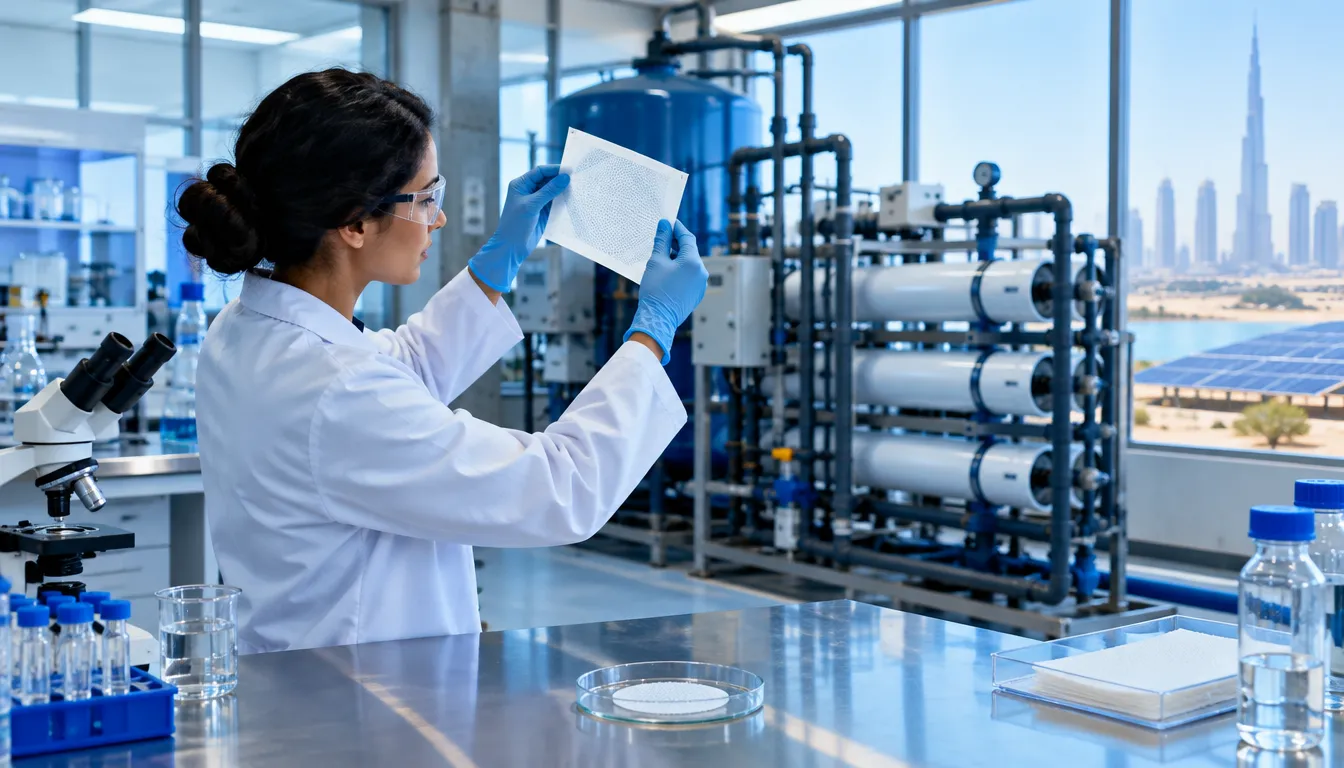
NYU Abu Dhabi’s Kawader fellowship has enabled an Emirati postdoctoral researcher to design PFAS water filtration membranes that capture and break down forever chemicals, strengthening the UAE’s water security research base.
An Emirati postdoctoral researcher at New York University Abu Dhabi is developing new PFAS water filtration membranes designed to capture “forever chemicals” from water supplies and break them down, rather than simply relocating the pollution elsewhere.
Reham Al Nuaimi is working through NYUAD’s Kawader Research Assistantship Programme, a three-year fellowship for Emirati graduates, in the Khalil Lab under Assistant Professor Safiya Khalil Alhashmi. Her research centres on covalent organic frameworks, highly ordered crystalline materials with pores engineered to interact with specific molecules.
Conventional filtration typically blocks PFAS contaminants without destroying them, pushing the same persistent chemicals into another waste stream. Al Nuaimi’s PFAS water filtration membranes are designed to both capture and chemically break down the pollutants, an approach that could reduce the long-term burden these compounds place on water treatment systems.
“Separation alone is not enough,” Al Nuaimi said, of the dual capture-and-degrade design that distinguishes her work from standard membrane technology. She previously scaled membrane production from laboratory samples to lengths of “tens of metres” during her PhD, experience she is now applying to move the new membranes closer to practical deployment.
“I don’t just want to study membranes. I want to see this work translated into real technology,” she said, adding that a single membrane cannot solve every water challenge but that a strong underlying method “can adapt” to different contaminants and settings.

The research adds to a growing body of UAE water security work built around national capacity-building programmes such as Kawader, which pairs Emirati graduates with university laboratories to develop technology aimed at the country’s water and environmental challenges. It follows other UAE efforts to broaden the country’s water strategy and to improve wastewater treatment across water-intensive industries.
PFAS contamination is an emerging concern for water utilities worldwide, and membrane technology capable of destroying the chemicals rather than merely trapping them would give UAE water authorities and desalination operators another tool as they plan for long-term water security.
The UAE relies heavily on desalinated seawater and treated groundwater to meet demand in a region with little natural freshwater, which makes contaminant-resistant membrane technology a strategic as well as a scientific priority. A membrane that can be manufactured at scale and adapted to different pollutants, rather than engineered for a single use case, is more likely to be adopted by utilities that need to plan treatment infrastructure years in advance.
Al Nuaimi’s work also reflects a broader effort by NYU Abu Dhabi to build homegrown scientific capacity through fellowships aimed specifically at Emirati graduates, rather than relying solely on imported technology or expertise. If her membranes progress from laboratory samples to pilot-scale production, the next step would typically involve testing against real water samples from UAE utilities to establish removal rates under local conditions.
PFAS compounds are used in a wide range of industrial and consumer products because they resist heat, water and oil, but that same chemical stability means they persist in the environment for years and accumulate in water systems once released. Regulators in several countries have begun tightening permissible limits for PFAS in drinking water, adding pressure on utilities to find treatment methods that go beyond standard filtration. Demand for effective PFAS water filtration is expected to grow accordingly as more utilities test their own supplies for contamination.
Translating a laboratory-scale membrane into something a utility can install at a treatment plant typically takes years of further engineering, cost analysis and regulatory testing. Al Nuaimi’s prior experience scaling a different membrane design during her doctorate suggests a pathway for that transition, even though the COF-based membranes described in her current research remain at an earlier stage of development.

