

 3:00 pm - September 29, 2026
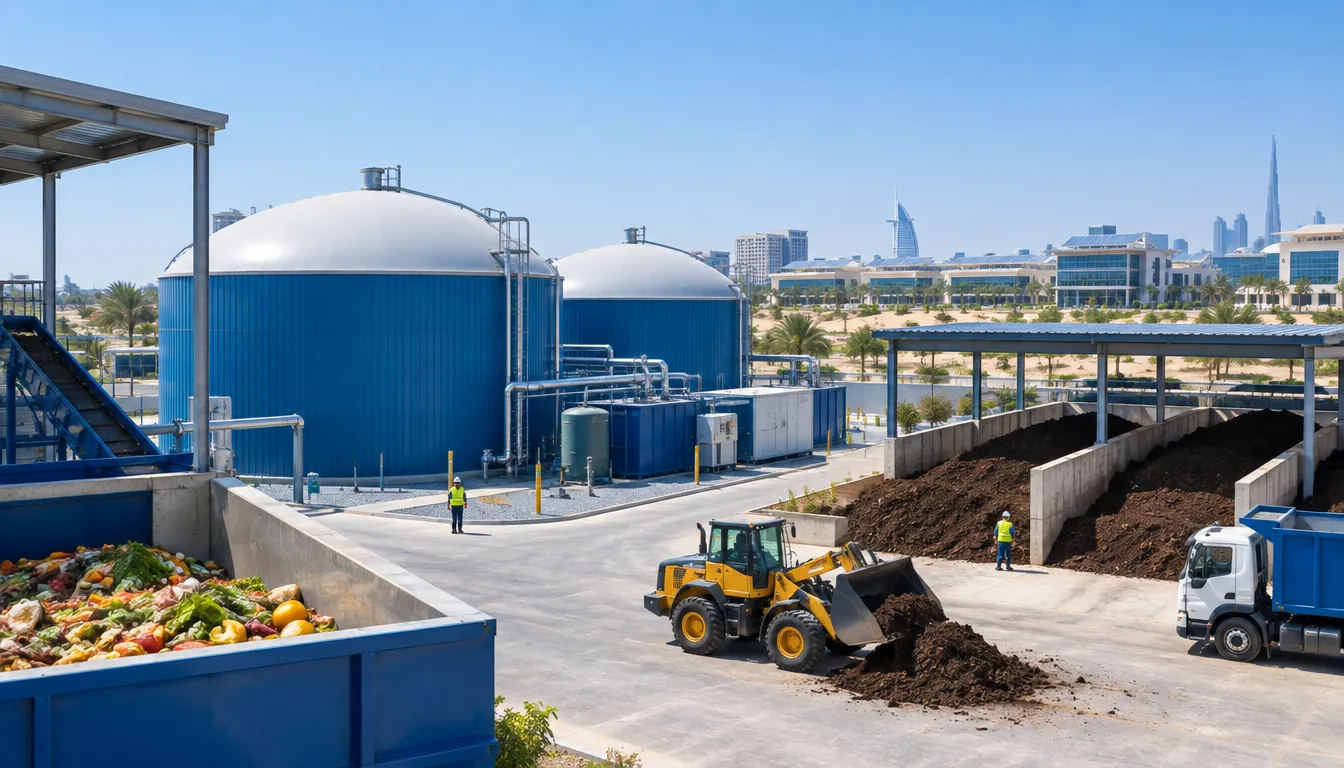
Emirates Biotech and United Arab Emirates University have opened a pilot plant near Al Ain that converts food waste to biogas and compost, testing whether packaging waste can be processed alongside it too.
Emirates Biotech and United Arab Emirates University (UAEU) have launched a joint pilot project to convert food waste to biogas and compost at what they describe as the UAE’s first integrated organic-waste valorisation plant. Sited near UAEU’s Al Ain campus, the plant will process up to 40kg of organic waste a day.
The partnership was launched at UAEU with value-chain stakeholders including the Emirates Environmental Group, Hotpack, AW Rostamani Group’s VerraPak, Tadweer Group, the University of Sharjah and Pacogreen. The project runs for two years, from August 2026 to August 2028, with installation and commissioning due by August 2027.
Food waste makes up nearly 40% of the UAE’s daily municipal solid waste, much of it sent to landfill. Conventional plastic packaging contaminated with food residue is difficult to recycle, so the pilot will test whether food waste to biogas conversion still works when compostable packaging is processed alongside it. The plant combines anaerobic digestion, which produces biogas, with composting of the resulting digestate to make nutrient-rich compost. A laboratory-scale assessment will also look at converting that biogas into renewable hydrogen.
The pilot forms part of wider efforts to cut the environmental footprint of the UAE’s food system. Diverting organic waste from landfill supports both the UAE’s Net Zero by 2050 Strategy and its national food security objectives, which call for less reliance on imported inputs and less waste across the supply chain. Landfilled food waste also generates methane, a potent greenhouse gas, so capturing it as biogas instead has a double climate benefit.
The pilot also feeds into a wider drive to keep organic waste out of the ground. Tadweer, Abu Dhabi’s waste management company, is targeting an 80% landfill diversion rate by 2031, and food waste is one of the hardest fractions to redirect because it is wet, mixed with other materials and often contaminated by packaging. Proving that food waste to biogas processing can absorb that packaging too would remove one of the main barriers to scaling it up.

“At UAEU, we believe that solving societal and environmental challenges requires strong collaboration between academia and industry,” said Dr Rami, Associate Provost for Research at UAEU. “Our partnership with Emirates Biotech demonstrates how research and innovation can be translated into practical, scalable solutions that support the UAE’s sustainability goals.”
Professor Zafar Said Sher, UAEU’s project lead, said the pilot would “evaluate a practical end-of-life pathway for food waste and compostable packaging while supporting the UAE’s circular economy, food security and Net Zero ambitions,” and would also train students and researchers in waste-to-resource technologies.
Dr Aman Kulshrestha, chief technology officer of Emirates Biotech, described the plant as “a novel integrated biorefinery concept for organic waste management in the UAE,” converting organic waste to biogas with the potential for upgrading to green hydrogen, while composting the digestate into nutrient-rich compost. Emirates Biotech estimates a scaled-up version of the process could cut carbon dioxide emissions by up to 89% compared with landfilling the same waste.
If the two-year trial holds up, turning food waste to biogas this way could be replicated across the UAE’s wider push to build a circular economy for organic waste, alongside efforts such as Dubai’s plan to turn organic waste into sustainable aviation fuel. For municipalities and industry, it offers a cheaper, lower-carbon alternative to landfill, while giving UAEU students and researchers a live testbed for waste-to-resource technology.

